Accurate monitoring is essential when you need mixes to translate beyond your room. The best studio monitors with room correction can reduce the influence of problematic acoustics, improve tonal balance, and make critical decisions easier.
This roundup includes compact nearfield monitors, larger professional speakers, and standalone correction systems for different room sizes, budgets, and workflows.
Best 10 Studio Monitors with Room Correction Picks for 2026
Best Compact Correction Monitor

- ARC room correction with included measurement microphone
- Time-aligned design for precise imaging
- Compact, flexible desktop or stand-mounted setup
Best For: Compact mixing and critical listening setups
Best Ultra-Nearfield Alternative

- Boundary EQ for desktop placement adjustment
- Bluetooth plus wired studio connectivity
- 4.5-inch monitors with 3D Imaging Waveguide
Best For: Small desktop studios and multimedia creation
Best Large Monitor With Acoustic Tuning

- 6.5-inch woofer for deeper low-frequency monitoring
- Wide EBM waveguide and solid imaging
- Manual acoustic-space and tonal adjustment controls
Best For: Larger home studios needing adjustable monitor response
Best Standalone Room Correction

- Measurement microphone, software, and correction processor included
- Corrects frequency imbalance and improves stereo imaging
- Adds monitor emulation to an existing setup
Best For: Studios upgrading existing monitors with calibration
Flexible Room-Fit Pick

- App-based room compensation and 9-band EQ
- 80W RMS bi-amped output
- XLR, TRS, RCA, AUX, and Bluetooth 6.0
Best For: Compact home studios and flexible desktop setups
Advanced Calibration Pick
IK Multimedia iLoud Precision 6 MKII
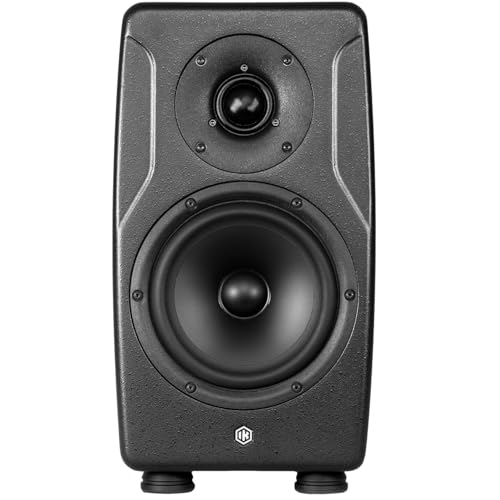
- Integrated ARC room calibration with measurement mic
- ARC X profiles, target curves, and monitor emulation
- 150W Class-D amplification with 96kHz DSP
Best For: Professional mixing, mastering, and immersive setups
Classic Accuracy Pick

- Includes two powered studio monitors
- Emphasizes uncolored, original sound
- Bi-amplified 5-inch woofer and 1-inch tweeter
Best For: Straightforward stereo studio monitoring with external room treatment
Flexible Room Tuning

- Three-way active design with 110W RMS power
- Rear controls plus ConneX app room compensation
- XLR, TRS, RCA, AUX, Bluetooth, and headphone output
Best For: Near-field studios and flexible desktop listening
Onboard EQ Control
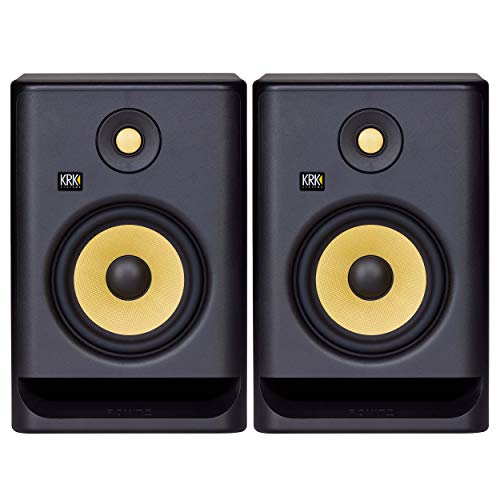
- 7-inch bi-amped monitor with Kevlar drivers
- LCD-driven onboard EQ for room adjustment
- Built-in Class D amplification for studio use
Best For: Mixing, broadcast, and dedicated studio setups
Compact Room Controls

- Small two-way pair with 3.5-inch woofers
- Room-control and high-trim response switches
- XLR/TRS, RCA, and stereo-mini inputs
Best For: Compact desktop monitoring and small studios
Best Compact Correction Monitor – iLoud MTM MKII Pair
The IK Multimedia iLoud MTM MKII is a strong choice if you want studio monitors with room correction in a compact desktop format. Its ARC X calibration, supplied ARC microphone, time-aligned design, and 36 Hz–32 kHz frequency range are suited to detailed mixing, editing, and critical listening.
Best For: Compact desktop studios, mixing, mastering, and creators who need flexible placement.
Pros:
- ARC room correction helps address room and placement inconsistencies.
- Precise time alignment supports accurate imaging and reduced phase distortion.
- Compact cabinets offer tabletop stands and mic-stand mounting options.
- ARC X monitor emulation helps check mix translation across reference systems.
Cons:
- The compact 3.5-inch monitor format may not suit listeners seeking maximum low-end output.
- It requires corded power and is not water resistant.
Choose this pair when space is limited but calibration and accurate nearfield monitoring remain priorities. The included ARC microphone makes the room-correction workflow more complete than a monitor-only setup.
Best Ultra-Nearfield Alternative – Kali LP-UNF
The Kali Audio LP-UNF is designed for ultra-nearfield monitoring, making it a practical option for small workspaces. It is not supplied with dedicated room-correction software, but its boundary EQ, 3D Imaging Waveguide, and touch-sensitive controls help tailor the listening experience around a desktop.
Best For: Desktop producers, multimedia creators, and listeners who want Bluetooth alongside wired studio connections.
Pros:
- Boundary EQ helps adapt the monitors to their placement.
- 3D Imaging Waveguide is designed to support imaging and a broad listening sweet spot.
- Bluetooth, RCA, USB, and 1/4-inch TRS connectivity provide flexible source options.
- The 4.5-inch woofer and 160-watt maximum output suit nearfield desktop use.
Cons:
- It does not include the dedicated measurement microphone and automated room-correction system found in specialized correction products.
- Bluetooth range is listed at up to 33 feet, but wireless operation still depends on the source device.
Consider the LP-UNF if your priority is a compact, versatile desktop monitor with basic placement adjustment rather than full software-based calibration. It is especially convenient when Bluetooth playback is part of your workflow.
Best Large Monitor With Acoustic Tuning – PreSonus Eris E7 XT
PreSonus Eris E7 XT 2-Way Active Studio Monitor with EBM Waveguide (Pack of 1)
Check Price On AmazonThe PreSonus Eris E7 XT is a larger active monitor with acoustic tuning controls for adapting its response to your room. While it is not a fully automated room-correction system, its EBM waveguide, wide sweet spot, and adjustable level, high-pass, low-frequency, high-frequency, and acoustic-space settings make it useful for practical studio setup adjustments.
Best For: Home studios and production spaces that need larger drivers, broad imaging, and manual room-tailoring controls.
Pros:
- 6.5-inch woven composite transducer provides deeper low-frequency capability than compact monitors.
- EBM waveguide delivers a wide 100° horizontal by 60° vertical coverage pattern.
- Multiple acoustic controls allow response tailoring to the listening space.
- RCA, TRS, and XLR inputs support common studio connections.
Cons:
- Sold as a single monitor, so a stereo setup requires two units.
- Manual acoustic tuning is less automated than microphone-based room correction.
- The larger cabinet needs more desk or stand space.
The Eris E7 XT makes sense when you want more low-end reach and control over room-related adjustments without adding a separate correction processor. Plan for a pair and sufficient placement space when building a stereo monitoring system.
Best Standalone Room Correction – IK Multimedia ARC Studio
The IK Multimedia ARC Studio is a dedicated path to studio monitors with room correction, adding measurement, calibration software, and a standalone correction processor to an existing monitoring chain. It is useful when you already own monitors and want to address frequency imbalances and stereo imaging without replacing them.
Best For: Home and professional studios that need a separate calibration system for existing monitors.
Pros:
- Includes a high-precision measurement microphone, correction software, and standalone processor.
- Designed to correct frequency imbalances and improve stereo imaging.
- Supports monitor emulation for checking mixes against different reference systems.
- Works with audio interfaces, studio monitors, desktops, and laptops.
Cons:
- It is a correction system rather than a pair of speakers, so monitors are required separately.
- Integration adds another processor and setup step to the signal chain.
- The supplied notes do not specify a wireless connection.
ARC Studio is the most direct choice here for upgrading an existing monitoring rig with dedicated calibration. It is particularly appealing when your current monitors are suitable but the room is making reliable mixing decisions difficult.
Flexible Room-Fit Pick – Edifier MR4.5
The Edifier MR4.5 is a practical choice for shoppers seeking studio monitors with room correction in a compact nearfield setup. Its app-based calibration, rear-panel controls, and multiple inputs make it adaptable for desktops, walls, corners, and other placement challenges.
Best For: Home studios, desktop monitoring, music production, and high-fidelity listening where flexible placement and connectivity matter.
Pros:
- Room compensation through the Edifier ConneX app, including acoustic-space and desktop-control adjustments.
- 80W RMS bi-amped output with a 4.5-inch mid-bass driver and 1-inch silk-dome tweeter.
- Balanced XLR and TRS, RCA, AUX, Bluetooth 6.0 with LDAC, and a front headphone jack.
- Customizable 9-band EQ plus adjustable low-cut settings.
Cons:
- The compact 4.5-inch design may offer less low-end reach than larger professional monitors.
- Its calibration and EQ features require app setup for the fullest control.
The MR4.5 stands out when room flexibility is a priority. It combines useful acoustic adjustments with broad connectivity and a compact footprint, making it especially suitable for small or multipurpose workspaces.
Advanced Calibration Pick – IK Multimedia iLoud Precision 6 MKII
The IK Multimedia iLoud Precision 6 MKII is built for buyers who want studio monitors with room correction and deeper monitoring tools. Its integrated ARC calibration, included measurement microphone, and ARC X software are designed to help create a more consistent reference environment.
Best For: Professional music production, mixing, mastering, immersive audio, and studios that need calibration profiles and virtual monitor emulation.
Pros:
- Integrated ARC System calibration analyzes the room and adjusts the monitor for neutral monitoring.
- ARC X adds target curves, voicing adjustments, and emulations of more than 20 monitor and consumer-device profiles.
- Linear-phase, time-coherent design with a graphene-reinforced tweeter and 6.5-inch woofer.
- 150W Class-D amplification, 96kHz DSP, and low-frequency management controls.
Cons:
- This listing is for one monitor, so a stereo setup requires a second unit.
- Its advanced professional feature set may be more than a basic desktop listener needs.
With automatic calibration and extensive ARC X control, the Precision 6 MKII is the most feature-rich option here for serious monitoring workflows. Its professional design also supports stereo, surround, and Atmos-oriented installations.
Classic Accuracy Pick – Yamaha HS5 Pair
The Yamaha HS5 pair suits buyers who want straightforward, uncolored studio monitoring. While it does not include built-in room correction, its emphasis on sonic purity and balanced inputs makes it a dependable reference point for a carefully arranged room or for users pairing monitors with external acoustic treatment.
Best For: Music production and studio monitoring where a familiar, neutral nearfield sound and included stereo pair are the main priorities.
Pros:
- Includes two HS5 powered studio monitors for a ready-made stereo setup.
- Designed to emphasize the original sound without coloring or alteration.
- Bi-amplified 5-inch woofer and 1-inch dome tweeter deliver 70W total amplification per listed system.
- Balanced or unbalanced XLR and TRS inputs support common studio connections.
Cons:
- No built-in room-correction system is listed, unlike the other options in this roundup.
- The 54Hz low-frequency specification may leave the deepest bass less pronounced than with larger monitors.
- Room placement and external acoustic treatment are especially important for accurate results.
The HS5 pair is a sensible traditional option for listeners who value an established, uncolored monitoring approach. Choose it when you prefer simple studio hardware and do not require integrated calibration features.
Flexible Room Tuning – Edifier MR5
The Edifier MR5 is a versatile choice for anyone seeking studio monitors with room correction. Its three-way design, broad frequency response, and rear-panel adjustments give you a practical way to adapt playback to your workspace, while the ConneX app adds room-compensation presets and EQ control.
Best For: Near-field studio work, desktop listening, and users who want wired and wireless connectivity with app-based acoustic adjustments.
Pros:
- Three-way active crossover with a 5-inch woofer, 3.75-inch midrange driver, and 1-inch silk-dome tweeter.
- Room-tuning options include physical high/low controls and ConneX app settings such as Low Cut-Off and Acoustic Space.
- Offers XLR, TRS, RCA, AUX, Bluetooth 6.0, and a front headphone output.
- 110W RMS amplification and MDF cabinets suit near-field use or mid-sized rooms.
Cons:
- The speakers are relatively substantial for a desktop setup.
- Wireless and app features require power and additional setup beyond a basic wired monitor pair.
The MR5 stands out for combining studio-oriented connections and a three-way layout with unusually flexible room adjustment. It is a strong fit when placement or room acoustics vary and you want more control than basic rear-panel switches provide.
Onboard EQ Control – KRK Rokit 7 G4
The KRK Rokit 7 G4 is a professional-oriented option among studio monitors with room correction considerations. Its onboard LCD-driven EQ provides visual control for adapting the monitor to a studio environment, while the 7-inch Kevlar woofer and dedicated Class D amplification are designed for mixing and broadcast work.
Best For: Home and professional studios, broadcast applications, and mixing setups that benefit from onboard visual EQ control.
Pros:
- 7-inch bi-amped monitor with a matching Kevlar woofer and 1-inch tweeter.
- Onboard LCD visual EQ supports monitor adjustment in the room.
- Built-in Class D power amplification simplifies the system.
- Designed for professional studio, broadcast TV, and mixing applications.
Cons:
- The larger 7-inch format may be more than a small desktop space needs.
- The supplied details list optical connectivity, so connection compatibility should be checked before purchase.
The Rokit 7 G4 is a good match for buyers who want a larger professional monitor with integrated EQ rather than app-based room correction. Its visual onboard controls make setup more deliberate, especially in a dedicated mixing or broadcast space.
Compact Room Controls – Yamaha HS3
The Yamaha HS3 is a compact pair for buyers looking for studio monitors with room correction features in a small workspace. Its room-control and high-trim response switches provide basic acoustic adjustment, while the 3.5-inch woofer, multiple inputs, and included anti-slip pads support practical desktop monitoring.
Best For: Small desks, compact music-production setups, and listeners who need straightforward room controls and flexible analog inputs.
Pros:
- Compact two-way design with a 3.5-inch woofer and 0.75-inch dome tweeter.
- Includes room-control and high-trim response controls for basic tuning.
- Provides XLR/TRS combo, RCA, and stereo-mini inputs.
- Includes speaker and stereo-mini-to-RCA cables plus anti-slip pads.
Cons:
- The 70 Hz–22 kHz response and 26W output offer less low-end reach and power than larger monitors.
- There is no wireless communication technology.
The HS3 prioritizes compactness and simple adjustment over high output. It is a sensible choice for a near-field desk where room-control switches, accessible analog connections, and a small footprint matter more than deep bass extension.
How We Picked the Best Studio Monitors with Room Correction
We focused on monitoring solutions that support dependable, neutral playback for recording, mixing, editing, and content production. The selection includes monitors with built-in correction, speakers designed for nearfield use, and standalone room-correction hardware or software that can work with compatible monitors.
We considered correction capabilities, driver and amplifier design, frequency response, connectivity, physical size, output, setup flexibility, and value. Because room correction cannot fix poor placement or severe acoustic problems by itself, we also considered how practical each option is in a real home studio or professional workspace.
Quick Comparison
- Best integrated correction: IK Multimedia iLoud MTM MKII and iLoud Precision 6 MKII.
- Best compact choices: Kali Audio LP-UNF, Yamaha HS3, and IK Multimedia iLoud MTM MKII.
- Best larger nearfield option: IK Multimedia iLoud Precision 6 MKII.
- Best standalone correction approach: IK Multimedia ARC Studio.
- Best value-oriented monitors: Yamaha HS5, PreSonus Eris E7 XT, and KRK Rokit 7 G4.
Key Buying Factors for Studio Monitors with Room Correction
Correction Type and Compatibility
Built-in correction offers the simplest setup, while a standalone system can provide more flexibility if you already own monitors you like. Check whether the correction process requires a measurement microphone, dedicated software, an audio interface connection, or specific speaker compatibility.
Room Size and Listening Distance
Small monitors are often better suited to desks, bedrooms, and short listening distances because they can reduce excessive bass buildup. Larger monitors can deliver deeper bass and higher output, but they need more space and careful positioning to perform accurately.
Frequency Balance and Low-End Control
Room correction is most useful in the bass and lower-midrange, where boundaries and room modes create major peaks and dips. Look for monitors with practical adjustment controls or correction profiles, but do not expect software to replace bass trapping, absorption, or proper placement.
Connections, Controls, and Calibration
Confirm that the inputs match your interface or mixer, especially if you need balanced XLR or TRS connections. Allow space for calibration, keep the speakers at ear height, form an equilateral triangle with your listening position, and use the same listening profile consistently while mixing.
Who Should Buy Which Studio Monitors with Room Correction?
Choose the iLoud MTM MKII if you need compact monitors with integrated ARC correction for a desktop or small room. Choose the iLoud Precision 6 MKII if you want a more powerful professional nearfield monitor with advanced correction features.
Choose ARC Studio if you already have suitable speakers and want a dedicated correction system. Choose the Kali LP-UNF or Yamaha HS3 for space-conscious setups, while the Yamaha HS5 and PreSonus Eris E7 XT suit buyers seeking familiar, straightforward nearfield monitoring.
Choose the KRK Rokit 7 G4 if you want larger output and onboard tuning flexibility. The Edifier MR4.5 and MR5 are practical choices for buyers who want affordable, versatile desktop or bookshelf-style monitoring, provided placement and room treatment are handled carefully.