The best audio interfaces with DSP effects combine reliable conversion and low-latency monitoring with built-in processing for vocals, instruments, podcasts, and live streams.
These 10 picks range from compact single-user interfaces to feature-rich systems with advanced routing, dual-computer support, and expandable effect libraries.
Best 10 Audio Interfaces with Dsp Effects Picks for 2026
Best Portable DSP Interface

- Four preamps with two Hi-Z inputs
- 37 included real-time Synergy Core effects
- Dual USB-C and 14-in/10-out routing
Best For: Mobile studios, streaming, and small recording sessions
Best for UAD Tracking

- Near-zero-latency UAD SOLO processing
- Five included premium plug-in titles
- Bus-powered with a low-noise headphone amp
Best For: Solo recording with vintage-modeled UAD tones
Best All-in-One Streaming DSP
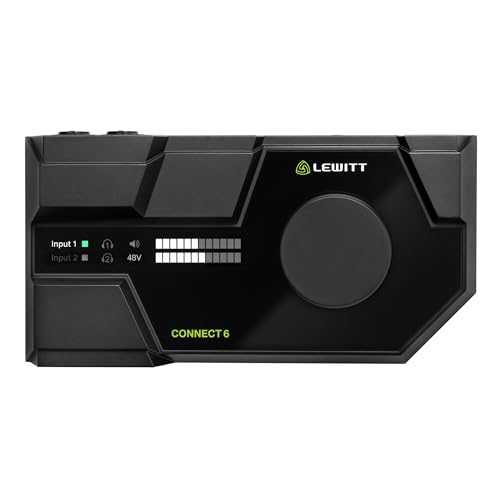
- Expander, compressor, EQ, and maximizer DSP
- Virtual channels, mixer, and loopback
- Auto Setup and iOS/Android integration
Best For: Streaming, podcasting, and mobile content creation
Best Premium UAD DSP Upgrade

- Unison preamps with classic gear emulations
- Access to 200+ UAD DSP and Native plug-ins
- Auto-Gain and Sonarworks monitor correction
Best For: Premium UAD tracking, mixing, and monitoring
Best for Dual-PC Streaming

- Onboard DSP voice processing
- Up to eight channels of dual-USB audio
- BEACN app routing and mixer control
Best For: Dual-PC streaming, gaming, and podcasting
Best for Plugin-Based Recording

- DUO Core UAD DSP processing
- Unison preamp and amp modeling
- Heritage Edition plug-in bundle
Best For: Windows recording, music production, and low-latency tracking
Best for Streamlined Voice Control

- 80dB XLR microphone gain
- Onboard voice DSP and VST chaining
- Touch controls with LED feedback
Best For: Streaming and creator-focused Wave Link setups
Flexible Effects Starter

- 24 preset digital effects
- Two combo inputs plus AUX and RCA
- USB recording with 48V phantom power
Best For: Beginners and compact live or recording setups
Compact DSP Control
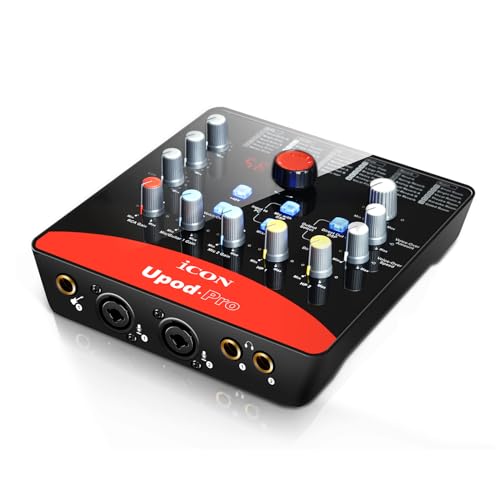
- Built-in ICON 72-DSP effect
- Two mic inputs and one guitar input
- Supports desktop and mobile operating systems
Best For: Portable recording with straightforward onboard effects
Streaming and Production Hub

- Onboard reverb, compression, EQ, and Voice FX
- Mixes audio from up to three applications
- Four flexible inputs and up to 96 kHz support
Best For: Streaming, podcasting, and multi-source production
Best Portable DSP Interface – Zen Quadro Synergy Core
The Antelope Audio Zen Quadro is a strong choice for creators comparing audio interfaces with dsp effects, especially when portable recording and near-zero-latency processing matter. Its four preamps, dual USB-C ports, bus-powered design, and included Synergy Core effects suit mobile studios, streaming setups, and small sessions.
Best For: Mobile producers, vocalists, instrumentalists, and streamers needing flexible routing and onboard effects.
Pros:
- Four Discrete preamps provide up to 75 dB of gain, with two Hi-Z inputs for guitar and bass.
- Includes 37 real-time Synergy Core effects, with processing handled by dedicated DSP and FPGA hardware.
- Dual USB-C, loopback, ADAT expansion, and standalone presets support varied studio and streaming workflows.
- Offers up to 130 dB AD/DA dynamic range and 64-bit AFC clocking.
Cons:
- Its broad routing and expansion features may be more than a basic two-input setup requires.
- Only 37 effects are included, while the larger library requires additional purchases.
The Zen Quadro stands out as a compact studio hub with unusually flexible connectivity and hardware-accelerated effects. It is particularly compelling for users who want one interface to cover recording, streaming, travel, and small live setups.
Best for UAD Tracking – Apollo Solo Heritage Edition
The Universal Audio Apollo Solo Heritage Edition brings UAD DSP effects to a compact, bus-powered interface. Its Unison preamp technology and included vintage compressor, EQ, tape, preamp, and guitar amp plug-ins let you track through modeled analog-style tones with near-zero latency.
Best For: Solo musicians, vocalists, and producers who want classic UAD processing in a portable setup.
Pros:
- UAD SOLO Core Processing supports near-zero-latency tracking through vintage-style plug-ins.
- Includes five award-winning plug-in titles from Teletronix, Pultec, and Universal Audio.
- Unison emulations cover equipment associated with Neve, API, Avalon, Manley, Marshall, and Fender.
- Bus-powered operation and a detailed, low-noise headphone amplifier support portable recording.
Cons:
- It is designed around a solo interface workflow rather than larger multi-input sessions.
- LUNA Recording System is available for Mac only, according to the supplied notes.
The Apollo Solo Heritage Edition is a focused option for producers who prioritize the UAD plug-in ecosystem and modeled analog tones. Its compact, bus-powered format makes it practical for personal recording while retaining a premium monitoring and processing experience.
Best All-in-One Streaming DSP – LEWITT Connect 6
The LEWITT Connect 6 is a practical pick among audio interfaces with dsp effects for creators who need straightforward control over recording, streaming, and mobile workflows. Its onboard expander, compressor, four-band EQ, and maximizer work alongside virtual channels, loopback, and automatic setup.
Best For: Streamers, podcasters, and mobile creators who want integrated processing and simple routing.
Pros:
- Onboard DSP includes an expander, compressor, four-band EQ, and maximizer.
- DSP-based virtual channels, mixer controls, and loopback support content-creation workflows.
- Auto Setup automatically finds optimal settings.
- Offers preamps with 72 dB of gain and a stated -133 dBV EIN noise performance.
Cons:
- Its maximum sample rate is 96 kHz, below some competing interfaces in this group.
- The supplied notes list fewer included software details than some recording-focused alternatives.
Connect 6 emphasizes convenience rather than a large plug-in ecosystem. Its combination of automatic setup, onboard dynamics and EQ, virtual channels, and loopback makes it well suited to creators who want a controlled signal without relying heavily on host processing.
Best Premium UAD DSP Upgrade – Apollo Twin X DUO Gen 2
Universal Audio Apollo Twin X DUO Gen 2 with UAD Analog Classics Thunderbolt 3 Audio Interface
Check Price On AmazonThe Universal Audio Apollo Twin X DUO Gen 2 is aimed at producers who want high-end audio interfaces with dsp effects and a deeper UAD workflow. Its Unison preamps, DUO DSP processing, access to the 200-plus UAD library, and monitoring tools support detailed tracking and mixing on Windows or macOS systems.
Best For: Producers and engineers building a premium Thunderbolt-based UAD recording and mixing setup.
Pros:
- Unison preamps provide real-time access to emulations associated with Neve, API, Avalon, Manley, Fender, and more.
- Supports the full library of more than 200 UAD DSP and Native plug-ins.
- Auto-Gain can set levels across multiple inputs in seconds.
- Sonarworks-powered Apollo Monitor Correction and bass management support room and monitoring control.
Cons:
- Thunderbolt 3 connectivity may be less convenient for systems without compatible ports.
- The premium feature set may be excessive for users needing only basic input and output duties.
The Apollo Twin X DUO Gen 2 is the most comprehensive choice here for a dedicated UAD production environment. It combines real-time Unison tracking with extensive DSP and Native plug-in access, plus monitoring features aimed at more serious mixing work.
Best for Dual-PC Streaming – BEACN Studio
BEACN Studio is a strong choice among audio interfaces with DSP effects for streamers, gamers, and podcasters who need a premium XLR connection plus flexible computer routing. Its onboard processing includes EQ, compression, expander/gate, noise suppression, and low-frequency enhancement.
Best For: Dual-PC streaming, gaming, podcasting, and users who want app-based audio routing.
Pros:
- Onboard DSP provides EQ, compression, gating, noise suppression, and more.
- Dual USB technology sends up to eight channels of digital audio between computers, consoles, and phones.
- BEACN App supports audio routing, mixer control, hearing-based tuning, and Live Profiles.
Cons:
- Its most advanced workflow depends on the BEACN software ecosystem.
- The feature set may be more than needed for a simple one-computer setup.
Choose BEACN Studio if DSP voice shaping and multi-device routing are central to your setup. It is particularly compelling when you want to manage audio from two computers through one streamlined control app.
Best for Plugin-Based Recording – Apollo Twin X Duo USB
The Universal Audio Apollo Twin X Duo USB is built for recording and mixing with UAD DSP effects. Its DUO Core processing supports near-zero-latency tracking through modeled compressors, EQs, tape machines, preamps, and guitar effects, while Unison technology recreates classic preamp and amplifier characteristics.
Best For: Music producers, vocalists, guitarists, and Windows users building a DAW-based recording setup.
Pros:
- UAD DSP enables near-zero-latency tracking through a broad range of modeled studio effects.
- Unison technology supports tube and transformer-style preamp, amp, and stompbox models.
- Heritage Edition includes compressor, preamp, EQ, reverb, and other UAD plug-ins.
- Works with VST, Audio Units, and AAX in major DAWs.
Cons:
- This USB model is specified for Windows rather than a broad range of operating systems.
- Its music-production features may be excessive for basic voice chat or simple streaming.
Consider the Apollo Twin X Duo USB when you want hardware-assisted plug-in processing and a more studio-oriented recording workflow. The included Heritage Edition collection adds useful starting points for tracking and mixing.
Best for Streamlined Voice Control – Elgato Wave XLR MK.2
Elgato Wave XLR MK.2 combines an XLR interface with a DSP mixer for creators who want hands-on control and straightforward voice processing. It offers 80dB of gain, onboard voice enhancer, compressor, and EQ effects, plus Wave Link routing and low-latency monitoring.
Best For: Streamers and creators using an XLR microphone with Wave Link, Stream Deck, or a compact desk setup.
Pros:
- 80dB of gain supports a wide range of XLR microphones.
- Wave FX Processor combines DSP effects and VST plug-ins in one signal chain.
- Touch controls and customizable LED feedback make level and mute adjustments quick.
- Wave Link provides integrated routing, effects, and monitoring control.
Cons:
- It has two channels, so it is less suited to larger multi-input setups.
- Wave Link requires Windows 11 or Apple Silicon Mac systems with the listed operating versions.
Wave XLR MK.2 is a practical pick for creators who want audio interfaces with DSP effects without a complicated studio workflow. Its touch controls, high gain, and Wave Link integration keep everyday streaming adjustments accessible.
Flexible Effects Starter – Pyle PMUX9
The Pyle PMUX9 is a practical option for shoppers seeking audio interfaces with DSP effects, especially if they want built-in presets without relying entirely on computer software. It combines two combo inputs, guitar and auxiliary connections, USB recording, and multiple monitoring outputs in a compact format.
Best For: Beginners, small recording setups, and live performers who want a broad selection of preset effects and flexible analog connectivity.
Pros:
- Includes 24 preset digital effects, including reverb, delay, chorus, tremolo, and pitch change.
- Offers two XLR/6.35 mm combo inputs plus guitar, AUX, and RCA stereo inputs.
- Provides 48V phantom power and USB recording at up to 24-bit/48 kHz.
- Compact design with headphone, phone, stereo, and monitor outputs.
Cons:
- Maximum sample rate is limited to 48 kHz.
- Supplied software compatibility is described specifically around Windows audio software.
- The built-in effects are presets rather than user-created processing chains.
Choose the PMUX9 if hands-on controls, numerous preset effects, and varied input options matter more than advanced software integration or higher sample rates.
Compact DSP Control – iCON UPod Pro
The iCON UPod Pro is a compact choice among audio interfaces with DSP effects, offering built-in processing through a top-panel control knob. Its two microphone inputs, guitar input, full-duplex analog I/O, and broad operating-system support make it suited to straightforward mobile or desktop recording.
Best For: Musicians and creators who want a small USB interface with integrated DSP, individual mic gain controls, and support across Windows, macOS, iOS, and Android.
Pros:
- Features a built-in ICON 72-DSP effect with top-panel control.
- Includes two mic inputs, one guitar input, and 2×2 analog I/O.
- Supports +48V and +5V phantom power.
- Works with Windows, macOS, iOS, and Android systems.
Cons:
- Uses 16-bit/48 kHz recording rather than a higher-resolution format.
- Its compact I/O layout may be limiting for larger setups.
- The supplied specifications list a single channel despite describing two mic inputs and 2×2 I/O.
The UPod Pro is appealing when portability and simple onboard DSP control are priorities. Consider another interface if you need higher-resolution recording or more extensive input expansion.
Streaming and Production Hub – PreSonus Revelator io44
The PreSonus Revelator io44 is a versatile pick among audio interfaces with DSP effects, pairing onboard reverb, compression, EQ, and Voice FX with an integrated mixer. Its USB-C connection, four flexible inputs, application mixing, and included Studio One Artist software support both recording and streaming workflows.
Best For: Streamers, podcasters, and musicians who need flexible routing, easy presets, and effects processing for multiple sources.
Pros:
- Provides onboard reverb, compression, EQ, and Voice FX processing.
- Integrated mixer can blend audio from up to three applications.
- Accepts up to four flexible sources, including microphones, guitars, headsets, and stereo devices.
- Supports up to 96 kHz and includes Studio One Artist plus Studio Magic software.
Cons:
- USB-C bus power means operation depends on the connected device.
- Its feature-rich mixer may require more setup than a basic interface.
- The supplied details identify Windows and macOS support, not a complete list of mobile operating systems.
The Revelator io44 stands out for users who want effects, routing, and recording tools in one compact unit. It is particularly well suited to streaming and hybrid production rather than minimal two-input recording.
How We Picked the Best Audio Interfaces with Dsp Effects
We focused on interfaces that provide meaningful onboard processing rather than simply bundling software effects. Our selection considers preamp quality, input and output flexibility, monitoring latency, DSP workflow, connection type, software support, and suitability for recording, streaming, or hybrid setups.
We also included a range of designs: professional Thunderbolt and USB interfaces, compact creator-focused mixers, and affordable models with built-in effects. Because DSP ecosystems vary widely, we considered both the included tools and how easy it is to control them during everyday use.
Quick Comparison
| Best For | What to Prioritize | Shortlist |
|---|---|---|
| Professional recording | High-quality preamps, stable drivers, and low-latency monitoring | Universal Audio Apollo Twin X, Apollo Solo, Antelope Zen Quadro |
| Streaming and content creation | Fast routing, vocal processing, and physical controls | BEACN Studio, Elgato Wave XLR MK.2, PreSonus Revelator io44 |
| Portable music production | Bus-powered connectivity, versatile inputs, and simple setup | LEWITT Connect 6, iCON UPod Pro |
| Budget effects | Basic connectivity and readily available presets | Pyle USB Audio Interface |
Key Buying Factors for Audio Interfaces with Dsp Effects
DSP Processing and Monitoring
Check whether effects run on the interface itself or depend on computer software. Hardware DSP can reduce monitoring latency and preserve computer resources, but premium effects may require additional purchases. Look for direct monitoring, adjustable effect chains, and the ability to save presets.
Inputs, Outputs, and Routing
Count the microphones, instruments, headphones, monitors, and external devices you expect to connect at the same time. Streamers may value loopback, virtual channels, and separate chat or guest mixes, while musicians may need high-impedance instrument inputs, multiple mic preamps, or line outputs for outboard gear.
Compatibility and Control
Confirm USB or Thunderbolt compatibility with your computer and operating system before buying. Companion software should make routing and effect adjustment clear, especially when switching between recording, streaming, and video-call setups.
Sound Quality and Expandability
Look for clean preamps, suitable gain range, dependable headphone output, and monitoring connections that match your workspace. If you plan to grow, consider ADAT or additional line outputs, although a simpler interface may be better value for a solo setup.
Who Should Buy Which Audio Interfaces with Dsp Effects?
Choose a Universal Audio Apollo or Antelope Zen Quadro if polished tracking, premium processing, and a mature studio ecosystem are your priorities. These are strong choices for musicians, vocalists, and producers who expect to build a more advanced setup.
Choose the BEACN Studio, Elgato Wave XLR MK.2, or PreSonus Revelator io44 for streaming, podcasting, and content creation. Their routing and mixer features are more useful than a large input count when you need quick control over microphones, applications, guests, and headphones.
Choose the LEWITT Connect 6 or iCON UPod Pro when you want a flexible, approachable interface for home recording and streaming without committing to a larger studio system. Choose the Pyle model if low cost and simple preset effects matter more than premium conversion, extensive routing, or long-term expansion.