The best drum pads for live performances give drummers fast access to samples, electronic percussion, effects, and layered sounds without taking up a full stage setup. The right model can expand an acoustic kit, anchor a hybrid rig, or provide a portable performance solution.
This roundup compares 10 options across multipads, sample pads, MIDI controllers, and individual electronic drum triggers, with attention to playability, connectivity, sound flexibility, and live-use practicality.
Best 10 Drum Pads for Live Performances Picks for 2026
Performance Powerhouse

- Nine velocity-sensitive RGB pads
- Built-in sampler, looper, and effects
- 32GB storage with 6GB+ of content
Best For: All-in-one live performers needing loops, samples, and melodic sounds
Road-Ready Classic

- Accurate triggering with pad isolation
- Four dual-trigger inputs plus hi-hat input
- Phrase looper with three overdub layers
Best For: Live drummers prioritizing rugged construction and expansion
Sample-Ready Showstopper

- 1,000 sounds and 32GB internal memory
- Wireless Bluetooth sampling
- Customizable LEDs and expandable trigger inputs
Best For: Sample-driven live sets with visual effects and expansion
Compact Controller
Akai MPD218 USB MIDI Pad Controller

- 16 velocity-sensitive MPC pads
- 48 assignable pads across three banks
- USB-powered with assignable knobs
Best For: Portable computer-based live rigs and beat production
Compact Sample Hub

- Four velocity-sensitive pads with dual trigger input
- 25 built-in sounds across eight kits
- SD-card sample loading and MIDI output
Best For: Compact live sample triggering and MIDI control
Realistic Zone Pad

- Three-zone design supports rimshot articulation
- Textured silicone offers a realistic feel
- Free-floating build helps reduce crosstalk
Best For: Expanding an electronic kit with quiet, responsive playing
Full-Feature Performance Pad
LEKATO PD705 Percussion Sample Pad

- Nine dual-zone velocity-sensitive pads
- 592-plus sounds and 30 drum kits
- MIDI, USB, trigger inputs, AUX, and looper
Best For: Versatile live performance and production setups
Mesh Precision Pick
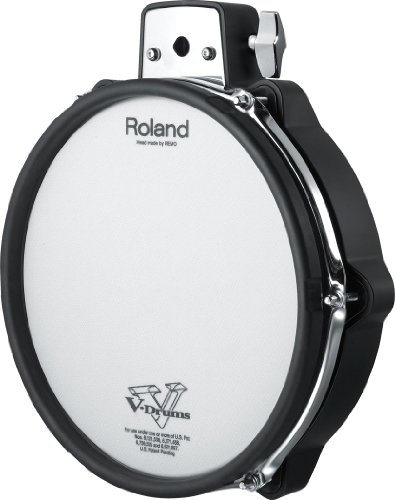
- 10-inch tensionable mesh head
- Dual-trigger head and rim response
- Dual-mounting, compact design
Best For: V-Drums players needing a flexible snare or floor-tom pad
Compact Rubber Workhorse

- Rubber playing surface
- Dual-trigger rim and bow/edge sounds
- Compatible with most V-Drums modules
Best For: Players wanting a compact, basic dual-trigger V-Drums pad
Large Mesh Snare Option

- 12-inch adjustable two-ply mesh head
- Low-height acoustic-snare-style hoop
- Independent head and rim detection
Best For: Players wanting a larger, snare-like mesh pad
Performance Powerhouse – Alesis Strike Multipad
For drummers seeking drum pads for live performances, the Alesis Strike Multipad combines nine velocity-sensitive RGB pads with onboard sounds, sampling, looping, and effects. Its display and tactile controls are designed to make editing and sound shaping practical onstage.
Best For: Performers who want an all-in-one multipad for triggering drums, loops, melodic sounds, and samples.
Pros:
- Nine velocity-sensitive RGB-lit pads support expressive playing.
- Built-in looper, sampler, effects processors, and USB sample loading expand performance options.
- Includes 32GB of storage with over 6GB of loops, drums, percussion, and melodic content.
- Provides USB audio and MIDI connectivity plus Ableton Live Lite and MPC Beats.
Cons:
- Its broad feature set may require more setup time than a basic pad controller.
- At 14.2 x 13.8 x 3.5 inches and 3,500 grams, it is less travel-friendly than compact controllers.
The Strike Multipad is a strong choice when live performance flexibility matters more than minimal size. Its looping, sampling, storage, and sound-shaping tools can cover several roles in one unit.
Road-Ready Classic – Roland SPD-30 Octapad
The Roland SPD-30 Octapad is a practical option for drum pads for live performances when reliable triggering and stage-ready construction are priorities. Its pad-sensing technology, illuminated controls, and expansion inputs support both standalone playing and added triggers.
Best For: Drummers who need a rugged multipad with accurate triggering, expansion capability, and onboard phrase looping.
Pros:
- V-Drums-derived sensing is designed for even triggering and pad isolation.
- Four dual-trigger inputs and a hi-hat controller input allow kit expansion.
- Phrase loop recording supports real-time playing and up to three overdub layers.
- Backlit LCD, pad indicator lights, and road-worthy construction suit live use.
Cons:
- The supplied notes do not specify onboard sound count or internal storage capacity.
- Its listed dimensions and 4,000-gram weight make it a substantial unit for transport.
The SPD-30 focuses on dependable playability and expansion rather than an extensive feature list. It makes sense for performers who value robust hardware, clear controls in low light, and the ability to add external pads or triggers.
Sample-Ready Showstopper – HXW Avatar PD708 Sample Pad
The HXW Avatar PD708 brings extensive sampling and expansion features to drum pads for live performances. It includes 1,000 built-in sounds, 32GB of internal memory, onboard effects, wireless sampling, and customizable LEDs for visually engaging club or stage setups.
Best For: Performers who want a feature-rich sampler pad with wireless audio sampling, expandable triggers, and colorful stage lighting.
Pros:
- Offers 30 kits, 1,000 built-in sounds, and 32GB of internal memory.
- Bluetooth 5.0 enables wireless sampling from a phone, tablet, or computer.
- Includes four effect processors with 24 effects and MIDI, USB, audio, headphone, and AUX connections.
- Nine customizable horizontal LED lights add visual impact in dark venues.
Cons:
- The manufacturer recommends downloading firmware updates from the HXW Music website.
- Its many expansion and sampling features may involve more configuration than a basic pad.
The PD708 is especially appealing for modern live sets built around samples, effects, and visual presentation. Its wireless sampling and generous storage make it versatile, while the trigger and pedal inputs leave room to build a larger setup.
Compact Controller – Akai MPD218 USB MIDI Pad Controller
The Akai Professional MPD218 is a compact USB MIDI controller for drum pads for live performances, beat making, and computer-based setups. Its 16 velocity-sensitive MPC pads, three pad banks, assignable knobs, and portable design make it suited to triggering software instruments and effects.
Best For: Producers, DJs, and musicians who perform with a computer or iOS setup and need a portable MIDI pad controller.
Pros:
- Sixteen thick, velocity-sensitive MPC pads provide expressive triggering.
- Three pad banks expand the controller to 48 assignable pads.
- Eighteen assignable knobs across three banks control DAW and software parameters.
- Includes note repeat, full level, MPC Beats, Ableton Live Lite, and Drum Synth 500.
Cons:
- It is USB-powered and functions as a MIDI controller, so it requires compatible external software or gear for sounds.
- The supplied notes do not list onboard sounds, internal storage, or standalone audio outputs.
The MPD218 is best viewed as a lightweight control surface rather than a standalone electronic drum pad. It is a sensible pick for software-based live rigs where portability, pad response, and hands-on parameter control are more important than built-in audio.
Compact Sample Hub – Alesis Sample Pad 4
For drummers seeking practical drum pads for live performances, the Alesis Sample Pad 4 offers four velocity-sensitive pads, built-in sounds, and SD-card sample expansion in a compact format. It can also send MIDI data to external sound modules or software.
Best For: Performers who want a portable sample pad for adding percussion, electronic sounds, or MIDI control to an existing setup.
Pros:
- Four velocity-sensitive pads support expressive playing.
- Includes 25 percussion and electronic sounds across eight ready-to-play kits.
- Loads additional samples from a standard SD or SDHC card.
- Provides a dual trigger input, kick input, and MIDI output for expansion.
Cons:
- Four onboard pads provide less playing surface than larger multipads.
- The built-in sound library is smaller than the libraries of more expansive sample pads.
The Sample Pad 4 is a straightforward, lightweight choice when you need sample triggering and MIDI connectivity without a large footprint. Its SD-card support makes it especially useful for performers who want to customize a compact live rig.
Realistic Zone Pad – Yamaha XP80 3-Zone Pad
The Yamaha XP80 is a focused 8-inch pad for players building responsive electronic kits or enhancing drum pads for live performances. Its three-zone design supports open and closed rimshots, while the textured silicone surface is designed to feel realistic and operate quietly.
Best For: Electronic drummers who prioritize realistic playing response, quiet operation, and detailed three-zone articulation.
Pros:
- Three zones support pad, open rimshot, and closed rimshot sounds.
- Textured cellular silicone provides a realistic playing feel.
- Free-floating construction improves sensitivity and helps reduce crosstalk.
- Quiet operation suits home practice and controlled performance environments.
Cons:
- This is a single pad rather than a complete sample-pad system.
- Its usefulness depends on compatibility with an electronic drum module or setup.
The XP80 is best viewed as a quality replacement or expansion pad rather than a standalone sound source. Its three-zone response and quiet silicone surface make it a strong option for players who value nuanced articulation in an electronic kit.
Full-Feature Performance Pad – LEKATO PD705 Percussion Sample Pad
The LEKATO PD705 is a feature-rich option for players comparing drum pads for live performances. It combines nine dual-zone velocity-sensitive pads with 592-plus sounds, custom kits, looping, trigger inputs, and MIDI and USB connectivity for a broad performance and production setup.
Best For: Performers who need a versatile multipad for live sounds, backing-track control, external triggers, and computer-based music workflows.
Pros:
- Nine dual-zone pads provide an expansive playing surface.
- Offers up to 592 preset sounds and 30 drum kits.
- Supports two additional dual-zone trigger pads or acoustic drum triggers.
- Includes five-pin MIDI, USB-B, looper, AUX, and custom sample-kit storage options.
Cons:
- Its extensive feature set may require more setup and learning than a basic sample pad.
- The unit is heavier than the Alesis option at approximately 3.17 kg.
- Software and firmware resources may be needed for sample management and updates.
The PD705 stands out when flexibility matters more than minimalism. With extensive sounds, expandable triggers, footswitch support, and computer connectivity, it is equipped for performers who want one multipad to handle several live and studio roles.
Mesh Precision Pick – Roland PDX-100
For drummers choosing drum pads for live performances, the Roland PDX-100 offers a lightweight 10-inch mesh playing surface with adjustable tension and dual-trigger response. Its compact design and dual-mounting capability make it practical for flexible V-Drums setups.
Best For: V-Drums players who want a versatile snare or floor-tom pad with mesh-head feel.
Pros:
- 10-inch mesh head provides adjustable tension and natural playing response.
- Dual-trigger sensor supports head and rim performance features.
- Dual-mounting capability helps accommodate different setup positions.
- Lightweight, compact casing suits space-conscious rigs.
Cons:
- It is a single pad, so additional mounting hardware or accessories may be needed.
- Its compatibility is centered on V-Drums setups and compatible modules.
The PDX-100 is a balanced choice when live players prioritize mesh feel, flexible positioning, and snare-or-tom versatility in a compact electronic kit.
Compact Rubber Workhorse – Roland PD-8
The Roland PD-8 is a straightforward option for drum pads for live performances, using a durable rubber playing surface and dual-trigger support. It is designed to work with most V-Drums modules and can detect rim-shot and bow/edge playing.
Best For: V-Drums users seeking a compact rubber pad for rim shots and bow/edge sounds.
Pros:
- Dual-trigger support enables rim-shot and bow/edge sounds.
- Works with most V-Drums modules.
- Compact dimensions make it suitable for tighter electronic drum layouts.
Cons:
- Rubber construction does not provide the mesh-head feel of the PDX models.
- The supplied notes do not specify adjustable head tension.
The PD-8 is a practical, uncomplicated pad for performers who value broad V-Drums compatibility and essential dual-trigger functionality over mesh response.
Large Mesh Snare Option – Roland PDX-12
For live performers comparing drum pads for live performances, the Roland PDX-12 stands out with a large 12-inch, two-ply mesh head and adjustable tension. Its low-height hoop and independent head-and-rim detection are suited to players who want a more snare-like setup.
Best For: Drummers who want a larger mesh pad for stick development and snare-style playing.
Pros:
- 12-inch two-ply mesh head offers adjustable rebound, resistance, and stick feel.
- Low-height hoop is similar to a standard acoustic snare.
- Independently detects head shots and rim shots.
- Can mount to traditional snare/tom stands and compatible tom holders.
Cons:
- At 6.9 pounds, it is heavier than the PDX-100.
- Its larger footprint may require more room in a compact live rig.
The PDX-12 is the strongest fit here for players who value a spacious, adjustable mesh surface and familiar snare ergonomics when building a live electronic setup.
How We Picked the Best Drum Pads for Live Performances
We organized this list around the needs of working musicians rather than treating every pad as interchangeable. Selection factors included pad layout, velocity response, onboard sounds, sampling and storage features, MIDI and USB connectivity, trigger compatibility, durability, and the ease of integrating each unit into a live setup.
The products cover several categories: all-in-one multipads for standalone performance, sample pads for expanding a kit, MIDI controllers for computer-based rigs, and individual V-Drum-style pads for modular electronic drum setups. Because these products serve different roles, the best choice depends on how you perform and what equipment you already own.
Quick Comparison
| Type | Best suited for | What to prioritize |
|---|---|---|
| Multipad | Standalone stage performance | Sound library, effects, sampling, outputs, and foot-control options |
| Sample pad | Adding one-shots or backing parts | Storage, trigger sensitivity, sample loading, and simple navigation |
| MIDI pad controller | Computer- or software-based rigs | USB MIDI, mapping flexibility, pad response, and reliable power |
| Individual drum pad | Expanding an electronic kit | Trigger zones, mounting compatibility, feel, and module support |
Key Buying Factors for Drum Pads for Live Performances
Playing Feel and Pad Layout
Velocity-sensitive pads are important for expressive dynamics, while the number, size, and spacing of pads affect how confidently you can perform under stage pressure. Textured silicone, mesh, and rubber surfaces each offer a different balance of rebound, noise, and durability.
Sounds, Sampling, and Control
Choose a multipad with onboard sounds and effects if you want to perform without a computer. If you use custom samples, check how easily files can be imported, how much storage is available, and whether sounds can be assigned to individual pads or groups. MIDI controllers typically depend on external software, but they may offer deeper customization.
Connectivity and Stage Integration
Review the available main outputs, headphone connection, MIDI ports, USB, auxiliary inputs, and trigger inputs. Stereo outputs can simplify routing, while separate outputs or flexible MIDI may be valuable for larger rigs. Confirm that the included or required power supply suits your venue setup.
Reliability and Portability
Live gear should be quick to set up and easy to protect in transit. Consider chassis construction, pad durability, mounting hardware, menu speed, and whether settings can be saved as performance-ready kits. A lighter unit may be ideal for frequent travel, while a larger pad surface can be worth the extra size for active playing.
Who Should Buy Which Drum Pads for Live Performances?
Choose an all-in-one multipad if you need onboard sounds, sampling, effects, and broad control from one unit. Choose a sample pad if your main goal is triggering extra percussion, loops, or one-shot effects alongside an acoustic or electronic kit.
Choose a MIDI pad controller if your performance centers on a laptop, drum software, or a DAW and you want flexible software mapping. Choose an individual electronic drum pad if you are expanding an existing module-based kit and need a specific size, playing surface, or trigger-zone configuration.
Before buying, match the pad’s connections and triggering requirements to your current equipment. The most capable unit is not always the best live choice; dependable response, quick access to sounds, and straightforward routing often matter more than an extensive feature list.