The right wireless conference microphone can make remote and hybrid meetings easier to hear, manage, and join from almost anywhere. The models in this roundup cover compact speakerphones, USB options, Bluetooth connectivity, AI noise reduction, and 360-degree voice pickup.
Use the guide below to compare connection options, microphone coverage, battery life, compatibility, and meeting-room needs before choosing a speakerphone for your home office or team.
Best 10 Wireless Conference Microphone Picks for 2026
Best Wireless Conference Microphone for Larger Meetings
TONGVEO Bluetooth Speakerphone

- 360-degree pickup for 8–12 people
- USB, Bluetooth, and wireless-dongle connections
- 6–8 hours of battery-backed meeting time
Best For: Medium-sized conference rooms and flexible hybrid meetings
Best Budget Wired Conference Microphone

- 360-degree pickup up to 11.5 feet
- Plug-and-play USB connection for Windows and Mac
- Mute button, indicator light, and stable anti-slip base
Best For: Small or medium meetings using a computer with separate speakers
Best Long-Battery Wireless Conference Microphone

- Six microphones provide 360-degree coverage
- AI processing reduces noise and echo
- Up to 24 hours of call time with Bluetooth or USB-C
Best For: Home offices and portable meetings requiring extended battery life
Best Portable Wireless Conference Microphone

- Bluetooth and USB connectivity
- Portable design with included travel pouch
- Up to 15 hours of battery life
Best For: Traveling professionals and small meeting spaces
Best for Flexible Hybrid Meetings
EMEET Luna 360° Conference Speaker

- 360° pickup from three microphone arrays
- USB, Bluetooth, AUX, and dongle connectivity
- Optional daisy chaining for larger meetings
Best For: Home offices and small-to-medium meeting spaces
Best for Travel and Battery Life
Yealink SP92 Teams Speakerphone

- Up to 20 hours of calls per charge
- AI noise cancellation and 360° room coverage
- Compact design with carrying case
Best For: Traveling professionals and 4- to 8-person meetings
Best for Stable Plug-and-Play Audio

- 360° pickup from two omnidirectional microphones
- USB-C connection with USB-A adapter
- Convenient speaker and microphone mute controls
Best For: Wired office, home-office, and huddle-room meetings
Flexible Room Coverage
RayBit POD4 Wireless Conference Speakerphone

- AI voice enhancement, echo cancellation, and noise reduction
- Includes expansion microphone and daisy-chain cable
- Bluetooth, USB, dongle, and daisy-chain connectivity
Best For: Expandable meeting-room setups from small to extra-large spaces
Simple USB Setup
Synbit SPK100 Conference Speakerphone
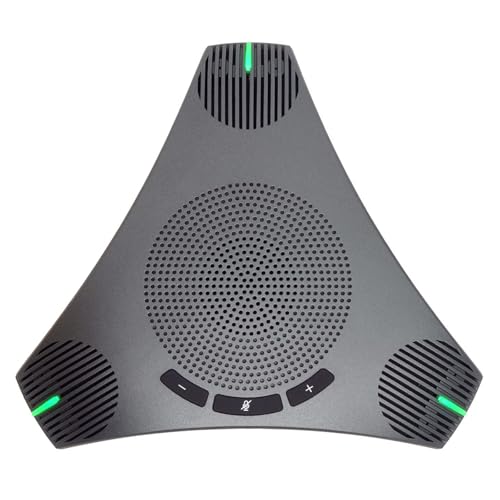
- Two omnidirectional mics cover a stated 3.5m radius
- Automatic gain, echo, and noise control
- Built-in two-port USB hub and plug-and-play setup
Best For: Desktop and laptop meetings using a direct USB connection
Portable All-Day Meetings
EMEET M0 Plus Bluetooth Speakerphone

- Four AI microphones provide 360-degree pickup
- Bluetooth 5.0 and USB-C connectivity
- Up to 10 hours of talk time per charge
Best For: Travel, home offices, and huddle rooms needing portable coverage
Best Wireless Conference Microphone for Larger Meetings – TONGVEO Bluetooth Speakerphone
For teams that need a wireless conference microphone with room-filling pickup, the TONGVEO combines a speaker and four-microphone array in one portable unit. Its 360-degree pickup, full-duplex audio, and USB, Bluetooth, or wireless-dongle connections make it adaptable for meetings with roughly 8 to 12 people.
Best For: Medium-sized conference rooms, hybrid meetings, and users who want flexible wired or wireless connectivity.
Pros:
- Four-microphone array provides 360-degree voice pickup for groups.
- Full-duplex audio, noise suppression, and voice enhancement support natural conversations.
- Works through USB, Bluetooth 5.0, or the included wireless dongle without requiring drivers.
- Built-in battery provides approximately 6 to 8 hours of working time.
Cons:
- Its larger-room capabilities may be more than needed for one or two users.
- Battery life is shorter than some competing wireless speakerphones.
The TONGVEO is a practical choice when coverage and connection flexibility matter more than minimal size. It is especially useful for teams sharing a table in a medium meeting room.
Best Budget Wired Conference Microphone – TONOR G11 USB Microphone
The TONOR G11 is a straightforward wireless conference microphone alternative for buyers who prefer dependable USB operation. This compact omnidirectional condenser mic captures voices from 360 degrees and connects directly to Windows or Mac computers for online meetings and recording.
Best For: Small or medium meetings where a simple USB microphone is preferable to a speakerphone.
Pros:
- Omnidirectional pickup reaches approximately 11.5 feet.
- Plug-and-play USB setup works with Windows and macOS without drivers.
- Dedicated mute button and blue status indicator simplify meeting controls.
- Metal construction, an anti-slip base, and a shielded 1.8-meter cable support desktop use.
Cons:
- It is a microphone only, not a speaker or speakerphone.
- USB cable operation does not provide wireless placement flexibility.
Choose the G11 if your computer already handles audio output and you mainly need clearer voice capture. Its uncomplicated design keeps setup and operation easy for everyday conference calls.
Best Long-Battery Wireless Conference Microphone – Anker PowerConf Speakerphone
The Anker PowerConf is a wireless conference microphone and speakerphone built for flexible home-office or conference-room use. Six microphones arranged in a 360-degree array work with Voice Radar 3.0 to reduce noise and echo, while Bluetooth and USB-C provide convenient connection options.
Best For: Users who want long wireless runtime, automatic voice balancing, and a portable speakerphone for group calls.
Pros:
- Six-microphone 360-degree array captures voices from around the table.
- AI-assisted noise reduction, echo cancellation, and multiple-speaker detection support clearer calls.
- Bluetooth and USB-C connectivity works with computers and phones without drivers.
- 5,200mAh battery offers up to 24 hours of call time and can charge other devices.
Cons:
- Its speakerphone design may be unnecessary if you only need microphone input.
- It is not waterproof, so it is intended for indoor use.
PowerConf stands out for buyers who prioritize battery endurance and hands-free portability. Its six-mic array and voice-processing features make it well suited to shared tables and changing meeting locations.
Best Portable Wireless Conference Microphone – Jabra Speak 510
The Jabra Speak 510 is a compact wireless conference microphone and speakerphone for meetings on the desk or on the move. It supports Bluetooth or USB connections, offers a portable tabletop design, and works with computers, phones, tablets, desk phones, and common online meeting platforms.
Best For: Travelers, small teams, and professionals who want a familiar portable speakerphone for business calls.
Pros:
- Bluetooth and USB connections provide flexible laptop, phone, and tablet use.
- Portable design includes a travel pouch for on-the-go meetings.
- Built-in microphone and high-resolution audio support clear conference conversations.
- Battery provides up to 15 hours of use and recharges in about two hours.
Cons:
- It has one microphone, so it may offer less coverage than multi-microphone arrays.
- The listed maximum range is 1.5 meters, which favors smaller meeting setups.
The Speak 510 is a sensible choice when portability and easy setup are the priorities. It fits best in personal workspaces or smaller meetings rather than large conference tables.
Best for Flexible Hybrid Meetings – EMEET Luna 360° Conference Speaker
The EMEET Luna is a versatile wireless conference microphone and speakerphone for home offices, huddle spaces, and larger meeting setups. Its three-microphone array provides 360° pickup, while VoiceIA noise reduction helps reduce background sounds such as keyboard clicks and air conditioning.
Best For: Home offices and small-to-medium meetings where flexible USB, Bluetooth, AUX, or dongle connectivity is useful.
Pros:
- Three microphone arrays provide 360° voice pickup and full-duplex conversation.
- VoiceIA noise reduction and automatic vocal volume adjustment support clearer calls.
- USB, Bluetooth, AUX, and dongle connection options make setup flexible.
- Two units can be daisy-chained for meetings with up to 16 or more attendees, using a separately purchased cable.
Cons:
- The daisy-chain cable is sold separately.
- The unit automatically shuts off after one hour of inactivity, which may not suit every meeting setup.
The Luna stands out when you need a wireless conference microphone that can adapt to different devices and room sizes. Its portable metal design and broad platform compatibility make it a practical all-purpose option, while the optional wired daisy chain adds room for expansion.
Best for Travel and Battery Life – Yealink SP92 Teams Speakerphone
The Yealink SP92 is a portable wireless conference microphone and speakerphone designed for small meeting rooms, home offices, and business travel. Its AI noise cancellation filters more than 1,000 types of noise, while the omnidirectional microphone covers a 13-foot radius for meetings of roughly four to eight people.
Best For: Mobile professionals and small teams that need long battery life, Teams certification, and multiple connection options.
Pros:
- AI noise cancellation helps reduce sounds such as keyboard taps and air conditioning hum.
- 360° coverage is designed for a 4- to 8-person room within a 13-foot radius.
- Up to 20 hours of call or music playback per charge.
- Supports Bluetooth 5.3, USB-C, and USB-A connections, with a carrying case included.
Cons:
- The included package does not include the optional BT51C dongle.
- Its mono speaker design may be less suited to stereo media playback.
Choose the SP92 if portability and dependable all-day operation matter more than expansion for large conference rooms. Microsoft Teams certification, broad UC compatibility, and a compact carrying case make it especially convenient for meetings across multiple locations.
Best for Stable Plug-and-Play Audio – EMEET M1A USB Speakerphone
The EMEET M1A is a wired alternative for shoppers who want a wireless conference microphone roundup option but prefer stable USB audio. Its two omnidirectional microphones provide 360° pickup, while VoiceIA technology combines noise reduction, echo cancellation, voice amplification, and full-duplex communication.
Best For: Offices, home workspaces, huddle rooms, and travel setups where a reliable USB connection and privacy controls are priorities.
Pros:
- Two omnidirectional microphones provide 360° voice pickup.
- VoiceIA processing supports noise reduction, echo cancellation, and voice amplification.
- Built-in USB-C cable and included USB-C-to-USB-A adapter simplify plug-and-play setup.
- Speaker and microphone mute controls help protect privacy during online meetings.
Cons:
- It has no wireless communication technology, so it requires a wired USB connection.
- The 3-watt speaker output is intended for personal and huddle-room use rather than large rooms.
The M1A is a sensible choice when consistent wired performance is more important than Bluetooth freedom. It offers straightforward connection, broad office-platform compatibility, and useful mute controls in a compact tabletop design.
Flexible Room Coverage – RayBit POD4 Wireless Conference Speakerphone
The RayBit POD4 is a wireless conference microphone system for teams that need flexible coverage across different meeting spaces. Bluetooth, a wireless dongle, USB, and daisy-chain connectivity make it adaptable, while AI voice processing helps keep conversations clear.
Best For: Small to extra-large meeting rooms that may need expandable microphone coverage.
Pros:
- AI-based echo cancellation, voice enhancement, full-duplex audio, and background-noise isolation.
- Includes a 1.8m expansion microphone with 360-degree pickup and a stated 3–5m pickup radius.
- Supports Bluetooth, USB, wireless dongle, and daisy-chain connections.
- Works with popular platforms including Zoom, Teams, Skype, and GoToMeeting.
Cons:
- Uses corded electric power rather than a built-in battery.
- The plastic tabletop design may be less suitable for users seeking a premium enclosure.
Its included expansion microphone and daisy-chain cable make the POD4 especially useful when one tabletop unit is not enough. It is a strong fit for buyers prioritizing connection flexibility and scalable room coverage.
Simple USB Setup – Synbit SPK100 Conference Speakerphone
The Synbit SPK100 is a USB wireless conference microphone alternative designed for straightforward computer-based meetings. Its two omnidirectional microphones, voice processing, and built-in USB hub support a tidy home-office or meeting-room setup.
Best For: Plug-and-play meetings from a desktop or laptop where USB connectivity is preferred.
Pros:
- Two 360-degree microphones capture voices within a stated 3.5m radius.
- AGC, acoustic echo cancellation, and automatic noise suppression support clearer calls.
- Built-in two-port USB hub can connect peripherals such as a mouse or keyboard.
- Includes a 3m USB cable and works with Windows, macOS, Linux, Android, and major meeting platforms.
Cons:
- USB-A is the listed connectivity option, with no Bluetooth connection specified.
- It requires corded power and a direct USB connection to the computer.
The SPK100 keeps installation simple with plug-and-play USB operation and physical volume and microphone controls. Choose it when easy computer connectivity and extra USB ports matter more than battery-powered portability.
Portable All-Day Meetings – EMEET M0 Plus Bluetooth Speakerphone
The EMEET M0 Plus combines a wireless conference microphone with four AI microphones, Bluetooth, and a rechargeable battery. Its compact design suits home offices, huddle rooms, and business travel, while daisy chaining can extend coverage for larger meetings.
Best For: Portable meetings and teams that need Bluetooth flexibility with up to 10 hours of talk time.
Pros:
- Four-microphone array provides 360-degree voice pickup with VoiceIA noise filtering and echo reduction.
- Supports Bluetooth 5.0, USB-C, and USB-C-to-A adapter connections.
- Up to 10 hours of talk time on one charge.
- Daisy chaining two compatible EMEET speakerphones can support up to 16 attendees.
Cons:
- Daisy-chain expansion is limited to compatible EMEET models.
- Its 3W speaker may be better suited to smaller rooms than very large spaces when used alone.
The M0 Plus is the most travel-friendly option in this group because it combines a compact tabletop format with battery operation and Bluetooth. It is a practical choice for users moving between offices, home workspaces, and business trips.
How We Picked the Best Wireless Conference Microphones
We focused on features that have the greatest effect on everyday calls: microphone pickup range, voice clarity, echo and noise reduction, connection methods, portability, battery performance, and compatibility with common meeting platforms. We also considered whether each model suits an individual desk, a small meeting room, or a group that needs broader coverage.
Because product specifications and software support can change, check the manufacturer’s current compatibility details before buying. A microphone that works well for a personal workspace may not provide enough coverage for a larger conference table.
Quick Comparison
| Best for | Look for | Most useful features |
|---|---|---|
| Home office | Compact Bluetooth or USB speakerphone | Simple setup, echo cancellation, portable design |
| Small teams | 360-degree pickup and multiple microphones | Wide coverage, voice enhancement, strong speaker output |
| Hybrid meetings | USB plus Bluetooth connectivity | Flexible device switching and reliable call control |
| Larger tables | Daisy-chain support or extended pickup | Expandable coverage and multiple pickup zones |
Key Buying Factors for a Wireless Conference Microphone
Microphone Coverage
Check the stated pickup pattern and recommended room size. Omnidirectional or 360-degree microphones are convenient for round tables, while models with several built-in microphones can help capture voices from different positions. Coverage also depends on room acoustics, seating distance, and background noise.
Connection Options
USB is generally the simplest choice for a computer and tends to provide a dependable connection. Bluetooth adds portability and works well with phones, tablets, and laptops. If you switch between devices often, choose a model that supports both or offers clear controls for changing connections.
Noise and Echo Control
AI noise cancellation, acoustic echo cancellation, and voice enhancement can improve conversations in busy offices or shared rooms. These features are useful, but they cannot fully compensate for loud HVAC systems, nearby conversations, or excessive distance from the microphone.
Battery Life and Controls
For a portable speakerphone, compare claimed talk time, charging method, and whether calls can be muted from the device. Physical controls are often faster and more dependable than relying entirely on conferencing software.
Platform Compatibility
Confirm support for your operating system and preferred meeting services, such as Zoom, Microsoft Teams, Google Meet, or standard Bluetooth calling. Certification may simplify setup, but a certified device can still have limitations depending on the computer, application, or firmware version.
Who Should Buy Which Wireless Conference Microphone?
Choose a compact USB model if you mainly take calls at one desk and want straightforward plug-and-play operation. Choose a Bluetooth speakerphone if you move between a laptop and phone or need a device for travel. Choose a multi-microphone 360-degree model for small teams seated around a table. Choose daisy-chain or expandable equipment when one unit may not cover the full room. For the best results, match the microphone’s pickup range to your actual seating layout rather than choosing solely by speaker volume or feature count.