Audio interfaces with DSP processing can move demanding effects and monitoring tasks away from your computer, helping you record with low latency while keeping sessions responsive.
These 10 models cover compact home studios, mobile production, streaming, podcasting, and larger recording setups. Use the guide below to match DSP capabilities, connectivity, I/O, and workflow to your needs.
Best 10 Audio Interfaces with Dsp Processing Picks for 2026
Premium Mobile DSP Recording

- Near-zero-latency UAD processing
- Includes five premium plug-in titles
- Bus-powered for portable recording
Best For: Mobile producers, vocalists, and guitarists
Flexible Connected DSP
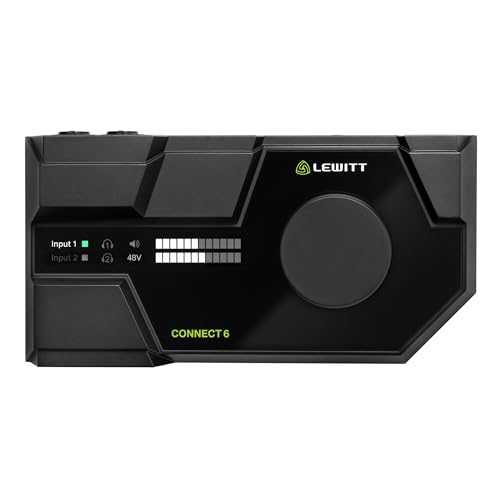
- Onboard dynamics, EQ, and maximizer
- Virtual channels and loopback included
- Works with computers and mobile devices
Best For: Streamers, podcasters, and mobile creators
All-in-One Broadcast Production

- APHEX voice processing presets
- Four XLR inputs and eight SMART pads
- Standalone and multitrack recording
Best For: Podcasters, streamers, and live broadcasters
Expandable Studio DSP

- Unison preamps for realtime processing
- Access to 200+ UAD DSP and native plug-ins
- Auto-Gain and monitor-correction tools
Best For: Producers, engineers, and serious home studios
Rackmount DSP Power
Antelope Audio Discrete 8 Synergy Core

- Eight mic/line inputs with extensive analog and digital I/O
- 36 real-time plugins plus Auto-Tune Synergy
- 121dB conversion and USB/Thunderbolt support
Best For: Multichannel studio recording and flexible low-latency processing
Premium UAD Processing
Universal Audio Apollo Twin X QUAD Gen 2
- Unison preamps for real-time analog gear emulations
- QUAD DSP with access to 200+ UAD DSP and Native plug-ins
- Thunderbolt 3, 192 kHz support, and Auto-Gain
Best For: Desktop recording with UAD effects and modeled preamps
Compact Built-In Effects
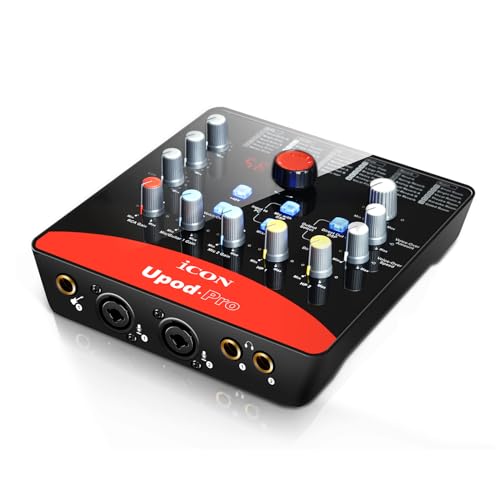
- Built-in 72-DSP effect with top-panel control
- Two mic inputs, guitar input, and 2×2 analog I/O
- Supports Windows, macOS, iOS, and Android
Best For: Simple guitar, microphone, and keyboard recording
Premium DSP Powerhouse

- Thunderbolt 3 interface with 32 channels
- Unison preamps for real-time analog emulations
- Includes access to 200+ UAD DSP and Native plug-ins
Best For: Producers seeking extensive DSP processing and premium studio features
Expandable Studio Workhorse

- 18 inputs and 20 outputs via USB
- Eight MIDAS-designed mic preamps
- ADAT I/O and MIDI support expansion
Best For: Multi-mic recording setups needing high channel capacity
Compact UAD Tracking Hub

- UAD-2 DUO Core processing for near-zero-latency tracking
- Unison preamps, amps, and stompbox emulations
- Includes Heritage Edition plug-in bundle
Best For: Windows musicians wanting compact desktop UAD processing
Premium Mobile DSP Recording – Apollo Solo Heritage Edition
The Universal Audio Apollo Solo Heritage Edition is a portable choice for audio interfaces with dsp processing, combining bus-powered operation with near-zero-latency UAD plug-in tracking. Its Unison preamps and included vintage-inspired plug-ins suit producers who want polished tones while recording on Mac or Windows.
Best For: Mobile producers, vocalists, guitarists, and home-recording setups that prioritize premium emulations and headphone monitoring.
Pros:
- Includes five award-winning plug-in titles and UAD SOLO Core Processing.
- Unison preamp and amp emulations support real-time tracking.
- Bus-powered design improves portability and reduces cable clutter.
- Works with major DAWs through VST, AU, and AAX 64 formats.
Cons:
- LUNA Recording System is available for Mac only.
- Its compact design is better suited to smaller recording setups than large studio I/O needs.
The Apollo Solo is a strong fit when DSP-powered monitoring and premium analog-style plug-ins matter more than extensive physical connectivity.
Flexible Connected DSP – LEWITT Connect 6
The LEWITT Connect 6 is a versatile pick among audio interfaces with dsp processing, adding onboard dynamics, EQ, maximizer effects, virtual channels, mixing, and loopback. Its automatic setup and broad computer and mobile integration make it practical for creators who want streamlined routing.
Best For: Streamers, content creators, podcasters, and musicians needing flexible desktop or mobile connectivity.
Pros:
- Provides onboard expander, compressor, four-band EQ, and maximizer processing.
- Includes DSP virtual channels, mixer functions, and loopback.
- Auto Setup helps find suitable settings quickly.
- Supports Windows, Mac, iOS, and Android integration through CONTROL CENTER.
Cons:
- Its maximum sample rate is 96 kHz, below some competing interfaces.
- More advanced routing may require learning the CONTROL CENTER software.
Choose the Connect 6 if easy setup, mobile compatibility, and built-in processing are central to your workflow.
All-in-One Broadcast Production – RØDECaster Pro II
The RØDECaster Pro II takes a console-based approach to audio interfaces with dsp processing, combining four XLR inputs, APHEX voice processing, sound pads, and multitrack recording in one unit. It can operate with a computer, microSD card, or USB drive, making it useful for live and standalone production.
Best For: Podcasters, streamers, live broadcasters, and creators who want hands-on control without a separate mixer.
Pros:
- APHEX processing presets can make voices broadcast-ready with one tap.
- Four studio preamps and multiple headphone outputs support group recording.
- Eight customizable SMART pads trigger music and effects live.
- Records multitrack to a computer, microSD card, or USB drive.
Cons:
- Its console format is larger and heavier than a compact desktop interface.
- Designed around production control, so it may be more than a simple two-channel recording setup needs.
The RØDECaster Pro II is especially compelling for creators who need DSP voice treatment, live playback, and standalone recording in one desk unit.
Expandable Studio DSP – Apollo Twin X DUO Gen 2
Universal Audio Apollo Twin X DUO Gen 2 with UAD Analog Classics Thunderbolt 3 Audio Interface
Check Price On AmazonThe Universal Audio Apollo Twin X DUO Gen 2 is a studio-focused option among audio interfaces with dsp processing, pairing Unison preamps with access to UAD DSP and native plug-ins. Thunderbolt 3 connectivity, Auto-Gain, and monitor-correction features make it suited to detailed recording and mixing workflows.
Best For: Producers, engineers, and musicians building a serious Mac or Windows studio around UAD processing.
Pros:
- Unison preamps support real-time emulations of recognized preamp and amplifier designs.
- Provides access to a library of more than 200 UAD DSP and native plug-ins.
- Auto-Gain can set levels across multiple inputs quickly.
- Sonarworks-powered monitor correction and bass management support more controlled mixing.
Cons:
- Thunderbolt 3 connectivity requires a compatible computer and port setup.
- Its studio-oriented feature set may exceed the needs of basic recording users.
For producers who want deep UAD integration, real-time analog-style processing, and room-aware monitoring tools, the Apollo Twin X DUO Gen 2 is the most expandable choice here.
Rackmount DSP Power – Antelope Audio Discrete 8 Synergy Core
For serious multichannel recording, the Antelope Audio Discrete 8 Synergy Core is one of the more capable audio interfaces with DSP processing. It combines eight mic/line inputs, extensive digital connectivity, FPGA and DSP effects, plus high-resolution conversion for studio production, vocals, and streaming.
Best For: Home and project studios needing eight preamps, flexible I/O, and real-time processing.
Pros:
- Eight mic/line inputs, eight DC-coupled outputs, S/PDIF, and dual ADAT connectivity.
- 121dB A/D and D/A conversion with a 130dB dynamic-range monitor converter.
- Includes 36 real-time plugins, Auto-Tune Synergy, and mic-modeling support.
- Supports USB and Thunderbolt connectivity with Mac and Windows systems.
Cons:
- Its rackmount format and broad I/O may be more than a small setup needs.
- Some of its specialized features depend on Antelope Audio software and compatible microphones.
The Discrete 8 Synergy Core is a strong choice when channel count, expansion, and low-latency effects matter. Its combination of conversion quality and onboard processing makes it particularly suited to tracking several sources at once.
Premium UAD Processing – Universal Audio Apollo Twin X QUAD Gen 2
Universal Audio Apollo Twin X QUAD Gen 2 with UAD Analog Classics Thunderbolt 3 Audio Interface
Check Price On AmazonThe Universal Audio Apollo Twin X QUAD Gen 2 is a compact Thunderbolt 3 option among audio interfaces with DSP processing. Its Unison preamps, next-generation conversion, QUAD DSP, and access to UAD plug-ins are designed for recording through modeled analog gear in real time.
Best For: Producers and vocalists who want Unison preamps and UAD processing in a compact desktop interface.
Pros:
- Unison preamps support real-time emulations of Neve, API, Avalon, Manley, Fender, and more.
- QUAD DSP works with the UAD library, including access to more than 200 UAD DSP and Native plug-ins.
- Offers high dynamic range and low distortion conversion at up to 192 kHz.
- Includes Auto-Gain and Apollo Monitor Correction powered by Sonarworks.
Cons:
- Thunderbolt 3 connectivity may require compatible computer hardware.
- The compact design provides fewer physical inputs than larger multichannel interfaces.
Choose the Apollo Twin X QUAD Gen 2 if modeled preamps and the UAD ecosystem are central to your workflow. It is especially appealing for tracking through effects while monitoring through speakers or headphones.
Compact Built-In Effects – iCON Pro Audio UPod Pro
The iCON Pro Audio UPod Pro is a straightforward, compact choice for users seeking audio interfaces with DSP processing on a smaller scale. It provides two microphone inputs, a guitar input, two-channel analog I/O, phantom power, and a built-in 72-DSP effect controlled from the top panel.
Best For: Basic guitar, microphone, and keyboard recording where simple built-in effects are useful.
Pros:
- Built-in 72-DSP effect with a convenient top-panel control knob.
- Provides two mic inputs, one guitar input, and 2×2 analog I/O for full-duplex recording and playback.
- Includes individual mic-preamp gain controls plus +48V and +5V phantom power.
- Works with Windows, macOS, iOS, and Android systems using supported audio protocols.
Cons:
- Its 16-bit/48 kHz specification is more limited than the higher-resolution alternatives here.
- The compact two-input design is not intended for larger multitrack sessions.
The UPod Pro makes sense for uncomplicated mobile or desktop recording setups. Its built-in effect and broad device compatibility add convenience, while the modest format keeps the feature set focused.
Premium DSP Powerhouse – Apollo x4 Gen 2
Universal Audio Apollo x4 Gen 2 with UAD Analog Classics Thunderbolt 3 Audio Interface
Check Price On AmazonThe Universal Audio Apollo x4 Gen 2 is a high-end choice for audio interfaces with DSP processing, combining Thunderbolt 3 connectivity, Unison preamps, and access to UAD plug-ins for low-latency tracking and mixing. Its 32-channel design and up-to-192 kHz conversion suit more demanding studio setups.
Best For: Home and project studios that want extensive UAD processing, multiple inputs, and premium conversion.
Pros:
- Unison preamps support real-time emulations of classic analog equipment.
- Access to more than 200 UAD DSP and Native plug-ins.
- Apollo Monitor Correction powered by Sonarworks supports room and headphone mixing.
- Auto-Gain can set levels across multiple inputs quickly.
Cons:
- Thunderbolt 3 connectivity may require compatible computer hardware.
- At 5.7 pounds, it is less portable than smaller desktop interfaces.
The Apollo x4 Gen 2 stands out when DSP plug-in access, Unison tracking, and detailed conversion matter more than minimizing cost or size. Its broad feature set is especially useful for producers building a versatile computer-based studio.
Expandable Studio Workhorse – Behringer UMC1820
The Behringer UMC1820 is a practical option for audio interfaces with DSP processing setups that prioritize plentiful I/O and expansion. It provides 18 inputs, 20 outputs, ADAT I/O, MIDI, and eight MIDAS-designed mic preamps for recording microphones and instruments.
Best For: Bands, rehearsal rooms, and home studios recording several microphones or instruments at once.
Pros:
- Offers 18 inputs and 20 outputs over USB 2.0.
- Includes eight MIDAS-designed mic preamps with 48V phantom power.
- ADAT I/O supports system expansion.
- Works with popular software such as Pro Tools, Ableton Live, and Cubase.
Cons:
- Its maximum sample rate is 96 kHz rather than 192 kHz.
- The supplied notes do not identify onboard DSP plug-in processing.
- Its larger 24.35-inch width may not suit compact desks.
The UMC1820 is strongest as a high-channel-count recording hub rather than a dedicated plug-in DSP platform. Choose it when input capacity, ADAT expansion, and MIDI are more important than built-in processing effects.
Compact UAD Tracking Hub – Apollo Twin X Duo USB
The Universal Audio Apollo Twin X Duo USB is a compact Windows-focused choice among audio interfaces with DSP processing. Its UAD-2 DUO Core processing enables near-zero-latency tracking through vintage compressors, EQs, tape machines, preamps, and guitar effects, while conversion reaches 24-bit/192 kHz.
Best For: Windows-based musicians and producers who want desktop-sized UAD processing for recording and mixing.
Pros:
- UAD-2 DUO Core processing supports near-zero-latency plug-in tracking.
- Unison technology models classic preamps, guitar amps, and stompboxes.
- Includes a Heritage Edition bundle with compressors, preamp, EQ, and reverb plug-ins.
- Built-in talkback microphone helps with studio communication and slates.
Cons:
- The supplied notes identify it as a Windows USB interface, limiting platform flexibility.
- Its desktop design provides less stated I/O than the Apollo x4.
The Apollo Twin X Duo USB is a focused solution for producers who want UAD effects while tracking without relying on large buffer settings. Its compact format and bundled plug-ins make it a convenient centerpiece for a smaller Windows studio.
How We Picked These Audio Interfaces with Dsp Processing
We focused on interfaces and production systems that use onboard DSP, FPGA processing, or integrated digital effects to support low-latency monitoring, tracking, mixing, or live production. The selection spans compact two-channel units, expandable rack interfaces, and all-in-one consoles with substantially different workflows.
We also considered microphone preamp quality, input and output counts, connection standards, software ecosystems, expandability, portability, and the practical value of included effects. Because DSP systems can be closely tied to proprietary software, compatibility and long-term workflow flexibility were important considerations.
Quick Comparison
- Best for compact studio recording: Universal Audio Apollo Solo or Apollo Twin models.
- Best for more I/O: Universal Audio Apollo x4, Antelope Discrete 8, or Behringer UMC1820.
- Best for streaming and podcast production: RØDE RØDECaster Pro II or LEWITT Connect 6.
- Best for integrated effects and flexible routing: Antelope Audio Discrete 8 Synergy Core.
- Best budget-oriented option: iCON UPod Pro, depending on your input and software requirements.
Key Buying Factors for Audio Interfaces with Dsp Processing
DSP Platform and Effects Library
Check what the onboard processing actually supports. Some systems provide a focused collection of compressors, equalizers, reverbs, and guitar effects, while others offer broad plugin libraries or FPGA-based processing. Confirm whether included effects are enough for your workflow and whether additional plugins cost extra.
Inputs, Outputs, and Expansion
Count the sources you expect to record simultaneously, including microphones, instruments, line-level devices, headphones, and monitor speakers. ADAT can expand many interfaces with external preamps, while extra line outputs are useful for headphone amps, cue mixes, outboard gear, and alternate monitors.
Computer Connection and Compatibility
Thunderbolt can offer excellent latency and bandwidth, but USB is often simpler and more broadly compatible. Verify the required ports, adapters, operating-system support, driver quality, and whether the interface works with your preferred digital audio workstation.
Monitoring and Workflow
Look for direct monitoring, independent headphone mixes, useful control software, talkback, loopback, and easy routing. Streamers and podcasters may value buttons, pads, and mix-minus features more than a traditional studio user does.
Sample Rate, Conversion, and Build Quality
Higher sample-rate support is not automatically better, but stable drivers, clean conversion, reliable preamps, and solid controls matter every day. Consider whether the unit will stay on a desktop or travel regularly.
Who Should Buy Which Audio Interfaces with Dsp Processing?
Choose a compact Apollo Solo or Twin if you mainly record vocals, guitar, or a small number of sources and want a polished low-latency plugin workflow. Step up to an Apollo x4 or rack-style Antelope interface when you need more simultaneous inputs, monitor outputs, or expansion for a growing studio.
The RØDECaster Pro II and LEWITT Connect 6 are better fits for creators who prioritize fast routing, streaming, podcasting, and hands-on control. The Behringer UMC1820 suits buyers who need many inputs and ADAT expansion at a comparatively accessible price, provided they do not require an extensive onboard effects ecosystem. The iCON UPod Pro is worth considering for basic recording and built-in effects when simplicity and cost are the main priorities.