A small room does not have to mean small sound. The right compact subwoofer can add deeper, fuller bass to movies, music, gaming, or desktop listening without overwhelming the room.
We selected 10 powered models ranging from compact wireless designs to affordable home-theater and studio options. Use the guide below to match output, connections, placement, and system compatibility to your setup.
Best 10 Subwoofers for Small Rooms Picks for 2026
Compact Power Pick

- 6-inch front-firing driver with 210W maximum output
- Compact footprint for small rooms and desktop systems
- RCA and auxiliary connectivity; W3 adapter compatible
Best For: Space-conscious music, movie, and gaming setups
Maximum Impact Choice

- 12-inch woofer for forceful home theater bass
- 200W amplifier power and 400W maximum acoustic output
- 29Hz–120Hz response with rear bass-reflex port
Best For: Small-to-medium theaters where output matters most
Room-Tuning Value
LITTOAK BS02 Powered Subwoofer

- 6.5-inch down-firing woofer in a compact cabinet
- DSP, low-pass dial, and phase switch for system matching
- LFE and line-in support with included RCA-to-3.5mm cable
Best For: Compact wired soundbar, desktop, and home theater systems
Balanced Bass Upgrade
Klipsch R-100SW 10-inch Subwoofer

- 10-inch front-firing woofer with 300W peak power
- 32Hz–120Hz frequency response
- Low-pass, phase, volume, auto-power, and LFE controls
Best For: Small-to-medium rooms wanting fuller theater and gaming bass
Best Compact Wireless Pick

- Wireless Wi-Fi design with app control
- Dual 6-inch woofers reduce distortion
- Trueplay tunes bass for the room
Best For: Sonos Beam or Ray owners in compact rooms
Best Traditional Home Theater Value

- 8-inch woofer with 100-watt dynamic power
- Twisted flare port supports tight bass
- Wired design works with varied audio sources
Best For: Small-room TV, home theater, and music setups
Best Connectivity on a Budget
- RCA, AUX, LFE, and high-level connections
- Compact 6.5-inch side-firing woofer
- Works with TVs, soundbars, and speakers
Best For: Mixed wired home-audio systems needing flexible inputs
Best Studio Pick

- Compact 8-inch design reaches 30 Hz
- Bluetooth 5.0 and flexible wired inputs
- Room-tuning crossover controls
Best For: Small-room studio monitoring and music listening
Best Compact Home Theater Value

- 6.5-inch woofer with 100W RMS
- RCA and speaker-level connectivity
- Adjustable crossover and phase controls
Best For: Small home-theater and gaming systems
Best Easy-Setup Down-Firing Option
BESTISAN SW65C Powered Subwoofer

- Down-firing 8-inch driver
- RCA, LFE, aux, and high-level inputs
- Coaxial cable included
Best For: Small-room TV and home-audio systems
Compact Power Pick – Audioengine S6 Mini Subwoofer
For shoppers comparing subwoofers for small rooms, the Audioengine S6 offers a compact way to add substantial bass without taking over the floor. Its 6-inch front-firing driver, 210-watt output, and wired RCA or auxiliary connectivity suit music, movies, gaming, and desktop setups.
Best For: Small living areas, desktop audio, and compact home theater systems that need strong bass from a relatively lightweight enclosure.
Pros:
- Compact 9.92-by-8.74-by-9.96-inch design
- 210 watts of maximum output with a 33Hz frequency response
- Supports RCA and auxiliary connections, plus compatibility with the Audioengine W3 wireless adapter
- Includes a three-year warranty
Cons:
- Wired subwoofer connectivity is standard; wireless operation requires the separate W3 adapter
- The 6-inch driver may provide less low-end scale than larger subwoofers
The S6 is a practical choice when space is limited but you still want noticeable bass impact. Its compact footprint and flexible inputs make it especially easy to integrate into a small media room or desk-based system.
Maximum Impact Choice – Klipsch R-120SW Subwoofer
The Klipsch R-120SW delivers the kind of output normally associated with larger home theater equipment. For subwoofers for small rooms, its 12-inch driver can be compelling for listeners who want powerful movie effects, though its larger cabinet requires careful placement.
Best For: Home theater enthusiasts who prioritize high output and deep bass and have enough room for a full-size floor-standing subwoofer.
Pros:
- 12-inch high-excursion spun-copper IMG woofer
- 200 watts of amplifier power and 400 watts maximum acoustic output
- 29Hz–120Hz frequency range at plus/minus 3dB
- Rear-firing bass-reflex port and included grille and power cord
Cons:
- Large 19.2-by-14-by-16.5-inch cabinet may overwhelm genuinely tight spaces
- At 31 pounds, it is less convenient to move than compact alternatives
- Uses wired RCA connectivity
The R-120SW is the performance-first option in this group. It can work in a small room if positioned thoughtfully, but shoppers should measure carefully before choosing it over a smaller subwoofer.
Room-Tuning Value – LITTOAK BS02 Powered Subwoofer
The LITTOAK BS02 is designed with compact placement in mind, making it a practical contender among subwoofers for small rooms. Its 6.5-inch down-firing woofer, DSP, adjustable low-pass control, and phase switch provide useful tools for blending bass with a soundbar, receiver, or stereo system.
Best For: Small home theater, desktop, and soundbar setups that need flexible wired connections and basic room-matching controls.
Pros:
- Compact 9.96-by-9.96-by-12.91-inch enclosure
- DSP and Class-D amplification deliver 60W RMS and 100W peak power
- Adjustable 40Hz–250Hz low-pass range and 0–180-degree phase switch
- Supports LFE and line-in connections, with an RCA-to-3.5mm cable included
Cons:
- Does not support Bluetooth, USB, optical, or other non-wired outputs
- 100-watt maximum output is lower than the larger Klipsch models
- Includes a 12-month warranty
The BS02 emphasizes integration rather than sheer volume. Its small footprint and tuning controls make it a sensible fit when you want to add controlled bass without crowding a compact listening area.
Balanced Bass Upgrade – Klipsch R-100SW 10-inch Subwoofer
The Klipsch R-100SW strikes a middle ground for shoppers seeking subwoofers for small rooms without stepping down to a mini model. Its 10-inch front-firing woofer and 300-watt peak amplifier provide strong bass, while low-pass and phase controls help tailor the output to the rest of the system.
Best For: Compact-to-medium home theaters and gaming systems that need more scale than a mini subwoofer but less bulk than a 12-inch model.
Pros:
- 10-inch front-firing spun-copper IMG woofer
- 150 watts continuous and 300 watts peak amplifier power
- 32Hz–120Hz frequency response at minus 3dB
- Includes volume, low-pass, phase, auto-power, and LFE RCA controls
Cons:
- 14.5-by-12.5-by-16.4-inch cabinet still needs dedicated floor space
- At 26 pounds, it is not as portable as the smaller options
- Connectivity is wired through RCA inputs
The R-100SW is a versatile compromise for rooms that can accommodate a conventional floor subwoofer. Its control set makes setup easier, while the 10-inch driver offers a substantial step up from compact six-inch designs.
Best Compact Wireless Pick – Sonos Sub Mini
For shoppers seeking subwoofers for small rooms, the Sonos Sub Mini is a particularly streamlined option for compatible Sonos setups. Its sealed cabinet, inward-facing woofers, and room-tuning technology are designed to add fuller bass without requiring a large floor footprint.
Best For: Sonos Beam or Ray owners who want wireless, app-controlled bass in a compact room.
Pros:
- Wireless Wi-Fi connectivity and app control simplify placement and operation.
- Dual 6-inch woofers use a force-canceling design to help neutralize distortion.
- Trueplay tuning adapts bass response to the room’s acoustics.
- Sonos lists a 25 Hz frequency response and 250-watt maximum output power.
Cons:
- Pairing is focused on compatible Sonos surround systems, especially Beam or Ray.
- Trueplay tuning requires a supported iOS device.
- It is not waterproof or designed for outdoor use.
The Sub Mini is a strong fit when simple wireless integration and room-aware tuning matter more than broad wired compatibility. It is best considered as an expansion for an existing Sonos system rather than a universal subwoofer.
Best Traditional Home Theater Value – Yamaha NS-SW050BL
The Yamaha NS-SW050BL is a practical wired choice for subwoofers for small rooms, combining an 8-inch woofer with a relatively straightforward powered design. Its twisted flare port is intended to support clear, tight bass for home theater and music systems.
Best For: Buyers who want a conventional powered subwoofer for a TV, receiver, music player, or desktop setup.
Pros:
- 8-inch cone woofer provides more driver area than many compact models.
- Advanced YST II technology and the twisted flare port target controlled bass.
- Its 100-watt dynamic power rating suits everyday home audio use.
- The floor-standing cabinet has a simple black finish designed to blend into a room.
Cons:
- It uses a wired connection rather than wireless subwoofer connectivity.
- The listed cabinet dimensions are 12 by 14 by 12 inches, so it needs more space than ultra-compact models.
- The supplied specifications list a 28 Hz frequency response, which is less low-reaching than the Sonos option’s listed response.
Choose the Yamaha when you prefer a familiar wired setup and an 8-inch driver. Measure the intended location first, since its cabinet is relatively substantial for a small-room system.
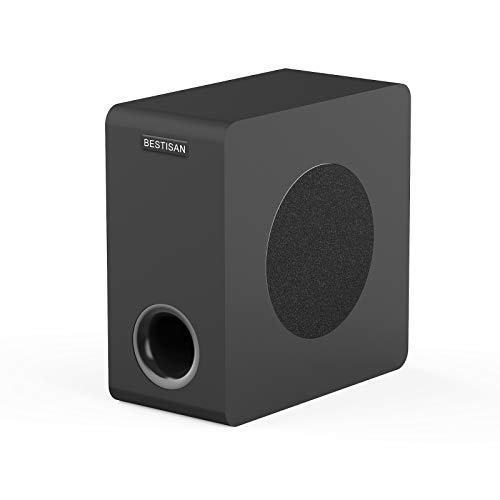
Best Connectivity on a Budget – BESTISAN SW65D
The BESTISAN SW65D is a flexible option for subwoofers for small rooms when you need several ways to connect. Its 6.5-inch side-firing woofer, compact wood cabinet, and RCA, AUX, LFE, and high-level speaker connections make it suitable for upgrading TVs, soundbars, receivers, and bookshelf speakers.
Best For: Buyers who need broad wired compatibility and a compact subwoofer for a mixed home-audio setup.
Pros:
- Offers RCA, 3.5mm AUX, LFE, and high-level speaker inputs and outputs.
- Side-firing 6.5-inch woofer and bottom-ported cabinet are designed for deep, tight bass.
- The 6.3-inch-wide cabinet can be easier to place than larger subwoofers.
- Works with TVs, home theater systems, soundbars, and bookshelf speakers.
Cons:
- It is a wired subwoofer, so placement is limited by cable routing.
- The listed frequency response is 40 Hz, so it may not reach as deeply as some alternatives.
- The manufacturer recommends pairing it with devices outputting no more than 850 mV for stable operation.
The SW65D makes the most sense when connection flexibility is a priority. Its compact width and multiple inputs can simplify integration, but confirm your source’s output level and available cables before buying.
Best Studio Pick – PreSonus Eris Sub 8BT
For shoppers comparing subwoofers for small rooms, the PreSonus Eris Sub 8BT offers a compact 8-inch design with accurate low end, flexible connections, and room-tuning controls. Its Bluetooth 5.0 support also makes it convenient for music listening and multimedia use.
Best For: Small-room studio monitoring, music production, and hi-fi listening.
Pros:
- Compact 8-inch enclosure reaches down to 30 Hz.
- Bluetooth 5.0 plus balanced TRS, RCA, and front-panel aux inputs.
- Highpass, lowpass, and frequency controls help tailor performance to the room.
- Front headphone output and automatic power-saving mode add convenience.
Cons:
- Its studio-focused features may be more than casual TV users need.
- It is a wired floor-standing unit despite Bluetooth audio input.
The Eris Sub 8BT is a particularly flexible choice when precise bass integration matters. It suits compact desktop or studio setups better than buyers seeking a dedicated wireless home-theater subwoofer.
Best Compact Home Theater Value – Rockville Rock Shaker 6.5
The Rockville Rock Shaker 6.5 is a practical option among subwoofers for small rooms, pairing a compact cabinet with 100 watts RMS and a 6.5-inch woofer. Adjustable crossover and phase controls help it integrate with a variety of home audio systems.
Best For: Compact home-theater, gaming, and music setups using RCA or speaker-level connections.
Pros:
- Compact black cabinet is designed to fit smaller spaces.
- 100 watts RMS and 200 watts peak provide substantial bass output.
- RCA and speaker-level inputs and outputs support flexible installation.
- Adjustable crossover and phase controls help customize integration.
Cons:
- No wireless connectivity is listed.
- The 6.5-inch driver may not deliver the same scale as larger subwoofers.
With its straightforward wired connectivity and compact form, the Rock Shaker 6.5 is well suited to buyers who want stronger movie, music, or gaming bass without a large cabinet. Its setup is especially useful when a receiver offers speaker-level connections.
Best Easy-Setup Down-Firing Option – BESTISAN SW65C Powered Subwoofer
The BESTISAN SW65C is a compact powered subwoofer for small rooms that uses a down-firing 8-inch driver to spread bass across the floor. Multiple wired inputs, including RCA, LFE, aux, and high-level speaker connections, make it adaptable to TVs, soundbars, bookshelf speakers, and receivers.
Best For: Small-room TV, soundbar, stereo, and home-theater systems needing an uncomplicated bass upgrade.
Pros:
- Down-firing design delivers room-filling low frequencies from a compact footprint.
- RCA, LFE, aux, and high-level speaker inputs and outputs support broad compatibility.
- Coaxial cable is included for a quicker setup.
- Remote control offers convenient operation.
Cons:
- It requires separate main speakers or a soundbar for full-range audio.
- The manufacturer recommends line-level signals of 850 mV or less and cautions against direct connection to high-power amplifiers.
- Wireless connectivity is not listed.
The SW65C makes sense when connection flexibility and easy integration are more important than advanced studio controls. Its down-firing layout and modest footprint are useful for adding bass in a compact living room or entertainment area.
How We Picked the Best Subwoofers for Small Rooms
We focused on powered subwoofers with compact or relatively space-conscious cabinets, since small rooms have less room for placement and are more vulnerable to boomy bass. The lineup includes models for televisions, home theaters, stereo systems, desktop speakers, and wireless ecosystems.
Our comparison emphasizes practical specifications: woofer size, amplifier power, frequency range, connection options, automatic standby features, wireless compatibility, and ease of integration. A larger driver is not automatically better in a small room; usable control and flexible placement often matter more than maximum output.
Quick Comparison
| Best For | Look For | Recommended Type |
|---|---|---|
| TV and compact living rooms | Simple setup and controlled output | Small powered subwoofer |
| Home theater | Low-frequency extension and adjustable crossover | 8- to 12-inch powered model |
| Desktop music or studio monitors | Balanced response and convenient connectivity | Compact studio subwoofer |
| Minimal-cable systems | Wireless ecosystem compatibility | Dedicated wireless subwoofer |
| Budget upgrades | RCA or speaker-level integration | Affordable powered subwoofer |
Key Buying Factors for Subwoofers for Small Rooms
Size and Output
Six- to eight-inch models are often easier to blend in bedrooms, offices, apartments, and smaller living rooms. Ten- and 12-inch subwoofers can deliver greater impact, but they may require more careful placement and volume adjustment. Prioritize clean, controlled bass over the highest advertised wattage.
Connections and Compatibility
Check whether your receiver, soundbar, speakers, or TV provides a compatible subwoofer output. RCA and LFE inputs are common in home theater systems, while some desktop and stereo setups use line-level or speaker-level connections. Wireless models are convenient, but they may only work within a specific brand ecosystem.
Placement and Controls
Place the subwoofer near the front of the room to start, then test different locations for smoother bass. Adjustable crossover, phase, and volume controls make blending easier. Down-firing designs can be practical, but flooring and nearby furniture still affect the result. Leave ventilation space and avoid hiding the cabinet inside closed furniture.
Room and Listening Priorities
For music, look for tight response and easy crossover adjustment. For films and games, deeper extension and higher output may be more valuable. In a very small room, room gain can make bass sound louder than expected, so a model with moderate output may perform better than an oversized unit.
Who Should Buy Which Subwoofers for Small Rooms?
Choose the Audioengine, Sonos, or another ecosystem-focused model if simple integration and a clean setup are your top priorities. These are especially appealing when you already own compatible wireless speakers or sound equipment.
Choose an eight- to 12-inch Klipsch or Yamaha model for a conventional home-theater or stereo system that needs stronger movie effects and music weight. Confirm cabinet dimensions before buying.
Choose a compact Bestisan, Littoak, or Rockville model when you want an affordable powered upgrade for a small TV, speaker system, or apartment setup. Verify the available inputs first.
Choose the PreSonus Eris Sub 8 for a desktop or studio-monitor system where controlled bass and nearfield listening are more important than room-filling volume.