Choosing accurate monitors is one of the most important decisions in a recording setup. The right pair can reveal tonal balance, dynamics, and placement problems before they reach your final mix.
We compared 10 popular near-field options from JBL, Yamaha, PreSonus, and Edifier, covering compact desktop speakers, versatile 5-inch models, and larger monitors for more demanding rooms.
Best 10 Studio Monitors with Flat Response Picks for 2026
Wide-Sweet-Spot Accuracy

- Wide Image Control Waveguide sweet spot
- Dual 41-watt Class-D amplification
- Boundary EQ and HF Trim controls
Best For: Music production, podcasting, and compact studios
Uncolored Monitoring

- Emphasizes sonic purity without coloration
- 54 Hz to 30 kHz stated frequency response
- 70-watt bi-amplified design
Best For: Music production and neutral studio monitoring
Flexible Nearfield Control
- 80-watt Class AB bi-amplification
- Acoustic tuning controls for room matching
- XLR, TRS, and RCA inputs
Best For: Home studios and flexible nearfield monitoring
Fuller Low-End Monitoring

- 8-inch woofers for greater low-end reach
- Room response controls for placement flexibility
- Low-resonance enclosure and quieter port design
Best For: Recording, mixing, and larger studio spaces
Wide-Sweet-Spot Pick

- 6.55-inch woofer and 1.25-inch silk-dome tweeter
- Wide EBM waveguide for broad listening coverage
- Multiple acoustic controls for room tuning
Best For: Home studios needing wide coverage and flexible acoustic adjustment
Compact Pair Pick

- Pair of compact 4.5-inch powered monitors
- 60 Hz–22 kHz frequency response at -10 dB
- Room-control and high-trim settings included
Best For: Small desktop production and editing setups
Budget Near-Flat Pick
- Near-flat response tuned for music creators
- 4-inch woofers with 1-inch silk-dome tweeters
- Monitor and music modes with flexible inputs
Best For: Entry-level desktop production and mixed-use listening
Compact Balanced Pick

- 4.5-inch woofer and 1-inch silk-dome tweeter
- 50W Class AB amplification with room-tuning controls
- TRS, RCA, auxiliary, and headphone connections
Best For: Compact home studios and desktop monitoring
Feature-Rich Flat-Tuning Pick

- 80W RMS with bi-amped DSP and 50Hz–40kHz response
- Room compensation, low-cut control, and nine-band app EQ
- Balanced XLR/TRS, Bluetooth 6.0, RCA, and AUX inputs
Best For: Flexible nearfield monitoring and high-resolution listening
Large Nearfield Reference
- 8-inch woofer and 1-inch tweeter for fuller nearfield output
- Boundary EQ helps maintain neutral bass near walls or desks
- Balanced XLR and 1/4-inch TRS inputs
Best For: Larger studios and production setups needing stronger bass
Wide-Sweet-Spot Accuracy – JBL 305P MkII Pair
The JBL 305P MkII pair is a practical choice for creators seeking studio monitors with flat response characteristics and clear stereo imaging. Its Image Control Waveguide is designed to provide a wide sweet spot, while Boundary EQ and HF Trim help adapt the sound to the room.
Best For: Music production, podcasting, vlog work, and cinematic sound design in compact studios.
Pros:
- Image Control Waveguide supports precise imaging and a wide listening area.
- Dual 41-watt Class-D amplification and 5-inch woofers provide useful headroom and bass extension.
- Boundary EQ and HF Trim offer practical room-adjustment options.
- XLR and 1/4-inch TRS inputs support balanced studio connections.
Cons:
- Five-inch woofers may provide less low-end impact than larger monitors.
- The supplied details list a wired, tabletop-oriented setup rather than wireless operation.
Choose this pair when accurate monitoring, broad imaging, and flexible placement controls matter more than maximum low-frequency output. It is a well-rounded nearfield option for smaller production and content-creation spaces.
Uncolored Monitoring – Yamaha HS5 Pair
The Yamaha HS5 pair is aimed at listeners who want studio monitors with flat response characteristics and a monitoring presentation that avoids deliberate coloration. Bi-amplification, a 5-inch woofer, and a 1-inch dome tweeter create a focused nearfield setup for music work.
Best For: Music production and studio monitoring where sonic neutrality is the priority.
Pros:
- Designed to emphasize sonic purity without coloring or altering the original sound.
- 54 Hz to 30 kHz frequency response covers a broad monitoring range.
- Bi-amped 70-watt system provides dedicated power for the woofer and tweeter.
- XLR and TRS inputs accept balanced or unbalanced signals.
Cons:
- The 5-inch woofer may not satisfy users seeking especially deep bass.
- The supplied specifications describe a corded setup without wireless audio functionality.
The HS5 is a sensible pick for mix-focused work when a straightforward, uncolored presentation is more important than a large bass footprint. Its input options also make it easy to integrate with common studio equipment.
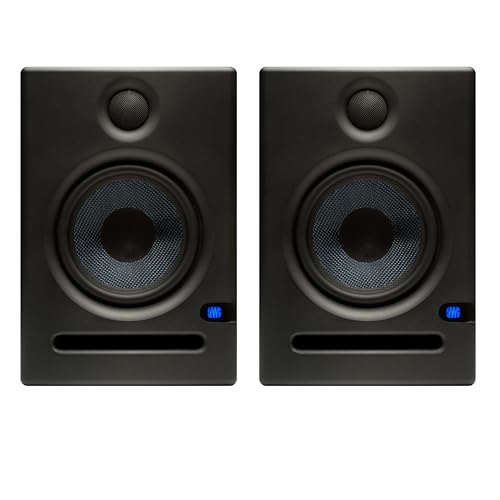
Flexible Nearfield Control – PreSonus Eris E5 Pair
The PreSonus Eris E5 pair combines nearfield clarity with acoustic tuning controls, making it a useful option for shoppers comparing studio monitors with flat response characteristics. Its 5.25-inch woven composite woofer, silk-dome tweeter, and front-firing port are designed for balanced monitoring and controlled low-end reproduction.
Best For: Home studios and professional monitoring setups that need flexible connections and room contouring.
Pros:
- 80-watt Class AB bi-amplification provides volume and headroom.
- Woven composite woofer is designed for solid low-end sound with minimal bass distortion.
- Acoustic tuning controls help tailor the monitors to the mixing environment.
- XLR, 1/4-inch TRS, and RCA inputs accommodate balanced and unbalanced sources.
Cons:
- These are still compact nearfield monitors, so they may not replace a larger system for very deep bass.
- The supplied warranty is two years, shorter than some competing options may offer.
Consider the Eris E5 when connection flexibility and room adjustment are as important as a balanced monitoring presentation. Protection features and a stated 102 dB maximum continuous SPL add practical value for regular studio use.
Fuller Low-End Monitoring – Yamaha HS8 Pair
The Yamaha HS8 pair is designed for larger monitoring spaces and listeners seeking studio monitors with flat response characteristics across a wider bandwidth. Its 8-inch woofer, low-resonance enclosure, and response controls target accurate reproduction while providing more low-end capability than smaller nearfield models.
Best For: Studio recording, audio mixing, and music production where an 8-inch monitor is appropriate.
Pros:
- Newly developed transducers are designed for a smooth response over a wide bandwidth.
- 8-inch woofers offer fuller low-frequency reproduction than the smaller models here.
- Room response controls help adapt the monitors to different acoustic environments.
- Low-resonance enclosure and noise-reduction port design support clearer reproduction.
Cons:
- The larger cabinets require more space and careful placement than 5-inch monitors.
- The supplied pair weighs 56 pounds, making repositioning less convenient.
- The available specifications identify corded connectivity rather than wireless operation.
The HS8 is the strongest fit here for producers who need more low-end reach and have enough room for larger monitors. Its enclosure and port design focus on reducing unwanted resonance and noise rather than adding coloration.
Wide-Sweet-Spot Pick – PreSonus Eris E7 XT
PreSonus Eris E7 XT 2-Way Active Studio Monitor with EBM Waveguide (Pack of 1)
Check Price On AmazonThe PreSonus Eris E7 XT is a strong choice for creators seeking studio monitors with flat response and a broad listening area. Its 6.55-inch woofer, silk-dome tweeter, and EBM waveguide are paired with multiple acoustic controls for adapting the monitor to your room.
Best For: Home studios, mixing setups, and listeners who need a wide sweet spot with flexible room-tuning controls.
Pros:
- 6.55-inch woven-composite woofer supports deep lows.
- 100° horizontal by 60° vertical waveguide provides a wide sweet spot and solid imaging.
- Level, high-pass, low-frequency, high-frequency, and acoustic-space controls help tailor the sound.
- Includes Studio One Prime and Studio Magic plug-in software.
Cons:
- Sold as a single monitor, so a stereo setup requires two units.
- Larger than the compact models in this roundup.
Choose the Eris E7 XT when room adjustment and broad, consistent monitoring matter more than minimizing desk space. Its connectivity includes RCA, TRS, and XLR inputs.
Compact Pair Pick – Yamaha HS4
The Yamaha HS4 is a compact pair of studio monitors for creators who want studio monitors with flat response in a smaller workspace. The 4.5-inch woofer and 1-inch dome tweeter cover 60 Hz to 22 kHz at -10 dB, while room-control and high-trim settings help refine placement.
Best For: Desktop music production, video editing, and compact stereo workstations.
Pros:
- Includes two speakers for a ready-made stereo setup.
- Compact 4.5-inch woofer design suits tabletop mounting.
- Offers room-control and high-trim response controls.
- Accepts XLR/TRS combo, RCA, and stereo-mini inputs.
Cons:
- 26-watt output is more limited than larger monitors.
- Smaller woofer may provide less low-end reach than larger models.
The HS4 is a practical fit when desk space and included stereo pairing are priorities. Its included cables and anti-slip pads also simplify setup with compatible sources.
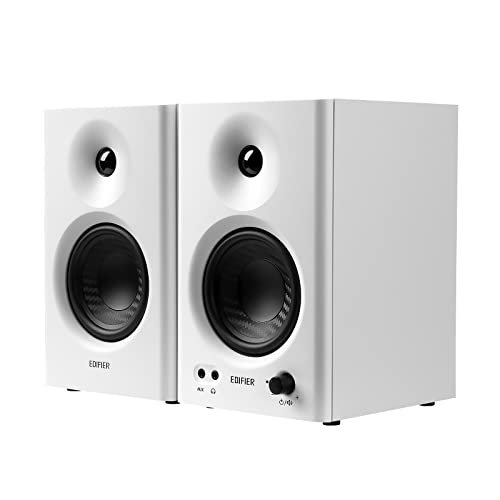
Budget Near-Flat Pick – Edifier MR4
The Edifier MR4 is designed for creators seeking studio monitors with flat response at an accessible, compact size. Its professionally tuned near-flat response, 4-inch composite woofers, and 1-inch silk-dome tweeters support production work, while the dual monitor and music modes add everyday flexibility.
Best For: Entry-level creators, computer-based production, and users who want one speaker system for monitoring and casual listening.
Pros:
- Near-flat response is professionally tuned for artists and music creators.
- 4-inch composite woofers and silk-dome tweeters provide clear, smooth sound.
- Balanced TRS, RCA, AUX, and front headphone connections support varied sources.
- Separate high- and low-frequency controls plus monitor and music modes add flexibility.
Cons:
- 4-inch woofers offer less low-frequency scale than larger monitors.
- Listed signal-to-noise ratio is 85 dB.
The MR4 stands out for a flexible desktop setup that can switch between production monitoring and relaxed listening. Its MDF structure is intended to reduce resonance, and the front controls keep adjustments convenient.
Compact Balanced Pick – PreSonus Eris E4.5
The PreSonus Eris E4.5 is a practical choice if you want studio monitors with flat response characteristics in a compact desktop-friendly format. Its 4.5-inch woven-composite woofer, silk-dome tweeter, room-tuning controls, and 50 watts of Class AB amplification make it suitable for production, reference listening, and multimedia use.
Best For: Home studios, desktop production, and listeners who need flexible wired connections in a small footprint.
Pros:
- High- and low-frequency controls help compensate for room placement and speaker orientation.
- Balanced TRS, RCA, and front-panel auxiliary inputs support professional and consumer sources.
- Wide listening sweet spot and front headphone output add everyday convenience.
- Compact cabinet delivers 50 watts of dual amplification.
Cons:
- The 4.5-inch woofer may not provide the low-end extension of a larger monitor.
- The pair includes one active and one passive speaker, so placement requires speaker-to-speaker wiring.
The Eris E4.5 stands out as an accessible near-field option for smaller rooms and desks. Its tuning controls make it easier to maintain a balanced reference sound when your setup is less than ideal.
Feature-Rich Flat-Tuning Pick – Edifier MR4.5
The Edifier MR4.5 is designed for listeners seeking studio monitors with flat response and extensive adjustment options. It combines 80 watts RMS, bi-amped DSP processing, a stated 50Hz–40kHz response, and controls for room placement, desktop surfaces, and custom EQ.
Best For: Nearfield monitoring, mixing, mastering, and high-fidelity listening where connectivity and room correction matter.
Pros:
- Bi-amped active crossover and 24-bit/96kHz DSP support transparent playback.
- Independent high and low controls, low-cut settings, and acoustic-space adjustment aid room integration.
- Balanced XLR and TRS, RCA, AUX, Bluetooth 6.0, and a front headphone jack provide broad connectivity.
- App-based nine-band EQ offers additional customization.
Cons:
- The larger feature set may be more than casual listeners need.
- Its 4.5-inch mid-bass drivers are still limited compared with larger monitors for deep bass.
The MR4.5 is the most adjustable option in this group. Its calibration controls and varied inputs make it especially useful when a monitor must serve both production and general listening duties.
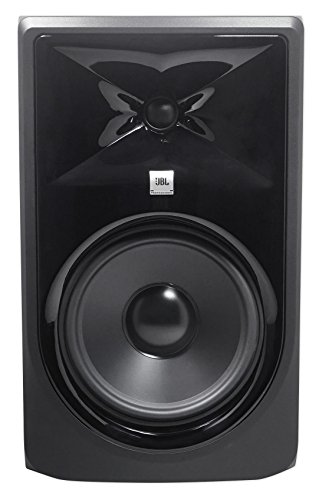
Large Nearfield Reference – JBL 308P MkII
The JBL 308P MkII is a larger near-field monitor for buyers who want studio monitors with flat response and more substantial low-frequency capability. Its 8-inch woofer, 1-inch tweeter, Slip Stream port, and boundary EQ are aimed at accurate, room-aware monitoring for music production and pro audio.
Best For: Larger desks, home or project studios, and producers who need stronger bass output from a professional active monitor.
Pros:
- 8-inch woofer provides more low-end authority than the smaller monitors in this roundup.
- Boundary EQ helps restore neutral low-frequency response near walls or on work surfaces.
- Balanced XLR and 1/4-inch TRS inputs support studio-oriented connections.
- Updated transducers are designed for improved transient response, bass, and lower harmonic distortion.
Cons:
- Sold individually, so a stereo setup requires purchasing two monitors.
- The larger cabinet needs more desk or stand space than compact 4.5-inch models.
- It offers fewer connection types than the Edifier, with no supplied wireless feature noted.
The 308P MkII is the strongest fit when scale and bass matter more than compactness. Its boundary EQ adds useful flexibility, but buyers should plan for the space and budget required for a pair.
How We Picked These Studio Monitors with Flat Response
We focused on powered near-field monitors designed for music production, mixing, editing, and critical listening. The selection includes compact models for desks and bedrooms, as well as larger speakers with more headroom and low-frequency extension. We considered driver size, amplifier design, input flexibility, room-control features, stereo pairing, and overall suitability for untreated or moderately treated rooms.
A truly flat response is difficult to achieve in any room, so placement and acoustics matter as much as the speaker specification. These models are best viewed as practical tools for minimizing coloration and making reliable mix decisions.
Quick Comparison
| Best For | Recommended Options | Typical Size |
|---|---|---|
| Small desks and compact rooms | Yamaha HS4, PreSonus Eris E4.5, Edifier MR4 | 4–4.5 inches |
| Balanced home-studio monitoring | JBL 305P MkII, Yamaha HS5, PreSonus Eris E5 | 5–5.25 inches |
| More bass and headroom | Yamaha HS8, JBL 308P MkII, PreSonus Eris E7 XT | 7–8 inches |
| Desktop listening with extra output | Edifier MR4.5 | 4.5 inches |
Key Buying Factors for Studio Monitors with Flat Response
Driver Size and Room Dimensions
Larger woofers generally provide deeper bass and higher output, but they can overload a small room and make placement more difficult. Four- and five-inch monitors are usually easier to integrate in bedrooms, offices, and compact project studios. Seven- and eight-inch models are better suited to larger rooms with sensible acoustic treatment.
Connectivity and Controls
Check whether the monitor offers balanced TRS or XLR inputs, unbalanced RCA inputs, or a combination. Balanced connections help reduce noise over longer cable runs. High- and low-frequency controls can also help compensate for boundary effects, although they cannot replace proper speaker placement.
Placement and Acoustic Response
Place each monitor at ear height, form an approximate equilateral triangle with your listening position, and aim the tweeters toward your ears. Keep the speakers away from walls when possible, and use isolation pads or stands to reduce desk vibration. Treat prominent reflections before relying heavily on EQ adjustments.
Power, Detail, and Listening Distance
Near-field monitors are intended for relatively close listening. Choose enough output for clean peaks without running the amplifier near its limits, but do not assume more power automatically means greater accuracy. A controlled, intelligible midrange is often more valuable than maximum volume.
Who Should Buy Which Studio Monitors with Flat Response?
Choose the Yamaha HS4, PreSonus Eris E4.5, or Edifier MR4 for a compact desk setup, casual production, podcast editing, or a small room. Choose the JBL 305P MkII, Yamaha HS5, or PreSonus Eris E5 if you want a strong all-purpose starting point for mixing and recording. Choose the Yamaha HS8, JBL 308P MkII, or PreSonus Eris E7 XT when you have more space, need greater bass extension, or work at higher monitoring levels. The Edifier MR4.5 is a practical middle ground for users who want desktop-friendly speakers with more output than entry-level compact pairs.