The best semi-modular synthesizers combine hands-on sound design with the flexibility of patch cables, giving musicians a faster way to explore subtractive synthesis, sequencing, modulation, and experimental textures.
This roundup compares 10 standout options across analog, hybrid, percussion, polyrhythmic, and performance-focused designs. Use the guide below to match features, workflow, and budget to the way you plan to create.
Best 10 Semi Modular Synthesizers Picks for 2026
Budget Analog Explorer

- Pure analog VCO, VCF, and VCA signal path
- Ladder filter with resonance and low/high-pass modes
- Compact design with a 32-step sequencer
Best For: Beginners and compact analog setups
Expandable Classic

- Analog Moog voice with ladder filter and external input
- 32-note sequencer with up to 64 sequences
- Tabletop or 60HP Eurorack operation
Best For: Growing modular and Eurorack systems
Hybrid Sound Lab

- 24 digital oscillators and 14 synth engines
- 10 percussion/noise engines plus analog ladder filter
- 32-step sequencer and LFO for movement
Best For: Versatile hybrid synthesis and percussion
Keyboard Performance Hub

- 32 velocity-sensitive keys with arpeggiator and sequencer
- Built-in spring reverb for synth and external audio
- 41 patch points plus MIDI and USB connectivity
Best For: Live keyboard performance and modular integration
Compact Patch-Ready Choice

- 40HP semi-modular analog design
- Eurorack compatible
- MIDI, LFO, and envelope generator
Best For: Beginners and compact Eurorack setups
Polyrhythmic Exploration Pick

- Two VCOs with subharmonic generators
- Four rhythm generators and two sequencers
- Tabletop or 60HP Eurorack use
Best For: Experimental rhythm and sound design
Full-Panel Patching Value

- Two VCO analog architecture
- 48 patch points
- Step sequencer and arpeggiator
Best For: Hands-on patching and performance setups
Classic Analog Explorer

- Build-it-yourself 100% analog MOOG design
- 44HP format with two oscillators and wavefolder
- Standalone use plus Eurorack integration
Best For: DIY musicians and compact Eurorack setups
Percussive Patch Machine
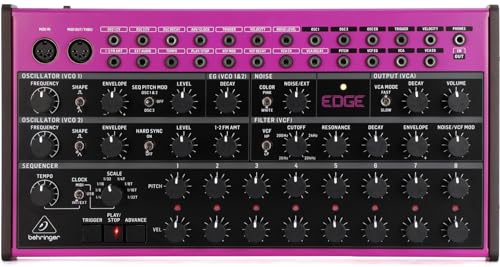
- Analog synthesizer built for gritty percussion
- 15-by-10 I/O patch matrix
- Dual 8-step sequencers with white and pink noise
Best For: Rhythm-focused electronic setups
Generative Sound Lab

- Dual generative eight-step sequencers
- Wavefolder, ring modulation, and morphing filter
- 32-jack patch bay with 20 inputs and 12 outputs
Best For: Experimental sequences and evolving sound design
Budget Analog Explorer – Behringer CRAVE
The Behringer CRAVE is a compact choice for shoppers seeking semi modular synthesizers with a straightforward analog signal path. Its 3340-style VCO, dual waveform options, ladder filter, and 32-step sequencer cover classic monophonic-style sound design in a small metal-and-plastic unit.
Best For: Beginners and producers wanting an affordable, compact analog synth for basses, leads, and hands-on sequencing.
Pros:
- Pure analog signal path with VCO, VCF, and VCA designs.
- Pulse and sawtooth oscillator outputs provide useful core waveforms.
- Classic 24 dB ladder filter includes resonance and switchable low/high-pass modes.
- 32-step sequencer supports pattern-based performance.
Cons:
- Its compact 2.5mm-jack format may require extra attention when connecting gear.
- The supplied notes do not list a built-in keyboard.
The CRAVE focuses on essential analog synthesis rather than a large feature set. It is a practical starting point for exploring semi-modular workflows, especially when size and classic filter character matter.
Expandable Classic – MOOG Mother-32
The MOOG Mother-32 is a flexible option among semi modular synthesizers, combining a warm analog voice with a 32-note step sequencer and an extended patchbay. It can work as a tabletop instrument or as a 60HP Eurorack module, giving a setup room to grow.
Best For: Synthesists who want authentic Moog character now and a clear path toward Eurorack expansion later.
Pros:
- Analog VCO, white-noise generator, Moog ladder filter, and external audio input.
- Sequencer offers two modes and up to 64 onboard sequences.
- Can be used standalone or installed in a 60HP Eurorack system.
- Multiple Mother-32 units can be combined for expanded sound design.
Cons:
- It is a single-count, tabletop/module-focused instrument rather than a keyboard synth.
- Its broader patching and expansion options may be more than a simple plug-and-play setup requires.
Mother-32 makes a strong long-term choice for buyers who value a recognizable analog voice and modular compatibility. The included patch cables and flexible format support both immediate use and deeper experimentation.
Hybrid Sound Lab – Behringer Grind
The Behringer Grind takes a broader approach to semi modular synthesizers by combining digital sound sources with analog filtering. Its 24 digital oscillators, 10 percussion/noise engines, 14 synth engines, LFO, and 32-step sequencer offer a varied platform for sound creation.
Best For: Producers who want multiple digital synthesis engines and percussion-focused possibilities alongside an analog ladder filter.
Pros:
- Hybrid architecture pairs digital oscillators and engines with an analog ladder filter.
- Includes 24 digital oscillators and 14 synth engines for varied timbres.
- Ten percussion/noise engines broaden rhythmic and textural use.
- Built-in LFO and 32-step sequencer support motion and pattern creation.
Cons:
- Its hybrid architecture may not suit buyers seeking an entirely analog signal path.
- The supplied notes do not specify a built-in keyboard.
- The larger 16.6-inch-wide format is less compact than the CRAVE.
Grind is the most engine-rich option in this group. Choose it when variety, percussion sounds, and digital synthesis are more important than a strictly vintage analog design.
Keyboard Performance Hub – MOOG Grandmother
The MOOG Grandmother is a performance-oriented entry in semi modular synthesizers, adding a 32-key velocity-sensitive keyboard, arpeggiator, sequencer, and spring reverb to its analog architecture. Its 41 patch points also make it suitable for connecting with other Moog or Eurorack equipment.
Best For: Keyboard players and live performers who want hands-on analog synthesis, built-in effects, and extensive patching.
Pros:
- Includes 32 velocity-sensitive full-size keys, arpeggiator, and sequencer.
- Hardware spring reverb can process the synth or external sounds.
- Provides 41 modular patch points for extensive analog interconnectivity.
- Offers MIDI DIN, USB MIDI, external audio input, and TRS audio output.
Cons:
- At 22.99 inches wide and 7.25 kg, it is less portable than compact desktop units.
- Its monophonic design is not intended for conventional polyphonic keyboard parts.
- The broader patching system may feel complex for users seeking a minimal setup.
Grandmother is the strongest all-in-one performance choice here, especially if you want keys and spring reverb without giving up modular connectivity. It also serves as a capable voice in a larger Moog or Eurorack system.
Compact Patch-Ready Choice – East Beast
The Cre8audio East Beast is a practical entry point into semi modular synthesizers, combining an East Coast-style analog voice with a 40HP format and Eurorack compatibility. Its envelope generator, MIDI, LFO, and included patch cables make it ready for hands-on experimentation without requiring a large setup.
Best For: Beginners and compact Eurorack users who want a straightforward analog semi-modular synth with MIDI control.
Pros:
- 40HP semi-modular format with Eurorack compatibility.
- Includes a multi-mode filter, envelope generator, and LFO.
- Supports MIDI and includes MIDI adapter pigtails and patch cables.
- Metal body and relatively light 2.1-pound weight.
Cons:
- Its 40HP format offers less panel space than larger semi-modular instruments.
- The one-year limited warranty is shorter than some buyers may prefer.
The East Beast is a well-rounded choice when portability, basic patching, and Eurorack integration matter more than an expansive control surface. It offers a focused way to explore semi-modular synthesis while retaining MIDI connectivity for a broader setup.
Polyrhythmic Exploration Pick – Moog Subharmonicon
The Moog Subharmonicon stands out among semi modular synthesizers for its unusual focus on subharmonics and evolving polyrhythms. Two VCOs with subharmonic generators, four rhythm generators, and two four-step sequencers provide a deep platform for experimental performance and sound design.
Best For: Experimental musicians and synthesists who want rich harmonic textures, generative-feeling rhythms, and extensive patching options.
Pros:
- Six tonal sources from two VCOs and four subharmonic generators.
- Four rhythm generators can drive either sequencer or both.
- Two four-step sequencers support unconventional polyrhythms.
- Can operate as a tabletop instrument or a 60HP Eurorack module.
Cons:
- Its specialized rhythmic and subharmonic architecture may be less immediate for beginners.
- The 60HP format requires more Eurorack space than compact alternatives.
- Its plastic body may not appeal to buyers seeking an all-metal enclosure.
The Subharmonicon is a distinctive choice for players who want semi-modular synthesis to generate complex relationships between pitch and rhythm. Its expansion options with compatible Moog instruments add flexibility for growing systems.
Full-Panel Patching Value – Behringer Model 15
The Behringer Model 15 is a practical semi modular synthesizer for buyers who want a larger analog instrument with plenty of routing potential. Its two VCOs, 48 patch points, built-in step sequencer, arpeggiator, and headphone output cover core sound-design and performance needs.
Best For: Musicians seeking a larger semi-modular analog setup with sequencing, arpeggiation, and extensive patch access.
Pros:
- Two VCOs provide an analog sound source foundation.
- Offers 48 patch points for hands-on signal routing.
- Includes a step sequencer and arpeggiator for performance use.
- Provides a headphone output for more direct monitoring.
Cons:
- Its 21.35-inch width takes more space than compact semi-modular units.
- At approximately 2,400 grams, it is less portable than lighter designs.
- The supplied notes do not specify Eurorack compatibility.
The Model 15 makes sense for users who prioritize a roomy interface and broad patching access. It is especially appealing when built-in sequencing and headphone monitoring are more important than minimizing footprint.
Classic Analog Explorer – MOOG Mavis
The MOOG Mavis is a compact semi modular synthesizer for players who want classic analog circuitry, hands-on patching, and a build-it-yourself experience. Its 44HP format combines two oscillators, a ladder filter, wavefolder, full ADSR, sample and hold, and a built-in keyboard in one approachable instrument.
Best For: DIY-minded musicians and Eurorack users seeking a compact MOOG voice with flexible patching.
Pros:
- 100% analog design with MOOG oscillator and ladder-filter circuits.
- Includes wavefolding, two oscillators, ADSR, sample and hold, mixer, attenuators, and mults.
- Can operate standalone or integrate with Eurorack systems after removal from its case.
- Includes assembly tools, patch cables, power supply, calibration tool, and dust cover.
Cons:
- Assembly is required before use.
- The compact 44HP format may feel limiting for users wanting a larger control surface.
Mavis is a strong choice when analog character and patching flexibility matter more than a ready-to-play desktop workflow. The included kit and built-in keyboard make it unusually complete, while Eurorack compatibility leaves room to expand.
Percussive Patch Machine – Behringer Edge
The Behringer Edge is a semi modular synthesizer focused on gritty, analog percussion. Its 15-by-10 I/O patch matrix supports hands-on experimentation, while dual 8-step sequencers, noise sources, and an envelope generator provide tools for building rhythmic patterns and textured hits.
Best For: Electronic musicians who want a dedicated analog percussion voice with sequencing and extensive patch access.
Pros:
- Analog, gritty, percussive sound profile.
- Large 15-by-10 I/O patch matrix encourages flexible signal routing.
- Includes two 8-step sequencers, white and pink noise, and an envelope generator.
- Includes power adapter and patch cables.
Cons:
- Its percussion-focused design is less suited to general-purpose melodic synthesis.
- The supplied notes provide limited detail about its external connectivity beyond USB Type-B.
Edge makes the most sense as a rhythm-centered addition to a hardware setup. Choose it when percussive tone, patch-matrix routing, and compact sequencer features are higher priorities than broad instrument coverage.
Generative Sound Lab – MOOG Labyrinth
The MOOG Labyrinth is a semi modular synthesizer for evolving, experimental sequences and richly colored textures. Its dual low-harmonic oscillators, wavefolder, ring modulation, variable-tone noise generator, state-variable filter, and 32-jack patch bay support deep sound shaping and generative performance.
Best For: Sound designers and electronic performers who want evolving sequences, unusual timbres, and extensive analog patching.
Pros:
- Dual generative eight-step sequencers include controls for sequences that change over time.
- Offers metallic FM, wavefolding, ring modulation, and variable-tone noise.
- Includes a voltage-controlled wavefolder and morphing lowpass/bandpass filter.
- Comprehensive patch bay provides 20 inputs and 12 outputs.
Cons:
- Its exploratory, generative design may be less direct for traditional keyboard-style playing.
- The supplied notes do not list a built-in keyboard.
Labyrinth is a compelling pick for users who want a semi modular synthesizer that can generate motion and unpredictability without requiring a large modular system. Its signal-routing options and unusual tone-shaping tools reward experimentation.
How We Picked the Best Semi Modular Synthesizers
We selected instruments with meaningful semi-modular routing, distinctive sound-generation features, and practical value for musicians at different experience levels. The list includes compact desktop synths, keyboard-equipped instruments, percussion-focused designs, and experimental systems. We also considered patch-point access, built-in sequencing, modulation options, playability, expandability, and whether each synthesizer has a clear use case rather than simply adding more controls.
Because these instruments vary considerably, the “best” choice depends on your workflow. A beginner may prioritize an approachable signal path, while an experienced performer may value multiple sequencers, unusual timing systems, or compatibility with Eurorack gear.
Quick Comparison
| Best For | What to Prioritize | Strong Matches |
|---|---|---|
| First semi-modular synth | Clear layout, normalled routing, accessible controls | Behringer CRAVE, Cre8audio East Beast, Moog Mavis |
| Keyboard performance | Integrated keys, expressive modulation, playable sequencing | Moog Grandmother |
| Classic analog bass and leads | Reliable oscillator, ladder filter, hands-on patching | Moog Mother-32, Behringer Model 15 |
| Experimental composition | Polyrhythms, unusual modulation, flexible routing | Moog Subharmonicon, Moog Labyrinth |
| Percussion and rhythm design | Dedicated trigger paths and timbral movement | Behringer Edge |
| Broad sound exploration | Multiple engines, digital flexibility, patch memory or variety | Behringer Grind |
Key Buying Factors for Semi-Modular Synthesizers
Signal Path and Sound Engine
Analog oscillators and filters often deliver familiar bass, lead, and sequence tones, while hybrid or multi-engine designs can provide a wider palette. Consider whether you want immediate classic synthesis or greater access to digital textures and alternate voices.
Patch Points and Expandability
Patch connectivity is central to the semi-modular experience. Check the number and type of inputs and outputs, the included patch cables, and compatibility with your existing equipment. A synth can be semi-modular without offering the depth needed for a larger modular setup.
Sequencing and Performance Controls
Look for the features that match your playing style: onboard patterns, step sequencing, clock division, trigger inputs, arpeggiation, or a keyboard. A compact desktop model may be ideal for studio sequencing, while a keyboard instrument can be better for live melodic performance.
Size, Connectivity, and Setup
Confirm the instrument’s footprint, power requirements, MIDI or USB connections, and audio outputs before buying. Smaller units are easier to integrate, but larger layouts may be more comfortable for patching and performance. If you use Eurorack, verify signal standards and mounting requirements rather than assuming compatibility.
Who Should Buy Which Semi Modular Synthesizers?
Choose the Behringer CRAVE or East Beast if you want an affordable, approachable entry point with hands-on patching. The Moog Mother-32 suits buyers seeking a focused classic Moog voice in a compact format, while the Moog Grandmother is the stronger choice for keyboard-led playing and live control.
For rhythm-first sound design, the Behringer Edge is the natural fit. Choose the Subharmonicon or Labyrinth if generative, polyrhythmic, or unconventional sequencing matters most. The Model 15 and Mavis appeal to users who want traditional analog patching with a distinctly Moog-inspired workflow, while the Behringer Grind is worth considering when broader hybrid synthesis is more important than a strictly analog signal path.