The best portable streaming encoders make it easier to send high-quality video live from events, studios, classrooms, houses of worship, and on-location productions. This roundup covers compact encoder-only devices as well as all-in-one switchers with screens, recording, and built-in streaming tools.
We included options for professional HDMI and SDI workflows, mobile creators, vertical video, multi-camera broadcasts, and budget-conscious IP streaming setups. Use the guide below to narrow the choices by inputs, protocols, resolution, portability, and production features.
Best 10 Portable Streaming Encoders Picks for 2026
Best Professional 4K Encoder

- HDMI and SDI inputs with layout mixing
- 4K H.264/HEVC encoding
- Up to six streaming destinations
Best For: Professional multi-source 4K production
Best Portable Vertical Studio

- All-in-one encoder, switcher, monitor, and recorder
- 7-inch touchscreen with multicamera tools
- Wi-Fi, Ethernet, and 4G LTE connectivity
Best For: Mobile Instagram and TikTok livestreaming
Best Touchscreen Production Encoder

- HDMI, USB, and IP-source support
- 5.44-inch AMOLED touchscreen
- Dual hot-swappable NP-F battery slots
Best For: Mobile multi-source production and streaming
Best SDI Streaming Encoder
Blackmagic Streaming Encoder HD

- 12G-SDI input with loop output
- H.264 and H.265 encoding
- 1080p60 HD support
Best For: Straightforward HD SDI workflows
Best All-in-One Pick

- Combines encoder, switcher, monitor, and recorder
- Supports three HDMI inputs and three simultaneous horizontal streams
- 10,000mAh battery provides over four hours of use
Best For: Creators wanting a self-contained multi-camera streaming setup
Best Protocol Support
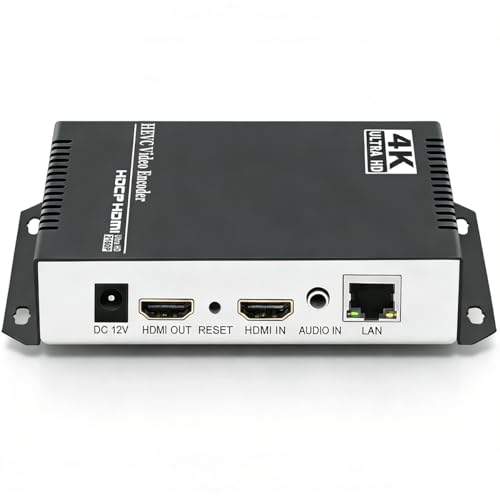
- Handles 4K input and output at up to 30fps
- Supports a wide range of streaming protocols
- Can output four streams with different protocols
Best For: Advanced HDMI-to-IP streaming and enterprise distribution workflows
Best for 4K Multi-Format Streaming

- Combines 4K encoding, switching, recording, and monitoring
- Supports horizontal and vertical multi-platform streaming
- Adds ISO recording, NDI, SRT, and network bonding
Best For: Multi-camera 4K events and vertical or horizontal live production
Best 4K Multi-Platform Pick
URayCoder UHE265-1L-4K Encoder

- 4K input at up to 30fps
- Up to four protocol outputs
- Overlays and lifetime support
Best For: 4K multi-platform streaming and customizable HDMI workflows
Best for Monitoring and Flexible Outputs

- 1×4K30 or 4×1080p30 modes
- Built-in OLED status display
- HDMI loop-out and broad protocols
Best For: Broadcast and IPTV workflows needing visible status monitoring
Best 1080p Value for Streaming

- 1080p at up to 60fps
- H.265, H.264, and MJPEG support
- Four protocol-based stream outputs
Best For: HD streaming with OBS, IPTV, NVR, and social platforms
Best Professional 4K Encoder – Magewell Ultra Encode AIO
For demanding portable streaming encoder setups, the Magewell Ultra Encode AIO combines HDMI and SDI connectivity with 4K encoding, onboard processing, and multi-destination streaming. It is a strong fit for crews that need broadcast-oriented flexibility in a rack-mountable unit.
Best For: Professional live production, venues, and workflows requiring HDMI/SDI inputs, 4K output, and simultaneous recording.
Pros:
- Supports HDMI and SDI inputs, including picture-in-picture and side-by-side layouts.
- Encodes up to 4K with H.264 or HEVC compression.
- Streams to as many as six destinations using protocols including RTMP, SRT, NDI|HX, and HLS.
- Can stream and record simultaneously to SD cards, USB storage, or network drives.
Cons:
- Its 3.6-pound rack-mountable design is less compact than simpler field encoders.
- Many advanced capabilities may be more than casual streamers need.
The Ultra Encode AIO is the most production-focused option here, especially when flexible inputs, 4K support, and redundant recording matter more than minimal size.
Best Portable Vertical Studio – YoloLiv Instream
The YoloLiv Instream is a portable streaming encoder built around vertical content creation. Its integrated touchscreen, switcher, recorder, and battery let creators stream without carrying a computer, with direct connectivity through Wi-Fi, Ethernet, or 4G LTE.
Best For: Mobile creators producing vertical livestreams for Instagram, TikTok, and similar platforms.
Pros:
- Combines an encoder, monitor, recorder, and multicamera switcher in one unit.
- Includes two HDMI inputs, one USB input, and a 7-inch touchscreen.
- Supports overlays, picture-in-picture, chroma key, transitions, and graphics.
- Built-in 10,000 mAh battery supports on-the-go operation.
Cons:
- Streaming and recording are limited to up to 1080p60 rather than 4K.
- The supplied notes identify RTMP/RTMPS streaming rather than a broader protocol selection.
Choose Instream when portability and vertical-first control are priorities. It is especially convenient for social livestreamers who want a self-contained setup with cellular connectivity.
Best Touchscreen Production Encoder – Magewell Director Mini
The Magewell Director Mini is a compact portable streaming encoder and production system for users who need switching, monitoring, recording, and streaming without an external PC. Its touchscreen and broad input support make it suitable for mobile productions with multiple sources.
Best For: Field producers and creators who need touchscreen scene control, multiple HDMI/USB sources, and flexible IP inputs.
Pros:
- Combines switching, encoding, recording, monitoring, and streaming in one device.
- Accepts two HDMI inputs, two USB-A inputs, and up to three simultaneous IP sources.
- 5.44-inch AMOLED touchscreen supports scene control and previewing.
- Dual hot-swappable NP-F battery slots support mobile operation.
Cons:
- Video encoding is limited to up to 1080p60.
- USB cellular modems are supported but not included.
- Its production features may require more setup than a basic encoder.
Director Mini stands out for creators who want a portable control surface and production toolkit rather than an encoder alone. Battery support and IP-source compatibility add useful flexibility for field work.
Best SDI Streaming Encoder – Blackmagic Streaming Encoder HD
The Blackmagic Design Streaming Encoder HD is a focused portable streaming encoder for HD workflows using 12G-SDI. It supports H.264 and H.265 encoding and handles 1080p video at up to 60 frames per second.
Best For: HD production setups that need a straightforward 12G-SDI encoder with loop-through connectivity.
Pros:
- Provides 12G-SDI input and loop output.
- Supports H.264 and H.265 codecs.
- Handles 1080p video at up to 60fps.
Cons:
- Does not offer the HDMI, touchscreen, or integrated switching features found on some alternatives.
- The supplied notes provide limited information about networking and recording functions.
This encoder is best considered a streamlined HD SDI tool. It makes sense for users already working in Blackmagic or SDI-based production environments who do not need an all-in-one switching studio.
Best All-in-One Pick – YoloBox Pro
The YoloLiv YoloBox Pro is a practical choice among portable streaming encoders for creators who want switching, encoding, monitoring, and recording in one battery-powered unit. Its 8-inch touchscreen, three HDMI inputs, and support for Wi-Fi, Ethernet, and 4G LTE make it suitable for mobile multi-camera productions.
Best For: Creators and small production teams needing an integrated multi-camera streaming setup without a laptop.
Pros:
- Combines an HD encoder, switcher, monitor, and recorder in one device.
- Supports up to three horizontal platforms simultaneously without subscription fees.
- Offers three HDMI inputs, USB and USB-C connectivity, SD card support, and one NDI input.
- Includes a 10,000mAh battery rated for more than four hours of use.
Cons:
- Streaming through 4G LTE and bonding may involve additional charges.
- It is limited to 1080p60 rather than 4K capture or output.
The Pro stands out for its balance of portability and built-in production tools. It is especially appealing when you want a self-contained streaming workflow with straightforward switching and overlays.
Best Protocol Support – URayCoder 4K HDMI Encoder
This URayCoder unit is one of the more flexible portable streaming encoders for users who need to convert HDMI video into network streams. It supports 4K input, a broad selection of protocols, and simultaneous output to multiple destinations, making it a strong fit for technical or enterprise-oriented setups.
Best For: Advanced streamers and organizations that need broad protocol compatibility, configurable encoding, and HDMI-to-IP transmission.
Pros:
- Supports 4K input and output at up to 30fps, with up to 120fps at 2K and lower resolutions.
- Works with RTSP, RTMP(S), SRT, HLS, UDP, WebRTC, FLV, and other protocols.
- Can output four video streams using different protocols simultaneously.
- Provides overlays, cropping, audio-source options, and adjustable resolution, frame rate, and bitrate.
Cons:
- It is an encoder box rather than an all-in-one touchscreen switcher and monitor.
- Its extensive configuration options may be more than casual users need.
Choose this model when network flexibility matters more than an integrated production interface. Its protocol range and customization features make it particularly useful for varied streaming servers and distribution workflows.
Best for 4K Multi-Format Streaming – YoloBox Ultra
The YoloLiv YoloBox Ultra is a high-end option among portable streaming encoders, combining 4K encoding, switching, recording, and monitoring in an 8-inch touchscreen device. It supports both horizontal and vertical streaming, multiple HDMI sources, and network bonding for demanding live productions.
Best For: Churches, schools, sports teams, and creators producing 4K, multi-camera, horizontal, or vertical live content.
Pros:
- Combines a 4K encoder, switcher, recorder, and touchscreen monitor without requiring a laptop.
- Supports four HDMI inputs plus USB-C and USB-A for more than 10 sources.
- Streams to three horizontal platforms or two vertical platforms simultaneously.
- Offers cellular bonding with up to five network connections, plus NDI, SRT, and ISO recording.
Cons:
- Cellular bonding and some connected services may involve additional charges.
- The 1 kg device is heavier than the YoloBox Pro.
- Battery recovery may require a specific dual-charger procedure if the device becomes stuck on the flashing logo.
The Ultra is the most capable choice here for creators who need 4K, vertical-video support, and deeper multi-camera production features. Its broader connectivity and ISO recording are valuable for complex live events, though the added capabilities bring more setup considerations.
Best 4K Multi-Platform Pick – URayCoder UHE265-1L-4K Encoder
If you need portable streaming encoders for 4K HDMI sources and multi-platform broadcasts, this URayCoder model offers a flexible feature set. It accepts 4K input at up to 30fps, supports lower-resolution output up to 120fps, and can send multiple streams using a wide range of protocols.
Best For: Creators and organizations that need 4K HDMI encoding, extensive protocol support, and simultaneous streaming to several platforms.
Pros:
- Supports 4K input and H.265/H.264 encoding.
- Can output up to four streams using different protocols.
- Offers overlays, captions, logos, timestamps, and image adjustments.
- Includes HDMI and line-in audio options plus lifetime support.
Cons:
- 4K operation is limited to 30fps.
- The broad configuration options may be more than casual users need.
This is a strong choice when resolution, protocol flexibility, and branding controls matter more than absolute simplicity. Its Ethernet-based workflow and browser-accessible management also suit installations where stable remote configuration is useful.
Best for Monitoring and Flexible Outputs – ORIVISION EH1401 Encoder
Among portable streaming encoders, the ORIVISION EH1401 stands out for its selectable output modes and built-in OLED display. It can provide one 4K30 stream or four simultaneous 1080p30 streams, while HDMI loop-out keeps a local monitor connected.
Best For: Live production, IPTV, digital signage, and broadcast setups that benefit from status monitoring and configurable output capacity.
Pros:
- Offers a choice between 1×4K30 and 4×1080p30 output modes.
- OLED screen displays the IP address, resolution, and encoding status.
- Supports H.265, H.264, MJPEG, SRT, RTMP/RTMPS, RTSP, HTTP, and UDP.
- Includes HDMI loop-out, OSD overlays, image flipping, and low-power operation.
Cons:
- 4K input must be enabled through the web interface because 1080p is the factory-default EDID.
- The supplied details list a one-year warranty, despite the product bullet mentioning three years.
The OLED display and loop-out connection make this encoder especially practical for troubleshooting and live monitoring. Choose it when you want a balance between 4K capability and the option to distribute several 1080p streams.
Best 1080p Value for Streaming – URayCoder UHE265-1S Encoder
This URayCoder is a practical option for portable streaming encoders focused on reliable 1080p delivery. It supports HDMI video up to 1920×1080 at 60fps, accepts HDMI or line-in audio, and works with common streaming, recording, and network-video protocols.
Best For: YouTube, Facebook, OBS, IPTV, NVR, and other 1080p streaming applications that do not require 4K input.
Pros:
- Supports 1080p video at up to 60fps.
- Encodes in H.265, H.264, or MJPEG.
- Can produce up to four streams with different protocols.
- Includes overlays, image adjustments, HDMI audio, line-in audio, and lifetime support.
Cons:
- Maximum supported resolution is 1080p.
- Its feature-rich configuration may require setup time for first-time users.
For standard HD broadcasts, this model provides many of the connectivity and customization tools found on more specialized encoders without adding a 4K requirement. It is a sensible fit for users prioritizing 60fps 1080p streaming and broad platform compatibility.
How We Picked These Portable Streaming Encoders
We selected products across several common live-production needs rather than focusing on a single type of device. The lineup includes dedicated HDMI-to-IP encoders, professional HDMI and SDI units, compact switchers, and portable all-in-one systems with integrated displays and controls.
Our comparison emphasizes supported video resolution, encoding formats, streaming protocols, input flexibility, recording capability, monitoring, portability, and ease of setup. Features such as RTMP, RTMPS, SRT, RTSP, HLS, NDI, HDMI loop-through, and multi-input switching can make a significant difference depending on where and how you broadcast.
Quick Comparison
| Best For | Look For | Products In This Roundup |
|---|---|---|
| Professional live production | HDMI and SDI inputs, reliable protocols, recording | Magewell Ultra Encode AIO; Magewell Director Mini |
| Mobile multi-camera streaming | Built-in screen, switching, battery-friendly design | YoloBox Pro; YoloBox Ultra; YoloLiv Instream |
| Simple HDMI encoding | Single-input operation and broad IP protocol support | Blackmagic Streaming Encoder HD and dedicated HDMI encoders |
| Higher-resolution workflows | 4K input support, HEVC, SRT, and flexible outputs | 4K-capable HDMI encoder models |
Key Buying Factors for Portable Streaming Encoders
Inputs and Production Control
Start with the cameras and sources you already use. HDMI is common for mirrorless cameras, camcorders, and computers, while SDI is preferred for longer cable runs and more demanding production environments. If you need camera switching, overlays, picture-in-picture, or vertical and horizontal layouts, an all-in-one switcher may be more practical than a single-purpose encoder.
Resolution and Compression
Choose a device that matches both your source resolution and your streaming platform. 4K support can preserve detail for recording or downscaled delivery, but it may require more bandwidth and storage. HEVC/H.265 can reduce bitrate compared with H.264, although H.264 remains broadly compatible with platforms and playback hardware.
Streaming Protocols and Network Options
RTMP and RTMPS are common for services such as YouTube Live and Facebook Live. SRT is useful when you need a more resilient contribution link over an unpredictable network, while RTSP, HLS, UDP, and NDI can support specialized distribution or local production workflows. Check Ethernet, Wi-Fi, cellular, and tethering requirements before buying.
Monitoring, Recording, and Reliability
A built-in screen can simplify framing, audio checks, and stream status when you are working remotely. Recording is valuable as a backup or for later editing. Also verify loop-through outputs, audio input support, cooling, power requirements, and whether the device can operate continuously without relying on a computer.
Who Should Buy Which Portable Streaming Encoders?
Choose a professional Magewell unit if you need dependable HDMI or SDI connectivity, multiple protocols, recording, and a more traditional production workflow. Choose a YoloLiv all-in-one system if portability, touchscreen control, camera switching, and fast social streaming matter more than a minimal encoder footprint.
Choose the Blackmagic model when you want a streamlined encoder from a well-known production ecosystem and already have compatible switching or capture equipment. Choose a dedicated HDMI-to-IP encoder for fixed installations, point-to-point contribution, IPTV, or simple single-camera streaming where built-in switching is unnecessary.
Finally, confirm the exact resolution, protocol, connector, power, and network specifications before ordering. “4K” support can refer to input, pass-through, recording, or streaming, and those capabilities are not always identical.