The best polyphonic synthesizers can deliver rich chords, evolving pads, layered textures, and expressive leads without forcing you into a single production style. This roundup covers compact hybrid instruments, classic analog designs, deep digital workstations, and premium performance keyboards.
Use the buying guide below to compare voice count, keyboard size, synthesis architecture, sequencing, connectivity, and workflow before choosing the right instrument for your studio or stage.
Best 10 Polyphonic Synthesizers Picks for 2026
Hybrid Sweet Spot

- Six-voice hybrid synthesis
- 37-key portable format
- Includes MiniFreak VST counterpart
Best For: Beginners seeking a flexible hybrid synthesizer
Expressive Explorer

- Eight-voice digital polyphony
- Polyphonic aftertouch and MPE support
- Three oscillators per voice
Best For: Intermediate players focused on expressive digital synthesis
Analog Sequencer Favorite
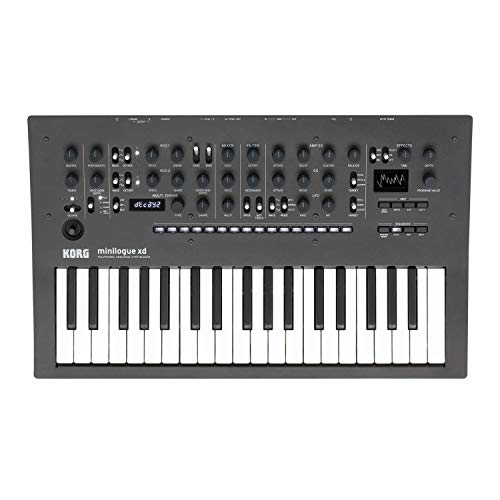
- Four-voice hybrid synthesis
- 16-step polyphonic sequencer
- OLED oscilloscope and 500 programs
Best For: Players wanting analog-style sound with sequencing
Experimental Compact
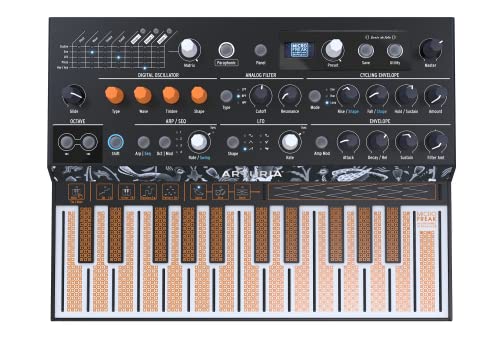
- 17 digital oscillator modes
- Polyphonic pressure-sensitive keybed
- CV, USB, and MIDI connectivity
Best For: Advanced users creating experimental and modular sounds
Analog Flagship
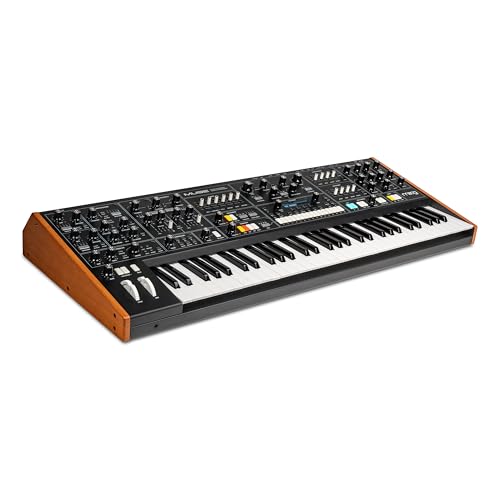
- Eight analog voices with dual oscillators and dual filters
- Hands-on controls, sequencer, arpeggiator, and chord memory
- 61-key, bi-timbral design with diffusion delay
Best For: Studio and performance-focused analog synthesis
Sequencing Powerhouse

- 16 tracks and 16-voice digital polyphony
- 128-step sequencing with parameter locks and probability
- USB Audio, Overbridge, effects, and four synth machines
Best For: Pattern-based electronic production and sound design
Versatile Keyboard
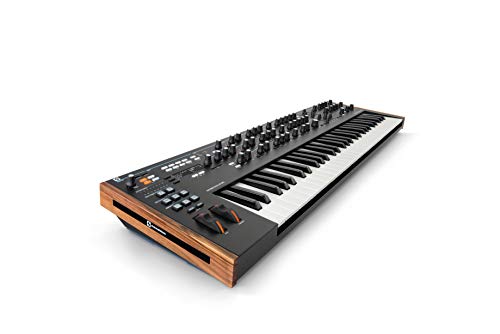
- 16 voices with two-part multitimbral operation
- Three Oxford oscillators support three synthesis approaches
- 61-key aftertouch keybed and dual analog filters
Best For: Keyboard performance, layered patches, and studio production
Classic Analog Polyphony

- Eight analog voices with two VCOs per voice
- Unison mode, arpeggiator, and sequencer
- 400 program memories in a Eurorack-style format
Best For: Vintage-inspired analog leads, basses, and chords
Modern Sound Sculpting

- Eight voices with digital wavetables and analog-style oscillators
- Deep 16-slot modulation matrix and onboard effects
- Polyphonic aftertouch, CV input, and desktop format
Best For: Flexible studio sound design and expressive performance
Keyboard-Centered Analog Power

- Four VCOs and a classic ladder filter
- 37 velocity-sensitive full-size keys
- Mono, unison, paraphonic, and polyphonic modes
Best For: Hands-on analog basses, leads, and keyboard performance
Hybrid Sweet Spot – Arturia MiniFreak
Arturia MiniFreak 37 Key Polyphonic 6-Voice Hybrid Synthesizer Keyboard (Standard, 37 Key)
Check Price On AmazonThe Arturia MiniFreak is a portable choice for musicians exploring polyphonic synthesizers with a hybrid digital-and-analog sound profile. Its 37-key format, six-voice polyphony, USB connectivity, and included VST counterpart make it suitable for hands-on playing and computer-based production.
Best For: Beginners and producers wanting an approachable, portable hybrid synthesizer.
Pros:
- Six-voice polyphony supports layered melodic parts.
- 37 keys provide more playing range than compact 25-key designs.
- Includes a MiniFreak VST counterpart for software integration.
- Portable 2.94 kg design with USB connectivity.
Cons:
- Its corded-electric power source is less convenient for fully mobile use.
- The supplied notes do not specify onboard sequencing or aftertouch features.
The MiniFreak stands out as a balanced entry point into polyphonic synthesizers, combining a manageable keyboard size with hybrid sound creation and straightforward USB workflow.
Expressive Explorer – ASM Hydrasynth Explorer
The ASM Hydrasynth Explorer is an intermediate-oriented option among polyphonic synthesizers, offering eight-voice digital wave morphing, three oscillators per voice, and four mutators. Its 37 semi-weighted keys add expressive control through polyphonic aftertouch and MPE compatibility.
Best For: Intermediate players who prioritize expressive performance and deep digital sound design.
Pros:
- Eight-voice polyphony supports substantial chordal arrangements.
- Polyphonic aftertouch and MPE compatibility enable detailed expression.
- Three oscillators per voice and four mutators provide extensive synthesis options.
- Supports microtuning through MIDI Tuning Standard files.
Cons:
- At 4.8 kg, it is heavier than some compact portable synthesizers.
- The supplied notes list a micro-USB or USB Type-C connection but do not specify the exact port configuration.
With its expressive keybed and advanced voice architecture, the Hydrasynth Explorer is a strong fit for players ready to move beyond basic polyphonic synthesizers and explore detailed digital programming.
Analog Sequencer Favorite – Korg minilogue xd
The Korg minilogue xd brings four-voice polyphony, analog modeling, and a digital multi-engine to the world of polyphonic synthesizers. Its built-in 16-step polyphonic sequencer, OLED oscilloscope, four voice modes, and 500-program library make it well suited to both sound design and pattern creation.
Best For: Musicians wanting an accessible hybrid synthesizer with sequencing and classic analog-style controls.
Pros:
- Combines dual-oscillator analog modeling with a digital multi-engine.
- Built-in 16-step polyphonic sequencer supports saving and recording sequences.
- Offers POLY, UNISON, CHORD, and ARP/LATCH voice modes.
- OLED oscilloscope provides real-time waveform visualization.
Cons:
- Four-voice polyphony is lower than some digital alternatives.
- The supplied notes specify a one-year warranty.
The minilogue xd is a practical middle ground for buyers comparing polyphonic synthesizers, pairing a compact design with strong sequencing tools, broad effects, and a versatile hybrid engine.
Experimental Compact – Arturia MicroFreak
The Arturia MicroFreak is a compact, advanced instrument for adventurous users exploring polyphonic synthesizers and paraphonic sound design. It combines numerous digital oscillator modes with a resonant analog filter, a pressure-sensitive 25-key touch-plate keyboard, sequencing functions, and CV, USB, and MIDI connectivity.
Best For: Advanced sound designers and modular users seeking experimental tones in a small format.
Pros:
- Offers 17 listed oscillator types spanning physical modeling, wavetable, vocoder, noise, and more.
- 25-key keyboard provides polyphonic aftertouch-style pressure sensing.
- Includes arpeggiator, step sequencer, automation recording, and Spice and Dice functions.
- CV outputs support pitch, gate, and pressure connections to compatible gear.
Cons:
- The 25-key touch-plate design may be less familiar than a conventional keyboard.
- Its paraphonic architecture is not the same as fully independent polyphony.
- The supplied notes identify it as an advanced-level instrument.
The MicroFreak is best viewed as a specialized creative tool rather than a traditional keyboard synthesizer, offering unusual synthesis options and broad connectivity for experimental setups.
Analog Flagship – MOOG Muse 8-Voice
The MOOG Muse is a studio- and stage-focused choice for musicians seeking an expressive analog polyphonic synthesizer. Its eight analog voices combine dual VCOs, dual filters, stereo VCAs, performance-oriented controls, and deep sequencing in a substantial 61-key instrument.
Best For: Producers, performers, and sound designers who want a hands-on analog centerpiece with substantial sequencing and modulation depth.
Pros:
- Eight analog voices with dual VCOs, modulation VCOs, dual VCFs, and stereo VCAs
- Intuitive knob-per-function layout with additional module menus
- Includes arpeggiator, chord memory, polyphonic sequencer, and stereo diffusion delay
- 256 patch locations, including two banks reserved for user patches
Cons:
- At 32 pounds, it is relatively heavy for moving between locations
- Its 61-key format and large 39-inch body require considerable space
The Muse is a strong fit when tactile analog control and performance features matter more than portability. Its eight voices, bi-timbral design, onboard effects, and 64-step sequencer make it a versatile centerpiece for both production and live use.
Sequencing Powerhouse – Elektron Digitone II
The Elektron Digitone II is a compact digital polyphonic synthesizer built for detailed sequencing and flexible sound design. It offers 16 tracks, 16-voice polyphony, four synth machines, extensive modulation, and Elektron’s parameter-lock and trig-based workflow.
Best For: Electronic musicians and producers who prioritize deep pattern sequencing, evolving digital sounds, and DAW integration.
Pros:
- Four synth machines cover wavetable-style, swarming, FM, and FM drum sounds
- 128-step sequencer includes parameter locks, trig conditions, probability, and micro-timing
- 16 voices can be distributed across 16 synth tracks
- Built-in effects, USB Audio, and Overbridge support expand studio flexibility
Cons:
- Its feature-dense sequencing workflow may take time to master
- It is a compact module rather than a keyboard-based instrument
The Digitone II is especially compelling for pattern-based composition and sound experimentation. Choose it when hands-on sequencing, modulation routing, and computer integration are more important than traditional keyboard performance.
Versatile Keyboard – Novation Summit 16-Voice
The Novation Summit is a full-size keyboard option for players who want flexible synthesis in a polyphonic synthesizer. Its 16 voices, two-part multitimbral architecture, three Oxford oscillators per voice, dual analog filters, and five-octave aftertouch-enabled keybed support both performance and studio work.
Best For: Keyboard players and producers who need broad subtractive, wavetable, and FM capabilities with two-part layering.
Pros:
- 16-voice polyphony with two-part multitimbral operation
- Three Oxford oscillators per voice support subtractive, wavetable, and FM synthesis
- Five-octave semi-weighted keybed includes velocity sensitivity and aftertouch
- Per-part effects and stereo audio input can integrate external signals
Cons:
- Its 61-key body is large and weighs 23.5 pounds
- It has a higher hardware footprint than a compact desktop synthesizer
The Summit suits players who want a conventional keyboard experience without giving up synthesis flexibility. Its dual-part design, analog filters, multiple oscillator approaches, and onboard effects make it adaptable for layered patches, live playing, and production.
Classic Analog Polyphony – Behringer PRO-800
The Behringer PRO-800 is a practical choice for musicians seeking classic analog polyphonic synthesizers in a Eurorack-style format. Its eight voices, two VCOs per voice, authentic analog signal path, and onboard sequencing provide substantial vintage-focused sound design and performance flexibility.
Best For: Players who want vintage-inspired analog polyphony, detuned leads, basses, and hands-on program recall.
Pros:
- Eight-voice polyphonic design with two VCOs per voice
- Pure analog VCO, VCF, and VCA signal path
- Unison mode, arpeggiator, sequencer, and 400 program memories
- Multiple saw, triangle, and pulse oscillator shapes
Cons:
- Eurorack-format design may require a suitable setup or placement solution
- USB connectivity is listed as USB Type B, with no broader connector details supplied
The PRO-800 stands out among polyphonic synthesizers for combining eight analog voices with extensive patch storage and classic oscillator options. Choose it if authentic, vintage-style analog character matters more than modern digital wavetable features.
Modern Sound Sculpting – Novation Peak
The Novation Peak is a compact desktop option for players who want flexible polyphonic synthesizers with extensive modulation and effects. Its eight voices combine analog-sounding numerically controlled oscillators with customizable digital wavetables, while the analog filter and onboard effects support detailed sound shaping.
Best For: Producers and performers who need broad digital-analog sound design, expressive control, and a powerful desktop module.
Pros:
- Eight-voice architecture with analog-sounding oscillators and 60 digital wavetables
- 16-slot modulation matrix plus direct front-panel assignments
- Three distortion stages per voice, reverb, delay, chorus, and arpeggiator
- Polyphonic aftertouch support, pedal inputs, animate buttons, and CV modulation input
Cons:
- Desktop module design does not include a built-in keyboard
- Optional die-cast aluminum stand is separate from the module
Peak is a strong fit for modern polyphonic synthesizers buyers who value modulation depth and tonal variety. Its compact format and expressive connectivity make it especially suitable for studio setups and performance rigs built around external controllers.
Keyboard-Centered Analog Power – Behringer POLY D
The Behringer POLY D is designed for players who want keyboard-based analog polyphonic synthesizers with a substantial, bass-forward sound. Its four VCOs, 37 velocity-sensitive semi-weighted keys, ladder filter, chorus, distortion, sequencer, and arpeggiator support both traditional playing and sound-design exploration.
Best For: Keyboard players seeking warm analog basses, rich leads, and flexible mono, unison, paraphonic, or polyphonic operation.
Pros:
- Four VCOs for thick, powerful analog tones
- 37 full-size semi-weighted keys with velocity functionality
- Mono, unison, and polyphonic/paraphonic modes
- Classic ladder filter, stereo chorus, distortion, sequencer, and arpeggiator
Cons:
- Four-voice design offers less polyphony than eight-voice alternatives
- At 26.1 pounds, it is relatively heavy for a synthesizer
- The supplied notes identify mixed connector details without specifying individual connections
The POLY D favors immediate keyboard interaction and oversized analog character over compact portability. It is a compelling choice when thick oscillators, full-size keys, and multiple playing modes are more important than maximum voice count.
How We Picked These Polyphonic Synthesizers
We selected instruments across a range of budgets, formats, and synthesis approaches rather than treating voice count as the only measure of quality. The lineup includes analog, digital, hybrid, keyboard, and desktop models, with options for beginners, sound designers, performers, and producers who need extensive sequencing.
Our comparison focuses on practical ownership factors: polyphony, oscillator and filter flexibility, hands-on controls, preset management, sequencing, effects, keybed design, connectivity, and how easily each synthesizer fits into a modern hardware or computer-based setup.
Quick Comparison
| Synthesizer type | Best suited to | What to prioritize |
|---|---|---|
| Compact hybrid or digital keyboard | Portable production and varied sound design | Preset depth, modulation, and onboard effects |
| Analog polyphonic synthesizer | Classic basses, pads, chords, and tactile performance | Voice count, tuning stability, and filter character |
| Desktop digital synthesizer | Sequencing, sound exploration, and compact studios | Workflow, automation, and external control |
| 61-key performance synthesizer | Live players and layered arrangements | Keybed response, splits, layers, and control access |
Key Buying Factors for Polyphonic Synthesizers
Voice Count and Note Behavior
Four voices can handle basic chords and bass parts, while eight or more voices provide greater freedom for sustained pads, layered patches, and fast playing. Also check whether effects, unison modes, splits, or sequencer tracks reduce available polyphony. Voice stealing is not always a problem, but it becomes noticeable when long-release sounds overlap.
Synthesis Architecture
Analog instruments are often chosen for immediate controls and familiar oscillator-filter tones. Digital and hybrid designs can offer wavetable movement, FM, samples, granular-style textures, or more complex modulation. Choose based on the sounds and programming workflow you will actually use, not just the feature list.
Keyboard, Size, and Control Layout
A 37-key instrument is a practical compromise for chords and portability. A 61-key model is more comfortable for two-handed performance, splits, and live work. Desktop units save space but require an external MIDI controller. Look for velocity and aftertouch support if expressive playing matters.
Sequencing and Connectivity
Built-in sequencers, arpeggiators, MIDI, USB, CV or gate, and audio inputs can significantly affect how a synthesizer integrates with other hardware. Producers who build complete arrangements in the instrument should prioritize automation and track count; keyboard players may care more about reliable MIDI, pedal connections, and fast patch changes.
Presets, Effects, and Workflow
Deep modulation is valuable only if the interface remains manageable. Compare patch memory, preset organization, onboard delay or reverb, editor software, and the number of dedicated controls. A simpler synthesizer can be the better choice when immediacy and creative momentum matter most.
Who Should Buy Which Polyphonic Synthesizers?
Choose a compact hybrid or digital model if you want broad sounds, portability, and modern modulation in a smaller package. An analog polyphonic synthesizer is a strong fit for players who value hands-on controls, classic tone, and direct performance interaction. Choose a desktop sequencer-focused instrument if you already have a controller and want rhythmically complex patterns or detailed automation.
For live performers and two-handed players, a 61-key instrument with splits, layers, and high polyphony is usually the most flexible option. Beginners should favor a clear interface and useful presets, while experienced sound designers may prefer deeper modulation, multiple synthesis engines, and extensive sequencing. Before buying, confirm the available space, required connections, and whether your current controller or DAW supports the instrument’s full feature set.