The best podcast recorder for a business interview should capture clear voices, minimize distracting background noise, and make it easy to review or transcribe the conversation afterward. The right choice depends on whether you prioritize AI-assisted notes, studio-quality control, portability, or long battery life.
This roundup compares 10 options across those priorities, including dedicated handheld recorders and compact digital devices designed for meetings, interviews, and on-the-go recording.
Best 10 Podcast Recorders for Business Interviews Picks for 2026
Best AI Interview Companion
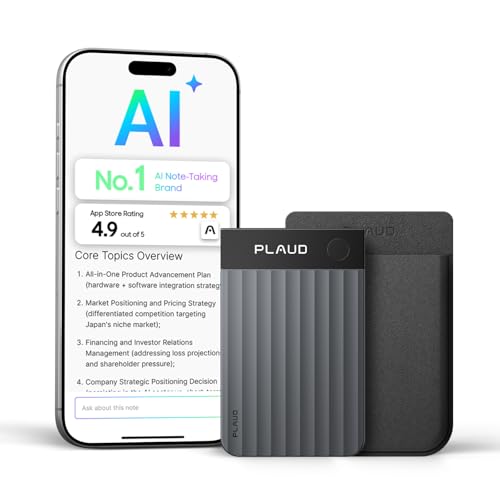
- AI transcription, summaries, and Ask Plaud follow-up tools
- Automatic call and meeting modes with directional audio
- Slim design, 64GB storage, and up to 30-hour Enhanced Mode battery
Best For: Business interviews and meetings needing organized AI-assisted notes
Best for Professional Audio Flexibility

- Two XLR/TRS inputs alongside built-in stereo microphones
- Four-track, 32-bit float recording for demanding projects
- USB-C recording or streaming with SD-card backup
Best For: Interview productions using external microphones, mixers, or multiple sources
Best for Offline Transcription

- Offline speech-to-text in five supported languages
- Six-microphone noise reduction with interview mode
- Up to 175 hours of battery life and flexible file exports
Best For: Confidential interviews and long events requiring offline transcription
Best Compact Stereo Recorder

- Lightweight 92 g body with X/Y stereo microphones
- 32-bit float recording for clip-free audio capture
- USB microphone mode for calls, podcasts, and streaming
Best For: Portable interviews and straightforward USB-connected recording
Best All-Around Value
EVISTR L357 64GB Voice Recorder

- 1536kbps stereo PCM recording with noise reduction
- 64GB storage and up to 32 hours of recording
- One-touch controls with USB-C file transfer
Best For: Business users seeking simple, organized interview recording
Best for Long Sessions

- 136GB total capacity with included 128GB TF card
- Up to 68 hours of continuous recording
- Dual microphones with automatic noise reduction
Best For: Frequent interviewers and back-to-back meetings
Best for Flexible Placement
Nanezan NZ007 Magnetic Recorder

- 128GB storage for up to 1,600 hours
- 70-hour battery life and one-touch recording
- Built-in magnet for metal-surface placement
Best For: Mobile interviewers needing compact, flexible placement
High-Capacity Pick

- 1536kbps PCM audio with noise cancellation
- 128GB card and up to 50 hours of recording
- Voice activation and one-button operation
Best For: Extended business interviews and organized recording archives
Compact Value Pick

- Stereo recording with microphone noise reduction
- Up to 20 hours of continuous recording
- Simple controls and MP3/WAV file support
Best For: Portable, occasional business interviews
File-Management Pick
EVIDA 128GB Interview Recorder

- 1536kbps recording and noise cancellation
- 128GB storage with up to 54 hours of battery life
- Four folders and six voice-activation levels
Best For: Organized, high-volume business interview recording
Best AI Interview Companion – Plaud Note Pro
For business professionals who want more than a basic audio file, the Plaud Note Pro combines recording with AI transcription, summaries, searchable follow-up, and multimodal notes. Its call-and-meeting modes, directional audio, and slim design make it a convenient option among podcast recorders for business interviews, especially when you need organized takeaways afterward.
Best For: Business interviews, meetings, and calls where AI-assisted notes and follow-up matter.
Pros:
- AI transcription, summaries, question answering, and next-step suggestions
- Automatically switches between call and meeting recording modes
- Four MEMS microphones plus a VPU microphone and up to 30 hours in Enhanced Mode
- Includes 64GB storage, cross-device access, and security compliance features
Cons:
- Advanced transcription use depends on Plaud plan limits or upgrades
- No headphone jack
- Recording requires attention to consent and local privacy laws
The Note Pro is a strong fit when the interview workflow includes transcription and content organization, not just capture. Consider the ongoing transcription-plan requirements when comparing its total cost with traditional recorders.
Best for Professional Audio Flexibility – Zoom H4 Essential
The Zoom H4 Essential is built for interviewers who may need microphones, instruments, or a mixer connection rather than a simple pocket recorder. With built-in stereo microphones, two XLR/TRS inputs, four-track recording, and 32-bit float capture, it offers flexible production capabilities for podcast recorders for business interviews.
Best For: Field interviews, podcasts, and productions requiring external microphones or mixer feeds.
Pros:
- Built-in stereo microphones plus two XLR/TRS inputs
- Four-track recording supports larger or more involved projects
- 32-bit float recording helps provide clip-free audio capture
- Can record or stream through USB-C while saving a backup to SD card
Cons:
- At 243 g, it is less pocket-friendly than smaller handheld options
- Requires two AA batteries
- Its broader feature set may be more than needed for basic one-on-one interviews
Choose the H4 Essential when connection options and recording resilience are priorities. It is particularly useful for teams that may expand from a straightforward interview setup to multi-source audio production.
Best for Offline Transcription – iFLYTEK 302Pro
The iFLYTEK 302Pro stands out for business interviewers who need offline voice-to-text and long battery life. Its six-microphone noise-canceling system, dedicated interview mode, smart bookmarks, and export options make it a practical choice among podcast recorders for business interviews where confidential or travel-friendly workflows are important.
Best For: Confidential meetings, interviews, conferences, and users who need offline transcription.
Pros:
- Offline transcription in English, Chinese, Japanese, Korean, and Russian
- Six microphones with AI noise reduction and dedicated interview mode
- Up to 175 hours of stated battery life and 190 hours of recording time
- Exports transcriptions as PDF, Word, or TXT and imports common audio formats
Cons:
- Recognition can be affected by background noise or accents
- 8GB storage is smaller than some competing devices
- No headphone jack
This recorder is compelling when offline processing, multilingual transcription, and extended battery life outweigh the benefits of cloud-based collaboration. Test recognition with your interview conditions before relying on it for final transcripts.
Best Compact Stereo Recorder – Zoom H1 Essential
The Zoom H1 Essential is a lightweight, straightforward option for recording interviews, meetings, podcasts, and remote calls. Its X/Y stereo microphones, 32-bit float recording, USB-C microphone mode, and 92 g design make it an approachable choice among podcast recorders for business interviews.
Best For: Portable one-on-one interviews, meetings, content capture, and USB-connected calls.
Pros:
- Lightweight 92 g design with built-in X/Y stereo microphones
- 32-bit float recording helps provide clip-free audio capture
- Works as a USB microphone for calls, livestreams, and podcasts
- Includes a 3.5 mm headphone jack and stated 10-hour battery life
Cons:
- Does not offer XLR/TRS inputs for external professional microphones
- Uses two AAA batteries
- Its stereo microphone design may be less adaptable than multi-input recorders for larger interviews
The H1 Essential makes sense when portability and simple operation are more important than extensive connectivity. It is a practical starting point for capturing clear interview audio without carrying a larger production recorder.
Best All-Around Value – EVISTR L357 64GB Voice Recorder
For shoppers comparing podcast recorders for business interviews, the EVISTR L357 offers a practical mix of clear PCM audio, straightforward controls, and substantial storage. Its adjustable gain and noise-reduction features can help capture voices in meetings and interviews, while USB-C makes file transfers simple.
Best For: Business users who want a compact recorder with easy one-touch operation, playback controls, and plenty of storage for recurring interviews.
Pros:
- 1536kbps stereo recording with dynamic and PCM noise reduction
- 64GB storage and up to 32 hours of continuous recording
- Adjustable seven-level gain and voice-activated recording
- USB-C transfer, WAV/MP3 support, and A-B repeat playback
Cons:
- Its built-in microphone may be less flexible than a recorder with external microphone inputs
- Voice-activated recording can omit quiet pauses that may matter in some interviews
The L357 is a sensible choice when ease of use and organized file handling matter as much as recording quality. Its dated-file naming and Windows/Mac compatibility are useful for a business interview workflow.
Best for Long Sessions – Tonfarb 136GB Voice Recorder
The Tonfarb recorder is a strong option among podcast recorders for business interviews when extended battery life and high storage capacity are priorities. Its dual microphones, automatic noise reduction, and 1536kbps PCM recording are designed for clear capture during meetings, interviews, and other longer sessions.
Best For: Interviewers who record frequently or need a recorder that can handle back-to-back meetings without frequent charging or file cleanup.
Pros:
- 136GB total storage with the included 128GB TF card
- Up to 68 hours of continuous recording on one charge
- Dual noise-reduction microphones and 1536kbps PCM audio
- One-click recording, password protection, and A-B repeat
Cons:
- The larger storage setup may be more than needed for occasional interviewers
- The supplied details list MP3 support but do not specify multiple recording-format options
Choose the Tonfarb when endurance is more important than having the smallest possible device. The large LCD screen, metal casing, and one-click side control make it well suited to a busy interview schedule.
Best for Flexible Placement – Nanezan NZ007 Magnetic Recorder
For business interviews that happen in changing locations, the Nanezan NZ007 stands out among podcast recorders for business interviews because its built-in magnet can attach to metal desks, rails, or other surfaces. It is also exceptionally light and compact, with one-touch recording and a long stated battery life.
Best For: Mobile interviewers who value discreet placement, pocket-friendly portability, and extended recording time.
Pros:
- 128GB capacity for up to 1,600 hours of recording
- Up to 70 hours of battery life
- Built-in magnet for convenient placement on metal surfaces
- One-touch operation, USB-C connectivity, and zinc-alloy construction
Cons:
- The supplied details identify the microphone mode as mono
- Magnetic placement is useful only on compatible metal surfaces
- The compact design may provide fewer on-device controls than larger recorders
The NZ007 is a compelling portability-first pick for field interviews and mobile business use. Its large capacity and magnetic mounting add flexibility, although users who want stereo capture or extensive manual controls may prefer another model.
High-Capacity Pick – 128GB PCM Interview Recorder
For business users comparing podcast recorders for business interviews, this model emphasizes clear PCM audio, generous storage, and simple operation. Its stereo microphone, 1536kbps recording, 50-hour battery life, and included 128GB TF card make it suited to extended interview sessions and easy file organization.
Best For: Interviewers who want substantial onboard storage, time-stamped files, and one-button recording.
Pros:
- 1536kbps PCM recording with noise cancellation and an omnidirectional stereo microphone
- Included 128GB TF card and up to 50 hours of continuous recording
- Voice activation, one-button controls, time-stamped files, and Type-C computer transfer
Cons:
- Built-in microphone rather than a separately specified external microphone input
- Its 1.44-inch screen may feel limited for managing many files
This is a practical choice when storage capacity and straightforward controls matter more than advanced podcast production features. Playback, speed control, A-B repeat, and password protection add useful review and file-management options.
Compact Value Pick – 8GB Voice-Activated Recorder
This compact option is worth considering for podcast recorders for business interviews when portability and simple controls are priorities. It offers high-definition stereo recording, voice activation, rechargeable power, and a supplied USB cable for transferring MP3 or WAV files.
Best For: Occasional interviewers who need a lightweight recorder with straightforward three-button operation.
Pros:
- Higher-sensitivity microphone, noise reduction, and stereo recording
- Up to 20 hours of continuous recording and 8 hours of playback with earphones
- Voice activation, time-stamped files, A-B repeat, variable playback speed, and password protection
- Supports MP3/WAV recording and doubles as an MP3 player
Cons:
- 8GB storage is substantially less than the 128GB alternatives
- Uses a Micro USB connection rather than the newer Type-C standard
Its smaller storage capacity makes it better suited to routine or short interview assignments than large recording archives. The rechargeable battery and simple controls help keep the workflow uncomplicated.
File-Management Pick – EVIDA 128GB Interview Recorder
For buyers evaluating podcast recorders for business interviews, the EVIDA 9296 focuses on high-resolution capture, long recording capacity, and organized file handling. It supports 1536kbps WAV recording, multiple MP3 quality settings, voice activation, and four-folder storage for separating projects.
Best For: Business users who need extensive storage, adjustable recording formats, and structured file organization.
Pros:
- 1536kbps recording with a noise-cancelling microphone and professional recording chip
- 128GB capacity and up to 54 hours of continuous recording
- Six voice-activation levels help reduce silence and whispering clips
- Four-folder A/B/C/D organization, password protection, bookmarks, and computer transfer
Cons:
- Listed microphone operation is mono with noise cancellation
- No headphone jack is listed in the specifications
- Its many settings may require more setup than a basic recorder
The EVIDA is a strong fit for interview workflows that involve many files or multiple projects. Its format choices and folder system provide useful control, while customer support and an 18-month warranty add practical reassurance.
How We Picked the Best Podcast Recorders for Business Interviews
We focused on the features that matter most when recording professional conversations: microphone quality, voice clarity, storage capacity, battery performance, portability, file access, and transcription support. We also considered whether a recorder is simple enough for a quick interview setup or flexible enough for creators who need manual audio control.
AI transcription can save time after an interview, but it should not replace a strong original recording. For important conversations, prioritize a device that saves standard audio files and lets you transfer or back them up easily.
Quick Comparison
| Recorder type | Best for | Main advantage |
|---|---|---|
| AI voice recorder | Meetings and rapid notes | Transcription and summaries |
| Handheld field recorder | Podcast production | Better microphone and recording control |
| Digital voice recorder | Interviews and routine use | Simple operation and generous storage |
| Voice-activated recorder | Long sessions | Records only when sound is detected |
Key Buying Factors for Podcast Recorders for Business Interviews
Audio Quality and Microphone Design
Speech intelligibility is the priority. Look for noise reduction, a sensitive microphone, and—when possible—stereo or adjustable microphone positioning. A handheld field recorder is usually the better choice for polished podcast audio, while compact dictation devices work well for one-on-one conversations in reasonably quiet rooms.
Transcription and File Compatibility
Built-in or companion-app transcription is useful for turning interviews into notes, quotes, and follow-up tasks. Check supported languages, subscription requirements, export options, and whether recordings remain accessible as common formats such as WAV or MP3.
Battery, Storage, and Transfer
Long interviews require dependable battery life and enough storage for uncompressed files. USB-C is convenient for charging and transferring recordings. Voice activation can extend runtime, but test it first because overly aggressive settings may miss quiet words or sentence beginnings.
Controls and Recording Environment
Physical record, pause, and playback controls reduce mistakes during live conversations. If interviews take place in offices, conference rooms, or events, consider wind protection, a headphone jack, input-level controls, and compatibility with an external microphone.
Who Should Buy Which Podcast Recorders for Business Interviews?
Choose an AI Recorder for Fast Notes
Buy an AI-focused model if your main goal is searchable transcripts, summaries, and meeting follow-up rather than full podcast production.
Choose a Handheld Recorder for Polished Podcasts
A Zoom-style field recorder is the better fit for creators who want clearer, more controllable audio and may record multiple people or connect additional microphones.
Choose a Digital Voice Recorder for Straightforward Interviews
Traditional digital recorders are practical for business users who want simple operation, high capacity, playback, and easy file storage without a complicated setup.
Choose a Voice-Activated Model for Extended Sessions
Voice-activated devices suit long interviews, lectures, and recurring fieldwork where conserving storage and battery matters. Always verify activation sensitivity before relying on one for an important interview.