The right recorder can make a multi-person podcast easier to produce by giving each speaker a separate track, dependable microphone connections, and monitoring that keeps problems from going unnoticed.
We’ve gathered 10 portable options, including purpose-built podcast recorders, handheld units, camera-friendly models, and bundles with microphones and accessories. Use the guide below to match features, workflow, and budget to your show.
Best 10 Multitrack Recorders for Podcasts Picks for 2026
Best All-in-One Podcast Setup

- Four XLR inputs with phantom power
- Four headphone outputs with individual volume
- Mix-minus for phone and USB interviews
Best For: Multi-person podcasts and remote interviews
Best Portable 32-Bit Option

- Four-track 32-bit float recording
- Built-in stereo mics plus two XLR/TRS inputs
- USB-C recording or streaming with SD backup
Best For: Mobile podcasting and mixed creative projects
Best for Camera-Based Production
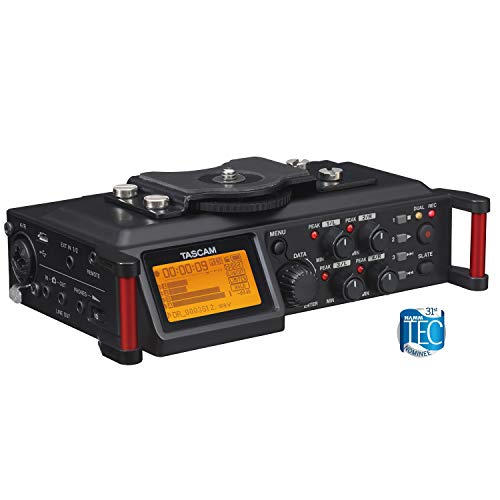
- Four balanced XLR inputs with phantom power
- Individual gain controls and safety recording mode
- Mounts above or below a camera
Best For: Video crews and multi-microphone field recording
Best for Larger Multitrack Sessions

- Up to six tracks plus a stereo mix
- 32-bit float recording with look-ahead limiters
- Up to 15 hours on four AA batteries
Best For: Larger podcasts and demanding location sessions
Versatile Field Pick

- Four XLR/TRS inputs with individual controls
- Records up to 24-bit/96kHz to SD
- Works as a multichannel USB audio interface
Best For: Portable podcasting, interviews, video, and music recording
Podcast Team Pick

- Four XLR inputs for multitrack podcast recording
- Four headphone outputs with separate volume controls
- Built-in AI noise reduction and tone tools
Best For: Multi-person podcast sessions and phone video recording
Creative Layering Pick

- Four-track recording with bounce and undo
- 32-bit float capture helps prevent clipping
- Built-in microphones, effects, and 80-plus rhythms
Best For: Layered podcast audio, music, and portable creative sessions
Complete 4-Person Starter Kit
Zoom PodTrak P4 with ZDM-1 Mics

- Four XLR inputs and four headphone outputs
- Includes four Zoom ZDM-1 podcast microphone packs
- Adds sound pads and TRRS/USB call-in support
Best For: Four-person podcast teams wanting a recorder-and-microphone bundle
Accessory-Heavy Recording Bundle
Zoom PodTrak P4 with SonicSound Extras

- Includes four microphones, pop filters, storage, and rechargeable batteries
- Offers four individually controlled headphone outputs
- Supports separate-track WAV recording and call-ins
Best For: Teams building a complete four-person podcast station
Four-Person Mic and Headphone Pack

- Includes four M-1 microphones, headphones, cables, and stands
- Provides independent headphone mixes for each participant
- Supports smartphone and USB call-ins with mix-minus audio
Best For: Panel shows and interviews needing a complete four-person audio kit
Best All-in-One Podcast Setup – PodTrak P4
For creators comparing multitrack recorders for podcasts, the Zoom PodTrak P4 is built around a complete interview workflow. It provides four XLR microphone inputs, four individually controlled headphone outputs, programmable sound pads, and multitrack recording for each input and pad.
Best For: Multi-person podcasts, call-in shows, and remote interviews requiring several microphones and separate headphone monitoring.
Pros:
- Four XLR inputs with phantom power support multiple microphones.
- Four headphone outputs offer individual volume control.
- Automatic mix-minus supports phone and USB remote interviews.
- Works as a 2-in/2-out USB audio interface and runs on two AA batteries.
Cons:
- Battery life is listed at up to 3.5 hours.
- Its podcast-focused design may be less suited to broader field-recording needs.
The PodTrak P4 is a practical choice when podcast production depends on multiple guests, live sound cues, and remote callers. Its dedicated monitoring and mix-minus features reduce the need for additional equipment.
Best Portable 32-Bit Option – H4 Essential
The Zoom H4 Essential is a flexible choice among multitrack recorders for podcasts, especially if you also record music, video audio, or field interviews. Its four-track recorder combines built-in stereo microphones with two XLR/TRS inputs and 32-bit float recording designed to help avoid clipped takes.
Best For: Solo creators and mobile users who want built-in stereo capture, external input support, and USB-C connectivity.
Pros:
- Records up to four tracks with 32-bit float audio.
- Built-in stereo microphones handle quick recordings without extra gear.
- Two XLR/TRS inputs accept external microphones or instruments.
- Can record or stream over USB-C while saving a backup to an SD card.
Cons:
- It has two external XLR/TRS inputs rather than four.
- Only two AA batteries are required, so longer sessions may need battery planning.
The H4 Essential suits podcasters who need a compact recorder that can move between spoken-word work, music, and video production. Spoken menu guidance is an additional convenience for accessible operation.
Best for Camera-Based Production – TASCAM DR-70D
The TASCAM DR-70D is a production-oriented pick among multitrack recorders for podcasts and video work. It offers four balanced XLR inputs with phantom power, individual gain controls, built-in microphones, and a design that can mount above or below a camera.
Best For: Filmmakers, interview crews, and podcasters recording several external microphones alongside camera-based production.
Pros:
- Four balanced XLR inputs support professional microphones and phantom power.
- Individual gain controls allow separate level adjustment for each input.
- Dual Recording mode creates a lower-level safety copy to help prevent distortion.
- Records to SD, SDHC, or SDXC cards, including cards up to 128GB.
Cons:
- It requires four AA batteries.
- The supplied notes describe a 90-day labor and one-year parts warranty.
- Its camera-production format may be less convenient for a simple desktop podcast setup.
The DR-70D is strongest when a podcast is part of a larger video or field-production workflow. Its four inputs, gain controls, and safety recording mode prioritize reliable capture over minimal setup.
Best for Larger Multitrack Sessions – Zoom H6 Studio
The Zoom H6 Studio stands out for creators who need more room to expand beyond a basic podcast setup. It records up to six individual tracks plus a stereo mix, uses 32-bit float recording, and includes large microphones capable of handling up to 140 dB SPL.
Best For: Larger podcast productions, location recording, and creators who also capture music or demanding live sound.
Pros:
- Supports six individual tracks plus a stereo mix.
- 32-bit float recording provides broad dynamic-range protection.
- Look-ahead limiters help prevent distortion from overloads.
- Offers recording rates from 44.1 to 192 kHz and up to 15 hours on four AA batteries.
Cons:
- The supplied notes do not specify the number or type of external microphone inputs.
- Its larger capabilities may be more than a small, two-person podcast requires.
- The listed dimensions and 1.05-pound weight make it less compact than simpler handheld options.
The H6 Studio is a strong fit when channel count, dynamic range, and long battery operation matter more than minimal size. It gives podcast producers additional capacity for guests, ambient sound, and parallel recording tasks.
Versatile Field Pick – Zoom H6
The Zoom H6 is a flexible choice among multitrack recorders for podcasts, especially if you also record video, music, or interviews on location. Its four XLR/TRS inputs, interchangeable microphone capsules, individual gain controls, and SD recording make it adaptable to changing setups.
Best For: Podcasters who want a portable recorder that can also serve as a multichannel USB audio interface.
Pros:
- Four XLR/TRS inputs with individual gain, pad, and phantom-power controls.
- Records WAV or MP3 directly to SD cards up to 128GB.
- Includes XY and MS microphone capsules for flexible stereo recording.
- Supports multichannel and stereo USB audio with PC, Mac, and iPad.
Cons:
- Requires four AA batteries for portable operation.
- Headphone output uses a 2.5mm jack.
The H6 is a strong all-purpose option when you need more than a podcast-specific recorder. Its combination of expandable microphones, four inputs, and high-resolution recording gives growing creators room to handle varied productions.
Podcast Team Pick – Zoom PodTrak P4next
The Zoom PodTrak P4next is purpose-built for multitrack podcasts with up to four in-person speakers and a call-in guest. Four XLR inputs, four independently controlled headphone outputs, and built-in AI processing make it a practical choice for recording a group without a complicated setup.
Best For: Podcast teams recording multiple hosts or guests who want accessible monitoring and automatic-sounding cleanup tools.
Pros:
- Four XLR inputs support multitrack recording for up to four people plus a call-in guest.
- Four headphone outputs have separate volume controls.
- AI noise reduction, tone enhancement, and compression simplify processing.
- Can connect to a phone for direct audio capture in video.
Cons:
- Its feature set is focused on podcast production rather than broader music recording.
- The supplied details do not specify the battery type.
For conversational shows, the P4next emphasizes workflow more than deep studio flexibility. It is particularly appealing when every participant needs a headphone feed and the producer wants help achieving balanced, clear audio quickly.
Creative Layering Pick – Zoom R4
The Zoom R4 brings a musician-oriented workflow to multitrack recorders for podcasts, with up to four tracks, bouncing, built-in effects, and 32-bit float recording. It is best suited to creators who want to layer vocals, instruments, or podcast elements while staying portable.
Best For: Solo creators and musicians who want a compact recorder for layered audio, ideas, voice work, and portable production.
Pros:
- Records and bounces up to four tracks, with undo for revisions.
- 32-bit float recording helps avoid clipping without manual gain adjustments.
- Two XLR/TS combo inputs accept microphones, instruments, keyboards, and more.
- Includes built-in stereo microphones, effects, and more than 80 rhythm patterns.
Cons:
- Only two XLR/TS combo inputs are provided.
- Its musician-focused rhythm and layering features may be unnecessary for straightforward interviews.
The R4 stands out when a podcast project involves sound design, musical segments, or repeated overdubs. Its 32-bit float workflow and bouncing capability reduce technical friction, while battery or USB-C power supports mobile recording.
Complete 4-Person Starter Kit – Zoom PodTrak P4 with ZDM-1 Mics
Zoom PodTrak P4 Portable Multitrack Podcast Recorder Bundle with 4X Zoom ZDM-1 Podcast Pack
Check Price On AmazonFor creators comparing multitrack recorders for podcasts, this Zoom PodTrak P4 bundle is a ready-to-use four-person setup. It combines four high-gain XLR inputs, four headphone outputs, sound pads, and four included ZDM-1 podcast microphone packs.
Best For: New or established four-person podcast teams that want microphones included with the recorder.
Pros:
- Four XLR microphone inputs with +48V phantom power
- Four independent headphone outputs for participant monitoring
- Four sound pads for music and samples
- Supports simultaneous TRRS and USB call-ins
Cons:
- Requires two AA batteries for portable operation
- The bundle’s microphone packs may be more equipment than solo creators need
This is a practical all-in-one choice for a four-person show, especially when independent monitoring and remote call-ins are priorities.
Accessory-Heavy Recording Bundle – Zoom PodTrak P4 with SonicSound Extras
This expanded Zoom PodTrak P4 package is aimed at buyers who want multitrack recorders for podcasts plus a broad set of accessories. It includes a 64GB card, rechargeable batteries and charger, four microphone packs, pop-filter boom-arm sets, and other setup essentials.
Best For: Four-person podcast productions that want microphones, monitoring accessories, storage, and power supplies in one package.
Pros:
- Four XLR inputs with gain controls, mute buttons, and phantom power
- Four headphone outputs with individual volume control
- Records separate input sources in 16-bit/44.1kHz WAV format
- Includes 64GB microSDXC storage and rechargeable batteries with charger
Cons:
- The extensive accessory bundle may be excessive for simple setups
- Listed battery life is up to about three hours with two AA batteries or USB power
- The listing identifies SonicSound Technologies as the brand rather than Zoom
Its strongest advantage is convenience: the recorder’s multitrack features are paired with storage, power, microphones, and mounting accessories for a fuller production setup.
Four-Person Mic and Headphone Pack – Zoom PodTrak P4 Bundle
This four-person bundle pairs the Zoom PodTrak P4 with four Zoom M-1 microphones, headphones, windscreens, XLR cables, and tabletop stands. It is a straightforward option for shoppers seeking multitrack recorders for podcasts with the core audio accessories already included.
Best For: Panel podcasts and interview setups where each participant needs a microphone and an independent headphone mix.
Pros:
- Includes four microphones, headphones, XLR cables, and tabletop stands
- Provides independent headphone mixes with individual level controls
- Supports echo-free smartphone and USB call-ins
- Can support wireless call-ins with the separately available BTA-2 receiver
Cons:
- The BTA-2 Bluetooth receiver is not included
- Requires two AA batteries for operation
- The supplied bundle is less focused on expanded storage and charging accessories
This kit is especially appealing when participant monitoring matters as much as recording, while its phone and USB call-in options add flexibility for remote guests.
How We Picked the Best Multitrack Recorders for Podcasts
We focused on the features that matter during an actual recording session: the number and type of inputs, independent headphone monitoring, multitrack capability, portability, power options, storage, USB connectivity, and tools that help prevent unusable audio. The selection includes dedicated podcast machines as well as flexible handheld and camera recorders, so you can compare specialized workflows with broader recording tools.
We also considered practical value. Some listings are recorder-only products, while others include microphones, headphones, cables, stands, or memory cards. Bundles can be convenient for starting a complete setup, but check the included accessory specifications before assuming they match the quality or configuration you need.
Quick Comparison
| Best For | What to Prioritize | Most Relevant Options |
|---|---|---|
| Two- to four-person studio podcasts | Multiple XLR inputs and headphone outputs | Zoom PodTrak P4 models and bundles |
| Remote interviews | Phone or USB connectivity, simple monitoring | Zoom PodTrak P4 |
| Video production | Camera-friendly design and combo inputs | TASCAM DR-70D, Zoom H6 |
| Field recording | Battery power, compact size, built-in microphones | Zoom H4 Essential, Zoom H6 |
| Music and creative multitracking | Track layering, effects, and bouncing | Zoom R4 |
Key Buying Factors for Multitrack Recorders for Podcasts
Inputs and Track Layout
Count both the physical inputs and the tracks you need to capture independently. Four XLR inputs are useful for co-hosts and guests, while combo XLR/TRS sockets add flexibility for microphones, instruments, and line-level sources. A recorder with fewer inputs may still work well for solo shows or two-person interviews.
Headphone Monitoring
Each participant should be able to hear the conversation without relying on a splitter that creates volume or impedance problems. Dedicated headphone outputs are especially valuable for in-person groups. For remote guests, look for convenient phone or USB routing and confirm how return audio is handled.
Recording Quality and Protection
Higher-resolution recording can provide more editing headroom, but it does not replace good microphone technique. Features such as limiters, high-pass filters, safety tracks, and 32-bit float recording can help manage sudden volume changes and difficult field conditions.
Portability and Workflow
Battery operation, SD-card recording, built-in microphones, and straightforward controls matter when recording away from a desk. If you plan to edit on a computer, verify USB audio-interface support and compatibility with your preferred software.
Who Should Buy Which Multitrack Recorders for Podcasts?
Choose a dedicated PodTrak-style recorder if your priority is a straightforward, multi-person podcast setup with several microphones and headphones. Select a handheld recorder if you also record events, ambience, music, or documentary interviews. Camera-focused models are better suited to videographers who need a compact audio unit that can integrate into a filming workflow.
For a first complete setup, a bundle may reduce shopping and cable compatibility concerns. For experienced creators, the recorder-only option usually offers more control over microphone, headphone, and accessory choices. Before buying, list your maximum number of speakers, recording location, monitoring requirements, and editing workflow; those four details will narrow the field quickly.