The best MIDI keyboards for producers make it easier to build chords, play basslines, program drums, and control instruments without relying entirely on a mouse. The right model depends on your preferred workflow, available desk space, and need for portability.
We’ve selected 10 controllers ranging from compact 25-key units to larger 49-key keyboards, with options for beginners, mobile producers, beat makers, and more performance-focused setups.
Best 10 Midi Keyboards for Producers Picks for 2026
Best Overall Workflow

- 49 semi-weighted keys with 16 poly-aftertouch pads
- Scale, Chord, and Arpeggiator modes
- Broad DAW integration with faders and OLED display
Best For: All-in-one DAW production and performance
Best Compact Starter

- Compact 25-key controller weighs 3.1 pounds
- Eight RGB pads plus encoders and faders
- Includes a useful music software package
Best For: Small desks and beginner-friendly production
Best for Beat Makers

- 37 velocity-sensitive mini keys for melodies and chords
- MPC pads with aftertouch and Note Repeat
- USB-C, MIDI Out, and three CV/Gate outputs
Best For: Portable beat making and hybrid hardware setups
Best Simple Full-Size Option

- 49 full-size velocity-sensitive keys
- Pitch/modulation wheels and sustain input
- Plug-and-play USB with bundled music software
Best For: Straightforward software instrument performance
Best All-Around Pick

- 25 velocity-sensitive keys plus eight MPC pads
- Color display, knobs, and advanced performance modes
- Includes instruments, DAW mapping, and learning tools
Best For: Producers wanting a compact all-in-one controller
Best for Ableton Live
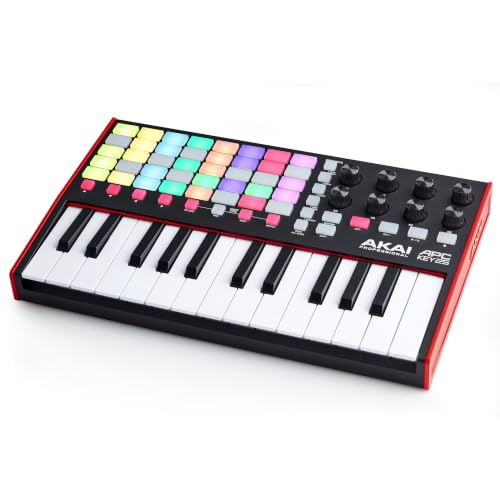
- 40 RGB pads for clip launching
- 1:1 Ableton Live mapping and navigation controls
- Eight knobs for track and device control
Best For: Ableton producers and live performers
Best Budget-Friendly Learning Pick

- Smart scales, arpeggio, chord, and note-repeat modes
- Eight pads, four wheels, OLED display, and USB-C
- Includes four DAWs and 40 teaching courses
Best For: Beginners and mobile-focused producers
Compact Beat-Making Pick

- 25 velocity-sensitive mini keys with eight MPC pads
- Eight knobs, joystick, and built-in arpeggiator
- Includes MPC Beats, instruments, sounds, and Splice access
Best For: Portable beat making and home production
Flexible Three-Octave Pick

- 37 keys provide three full octaves
- CV/Gate, MIDI I/O, and a built-in 64-step sequencer
- RGB pads, Chords and Scales modes, and DAW controls
Best For: Melodic production and hybrid hardware setups
Modern Portable Pick

- Full-color screen, encoder, and eight assignable knobs
- RGB pressure-sensitive pads with Chord, Scale, and arpeggiator tools
- USB-C, MIDI Out, mapped DAW controls, and included software
Best For: Mobile production and fast software-focused workflows
Best Overall Workflow – Novation Launchkey 49 MK4
For producers who want a broad, hands-on setup, the Novation Launchkey 49 MK4 combines 49 semi-weighted keys with deep DAW control, pads, faders, and creative performance modes. It is a strong choice among midi keyboards for producers who want one controller for playing, sequencing, clip launching, and mixing.
Best For: Producers seeking an all-in-one controller for DAW-based composition and performance.
Pros:
- 49 semi-weighted keys provide more range than compact controllers.
- Sixteen FSR pads support drumming, clip launching, step sequencing, and chord triggering.
- Scale, Chord, and Arpeggiator modes encourage fast idea generation.
- Works with major DAWs and includes a broad software bundle.
Cons:
- Its 49-key footprint is less convenient for small desks or mobile setups.
- At 9 pounds, it is heavier than the compact options in this roundup.
The Launchkey 49 MK4 is the most complete option here for producers who value both keyboard range and extensive production controls. Its larger footprint is the tradeoff for that versatility.
Best Compact Starter – Arturia MiniLab 3
The Arturia MiniLab 3 is a compact 25-key controller designed for producers who want hands-on access to instruments, drums, tracks, and effects without giving up much desk space. Its software bundle and straightforward controls make it approachable for home studios and beginners exploring midi keyboards for producers.
Best For: Compact desktop setups, beginners, and producers who want integrated software and drum controls.
Pros:
- Compact 25-key design weighs just 3.1 pounds.
- Eight RGB velocity- and pressure-sensitive pads support drum programming and performance.
- Eight rotary encoders, four faders, a display, and browsing knob provide hands-on control.
- Includes Ableton Live Lite, Analog Lab Intro, UVI Model D, and other software.
Cons:
- Twenty-five slim keys offer less playing range than 37- or 49-key models.
- It has USB connectivity rather than the broader MIDI and CV/Gate connections found on some alternatives.
The MiniLab 3 prioritizes portability and an accessible workflow. It is a practical entry point, though producers who regularly play two-handed parts may prefer a larger keyboard.
Best for Beat Makers – Akai MPK Mini Plus II
The Akai Professional MPK Mini Plus II adds a 37-key range to a portable production controller, giving producers more room for melodies and chords than a typical mini keyboard. With MPC-style pads, creative sequencing tools, a display, and CV/Gate outputs, it is one of the most flexible midi keyboards for producers who work with beats and hardware.
Best For: Beat makers and producers who want portable controls with MPC software and modular connectivity.
Pros:
- Thirty-seven velocity-sensitive mini keys support melodies, chords, and two-handed playing.
- Eight RGB MPC pads include aftertouch for expressive finger drumming.
- Arpeggiator, Chord, Note Repeat, and additional creative functions support idea generation.
- Includes full-size MIDI Out and three CV/Gate outputs alongside USB-C.
Cons:
- Mini keys may feel less substantial than full-size keys.
- Its expanded feature set may take longer to learn than a simpler keyboard-only controller.
The MPK Mini Plus II is a strong middle ground between a compact beat controller and a more expansive keyboard. Its connectivity also makes it appealing beyond a computer-only setup.
Best Simple Full-Size Option – M-Audio Keystation 49 MK3
The M-Audio Keystation 49 MK3 focuses on the essentials: 49 full-size velocity-sensitive keys, pitch and modulation wheels, transport controls, and plug-and-play USB operation. For producers who primarily need a straightforward keyboard for software instruments, it is a practical alternative among midi keyboards for producers.
Best For: Producers who prioritize full-size keys and simple DAW control over pads and advanced sequencing features.
Pros:
- Forty-nine full-size velocity-sensitive keys capture playing dynamics.
- Pitch and modulation wheels, octave buttons, and sustain input support expressive performances.
- USB connection requires no drivers or external power supply on Mac or PC.
- Includes MPC Beats, Ableton Live Lite, AIR instruments, and learning resources.
Cons:
- It does not include drum pads, rotary encoders, or an onboard arpeggiator.
- Its 49-key design takes up more desk space than compact controllers.
The Keystation 49 MK3 is best when a dependable, full-size playing surface matters most. Choose another model if you need integrated beat pads or extensive hands-on mixer control.
Best All-Around Pick – Akai MPK Mini IV
The Akai Professional MPK Mini IV is a versatile choice among midi keyboards for producers who want keys, pads, knobs, and performance tools in a compact controller. Its 25 velocity-sensitive mini keys, MPC pads, color display, and USB-C connectivity suit both studio production and portable setups.
Best For: Producers who want one compact controller for melodies, beat making, sound browsing, and DAW control.
Pros:
- Combines 25 velocity-sensitive keys, eight MPC pads, eight assignable knobs, and a full-color screen.
- Includes arpeggiator, chord, scale, Pattern, Freeze, and Mutate functions for faster idea generation.
- Offers pre-mapped integration with Ableton Live, Logic Pro, FL Studio, and other DAWs.
- Includes a broad virtual instrument collection, Melodics trial, Splice access, and an NKS sound-bundle option.
Cons:
- Mini keys may be less suitable for players who prefer a full-size piano-style keybed.
- It is USB-powered and does not function as a standalone sound-producing keyboard.
With its unusually broad control set and portable design, the MPK Mini IV is a strong fit for producers who switch between composing, sequencing, and finger drumming.
Best for Ableton Live – Akai APC Key 25 MK2
The Akai APC Key 25 MK2 is one of the most focused midi keyboards for producers working in Ableton Live. It pairs 25 velocity-sensitive mini keys with a 5×8 RGB pad matrix, dedicated navigation buttons, and eight assignable knobs for clip launching and software control.
Best For: Ableton Live users who prioritize clip launching, live arrangement, and hands-on track control.
Pros:
- Provides 40 RGB pads for launching clips, loops, vocals, and melodic samples.
- Offers 1:1 mapping with Ableton Live 11, 12, and 7 onwards according to the supplied notes.
- Includes eight rotary knobs for volume, pan, effects sends, automation, and device macros.
- USB-powered and portable, with Ableton Live Lite plus Hybrid 3, Mini Grand, and Velvet included.
Cons:
- Its strongest integration is with Ableton Live, making it less universal for other DAW workflows.
- The 25 mini-key layout provides only two octaves before using the octave buttons.
This controller makes the most sense when clip launching and live software performance matter as much as playing keys.
Best Budget-Friendly Learning Pick – Donner DMK 25 Pro
The Donner DMK 25 Pro is a practical option among midi keyboards for producers who want portable controls and beginner-oriented software support. Its 25 keys, eight drum pads, OLED display, smart scales, arpeggio functions, and USB-C connectivity make it suitable for learning and sketching ideas with a computer or mobile device.
Best For: Beginners and mobile producers seeking guided lessons, smart-scale features, and flexible PC or mobile connectivity.
Pros:
- Includes 16 smart-scale tones, arpeggio, note repeat, chord functions, and a pitch/mod touch bar.
- Provides eight drum pads, four control wheels, six transport controls, and an OLED display.
- Supports PC, Mac, Android, and iOS setups with the included USB-C adapter.
- Includes four DAW software packages and 40 keyboard-teaching courses.
Cons:
- It produces no sound by itself and requires a computer or mobile device with DAW software.
- Mobile use may require an additional compatible OTG adapter depending on the device interface.
The DMK 25 Pro stands out for its teaching content and creative assist modes, though buyers should plan on using it with external software rather than as a standalone instrument.
Compact Beat-Making Pick – Akai MPK Mini MK3 25-Key
For producers who want a compact starting point, the Akai Professional MPK Mini MK3 combines 25 velocity-sensitive mini keys with hands-on beat-making controls. Its pads, knobs, joystick, arpeggiator, and included software make it a practical choice among midi keyboards for producers working in a home studio or mobile setup.
Best For: Beat makers, beginners, home producers, and producers who prioritize portability.
Pros:
- Eight velocity-sensitive MPC-style pads support finger drumming, sample triggering, Note Repeat, and Full Level.
- Eight assignable knobs, a four-way pitch/modulation joystick, and a built-in arpeggiator provide useful hands-on control.
- Includes MPC Beats, three virtual instruments, 2GB of sound content, an NKS bundle choice, and two months of Splice.
- Compact USB-powered design is easy to use with Mac and Windows DAWs.
Cons:
- The 25 mini-key layout offers less range than a larger controller.
- USB connectivity and a single USB port may be limiting for more complex hardware setups.
The MPK Mini MK3 is a strong value for beat-focused production in a small footprint. Choose it when pads and portability matter more than a full-range keybed or extensive hardware connectivity.
Flexible Three-Octave Pick – Akai MPK Mini Plus 37-Key
The Akai Professional MPK Mini Plus gives producers three full octaves for melodic and harmonic parts while retaining pads and DAW controls. It stands out among midi keyboards for producers who need more playable range and want to connect both computer-based and external hardware setups.
Best For: Producers composing melodies and chords, performing parts, and integrating modular gear or sound modules.
Pros:
- Thirty-seven keys provide three full octaves for more comfortable melodic and harmonic performance.
- CV/Gate and MIDI I/O expand connectivity to modular gear, synthesizers, and sound modules.
- A built-in 64-step sequencer supports separate drum and melody or chord tracks.
- Includes eight RGB MPC pads, Chords and Scales modes, assignable knobs, DAW transport controls, and MPC Beats.
Cons:
- The larger 37-key format is less compact than the 25-key MPK models.
- Its durable plastic construction may feel less premium than a metal-bodied controller.
The MPK Mini Plus is the more versatile choice for producers who have outgrown a 25-key controller. Its extra keys, sequencing, and CV/Gate and MIDI connections make it better suited to evolving studio workflows.
Modern Portable Pick – Akai MPK Mini IV 25-Key
The Akai Professional MPK Mini IV updates the compact controller format with a full-color screen, USB-C, full-size MIDI Out, and deeper performance tools. For producers comparing midi keyboards for producers, it offers a streamlined way to control software instruments, navigate presets, and build beats without constantly reaching for the computer.
Best For: Beginners, mobile producers, content creators, and experienced users wanting modern controls in a compact controller.
Pros:
- Full-color display, push/turn encoder, and eight assignable knobs provide direct access to settings, presets, and DAW functions.
- Eight velocity- and pressure-sensitive RGB MPC pads offer responsive finger drumming with visual feedback.
- Chord, Scale, and enhanced arpeggiator modes support songwriting and live jamming.
- USB-C, full-size MIDI Out, pre-mapped DAW integration, and a broad included software collection support quick setup.
Cons:
- The 25-key mini keyboard has less physical range than the 37-key MPK Mini Plus.
- The supplied notes identify USB connectivity and USB-C hardware but do not indicate standalone power operation.
The MPK Mini IV is the most feature-forward option here for producers who value screen-based navigation, modern connectivity, and guided software integration. Its compact key count remains the main trade-off.
How We Picked the Best Midi Keyboards for Producers
We focused on features that directly affect music production: key count, portability, pad and knob layouts, software integration, USB connectivity, expressive control, and suitability for different studio sizes. The lineup includes compact controllers for travel, 37-key models that balance range and footprint, and 49-key options for playing more complete parts.
We also considered workflow differences. Some producers prioritize drum pads and clip launching, while others need a comfortable keyboard range, arpeggiators, scales, or deep DAW control. Because no single controller fits every setup, the recommendations span several common use cases and budgets.
Quick Comparison
- Best overall flexibility: Novation Launchkey 49 MK4
- Best compact all-rounder: Arturia MiniLab 3
- Best for a larger portable layout: Akai MPK Mini Plus II or MPK Mini Plus
- Best for simple keyboard control: M-AUDIO Keystation 49 MK3
- Best for Ableton-style clip workflows: Akai APC Key 25 MK2
- Best budget-friendly portable option: Donner 25-key controller
- Best compact Akai options: MPK Mini IV or MPK Mini MK3
Key Buying Factors for Midi Keyboards for Producers
Key Count and Playing Range
Twenty-five keys are convenient for compact desks, travel, and beat production, but they may require octave switching for melodic parts. Thirty-seven keys offer a useful middle ground, while 49 keys are better for two-handed chords, basslines, and lead parts without constant transposition.
Pads, Knobs, and DAW Control
Drum pads are valuable for finger drumming, triggering samples, and launching clips. Assignable knobs and faders provide hands-on control over software instruments and effects. If you work heavily in Ableton Live, a controller designed around clip launching can be more useful than a traditional keyboard layout.
Portability and Connectivity
Check the controller’s dimensions, weight, and USB connection before buying. USB-C models can suit newer laptops and mobile setups, while compact 25-key keyboards are easiest to pack. Also confirm whether the controller supports sustain pedals, external MIDI, or other connections your setup requires.
Software and Workflow
Included software can add meaningful value, but compatibility with your preferred DAW matters more. Look for scale modes, arpeggiators, onboard displays, and mapping tools if you want to spend less time configuring controls and more time creating.
Who Should Buy Which Midi Keyboards for Producers?
Choose a 25-key controller if desk space, portability, or beat production is your priority. These models suit laptop producers, beginners, and musicians who already use another keyboard for extended playing.
Choose a 37-key model if you want more range without the footprint of a full-size controller. This is a strong compromise for producers who play melodic parts but still need pads and compact studio ergonomics.
Choose a 49-key model if you regularly play two-handed arrangements, basslines, and leads. The additional range is especially useful when the keyboard is your main performance input.
Finally, prioritize workflow over specifications alone. A controller that matches your DAW, preferred instruments, and available workspace will usually improve productivity more than a model with extra features you rarely use.