The best looper pedals make it easier to practice, build arrangements, and perform layered guitar parts without a band. The right choice depends on how much recording time, control, and rhythm support you need.
We’ve gathered 10 looper pedals ranging from compact beginner-friendly options to versatile loop stations with multiple memories, overdubbing, tuners, and drum patterns.
Best 10 Looper Pedals Picks for 2026
Best Budget Looper
LEKATO Guitar Looper with Tuner

- Nine loops and 40 minutes total recording time
- 48K/24-bit audio with unlimited overdubbing
- Built-in tuner and USB WAV file transfer
Best For: Players wanting long recording time and practical connectivity
Best Simple Stereo Looper

- 12 minutes of stereo recording time
- 24-segment LED status indicator
- Includes adapter, cables, and picks
Best For: Beginners and players wanting uncomplicated stereo looping
Best Minimalist Looper

- Five minutes of loop time
- Unlimited overdubs with undo/redo
- True bypass and analog-dry-through
Best For: Guitarists wanting a compact, transparent practice looper
Best Advanced Looper

- 13 hours of stereo recording and 99 phrase memories
- 57 rhythms, seven drum kits, and reverse function
- Multi-color LCD, MIDI, USB, and external control
Best For: Performers needing extensive storage and advanced control
Compact Creative Control

- Six-minute loops with unlimited overdubs
- Reverse, half-speed, and double-speed playback
- Compact design with external-control support
Best For: Guitarists seeking flexible looping in a compact pedal
Visible Value Pick

- Three loop slots and 90 minutes of recording
- Bright display for loop status and timing
- Unlimited overdubs with auto save and true bypass
Best For: Players wanting spacious, easy-to-monitor looping on a budget
Performance Multitrack Choice

- Four looping modes with dual-track operation
- Stores 128 loops and over three hours of audio
- USB audio interface with microphone, MIDI, and stereo I/O
Best For: Performers and creators needing advanced, connected looping
Long-Memory Pick
LEKATO 40-Minute Looper With Tuner

- Nine loops with 40 minutes total recording time
- 48kHz/24-bit uncompressed audio and Analog-Dry-Through
- Built-in tuner plus USB WAV import/export
Best For: Players who need extended loop storage and simple controls
Drum-Backing Pick
LEKATO 2-in-1 Looper and Drum Machine
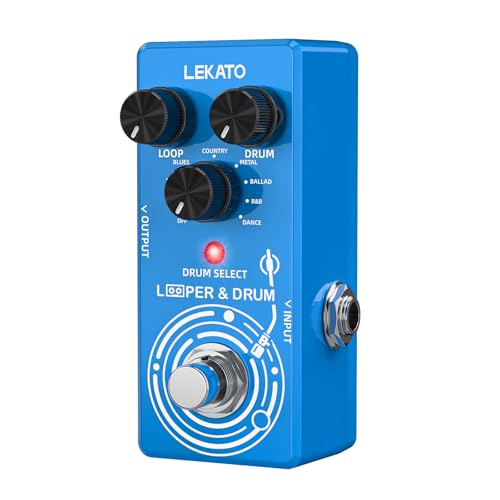
- Looper and drum machine work independently or together
- Eight grooves with tap tempo and phrase sync
- Six minutes of looping with unlimited overdubs
Best For: Solo players who want built-in rhythmic accompaniment
Mini Simplicity Pick

- Compact aluminum-alloy enclosure
- Five minutes of 24-bit looping with unlimited overdubs
- USB import/export and Analog-Dry-Through
Best For: Players seeking a simple, space-saving looping pedal
Best Budget Looper – LEKATO Guitar Looper with Tuner
For musicians who want generous recording capacity without a complicated interface, this LEKATO is a practical choice among looper pedals. It provides nine loops, unlimited overdubbing, a built-in tuner, and USB file transfer for moving WAV loops to and from a computer.
Best For: Players seeking a versatile looper with long recording time, tuner functionality, and included power accessories.
Pros:
- Offers nine loops, up to 10 minutes per recording, and 40 minutes total recording time.
- Uses 48K/24-bit sampling for lossless, uncompressed audio.
- Includes a built-in tuner, USB import/export, and unlimited overdubbing.
- Includes a USB cable and selectable AU/US/UK/EU power supply.
Cons:
- Its single-knob control layout may be less immediate for players wanting extensive onboard control.
- It requires corded power and is specified for a 9V, 0.6A supply.
The LEKATO stands out for recording time and connectivity in a compact pedal. Its visual time indicator and one-button foot commands keep core looping functions accessible, while USB support adds useful practice and performance flexibility.
Best Simple Stereo Looper – Boss RC-1 Loop Station
Boss RC-1 Loop Station | Bundle with Gearlux Power Supply, Instrument Cable, Patch Cable, and Picks
Check Price On AmazonThe Boss RC-1 is a straightforward option for guitarists and other players comparing looper pedals. Its circular 24-segment LED shows whether you are recording, overdubbing, or playing, while stereo inputs and outputs support stereo instruments, effects, and amplifiers.
Best For: Beginners and performers who want simple stereo looping with a clear status display and bundled accessories.
Pros:
- Provides up to 12 minutes of stereo recording time.
- The 24-segment LED loop indicator makes the current mode easy to monitor.
- Recorded phrases remain in memory after the pedal is turned off.
- The bundle includes a power adapter, instrument cable, patch cable, and picks.
Cons:
- The included bundle adds convenience but may be unnecessary for players who already own cables and power supplies.
- Battery operation is rated at approximately 4.5 hours, and the optional PSA adapter is otherwise sold separately.
With stereo I/O, flexible external footswitch options, and a simple operating concept, the RC-1 is well suited to players who prioritize dependable basic looping over advanced rhythm or editing features.
Best Minimalist Looper – TC Electronic Ditto Looper
The TC Electronic Ditto keeps the looper-pedal experience focused on the essentials. Designed for guitarists, it offers five minutes of looping time, unlimited overdubs, undo/redo, true bypass, and analog-dry-through in a compact format.
Best For: Guitarists who want a compact, transparent looper for focused practice and layered parts.
Pros:
- Provides five minutes of loop time with unlimited overdubs.
- Includes undo and redo functions for correcting loop layers.
- True bypass and analog-dry-through preserve the dry signal path.
- Its compact design weighs only 2.72 ounces.
Cons:
- The required 9V power supply is not included.
- It has less recording capacity than the other listed loopers.
- Its minimalist feature set does not include a built-in tuner, USB, or rhythm library.
The Ditto is a strong fit when ease of use and signal transparency matter more than extended memory or connectivity. Its limited controls reduce distractions, making it an approachable choice for building simple guitar loops.
Best Advanced Looper – BOSS RC-5 Loop Station
For players who need deeper control and substantial storage, the BOSS RC-5 is one of the most capable looper pedals in this group. It combines 13 hours of stereo recording, 99 phrase memories, built-in rhythms, a multi-color LCD, MIDI, USB, and 32-bit audio processing.
Best For: Performers and experienced users building detailed looping setups with rhythms, saved phrases, and external control.
Pros:
- Offers 13 hours of stereo recording and storage for 99 phrase memories.
- Includes 57 rhythms with A/B variations and seven drum kits.
- Provides reverse looping, a multi-color LCD, USB, MIDI I/O, and external control support.
- Uses 32-bit AD/DA conversion and 32-bit floating-point processing.
Cons:
- Its extensive feature set may be more than casual players need.
- An optional PSA adapter is listed for extended use, while battery operation is also supported.
- Mini TRS MIDI connections may require compatible cabling for some setups.
The RC-5 is the strongest choice here for complex arrangements and stage-ready flexibility. Its phrase memory, rhythm library, display, and connectivity make it better suited to structured performances than quick, minimalist looping.
Compact Creative Control – MXR Clone Looper
The MXR Clone Looper is a compact choice for guitarists who want straightforward looping without giving up useful performance tools. It records loops up to six minutes, supports unlimited overdubs, and offers reverse, half-speed, and double-speed playback.
Best For: Guitarists who want a small looper pedal with flexible playback options and high-quality loop storage.
Pros:
- Records loops up to six minutes with unlimited overdubs.
- Offers reverse, half-speed, and double-speed playback.
- 88.2kHz loop storage is designed to handle high-gain distortion.
- External control options support tap tempo, output level, and one-time loop playback.
Cons:
- Its compact design provides less recording time and storage than larger multi-track loopers.
- Some external-control features require additional MXR accessories.
The Clone Looper is a practical fit when pedalboard space matters but you still want creative playback functions. Its six-minute capacity is suitable for practice, songwriting, and performance-oriented looping.
Visible Value Pick – Donner Triple Looper
The Donner Triple Looper gives players three independent loop slots and up to 90 minutes of total recording time. Its bright display shows loop status and recording progress, while unlimited overdubs and automatic saving make it useful for practice, songwriting, and live playing.
Best For: Beginners, solo performers, and buskers who want multiple stored loops with clear visual feedback.
Pros:
- Provides three loop slots with up to 30 minutes per loop.
- Bright screen displays loop status, timing, and recording progress.
- Supports unlimited overdubs, undo/redo, and automatic saving.
- True bypass helps preserve the guitar signal when the pedal is off.
Cons:
- The required 9V center-negative, 500mA power supply is not included.
- The listed warranty is six months.
For the money-conscious player, this Donner looper pedal emphasizes capacity and ease of use. The three-slot layout is especially helpful for organizing separate song sections or keeping multiple ideas ready to recall.
Performance Multitrack Choice – HeadRush LOOPER +
The HeadRush LOOPER + is a performance-focused option for musicians who need dual-track operation, extensive storage, and broader connectivity. It combines four looping modes with a full-color display, RGB loop-status ring, USB audio, and microphone, instrument, and MIDI connections.
Best For: Gigging musicians, vocalists, and home-studio users who need advanced multitrack looping and recording features.
Pros:
- Offers single, multi, sync, and song looping modes.
- Stores up to 128 loops with more than three hours of total audio.
- Supports unlimited layering and drag-and-drop loop transfer.
- Works as a 2-in/2-out USB audio interface for recording or streaming.
Cons:
- The larger 6.24-by-8.52-inch chassis and 1.7 kg weight take more pedalboard space.
- Its advanced feature set may be more than a beginner needs.
- Battery operation requires four AA batteries.
The LOOPER + stands out among looper pedals for players building complete arrangements or integrating looping with a computer. Its rugged steel chassis, dual pedals, storage, and connectivity make it suited to demanding live and studio workflows.
Long-Memory Pick – LEKATO 40-Minute Looper With Tuner
For players comparing looper pedals, this LEKATO model stands out for its generous memory, uncompressed 48kHz/24-bit audio, and built-in tuner. It supports up to 40 minutes across nine loops, with individual recordings lasting as long as 10 minutes.
Best For: Guitarists and bassists who want extended looping, unlimited overdubs, and convenient USB file transfer.
Pros:
- Nine loops and up to 40 minutes of total recording time.
- 48kHz/24-bit uncompressed audio with Analog-Dry-Through.
- Built-in tuner operates continuously without interrupting the phrase.
- USB import/export supports WAV loop transfers without a separate driver.
Cons:
- Requires a 9V power source capable of 300mA.
- One-knob control and foot commands favor simplicity over extensive hands-on controls.
This is a practical choice when recording capacity matters more than a compact feature set. The visual time indicator, tuner, and USB connectivity make it especially flexible for practice and arranging.
Drum-Backing Pick – LEKATO 2-in-1 Looper and Drum Machine
This LEKATO combines a looper pedal with a built-in drum machine, giving solo players a rhythm section and looping setup in one compact unit. It offers six minutes of high-fidelity recording, unlimited overdubs, and USB import/export.
Best For: Solo artists, practice sessions, bedroom jamming, and busking with integrated drum backing.
Pros:
- Looper and drum machine can operate independently or simultaneously.
- Eight drum grooves use samples from three acoustic drum kits.
- Tap Tempo and automatic phrase synchronization support flexible practice.
- Independent volume controls help balance loops and drum tracks.
Cons:
- The drum machine’s automatic synchronization supports only 4/4 phrases.
- A 9V DC power adapter and cable are not included.
- Six minutes of loop recording is less than some extended-memory loopers.
Choose this model if rhythmic accompaniment is as important as layering guitar or bass parts. Buffer Bypass, low current draw, and USB connectivity add practical value for pedalboard and computer-based use.
Mini Simplicity Pick – LEKATO ONE Mini Looper Pedal
Among compact looper pedals, the LEKATO ONE focuses on essential controls and a small aluminum-alloy enclosure. It provides five minutes of 24-bit uncompressed looping, unlimited overdubs, and USB transfer for WAV files.
Best For: Guitarists who want an uncomplicated, space-saving looper for basic layering and portable setups.
Pros:
- Ultra-compact aluminum-alloy construction is convenient and sturdy.
- Five minutes of looping with unlimited overdubbing and redo.
- 24-bit uncompressed audio with Analog-Dry-Through.
- USB supports importing and exporting music files.
Cons:
- Five minutes of loop time is limited compared with longer-memory models.
- Its single-knob design provides only essential control.
- It uses a Micro-B USB connection rather than USB-C.
This is a sensible entry-level-style option for players who value straightforward foot operation and minimal pedalboard space. It avoids unnecessary complexity while retaining quality audio and basic computer connectivity.
How We Picked These Looper Pedals
We focused on the features that matter most in real playing situations: recording time, loop storage, overdub capability, undo and redo controls, footswitch layout, sound quality, and ease of use. We also considered whether each pedal includes practical extras such as a tuner, USB connectivity, rhythm patterns, a display, or true bypass.
The selection covers several use cases and budgets rather than treating every looper as interchangeable. Simple pedals can be ideal for learning and spontaneous practice, while more advanced loop stations are better suited to structured performances and complex arrangements.
Quick Comparison
| Best For | Features to Prioritize |
|---|---|
| Beginners | One-button operation, clear status indicators, and simple undo controls |
| Practice | Reliable playback, unlimited overdubs, and a built-in tuner |
| Live performance | Multiple loop memories, dedicated footswitches, and strong visual feedback |
| Solo musicians | Drum patterns, tap tempo, and longer recording capacity |
| Budget setups | Essential looping controls without unnecessary menu navigation |
Key Buying Factors for Looper Pedals
Loop Time and Storage
Check both the maximum recording length and the number of available loop slots. A short loop may be enough for practice, but longer capacity is more useful for complete song sections or live arrangements.
Controls and Footswitches
Basic pedals commonly combine record, overdub, stop, and erase functions on one or two switches. Dedicated controls are easier to manage while playing, especially when you need to undo a layer or change sections quickly.
Rhythm Features
Built-in drum grooves can help keep a loop musical and consistent. Look for adjustable tempo and tap-tempo functionality if you plan to practice without a separate drum machine.
Connectivity and Sound
True bypass and analog-dry-through designs help preserve your original guitar signal. USB connectivity can make it easier to transfer loops or update the pedal, while stereo inputs and outputs may be important for broader rigs.
Who Should Buy Which Looper Pedals?
Choose a straightforward single-loop pedal if you are new to looping, mainly want a practice companion, or prefer minimal setup. Models with a tuner are especially convenient for compact guitar boards.
Intermediate players should consider pedals with longer loop times, unlimited overdubs, and dedicated undo or redo functions. These features provide more freedom when building layered parts without making the workflow overly complicated.
Solo performers and advanced users will benefit most from multiple loop memories, rhythm tracks, tap tempo, and clearer displays. Before buying, confirm the pedal’s power requirements and make sure its footswitch arrangement matches how you perform. The best looper pedal is the one whose controls you can operate confidently without taking your attention away from the music.