The right looper pedal can turn a solo set into a layered performance, adding rhythm, harmony, and texture without requiring extra musicians. The best choice depends on how quickly you need to create loops, how much control you want onstage, and whether built-in drums or multiple loop tracks matter.
We compare 10 popular options across ease of use, recording time, overdub control, live-friendly features, and overall flexibility so you can choose a pedal that fits your instrument, setup, and performance style.
Best 10 Looper Pedals for Live Performances Picks for 2026
Reliable Starter

- Simple record, overdub, play, and undo/redo controls
- 12 minutes of stereo recording time
- 24-segment loop indicator and memory retention
Best For: Players who want uncomplicated live looping
Minimalist Performer

- Compact modern pedal design
- Hands-free footswitch operation
- Analog signal format
Best For: Space-conscious guitar pedalboards
Extended Looping
Donner Triple Looper Guitar Pedal

- Three loop slots with 90 minutes total recording
- Unlimited overdubs with undo/redo
- Bright screen and true-bypass signal path
Best For: Solo performers creating multi-section arrangements
Full-Feature Rig

- 100 slots and 300 minutes of total storage
- Built-in drum machine with 220 patterns
- Touchscreen, dual footswitches, and auto-record
Best For: Performers needing loops, rhythms, and extensive control
Best Simple Looper

- Five minutes of loop time
- Unlimited overdubs with undo/redo
- True bypass and analog-dry-through
Best For: Guitarists wanting a compact, easy-to-operate live looper
Best Looper With Drums

- 140 minutes across 14 save slots
- 121 drum grooves in 11 genres
- Stereo I/O with separate routing options
Best For: Live performers building longer, rhythm-backed stereo loops
Best Looper With Tuner
LEKATO Guitar Looper With Tuner

- Nine loops and 40 minutes total time
- Built-in tuner with continuous switching
- USB WAV import and export
Best For: Players wanting looping, tuning, and computer file management in one pedal
Best Drum-Machine Combo
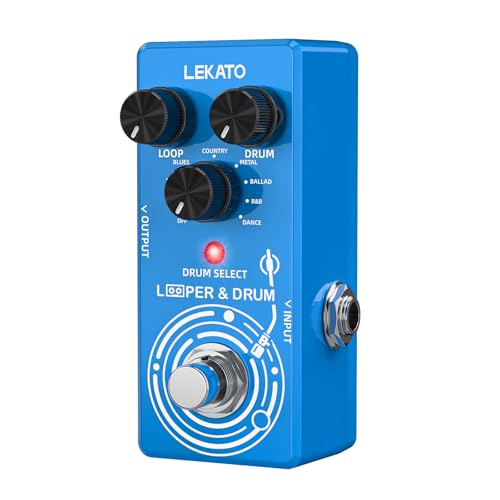
- 6-minute looper with unlimited overdubs
- Eight grooves with real drum samples
- USB-C import/export and dual volume controls
Best For: Solo performers needing loops and drum backing in one pedal
Best Multi-Loop Station

- Three loops with 18 minutes total recording
- SYNC recording and built-in tuner
- Automatic saving and USB WAV transfer
Best For: Performers creating layered multi-part arrangements
Best Simple Mini Looper

- Five minutes of 24-bit looping
- Unlimited overdubs with foot-command controls
- Compact aluminum-alloy design with USB
Best For: Players wanting basic live layering in a small pedal
Reliable Starter – BOSS RC-1 Loop Station
The BOSS RC-1 is a straightforward choice for players seeking looper pedals for live performances. Its simple stompbox layout supports recording, playback, overdubbing, and undo/redo, while the 24-segment indicator makes the current loop mode easy to monitor.
Best For: Guitarists, bassists, and keyboard players who want an easy-to-use live looper.
Pros:
- Simple controls for recording, overdubbing, playback, and undo/redo
- 12 minutes of stereo recording time
- Stereo inputs and outputs with memory retention after power-off
- Includes a 9V battery and carries a five-year BOSS warranty
Cons:
- AC adaptor is sold separately
- Offers less storage and feature depth than larger loopers
The RC-1 focuses on dependable core looping rather than complex song management. It is a practical fit when quick operation and clear visual feedback matter most on stage.
Minimalist Performer – TC Electronic DITTO 2 LOOPER
The TC Electronic DITTO 2 LOOPER is a compact option for musicians comparing looper pedals for live performances. Its footswitch-based design and analog signal format suit players who prefer a focused pedal with a modern, space-conscious form.
Best For: Guitarists who want a compact, dedicated looper for live setups.
Pros:
- Compact dimensions help conserve pedalboard space
- Footswitch control is suited to hands-free performance
- Analog signal format
Cons:
- The supplied notes do not specify recording time or loop-storage capacity
- Requires a 9V power source
The DITTO 2 is best considered when small size and basic foot-controlled operation take priority. Buyers who need detailed memory specifications should verify those capabilities before choosing it.
Extended Looping – Donner Triple Looper Guitar Pedal
The Donner Triple Looper is built for performers who need more room for song sections and layered parts. With three loop slots, up to 90 minutes of total recording time, and a visible status screen, it offers useful control for looper pedals for live performances, practice, and street gigs.
Best For: Solo performers and buskers building verse, chorus, and solo sections.
Pros:
- Three independent loop slots with up to 30 minutes per loop
- 90 minutes of total recording time and unlimited overdubs
- Bright screen shows loop status, progress, and timing
- Auto-save, true bypass, and undo/redo support
Cons:
- Requires a 9V DC, center-negative 500mA supply
- The supplied notes conflict on whether a power adapter is included, so confirm package contents
- Six-month warranty is shorter than some competing options
The Triple Looper stands out for storage and visual guidance without requiring a complicated control scheme. It is a strong choice for performers who need multiple extended loops, provided the power requirements fit their setup.
Full-Feature Rig – MOOER GL100 Looper Pedal
The MOOER GL100 combines looping and rhythm accompaniment for performers who want a more complete live setup. Its 100 memory slots, 300 minutes of total storage, drum machine, auto-record, and quantized alignment make it one of the more feature-rich choices among looper pedals for live performances.
Best For: Musicians who want stored loops, built-in rhythms, and detailed timing control.
Pros:
- 100 memory slots with 300 minutes of total storage
- 220 drum patterns across 11 rhythm styles
- Auto-record, count-in, DrumMatch, and quantized end alignment
- Dual footswitches, touchscreen control, and flexible stereo or split drum output
Cons:
- Its broad feature set may require more setup and learning than a basic looper
- Each memory slot stores up to three minutes of recording
- Requires a 9V, 300mA power source
The GL100 is aimed at performers who value arrangement flexibility over minimal controls. Time-stretching, slot jumping, editor software, and audio import/export add substantial capability for prepared live sets and extended creative work.
Best Simple Looper – TC Electronic Ditto Looper
For guitarists seeking straightforward looper pedals for live performances, the TC Electronic Ditto Looper keeps the controls focused on recording and layering phrases. It provides up to five minutes of loop time, unlimited overdubs, and undo/redo functions in a compact pedal.
Best For: Guitarists who want an uncomplicated, transparent-sounding looper for live layering.
Pros:
- Up to five minutes of looping time with unlimited overdubs
- Undo and redo functions support flexible live editing
- True bypass and analog-dry-through help preserve the dry signal
- Compact, lightweight design with a simple control layout
Cons:
- Requires a separate 9V power supply providing at least 100mA
- Offers looping only, without a built-in drum machine or tuner
The Ditto Looper is a focused choice when ease of use and signal transparency matter more than expanded storage or rhythm features. Its limited control set can be an advantage during a busy performance.
Best Looper With Drums – MOOER Groove Loop X2
The MOOER Groove Loop X2 is built for performers who want looper pedals for live performances with rhythm support and expanded storage. It combines a stereo looper, drum machine, and file-management features in one pedal.
Best For: Performers who need stereo looping, built-in drum grooves, and longer saved arrangements.
Pros:
- Fourteen save slots with up to 10 minutes per loop, totaling 140 minutes
- Built-in drum machine offers 121 grooves across 11 genres
- Automatic, count-in, and normal recording modes provide performance flexibility
- Stereo inputs and outputs, separate routing, and external footswitch support
Cons:
- Requires a 9V DC, 300mA center-negative adapter
- Larger and heavier than a basic single-function looper
- Its broader feature set may require more setup and operation familiarity
With extensive loop storage, tempo tools, drum synchronization, and stereo connectivity, the Groove Loop X2 suits more elaborate live rigs. Its editor software also supports importing and exporting audio files.
Best Looper With Tuner – LEKATO Guitar Looper With Tuner
The LEKATO Guitar Looper combines looping, tuning, and computer file transfer in a practical pedal for live performers. It supports up to 40 minutes of total recording time across nine loops, with individual recordings lasting up to 10 minutes.
Best For: Players who want a looper with an integrated tuner, USB transfers, and included power accessories.
Pros:
- Nine loops with up to 40 minutes of total recording time
- Built-in tuner supports continuous switching without an interruption
- USB import and export enables WAV loop file management with a computer
- Includes a USB cable and 9V power supply
Cons:
- Single-knob operation provides limited direct control over playback volume
- The supplied adapter is rated at 0.6A, so replacement power supplies must be matched carefully
The LEKATO is a versatile middle ground for players who value practical extras alongside looping. Its visual time indicator, tuner, and USB workflow can be useful for preparing and managing live material.
Best Drum-Machine Combo – LEKATO Looper Drum Machine
For musicians comparing looper pedals for live performances, this LEKATO combines a high-quality looper with a built-in drum machine. Independent or simultaneous operation, automatic saving, and dual volume controls make it practical for solo sets, street performances, and layered arrangements.
Best For: Solo performers who want loop layering and drum backing in one compact pedal.
Pros:
- Combines a 6-minute looper with eight drum grooves and real acoustic drum samples.
- Supports unlimited overdubs, undo/redo, and automatic saving.
- USB-C import/export and independent looper and drum volume controls add performance flexibility.
- Buffer bypass helps preserve tone through longer cable runs and larger pedalboards.
Cons:
- Power supply and cable are not included.
- Automatic drum tempo sync supports only phrases in 4/4 time.
- Its drum-focused feature set may be more than needed for basic looping.
This is a strong all-in-one choice when live performance arrangements benefit from both rhythmic accompaniment and layered loops, particularly if you want computer file management through USB.
Best Multi-Loop Station – LEKATO 3-Loop Looper Pedal
This LEKATO is a versatile option among looper pedals for live performances, with three loop slots, synchronization recording, and up to 18 minutes of total recording time. Its visual time indicator, tuner, and USB file transfer support make it suited to more involved sets.
Best For: Guitarists and bassists building multi-part live arrangements with several saved loops.
Pros:
- Provides three loops, up to six minutes per loop, and 18 minutes total recording time.
- SYNC recording can start during playback to reduce missed entries.
- Includes a tuner, unlimited overdubbing, undo/redo, and separate foot-command functions.
- Automatically saves recordings and supports WAV import/export through USB.
Cons:
- Requires a 9V center-negative power supply, which is not included.
- The broader feature set may take more practice than a basic one-button looper.
- Its listed current requirement is 300mA, so power compatibility should be checked.
With multiple loop slots and synchronization features, this pedal offers useful flexibility for performers who need to organize several parts rather than rely on one continuously replaced loop.
Best Simple Mini Looper – LEKATO ONE Looper Pedal
If you want straightforward looper pedals for live performances, the LEKATO ONE focuses on essential controls in a compact aluminum-alloy enclosure. It offers five minutes of uncompressed looping, unlimited overdubs, and foot-command access to the core functions.
Best For: Players who want a small, uncomplicated looper for basic live layering.
Pros:
- Compact aluminum-alloy construction is designed for convenient, sturdy use.
- Offers five minutes of 24-bit uncompressed looping with unlimited overdubs.
- Analog dry-through preserves the dry signal’s analog path.
- USB supports WAV import/export, and the package includes a power supply according to the selected option.
Cons:
- It provides only a single looping section rather than multiple loop slots.
- Controls are intentionally limited, with one knob for playback volume.
- Power requirements are 9V and 300mA, so replacement supplies must match those specifications.
This is the most focused choice of the three for musicians who value a small footprint and uncomplicated operation over drum accompaniment or multiple loop memories.
How We Picked These Looper Pedals for Live Performances
We focused on features that matter during rehearsals, gigs, and solo performances rather than treating maximum specifications as the only measure of quality. The lineup includes straightforward loopers for beginners, compact pedals for small boards, and more capable models with multiple loops, drum patterns, tuning, USB connectivity, or synchronization features.
Our comparisons emphasize footswitch usability, loop capacity, overdub and undo/redo functions, audio-routing flexibility, bypass behavior, and practical value. A good live looper should be predictable under pressure, easy to hear clearly, and compatible with the rest of your signal chain.
Quick Comparison
| What to prioritize | Best fit |
|---|---|
| Simple recording and playback | Single-loop pedals with intuitive controls |
| Layered arrangements | Models with multiple loops or generous recording time |
| Rhythmic solo performances | Loopers with built-in drum machines and tap tempo |
| Fast setup and practice | Pedals with tuners, clear displays, or USB transfer |
| Flexible pedalboard integration | True-bypass or analog-dry-through designs with suitable stereo I/O |
Key Buying Factors for Live Performances
Loop Control and Timing
Look for dependable footswitch behavior and controls that are easy to distinguish while standing. Dedicated undo/redo functions are especially useful when an unwanted overdub would otherwise force you to start again. Multiple independent loops can support more complex arrangements, but they also require more practice.
Recording Time and Memory
Check both the maximum loop length and whether the pedal offers multiple saved phrases. A short loop may be sufficient for riffs and repeating chord patterns, while longer capacity is more useful for song sections, transitions, or extended improvisation. Confirm whether advertised time is total memory or time per loop.
Drums, Sync, and Connectivity
Built-in drum grooves can provide a strong foundation for solo performers, but they add controls and may take practice to operate smoothly. Tap tempo is valuable for keeping patterns aligned with a song. USB can help with backups or transferring loops, while sync functions matter when using other tempo-based pedals or equipment.
Signal Flow and Power
Verify input and output types, mono or stereo operation, bass compatibility, and power requirements before buying. Analog-dry-through or true bypass can help preserve your instrument’s dry signal when the effect is inactive. Use the recommended adapter and check your pedalboard’s current capacity, especially with drum-enabled models.
Who Should Buy Which Looper Pedals for Live Performances?
Beginners and minimalists: Choose a simple, clearly labeled looper with one main loop and uncomplicated controls. It is easier to learn timing and footswitch technique without menu diving.
Solo performers: Prioritize longer recording time, reliable overdubs, built-in drums, and a tuner if the pedal will be the center of your setup.
Arrangement-focused players: Consider multiple loops, memory options, undo/redo, and stereo routing for songs that need separate sections or layered parts.
Compact pedalboard users: Favor small enclosures and straightforward power requirements, but do not sacrifice switch spacing if you perform standing up. The best Looper Pedals for Live Performances are the ones you can operate confidently while listening to the band, audience, and room.