The best looper pedals for home studios make it easier to practice, write songs, build layered arrangements, and record ideas without a complicated setup. The right model depends on whether you prioritize simple one-button operation, multiple tracks, drum patterns, effects, or computer connectivity.
We’ve gathered 10 options across beginner, performance, and production-focused categories so you can match features and workflow to your available space, equipment, and budget.
Best 10 Looper Pedals for Home Studios Picks for 2026
Best Beginner Pick

- 12 minutes of stereo recording
- Clear 24-segment loop indicator
- Simple overdub, undo, and redo controls
Best For: Beginners and home-studio musicians wanting an easy stereo looper
Best Minimalist Choice

- Five minutes of loop time
- Unlimited overdubs with undo/redo
- True bypass and analog-dry-through
Best For: Guitarists wanting a compact, straightforward looper
Best Advanced Studio Hub
Aeros Loop Studio Gold Edition
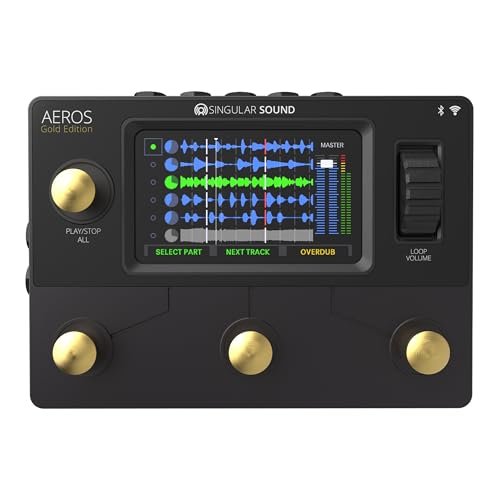
- Six stereo tracks and six song parts
- Up to 10 hours per song
- Touchscreen mixer and broad connectivity
Best For: Producers and multi-instrumentalists creating complex loop arrangements
Best Value With Tuner

- Nine loops and 40 minutes total recording
- Built-in tuner with uninterrupted switching
- USB WAV import/export and 48kHz/24-bit audio
Best For: Guitarists wanting storage, tuning, and USB file transfer
Premium Studio Looper

- Four looping modes with color display
- Stores 128 loops and over three hours of audio
- 2-in/2-out USB interface for DAW recording
Best For: Home studios needing advanced looping and computer integration
Budget Looping Essential

- Nine loops with 40 minutes of total recording
- Unlimited overdubs and simple foot commands
- Built-in tuner and USB loop-file transfers
Best For: Budget-conscious guitar and bass home-studio setups
Best Visual Looper

- Three loop slots with 90 minutes total recording time
- Bright screen and simple single-footswitch control
- Unlimited overdubs, auto-save, and true bypass
Best For: Home-studio players who prioritize long loop storage and visual feedback
Best All-in-One Setup

- 80-second stereo looper with drums and metronome modes
- Amp modeling, effects, presets, and expression control
- USB-C and OTG connectivity for editing and recording
Best For: Home studios seeking looping plus comprehensive guitar processing
Best Looper With Drums
LEKATO LP-02 Looper Drum Machine
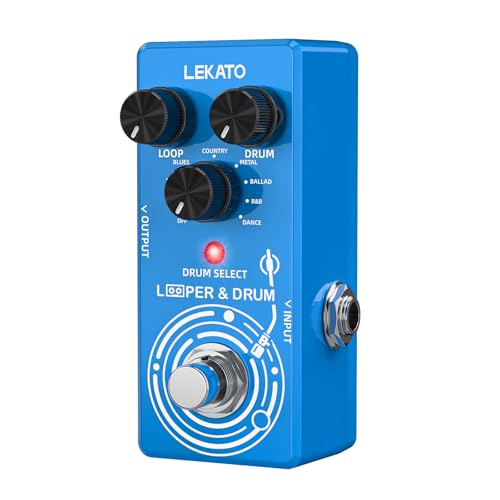
- Six-minute high-fidelity looper with unlimited overdubs
- Eight grooves with sampled acoustic drum kits
- USB import/export, tap tempo, and independent volume controls
Best For: Bedroom jam sessions and songwriting with built-in rhythmic backing
Best Beginner Pick – BOSS RC-1 Loop Station
For musicians seeking approachable looper pedals for home studios, the BOSS RC-1 keeps the workflow simple. Its intuitive loop indicator, stereo connectivity, and straightforward record, playback, overdub, undo, and redo functions suit guitar, bass, and keyboard players.
Best For: Beginners and home-studio musicians who want a dependable, easy-to-use stereo looper.
Pros:
- Simple controls and a 24-segment LED loop indicator
- Supports up to 12 minutes of stereo recording
- Allows unlimited-feeling creative layering through overdubs, undo, and redo
- Retains recorded phrases after the pedal is turned off
Cons:
- AC adapter is optional and sold separately
- Included battery provides approximately 4.5 hours of use
The RC-1 is a practical starting point when ease of operation matters more than advanced production features. Its compact stompbox design and five-year BOSS warranty add useful reassurance for regular studio practice.
Best Minimalist Choice – TC Electronic DITTO LOOPER
The TC Electronic DITTO LOOPER is a focused option among looper pedals for home studios, offering a guitar-oriented interface with five minutes of loop time and unlimited overdubs. True bypass and analog-dry-through are designed to preserve the instrument signal when the effect is not engaged.
Best For: Guitarists who prefer a compact, transparent looper with only the essential controls.
Pros:
- Five minutes of loop time with unlimited overdubs
- Undo and redo functions support quick experimentation
- True bypass and analog-dry-through help maintain the dry signal
- Compact, guitarist-focused design
Cons:
- Requires a 9V power supply providing 100mA or more
- Power supply is not included
- Offers less recording capacity than larger multi-track loopers
Choose the DITTO when a streamlined guitar looper is more useful than extensive storage or connectivity. It is uncomplicated and transparent, but its short loop time and external power requirement may limit more ambitious setups.
Best Advanced Studio Hub – Aeros Loop Studio Gold Edition
Aeros Loop Studio Gold Edition - 6 Track, Stereo Looper Pedal | Touch Screen and Hands Free Mixing
Check Price On AmazonFor complex arrangements, the Aeros Loop Studio Gold Edition stands out among looper pedals for home studios with six song parts, six stereo tracks per song, and unlimited overdubs. Its touchscreen mixer, 32-bit floating-point audio, and USB, Wi-Fi, Bluetooth, and MIDI-related connectivity support more involved production workflows.
Best For: Multi-instrumentalists, vocalists, and loop-based producers building detailed arrangements.
Pros:
- Supports six song parts and six stereo tracks per song
- Records up to 10 hours per song and stores over 48 hours with a 32GB SD card
- Includes Reverse, Fade In/Out, and Loop Decay effects
- Touchscreen mixing plus USB, Wi-Fi, and Bluetooth connectivity
Cons:
- Large and heavy compared with basic stompbox loopers
- 32GB SD card is not included
- Requires a 9V, 300mA power source
The Aeros is suited to creators who want a looper that can function as a central arrangement tool rather than a simple phrase recorder. Its expanded feature set and storage potential are compelling, though the larger footprint and higher power demand may be excessive for basic practice.
Best Value With Tuner – LEKATO Guitar Looper Pedal
The LEKATO Guitar Looper combines looping, tuning, and computer file transfer in a practical package for home studios. It provides nine loop slots, up to 40 minutes of total recording time, USB import/export, and 48kHz/24-bit sampling for detailed phrase work.
Best For: Guitarists who want generous loop storage, an integrated tuner, and USB WAV-file management.
Pros:
- Nine loops with up to 10 minutes per single recording
- 40 minutes of total recording time
- Built-in tuner supports continuous switching without interrupting the phrase
- USB import/export and 48kHz/24-bit sampling
Cons:
- Requires the supplied 9V, 0.6A power adapter for operation
- Single-knob design may offer less immediate control than multi-control loopers
The LEKATO is a versatile budget-minded choice for players who value storage and computer access alongside basic looping. Its tuner and USB workflow make it particularly practical for songwriting and practice, while the one-button foot-command system keeps the core functions compact.
Premium Studio Looper – Dual-Track Looper Pedal
For home studios that need serious looping and recording flexibility, the Dual Track Looper Pedal combines a color display, multiple looping workflows, generous internal storage, and USB audio connectivity. Its microphone and stereo instrument inputs also make it suitable for guitar, bass, keyboards, and vocals.
Best For: Home-studio musicians who want advanced looping, loop storage, and direct DAW or streaming integration.
Pros:
- Offers single, multi, sync, and song looping modes.
- Stores up to 128 loops and more than three hours of total audio.
- Works as a 2-in/2-out USB audio interface for recording or streaming.
- Includes a full-color display, RGB loop status ring, and two rugged pedals.
Cons:
- Larger and heavier than a basic single-switch looper.
- Requires a 9V, 500mA power supply or four AA batteries.
With its extensive storage and USB workflow, this is the most studio-oriented choice in the group. It is especially compelling if you want to build layered arrangements and move loop files between the pedal and computer.
Budget Looping Essential – LEKATO Looper and Tuner
The LEKATO Looper is a compact option for home studios that want straightforward looping without a large multi-effects unit. It provides unlimited overdubs, 40 minutes of total recording time, USB loop-file transfers, and a built-in tuner in a small pedal format.
Best For: Guitarists and bassists who want an affordable, simple looper with tuning and basic computer file management.
Pros:
- Provides nine loop slots and up to 40 minutes of total recording time.
- Supports unlimited overdubbing with undo, redo, stop, and erase commands.
- Uses 48kHz/24-bit uncompressed audio with analog dry-through.
- Includes a built-in tuner and USB upload/download capability.
Cons:
- Single-knob operation and one-button foot control are less expansive than multi-track designs.
- Designed around 1/4-inch mono/TS connectivity rather than broader studio I/O.
This pedal is a practical starting point for basic songwriting, practice, and layered guitar or bass parts. Choose it when compact size and ease of use matter more than multiple tracks or extensive routing.
All-in-One Studio Rig – Donner Arena 2000
The Donner Arena 2000 suits home studios where looping is only one part of the setup. Alongside a 60-second looper, it includes drum rhythms, amp and cabinet modeling, 278 effect types, headphone output, USB-C, MIDI, and XLR connections for a broad recording and performance workflow.
Best For: Guitarists who want looping combined with amp modeling, effects, drum backing, headphones, and flexible studio or live connections.
Pros:
- Combines a 60-second looper with 40 drum rhythms for demo creation.
- Includes 278 effects, 80 amp simulations, and 50 cabinet simulations.
- Offers headphone output for late-night practice and creation.
- Provides USB-C, MIDI, AUX, and XLR connectivity, plus third-party IR support.
Cons:
- The 60-second looper is shorter than the recording capacity of the dedicated loopers.
- Its extensive effects and routing may require more setup than a simple looper.
- Does not include a battery compartment.
For a home studio centered on guitar production, the Arena 2000 delivers the broadest sound-shaping toolkit of these options. Its looper is useful for sketches and one-person arrangements, while the drum machine and modeling expand its role beyond looping.
Best Visual Looper – Donner Triple Looper
For home studios needing straightforward looping with plenty of storage, the Donner Triple Looper offers three independent loop slots, a bright status screen, and up to 90 minutes of total recording time. Its single-footswitch workflow keeps recording, overdubbing, undoing, and clearing accessible without a complicated setup.
Best For: Bedroom producers, songwriters, and solo guitarists who want long recording times and clearly visible loop status.
Pros:
- Three independent loop slots, with up to 30 minutes per slot.
- Bright screen displays loop status, recording progress, and timing.
- Unlimited overdubs, auto-save, and true bypass help support layered recording.
- Compact 2.36-by-2.36-inch footprint.
Cons:
- Power adapter is not included and requires a 9V DC, center-negative supply.
- One footswitch may be less immediate for complex hands-free control.
The Donner is a practical choice when loop capacity and simple operation matter more than extensive effects or rhythm features. The visual display and auto-save function are especially useful for developing song sections in a home studio.
Best All-in-One Setup – MOOER GE150 Pro
The MOOER GE150 Pro is more than a looper pedal for home studios: it combines an 80-second stereo looper with amp modeling, cabinet simulations, effects, drums, USB-C connectivity, and phone-friendly OTG recording. It suits players who want one unit for practice, tone shaping, and quick recording.
Best For: Guitarists building flexible home-studio rigs around amp modeling, effects, looping, and direct recording.
Pros:
- Includes 200 presets, 170 effects, 55 amp models, and 26 cabinet simulations.
- 80-second stereo looper works alongside 40 drum rhythms and 10 metronome modes.
- USB-C supports computer editing, data management, firmware updates, and OTG recording.
- Four multipurpose footswitches and an expression pedal provide broad control.
Cons:
- The looper has less recording time than dedicated long-duration loop pedals.
- Its larger feature set may require more setup and navigation than a simple looper.
- The standard model is corded electric rather than battery powered.
Choose the GE150 Pro if your home studio needs a complete guitar workstation rather than a standalone looper. Its USB, AUX, headphone, and OTG options make it particularly versatile for silent practice and recording workflows.
Best Looper With Drums – LEKATO LP-02 Looper Drum Machine
The LEKATO LP-02 combines a 6-minute looper with a built-in drum machine, making it a compact option for home studios focused on practice and songwriting. Its independent volume controls, tap tempo, unlimited overdubs, and USB import/export support make it easy to build and manage layered ideas.
Best For: Bedroom musicians who want loop recording and realistic drum backing in a small, low-current pedal.
Pros:
- 2-in-1 looper and drum machine can operate independently or together.
- Provides 6 minutes of 44.1kHz/24-bit recording with unlimited overdubs.
- Eight drum grooves use samples from three professional acoustic drum kits.
- USB import/export, auto-save, dual volume controls, and tap tempo add workflow flexibility.
Cons:
- Six minutes of loop time is more limited than some extended-loop models.
- Automatic drum synchronization supports only phrases in 4/4 time.
- Power adapter and cable are not included.
The LP-02 is a strong fit when rhythmic practice is as important as looping. Its small footprint and less-than-80mA current draw suit compact pedalboards, while USB transfer helps move ideas between the pedal and a computer.
How We Picked the Best Looper Pedals for Home Studios
We focused on the features that matter most in a home setup: recording time, overdub and undo functions, track organization, sound quality, connectivity, controls, and ease of use. We also included both dedicated loopers and multi-effects units with looping built in, since a compact all-in-one pedal can be useful when desk or pedalboard space is limited.
Because home musicians have different workflows, the selection spans straightforward single-loop pedals, multi-track systems, loopers with drum machines, and processors that combine amp modeling, effects, and recording tools.
Quick Comparison
| Best For | What to Look For |
|---|---|
| Beginners | Clear footswitches, simple controls, and dependable undo or redo functions |
| Layered songwriting | Long recording time, unlimited overdubs, and easy loop management |
| Full arrangements | Multiple synchronized tracks, stereo operation, and section control |
| Practice sessions | Built-in drum patterns, tap tempo, and quick start/stop operation |
| Compact rigs | Integrated effects, amp modeling, tuner, and USB connectivity |
Key Buying Factors for Looper Pedals for Home Studios
Loop Time and Track Layout
Check both the total recording time and how that time is organized. A basic looper may provide one continuous phrase, while a multi-track model can separate verses, choruses, or rhythm and lead parts. Longer loop time is useful for songwriting, but track control may matter more than raw minutes.
Controls and Footswitch Workflow
Home use does not eliminate the need for reliable foot control. Look for clearly defined record, play, stop, and overdub actions. Dedicated undo and redo controls reduce mistakes, while displays can make saved loops and track status easier to manage.
Sound, I/O, and Connectivity
Analog-dry-through and true bypass can help preserve your instrument’s direct tone. Stereo inputs and outputs are important for keyboards, stereo effects, or wider recordings. USB may support backups, firmware updates, or computer integration, but confirm exactly what the connection supports before buying.
Extra Features
Drum grooves, tap tempo, tuners, effects, amp models, MIDI, and microphone support can expand a pedal’s usefulness. These features are valuable when they simplify your setup, but a feature-heavy unit may take longer to learn than a dedicated looper.
Who Should Buy Which Looper Pedals for Home Studios?
Choose a simple single-track pedal if you want fast, reliable practice or occasional layering with minimal setup. Guitarists writing complete arrangements should consider a multi-track looper with independent sections and longer recording capacity. If you want rhythm accompaniment, prioritize a model with built-in drums and tap tempo.
A multi-effects processor with looping is a strong choice for players who also need amp modeling, cabinet simulation, presets, and a broad effects library. Conversely, dedicated loopers are usually easier to operate and may be the better fit for a focused home recording chain. Before buying, verify input and output compatibility with your instrument, amplifier, interface, headphones, and any stereo equipment you plan to use.