The best field recorder with Bluetooth control can make recording easier by adding wireless monitoring, app access, remote operation, or phone connectivity to a compact audio setup.
This roundup covers options for filmmakers, musicians, podcasters, interviewers, and note-takers, including 32-bit float models, multitrack recorders, AI transcription devices, and Bluetooth-enabled call recorders.
Best 10 Field Recorder with Bluetooth Control Picks for 2026
Best Pro XLR Pick

- 32-bit float recording with dual AD converters
- Two locking XLR inputs and low-noise preamps
- BTA-1 adapter enables compatible Zoom wireless control
Best For: Professional two-channel XLR field recording
Best Pocket Wireless Recorder

- 32-bit float recording with locking 3.5mm input
- Sidus Audio Bluetooth control up to 75 meters
- Includes lavalier mic and supports timecode
Best For: Portable filmmaking and lavalier-based production
Best Lavalier Option

- Compact 32-bit float lavalier recorder
- F2 Control app offers Bluetooth settings and transport control
- Includes 32GB card and fuzzy windbuster
Best For: Remote-controlled interviews and spoken-word recording
Best Built-In Stereo Recorder

- 32-bit float stereo recording with X/Y microphones
- Captures sources up to 130 dB SPL
- Functions as a USB microphone across major platforms
Best For: Stereo ambient, music, podcast, and USB recording
Wireless Multi-Unit Recorder

- Three mics with nine recording patterns
- 32-bit float recording reduces clipping concerns
- Bluetooth control and multi-unit timecode sync
Best For: Music, podcasts, film, and flexible field capture
Touchscreen Bluetooth Recorder

- Large touchscreen plus physical controls
- Offline speech-to-text and voice activation
- Expandable storage up to 1TB
Best For: Meetings, lectures, interviews, and everyday note capture
Professional Production Pick
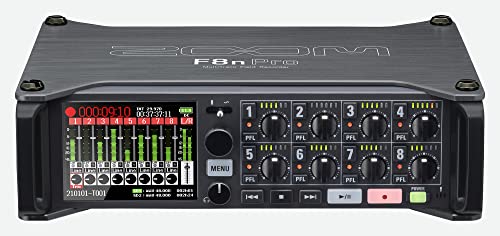
- Eight inputs and 10-track recording
- 32-bit float capture with dual SD backup
- Wireless Bluetooth control and accurate timecode
Best For: Filmmakers and professional location sound crews
Smart Note-Taking Choice

- Bluetooth app control with 64GB storage
- Transcribes and summarizes in 152 languages
- 35-hour battery with noise cancellation
Best For: Meetings, lectures, interviews, and field research
Phone Call Recording Pick

- Records both sides of Bluetooth phone calls
- Standalone recorder with built-in speaker
- USB plug and up to 12-hour battery life
Best For: Phone calls, dictation, meetings, and basic voice notes
Best Pro XLR Pick – Zoom F3 Bluetooth Bundle
If you need a field recorder with bluetooth control and professional XLR connectivity, the Zoom F3 bundle is a strong choice. Its 32-bit float recording and dual AD converters reduce the need for gain adjustment, while the included BTA-1 adapter enables wireless control for compatible Zoom recorders.
Best For: Sound designers, podcasters, and filmmakers who need compact, clean two-channel XLR recording.
Pros:
- 32-bit float recording helps capture wide dynamic range without setting gain.
- Two locking XLR inputs and low-noise preamps support professional microphones.
- Compact metal housing includes mounting bars and a tripod mount.
- Included BTA-1 provides Bluetooth control for compatible Zoom recorders.
Cons:
- It is a two-track recorder rather than a larger multitrack unit.
- Bluetooth control is intended for compatible Zoom recorders.
- The built-in microphone format may not suit users seeking integrated microphones.
The F3 bundle stands out when dependable XLR inputs and 32-bit float capture matter more than onboard microphones. It is a practical portable setup for controlled remote operation within the compatible Zoom ecosystem.
Best Pocket Wireless Recorder – Deity PR-2
The Deity PR-2 is a field recorder with bluetooth control designed for compact production setups. Its locking 3.5mm input accepts lavalier, line, or shotgun-microphone sources, while the Sidus Audio app supports wireless monitoring and control from up to 75 meters.
Best For: Videographers, journalists, and filmmakers who want pocket-sized recording with app control and timecode support.
Pros:
- Supports both 24-bit and 32-bit float recording for flexible gain handling.
- Bluetooth app control and monitoring work from up to 75 meters away.
- Includes a W.Lav Pro lavalier microphone.
- Offers timecode compatibility, USB sound-card functionality, and up to 30 hours of battery life.
Cons:
- Its single locking 3.5mm input is less suitable for multiple XLR sources.
- The recorder uses two AA batteries rather than an internal rechargeable battery.
- Wireless control depends on the Sidus Audio app and Bluetooth connection.
Choose the PR-2 when portability, lavalier workflows, and remote app operation are central to your setup. Its timecode and computer-streaming features add useful flexibility for production work.
Best Lavalier Option – Zoom F2-BT Bundle
For a field recorder with bluetooth control that stays out of the way, the Zoom F2-BT is a compact lavalier-focused option. It records 32-bit float audio directly to microSD cards and connects to the F2 Control app for settings adjustment and remote transport control.
Best For: Interviews, presentations, and video production using a lavalier microphone.
Pros:
- 32-bit float recording minimizes clipping concerns and gain adjustment.
- Built-in Bluetooth supports F2 Control app settings and remote transport control.
- Records 44.1kHz/32-bit or 48kHz/32-bit audio files.
- Supports microSD and SDHC cards up to 512GB, with a 32GB card included.
Cons:
- Its lavalier-oriented design is less versatile than an XLR recorder.
- Remote control features are specific to the Bluetooth model and F2 Control app.
- It is intended for compact single-source recording rather than multitrack work.
The F2-BT is a straightforward choice for creators who want a small recorder attached to a subject and controlled remotely. The included lavalier accessories make it especially practical for spoken-word capture.
Best Built-In Stereo Recorder – Xvive XV1-R
The Xvive XV1-R is a practical alternative for shoppers comparing a field recorder with bluetooth control against a self-contained stereo recorder. Its X/Y microphones capture up to 130 dB SPL, and 32-bit float recording, auto-record, and pre-record features support concerts, podcasts, and location work.
Best For: Musicians, podcasters, and filmmakers who need built-in stereo microphones and USB microphone functionality.
Pros:
- Stereo 32-bit float recording supports high-dynamic-range sources without constant gain adjustment.
- X/Y microphones capture up to 130 dB SPL without distortion according to the supplied specifications.
- Supports WAV up to 96kHz plus compressed AAC recording options.
- Works as a USB microphone with PC, Mac, iOS, and Android devices.
Cons:
- The supplied specifications list no headphone jack.
- Bluetooth control is not identified among the supplied features.
- Battery and recording life are listed at up to 12 hours, less than some competing options.
The XV1-R is best viewed as a self-contained stereo recorder rather than a Bluetooth-controlled model. Its built-in X/Y microphones and USB function make it convenient for ambient recording, live sources, and computer-based audio.
Earbud-Controlled AI Recorder – HiDock P1
The HiDock P1 is a practical choice if you want a field recorder with bluetooth control that works through Bluetooth earbuds. Its Call, Room, and Whisper modes cover meetings, interviews, conferences, and quick voice notes, while the companion app adds transcription and summaries.
Best For: Remote meetings, interviews, students, and professionals who want discreet recording with AI-assisted organization.
Pros:
- Records through compatible Bluetooth earbuds using BlueCatch technology.
- Three recording modes support calls, room recording, and spontaneous notes.
- Includes free transcription support and summaries through the HiNotes app.
- Local-first recording storage and encrypted cloud processing support privacy.
Cons:
- Its feature set depends on the companion app and compatible Bluetooth earbuds.
- Designed around MP3 recording rather than the higher-resolution WAV format listed for some dedicated recorders.
The P1 stands out for hands-free, discreet capture rather than traditional microphone versatility. Choose it when Bluetooth-earbud recording and transcription are more important than advanced multi-pattern field recording.
Wireless Multi-Unit Recorder – Zoom H2 Essential
The Zoom H2 Essential is a strong field recorder with bluetooth control for musicians, podcasters, filmmakers, and journalists. Its three microphones and nine selectable patterns provide flexible mono, stereo, and surround-style capture, while 32-bit float recording helps reduce clipping concerns.
Best For: Creators who need flexible microphone patterns, clip-free recording, USB microphone operation, and wireless synchronization between multiple units.
Pros:
- Three built-in microphones offer nine selectable recording patterns.
- 32-bit float recording captures audio without requiring constant gain adjustments.
- Can operate as a USB microphone while recording a backup to an SD card.
- Bluetooth supports wireless control and timecode synchronization between multiple H2 Essential units.
Cons:
- Requires two AA batteries, unlike models with built-in rechargeable batteries.
- Its Bluetooth features are focused on control and synchronization rather than Bluetooth-earbud recording.
The H2 Essential is the most capable option here for conventional field recording and multi-source capture. It is a better fit than an AI-focused recorder when clean, flexible audio acquisition is your primary goal.
Touchscreen Bluetooth Recorder – Innioasis R1
The Innioasis R1 combines Bluetooth connectivity, a large touchscreen, voice activation, and offline speech-to-text in a compact digital recorder. For shoppers seeking a field recorder with bluetooth control, it offers straightforward touchscreen operation alongside physical buttons and several scenario-specific recording modes.
Best For: Students, office workers, journalists, and anyone who values touchscreen control, long recording sessions, and offline transcription.
Pros:
- 3.69-inch touchscreen provides full touch control while retaining physical buttons.
- Recording modes include interview, meeting, lecture, pocket, and general settings.
- Built-in offline speech-to-text can produce exportable transcripts.
- Supports scheduled and automatic recording, password protection, and storage expansion up to 1TB.
Cons:
- The supplied details do not specify a particular Bluetooth control workflow.
- Ships with 8GB of internal storage, with expanded capacity requiring an external SD card.
- Its built-in battery is rechargeable but not user-replaceable according to the supplied specifications.
The R1 is a feature-rich everyday recorder centered on accessibility and organization. Select it for touchscreen convenience and offline transcription, especially when you need long-form meeting or lecture recording rather than advanced microphone pattern control.
Professional Production Pick – Zoom F8n Pro
If you need a field recorder with bluetooth control for film or location work, the Zoom F8n Pro is built for multi-channel production. It combines eight inputs, 10-track recording, 32-bit float capture, and wireless control in a recorder designed for demanding shoots.
Best For: Filmmakers, location sound mixers, and professional field recording setups.
Pros:
- 32-bit float recording and dual AD converters help capture clip-free audio across a wide dynamic range.
- Eight inputs, 10 tracks, and preamps offering up to 75dB of gain support complex production setups.
- Dual SD slots enable redundant recording, while accurate 0.2ppm timecode keeps tracks aligned with picture.
- Can function as an 8-in/4-out USB audio interface while recording to SD cards.
Cons:
- At 1.8 kg, it is substantially heavier than compact voice recorders.
- Its professional feature set may be more than casual users need.
- Battery life is listed at approximately 8.5 hours.
The F8n Pro is the strongest choice here for serious production audio, especially when multiple microphones, backup recording, timecode, and clip-resistant capture matter more than portability.
Smart Note-Taking Choice – YESTRYS AI Voice Recorder
For buyers seeking a field recorder with bluetooth control for meetings, lectures, or interviews, this YESTRYS model focuses on automatic transcription rather than multi-channel production. Its app control, 64GB storage, and AI tools make it suited to turning spoken recordings into organized notes.
Best For: Students, professionals, researchers, and travelers who want transcription and summaries.
Pros:
- GPT-4o-powered transcription and summarization can help convert recordings into usable notes.
- Supports transcription and summaries in 152 languages.
- 64GB of storage is rated for more than 500 hours of audio, with encrypted cloud backup through the app.
- Offers a 35-hour battery and noise-cancellation-focused microphone system.
Cons:
- Its main focus is voice notes and AI processing, not professional multitrack field recording.
- Advanced transcription and templates depend on the included one-year premium access.
- The supplied details do not specify a standard headphone output.
This recorder is a practical match for documentation-heavy work. Choose it when app-based control, long battery life, and searchable AI-generated notes are more valuable than timecode or multiple microphone inputs.
Phone Call Recording Pick – RecorderGear PR200
The RecorderGear PR200 is a compact option if your priority is a field recorder with bluetooth control for phone calls. It records both sides of conversations from compatible Bluetooth phones and also works as a standalone recorder for meetings, lectures, dictation, and memos.
Best For: Users who need simple Bluetooth phone-call recording plus basic voice recording.
Pros:
- Records both sides of calls from Bluetooth-compatible iPhone, Android, and other mobile phones.
- Works independently as a recorder for meetings, lectures, dictation, and memos.
- Built-in speaker and USB plug make playback and computer transfer straightforward.
- Offers up to 12 hours of battery life and extensive stated recording capacity.
Cons:
- Its supplied specifications list 4GB of storage, less than some newer voice recorders.
- It is designed for calls and basic voice capture rather than professional film audio.
- Bluetooth compatibility is required for wireless call recording.
The PR200 is a focused, portable solution for call recording and everyday voice notes. It is a better fit for straightforward phone integration than for users who need advanced transcription, multitrack inputs, or production timecode.
How We Picked the Best Field Recorder with Bluetooth Control
We selected products across the main use cases for portable recording rather than treating every model as interchangeable. The lineup includes compact lavalier recorders, handheld stereo units, professional multitrack field recorders, Bluetooth-enabled voice recorders, and devices designed for phone calls or AI transcription.
Our comparison emphasizes recording quality, Bluetooth functionality, portability, input options, file formats, storage, battery practicality, and workflow compatibility. A Bluetooth feature can mean remote control, wireless monitoring, phone integration, or connection to earbuds, so confirm the exact function before buying.
Quick Comparison
- Best for professional filmmaking: Zoom F8n Pro, with multiple inputs and multitrack recording.
- Best for compact production audio: Zoom F3 or Deity PR-2, especially when 32-bit float recording is useful.
- Best for lavalier recording: Zoom F2-BT, designed for discreet talent-worn audio.
- Best for handheld stereo recording: Zoom H2 Essential or Xvive XV1-R.
- Best for meetings and notes: AI-focused recorders such as HiDock P1 and the 64GB transcription model.
- Best for calls: PR200, subject to phone compatibility and applicable recording laws.
Key Buying Factors for a Field Recorder with Bluetooth Control
Bluetooth Purpose
Determine whether you need Bluetooth for remote control, wireless headphones, smartphone management, file transfer, or call recording. Some recorders require a dedicated adapter, while others use Bluetooth as a core part of the workflow.
Recording Format and Safety
32-bit float recording provides substantial flexibility when levels are difficult to predict, making it useful for interviews, documentary work, and changing sound sources. Standard WAV remains a dependable choice for editing, while AAC may be convenient for smaller files and casual sharing.
Inputs and Microphones
Built-in stereo microphones are convenient for ambience, music practice, and quick interviews. XLR or TRS inputs are more suitable for professional microphones, mixers, and filmmaking rigs. A lavalier-focused recorder is usually better for speech than a handheld stereo model worn in a pocket.
Storage, Power, and Monitoring
Check whether the recorder uses microSD cards, internal storage, removable batteries, or USB charging. Headphone monitoring, limiter options, wind protection, and easy file transfer can matter more in the field than extra features.
Who Should Buy Which Field Recorder with Bluetooth Control?
Filmmakers and production crews should prioritize reliable inputs, multitrack capability, timecode support, and monitoring. Solo creators and interviewers will generally benefit from a compact 32-bit float recorder or a lavalier-focused model. Musicians should look for quality stereo microphones, suitable input connections, and simple overdub or file-transfer workflows.
Students, journalists, and meeting users may prefer a lightweight voice recorder with transcription or app support. Phone-heavy users should verify iPhone or Android compatibility before choosing a Bluetooth call-recording accessory. For any recorder used in conversations or calls, follow local consent and privacy requirements.