The best field monitor for directors makes it easier to judge framing, focus, exposure, and continuity without crowding around a camera’s built-in screen. The right choice depends on your set, from handheld daylight shooting to multi-camera studio production.
Our selected 2026 options range from compact 7-inch monitors to large director displays with SDI, 4K HDMI, HDR, LUT support, and quad-view monitoring. Use the guide below to match screen size, brightness, inputs, and workflow to your production.
Best 10 Field Monitor for Directors Picks for 2026
Best Daylight Touchscreen Pick

- 2000-nit touchscreen with automatic backlight control
- 4K HDMI loop-through and professional monitoring tools
- Supports custom 3D LUTs and NP-F batteries
Best For: Portable outdoor camera rigs and director monitoring
Best Production-Set Monitor
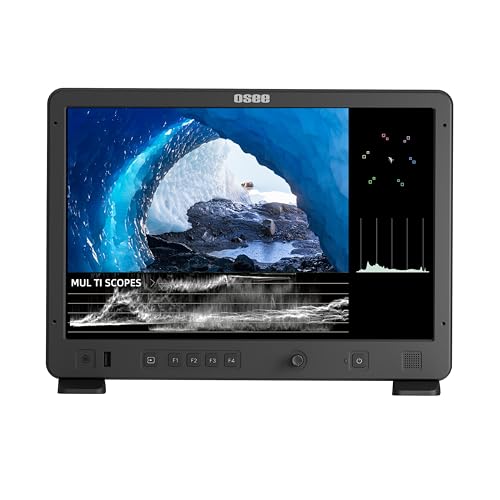
- Large 1500-nit 10-bit IPS display
- Dual 3G-SDI I/O and 4K HDMI input
- V-Mount power and C-stand mounting included
Best For: Professional film sets, DIT stations, and client village viewing
Best Large Touchscreen Value

- 2000-nit 10.1-inch touchscreen
- Dual HDMI with support up to 4K at 60Hz
- Dual NP-F plates and custom LUT support
Best For: Outdoor HDMI shoots needing a larger shared display
Best Broadcast-Style Carry-On

- Large 17.3-inch Full HD display
- 3G-SDI, HDMI, composite, and component connectivity
- Tally lights, sunshade, and suitcase included
Best For: Large shared viewing and mixed-signal broadcast setups
Best Daylight Field Monitor
osee T7 7-inch 3000-Nit Monitor

- 3000-nit display for bright daylight
- Waveform, false color, focus peaking, and LUT tools
- Compact 7-inch design with flexible power options
Best For: Outdoor productions needing a bright, portable monitor
Best Multi-Camera Director Monitor
FEELWORLD ATEM156 Quad-Split Monitor

- Four HDMI inputs and loop outputs
- Quad, dual, single, and PiP viewing modes
- 15.6-inch IPS screen with broadcast tools
Best For: Live production and multi-camera HDMI monitoring
Best Large Broadcast Field Monitor
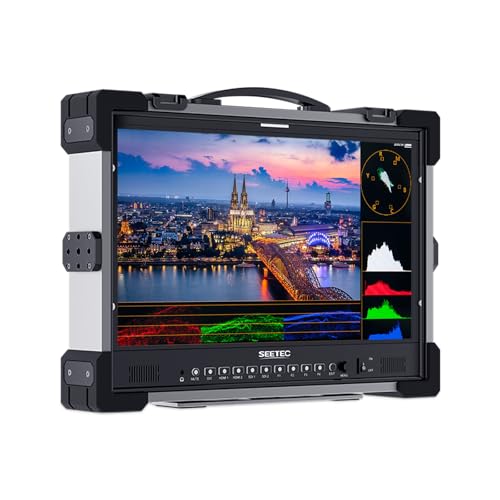
- 21.5-inch 1000-nit display
- SDI and 4K HDMI connectivity
- Waveform, HDR, and custom LUT support
Best For: Broadcast and field setups needing a large shared display
Best HDMI Multiviewer
ATEM156 Director Broadcast Monitor

- Four 4K HDMI inputs and outputs
- 15.6-inch Full HD IPS display
- Focus, False Color, and Pixel-to-Pixel tools
Best For: HDMI live production and ATEM Mini-style switching
Best Outdoor Director Monitor
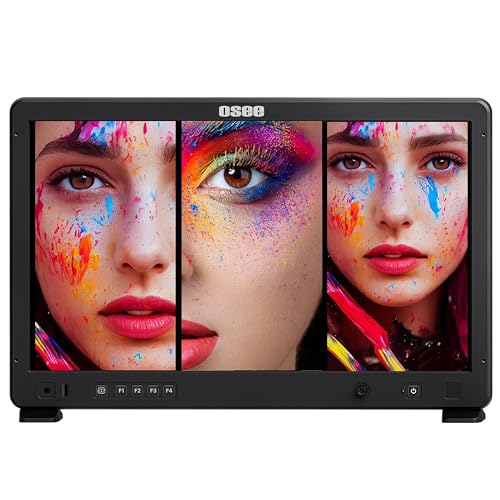
- 1500-nit daylight-viewable display
- 3x 4K HDMI and 3x 3G-SDI inputs
- 10-bit IPS with custom 3D LUT support
Best For: Outdoor multi-camera productions with HDMI and SDI sources
Best Portable HDMI Monitor
ATEM156-CO Carry-On Broadcast Monitor

- Four 4K HDMI inputs and loop outputs
- 15.6-inch Full HD IPS display
- Includes a carry-on suitcase and V-mount plate
Best For: Mobile HDMI live production and multi-camera crews
Best Daylight Touchscreen Pick – NEEWER F700 7-inch Monitor
For directors seeking a practical field monitor for directors, the NEEWER F700 combines a highly visible 2000-nit touchscreen with a compact 7-inch design. Its automatic backlight control, 4K HDMI loop-through, and broad exposure tools make it well suited to mobile camera rigs and outdoor filming.
Best For: Directors who need a compact, daylight-readable monitor with touchscreen controls and extensive image-analysis tools.
Pros:
- 2000-nit IPS touchscreen with automatic ambient-light brightness adjustment.
- 4K HDMI loop input and output, plus headphone-based audio monitoring.
- Includes waveform, vectorscope, false color, zebras, histogram, HDR, and focus-peaking tools.
- Supports 15 preloaded and up to 60 custom 3D LUTs.
Cons:
- NP-F batteries, DC cable, and headphones are not included.
- Its 7-inch screen is smaller than larger director and client-viewing monitors.
The F700 is a flexible choice when portability matters most. Its 1/4-inch mounting points, included cold shoe mount, multiple power options, and adjustable cooling make it adaptable for extended outdoor shoots.
Best Production-Set Monitor – osee Mega 15S 15.4-inch
The osee Mega 15S is a strong field monitor for directors who need a larger viewing surface for on-set decisions and client village monitoring. Its 15.4-inch 10-bit IPS display, 1500-nit brightness, SDI connectivity, and professional scopes are designed for more demanding production environments.
Best For: Directors, DITs, and cinematographers working with SDI-equipped cameras, wireless transmitters, or multi-camera video systems.
Pros:
- Large 15.4-inch 10-bit IPS panel with 1500-nit peak brightness.
- Dual 3G-SDI inputs and outputs plus a 4K HDMI input.
- Offers waveform, vectorscope, RGB histogram, false color, and focus peaking.
- Includes a pre-installed V-Mount plate and C-stand/light-stand mounting options.
Cons:
- The larger production-monitor format is less compact than small camera-top displays.
- Its single HDMI input may be limiting for HDMI-heavy setups.
With hardware auto color calibration, Rec.709 support, 3D LUT importing, HDR preview, and multiple rigging options, the Mega 15S is built for serious on-location monitoring rather than lightweight handheld use.
Best Large Touchscreen Value – FEELWORLD LUT11 10.1-inch
The FEELWORLD LUT11 offers a spacious 10.1-inch touchscreen for directors who want more viewing area than a compact camera monitor without moving to a full production display. Its 2000-nit screen, dual HDMI connections, and built-in light sensor make it useful for bright outdoor shoots and live monitoring.
Best For: Directors and camera operators who want a bright touchscreen monitor with dual-battery power and 4K HDMI support.
Pros:
- 2000-nit IPS display with automatic brightness adjustment for daylight use.
- Full touchscreen interface with support for up to 50 custom LUTs.
- Provides waveform, vectorscope, histogram, HDR, peaking, false color, and audio-level tools.
- Dual HDMI inputs and one output support signals up to 4K at 60Hz.
Cons:
- It uses HDMI connectivity rather than the SDI inputs and outputs found on production-oriented monitors.
- Its glossy screen finish may be less glare-resistant than a matte display.
- Batteries are not listed among the included components.
The LUT11 is a practical middle ground for a field monitor for directors: larger and easier to share than a 7-inch model, while still offering touchscreen operation, flexible mounting, and dual NP-F battery plates.
Best Broadcast-Style Carry-On – SEETEC P173 17.3-inch
The SEETEC P173 is a large carry-on monitor for directors who prioritize a broad 17.3-inch view and broad broadcast connectivity. It supports 3G-SDI, HDMI, composite, and component signals, while its tally lights and included suitcase make it suitable for organized production setups.
Best For: Directors and crews who need a large monitoring surface, tally indication, and compatibility with varied professional video sources.
Pros:
- Large 17.3-inch 1920×1080 display for easier shared viewing.
- Supports 3G HD-SDI, HDMI, composite, and component input and output.
- Includes focus assist, check field, image freeze, image flip, markers, and safe-frame tools.
- Front and rear three-color tally lights support recording-status visibility.
Cons:
- Its listed 400-nit brightness is lower than the daylight-focused monitors in this roundup.
- The glossy screen finish may reflect bright set lighting.
- It is less compact than smaller field-monitor designs.
The P173 stands out when screen size and signal flexibility matter more than maximum outdoor brightness. Its tally kit, V-battery plate, sunshade, and protective suitcase add useful production-oriented accessories.
Best Daylight Field Monitor – osee T7 7-inch 3000-Nit Monitor
For directors who need a portable field monitor for directors in bright outdoor conditions, the osee T7 combines a highly visible 3000-nit display with a useful set of exposure, focus, framing, and LUT tools. Its 7-inch size and 438g weight help keep camera rigs manageable.
Best For: Outdoor narrative, commercial, and documentary shoots where daylight visibility and detailed camera monitoring matter.
Pros:
- 3000-nit brightness supports viewing in strong daylight, often without a sun hood.
- Waveform, false color, focus peaking, histogram, anamorphic tools, and HDR/SDR LUT support assist on-set decisions.
- 1920×1200 resolution, 1200:1 contrast, and a 170-degree viewing angle provide a detailed monitoring image.
- Supports NP-F batteries, DC input, AC power, and the included D-tap cable.
Cons:
- The 7-inch screen provides less shared viewing space than larger production monitors.
- The glossy finish may be less convenient than a matte screen in some reflective environments.
The T7 is a strong choice when a director needs bright, detailed monitoring without adding a large display to the camera setup. Its preset-based controls and single joystick can also make repeated on-set adjustments faster.
Best Multi-Camera Director Monitor – FEELWORLD ATEM156 Quad-Split Monitor
The FEELWORLD ATEM156 is a practical field monitor for directors overseeing multiple HDMI feeds. Its 15.6-inch screen can show four sources in a quad split, while HDMI loop outputs support connection to switchers and other broadcast equipment.
Best For: Live events, studio productions, streaming setups, and directing environments that require simultaneous monitoring of multiple HDMI sources.
Pros:
- Four HDMI inputs and four loop outputs support quad-split monitoring and signal pass-through.
- Supports quad, dual, single-image, and picture-in-picture viewing modes.
- 15.6-inch IPS display offers a 170-degree viewing angle, with peaking and false-color tools.
- Aluminum housing, VESA mounting, front headphone output, and hotkeys suit broadcast workflows.
Cons:
- At 1.57kg, it is less convenient for lightweight mobile camera rigs.
- The 250 cd/m² brightness is better suited to controlled or shaded environments than strong daylight.
- A V-mount battery plate is included, but the battery itself is not.
Choose the ATEM156 when the director’s priority is seeing several sources at once rather than maximizing outdoor brightness. Its loop-through design and switcher-friendly layout make it especially useful for live production control.
Best Large Broadcast Field Monitor – SEETEC P215 PRO-CO 21.5-Inch
The SEETEC P215 PRO-CO gives directors a large 21.5-inch viewing surface while retaining broadcast-oriented connectivity. As a field monitor for directors, it combines 1000-nit brightness, SDI and 4K HDMI support, waveform monitoring, and a protective carry-on case.
Best For: Broadcast, studio, and field productions where multiple crew members need a large, bright reference display.
Pros:
- 1000-nit brightness supports viewing indoors and outdoors in many lighting conditions.
- Two SDI and two HDMI inputs, plus SDI and HDMI outputs, suit professional video workflows.
- Waveform monitoring, HDR support, CalMAN calibration, and 32 custom LUT slots aid image evaluation.
- Protective shell, aluminum frame, and reinforced corners help protect the monitor during transport.
Cons:
- The 21.5-inch form factor is substantially less portable than a small on-camera monitor.
- The display is 1920×1080, even though its HDMI input supports 4K at 60Hz.
- Its listed 89-degree viewing angle is narrower than the 170-degree angles of the other options.
The P215 PRO-CO makes sense when shared viewing, SDI connectivity, and transport protection outweigh compactness. It is better suited to a dedicated monitoring position or production case than to a lightweight handheld rig.
Best HDMI Multiviewer – ATEM156 Director Broadcast Monitor
If you need a field monitor for directors working with HDMI-based live production, the SEETEC ATEM156 combines a 15.6-inch Full HD display with four HDMI inputs and outputs. Its multiview capability, focus tools, and V-mount support make it practical for previewing multiple sources and checking image sharpness on set.
Best For: Directors and crews using ATEM Mini-style switchers for HDMI live streaming, broadcasting, and multi-camera monitoring.
Pros:
- Four 4K HDMI inputs and outputs support multiview monitoring and signal loop-through.
- 15.6-inch IPS panel provides 1920×1080 resolution, 170-degree viewing angles, and 250-nit brightness.
- Includes Peaking Focus, False Color, and Pixel-to-Pixel tools for checking focus and exposure.
- Supports 12V DC power and a V-mount battery plate.
Cons:
- The 250-nit brightness is better suited to controlled or shaded environments than strong direct sunlight.
- Battery is not included.
- HDCP sources may require an HDMI splitter to strip the signal.
Choose this model when HDMI connectivity and straightforward multiview operation matter more than extreme outdoor brightness. The included bracket and V-mount plate also make it adaptable for production setups that need either mains or battery power.
Best Outdoor Director Monitor – Mega 22S4 Multi-View Monitor
For directors who need a field monitor for directors on bright outdoor sets, the osee Mega 22S4 emphasizes visibility, multi-camera flexibility, and professional monitoring tools. Its 1500-nit panel, 3G-SDI and 4K HDMI connectivity, and horizontal/vertical multi-view modes support demanding production workflows.
Best For: Commercial, social media, and multi-camera productions that need daylight viewing, SDI connectivity, and teamwide signal monitoring.
Pros:
- 1500-nit brightness and included sun hood are designed for clearer viewing in direct sunlight.
- Supports three 4K60 HDMI inputs and three 3G-SDI inputs, with two multi-window loop outputs.
- 10-bit IPS panel supports Rec.709, HLG/PQ HDR, log profiles, and up to 10 custom 3D LUTs.
- Offers waveform, vectorscope, False Color, anamorphic de-squeeze, and focus peaking tools.
Cons:
- At 9.5 kg, it is substantially less portable than smaller field monitors.
- Hard case is not included.
- Its professional feature set may be more than needed for simple single-camera monitoring.
The Mega 22S4 is the strongest choice here for outdoor direction and larger crews that need both HDMI and SDI sources. Its size and weight favor a structured production setup, while the battery plates and accessory mounting points support field deployment.
Best Portable HDMI Monitor – ATEM156-CO Carry-On Broadcast Monitor
The SEETEC ATEM156-CO is a practical field monitor for directors who need four HDMI sources in a transportable package. It provides a 15.6-inch Full HD IPS screen, HDMI loop-through, focus-assistance tools, and a carry-on suitcase for productions that move between locations.
Best For: Mobile HDMI studio, live-streaming, and multi-camera crews that want built-in transport protection.
Pros:
- Four 4K HDMI inputs can connect cameras, computers, consoles, and other sources.
- Four HDMI outputs can loop signals to devices such as ATEM Mini or ATEM Mini Pro.
- Peaking Focus, False Color, and Pixel-to-Pixel functions help with image evaluation.
- Includes a V-mount battery plate, power adapter, cable, and suitcase.
Cons:
- The 250-nit screen is not intended for strong direct sunlight.
- Battery is not included.
- HDCP signals may require an HDMI splitter.
This version is a good fit when portability is a priority but you still need a four-source HDMI workflow. The included suitcase distinguishes it from a basic monitor package, although crews working outdoors in bright sun may prefer a higher-brightness display.
How We Picked the Best Field Monitor for Directors
We focused on features that matter when a director needs a dependable view of live footage: screen brightness, resolution, input and output compatibility, viewing size, monitoring tools, and portability. The selection includes compact camera-top models, carry-on broadcast monitors, and larger production displays for directors working with multiple feeds.
Brightness is especially important outdoors, while SDI connectivity, multiple HDMI inputs, LUT support, HDR compatibility, and multi-view modes can be more valuable on a controlled set. We also considered practical differences between 7-inch, 15.6-inch, 17.3-inch, and 21.5-inch screens.
Quick Comparison
- Portable camera monitoring: The NEEWER F700, FEELWORLD LUT11, and osee T7 suit DSLR, mirrorless, and compact cinema-camera setups.
- Director-sized viewing: The 15.6-inch, 17.3-inch, and 21.5-inch models provide more comfortable viewing from a distance.
- Multi-camera work: The FEELWORLD ATEM156, osee Mega 22S4, and other four-input models are designed for switching, comparison, or simultaneous feeds.
- Broadcast connectivity: The P173-9HSD-CO, P215 PRO-CO, and osee Mega 15S add production-oriented SDI and HDMI connections.
Key Buying Factors for a Field Monitor for Directors
Brightness and Outdoor Visibility
For exterior shoots, prioritize a daylight-viewable display rated around 1,000 nits or higher. Models rated at 1,500 to 3,000 nits are better suited to bright locations, although a sun hood and proper positioning still help. A 250- or 400-nit screen may be adequate indoors or in shaded areas.
Screen Size and Viewing Distance
A 7-inch monitor is convenient near the camera, but it may be too small for a director several feet away. Choose a 15.6-inch or larger display when multiple crew members need to evaluate the image. Larger monitors improve visibility but add weight, power demands, and transport requirements.
Inputs, Outputs, and Signal Support
Check whether your cameras output HDMI, 3G-SDI, or both. HDMI is common on DSLR and mirrorless cameras, while SDI is preferred for longer, more secure cable runs. Multiple inputs and outputs are useful for switchers, recorders, wireless video systems, and pass-through monitoring.
Monitoring Tools
Touch controls, 3D LUT support, HDR, waveform or exposure tools, focus assistance, and multi-view layouts can improve on-set decisions. Confirm that the monitor’s supported resolution and frame rates match your cameras and switchers.
Who Should Buy Which Field Monitor for Directors?
Solo filmmakers and camera operators should start with a bright 7-inch model that adds focus and exposure visibility without making the rig unwieldy. Outdoor crews should prioritize the highest brightness ratings, especially when the monitor cannot be shaded.
Directors and cinematographers on narrative sets will generally benefit from a 15.6-inch or larger screen, particularly when viewing from a seated position or behind a camera cart. Live-streaming and multi-camera teams should choose a quad-input or multi-view display, while broadcast crews should favor SDI-equipped models with the required signal formats.
Before buying, verify mounting options, power requirements, cable length, supported frame rates, and the exact input configuration. Those details often determine whether a monitor integrates smoothly into your existing production workflow.