A good desktop controller for music production studio work can speed up mixing, improve hands-on control, and make everyday sessions feel less mouse-heavy. The right pick depends on whether you need faders, pads, monitor control, or all three.
In this roundup, we focus on practical desktop controllers that fit real studio workflows, from compact MIDI surfaces to full monitor-management hubs.
Best 10 Desktop Controller for Music Production Studio Picks for 2026
Hybrid DAW Controller
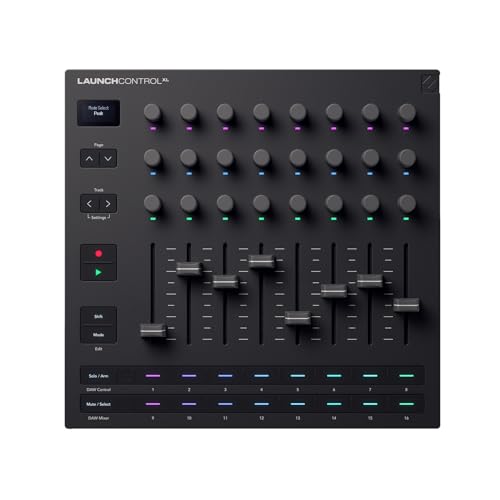
- 24 encoders, 8 faders, and 16 buttons
- Works with major DAWs and HUI setups
- MIDI I/O supports hardware synths and effects
Best For: Hybrid producers who need DAW and hardware control
Passive Monitor Volume Controller

- Passive studio volume controller
- Dual pair input/output support
- Compact desktop monitoring design
Best For: Simple monitor volume control on a small studio desk
Slim DAW Fader Surface

- Low-profile USB control surface
- 8 mixer channels for basic track control
- Supports major DAW software with transport features
Best For: Compact track and transport control on a small desk
Pad Performance Controller

- 16 RGB velocity- and pressure-sensitive pads
- 20 assignable buttons plus 4 encoders
- Includes Studio One Artist and Ableton Live Lite
Best For: Beatmakers who want expressive pad-based control
Universal DAW Control
Behringer X-TOUCH Universal Control Surface

- 9 touch-sensitive motorized faders
- 8 LCD scribble strips for track info
- HUI and Mackie Control support
Best For: Hands-on DAW mixing with clear track feedback
Passive Monitor Switching
Mackie Big Knob Passive Monitor Controller

- Passive signal path for clean monitoring
- Two sources and two monitor pairs
- Mono, mute, and dim controls
Best For: Simple, transparent monitor control on the desk
Clip Launching Performance
Akai APC Mini MK2 Ableton Controller

- 64 RGB pads for clip launching
- 9 assignable faders for mix control
- USB-powered with Ableton Live integration
Best For: Ableton Live clip launching and compact hands-on control
Studio Monitor Controller

- All-in-one monitor and source control
- Built-in talkback mic with level control
- USB audio interface up to 192 kHz
Best For: Producers needing a compact control-room hub
Pad Controller

- 16 RGB velocity-sensitive pads with aftertouch
- 1:1 integration with MPC2 software
- Assignable touch strip and transport controls
Best For: Beat makers and MPC-focused producers
Compact MIDI Control Surface

- Eight faders in a compact layout
- USB and Bluetooth connectivity
- Backlit switches for portable control
Best For: Small studios needing simple wireless mixing control
Hybrid DAW Controller – Novation Launch Control XL 3
If you want a desktop controller for music production studio workflows that can handle both software and hardware, the Novation Launch Control XL 3 is built for that hybrid job. It offers deep integration with major DAWs like Ableton Live, Logic Pro, FL Studio, Cubase, and HUI-compatible setups, while also giving you MIDI In, Out, and Out2/Thru for external gear.
Best For: Producers who want hands-on DAW control plus flexible MIDI mapping for synths, effects, and hybrid studio setups.
Pros:
- 24 endless encoders, 8 faders, and 16 assignable buttons for broad control.
- Deep integration with major DAWs, including Ableton Live, Logic Pro, FL Studio, Cubase, and HUI.
- Custom Modes let you combine DAW, plugin, and hardware control in one surface.
- OLED display gives real-time feedback while working.
Cons:
- Best suited to users who will actually map and customize controls.
- More controller than a simple plug-and-play volume box.
This is the most versatile option here for a hybrid studio, especially if you manage software and external MIDI gear from the same desk. The extra mapping depth and hardware MIDI ports make it a strong pick for larger production setups.
Passive Monitor Volume Controller – Behringer STUDIO M
The Behringer STUDIO M is a simple desktop controller for music production studio monitoring when you mainly need convenient volume control. As a passive studio volume controller with dual pair input/output support, it fits a straightforward desktop monitoring role rather than a full DAW control surface.
Best For: Users who want a compact passive monitor volume controller for a basic studio desk setup.
Pros:
- Passive design keeps the unit simple.
- Dual pair input/output support adds basic routing flexibility.
- Compact footprint for a small desktop setup.
- Works as a straightforward studio volume controller.
Cons:
- Not a full-featured DAW control surface.
- Limited to basic monitor control compared with fader-heavy controllers.
If your priority is hands-on monitor level control and not deep production mapping, this is the most minimal option in the group. It makes sense for stripped-down desks where simplicity matters more than advanced software integration.
Slim DAW Fader Surface – Korg nanoKONTROL2
The Korg nanoKONTROL2 is a slim desktop controller for music production studio users who want basic DAW transport and mixer-style control in a compact footprint. Its low-profile design, 8 mixer channels, and support for major software titles make it a practical choice for tight desk spaces.
Best For: Mobile or desktop producers who want a compact USB control surface with simple track and transport control.
Pros:
- Low-profile design takes up very little desk space.
- 8 mixer channels suit basic track control.
- Supports major DAW programs and includes track select and marker advance functions.
- USB-powered simplicity keeps setup easy.
Cons:
- Limited control count compared with larger surfaces.
- Best for streamlined workflow rather than deep custom mapping.
This is a strong pick if you want affordable, compact hands-on control without crowding your workstation. It is best viewed as a lightweight mixer and transport companion rather than a centerpiece controller.
Pad Performance Controller – PreSonus ATOM
The PreSonus ATOM is a desktop controller for music production studio beat-making and sample triggering, especially if you prefer pads over faders. It pairs tightly with Studio One Artist and Ableton Live Lite, and it also supports most music production and performance software over USB.
Best For: Beatmakers and performers who want expressive pad control, clip triggering, and hands-on MIDI editing.
Pros:
- 16 full-size velocity- and pressure-sensitive RGB pads for expressive playing.
- 20 assignable buttons and 4 endless rotary encoders expand control options.
- Includes Studio One Artist, Ableton Live Lite, and the Studio Magic Plug-In Suite.
- Useful for loops, effects, MIDI editing, and timeline navigation.
Cons:
- Pad-focused layout is less ideal if you want faders for mixing.
- Best gains come with supported software integration.
ATOM is the most performance-oriented option in this roundup, with enough editing and transport control to stay useful in a studio workflow. If your production style centers on pads, loops, and virtual instruments, it offers a lot of capability in a compact unit.
Universal DAW Control – Behringer X-TOUCH Universal Control Surface
If you want a desktop controller for music production studio use that feels closer to a hardware mixer than a basic MIDI box, the Behringer X-TOUCH is built for hands-on DAW control. It supports HUI and Mackie Control protocols and works with compatible software like Ableton Live, Avid Pro Tools, and FL Studio, so it fits into a wide range of studio setups.
Best For: Producers who want motorized faders, track labeling, and broad DAW compatibility in a desktop control surface.
Pros:
- 9 touch-sensitive 100 mm motorized faders for hands-on mixing
- 8 LCD scribble strips help show track names and parameters at a glance
- Supports HUI and Mackie Control for integration with compatible DAWs
- Includes USB, Ethernet, and MIDI connectivity options
Cons:
- Designed for DAW control rather than pad-based performance
- Physical footprint may be large for very tight desks
Overall, the X-TOUCH is a strong fit if your priority is tactile mixing and clear session feedback. Its motorized faders and labeled display strips make it especially useful in studio workflows where fast navigation matters.
Passive Monitor Switching – Mackie Big Knob Passive Monitor Controller
For a desktop controller for music production studio monitoring, the Mackie Big Knob Passive focuses on the essentials: source selection, monitor switching, and volume control without adding electronics to the signal path. It offers two sources and two monitor pairs, making it a straightforward tool for compact studio and editing-suite setups.
Best For: Engineers and home-studio users who want simple, transparent monitor control on the desk.
Pros:
- Passive audio path for pristine audio quality
- Switches between two sources and two monitor pairs
- Mono, mute, and dim buttons for quick monitoring changes
- Sturdy metal build designed for studio use
Cons:
- No powered features or advanced DAW control
- Focused on monitoring, not MIDI or clip launching
If you mainly need reliable monitor management rather than a full-featured control surface, this unit keeps the workflow simple. Its passive design and basic switching make it a practical desktop choice for clean, direct studio listening.
Clip Launching Performance – Akai APC Mini MK2 Ableton Controller
If your desktop controller for music production studio work is centered on Ableton Live, the Akai Professional APC Mini MK2 is designed for fast clip launching and hands-on session control. Its 64 RGB pads, 9 faders, and pre-mapped Ableton integration make it useful for arranging, mixing, and triggering ideas in a compact footprint.
Best For: Ableton Live users who want a compact controller for clips, faders, and creative performance.
Pros:
- 64 RGB pads provide visual feedback for clip launching
- 9 assignable faders support mixer and macro control
- Pre-mapped 1:1 integration with Ableton Live
- USB-powered, compact, and portable for studio or stage use
Cons:
- Built around Ableton Live rather than broad DAW control
- Plastic construction may feel less substantial than metal units
This is a smart pick when you want immediate, pad-based control without extra power adapters. It is especially appealing for users who need a lightweight controller that supports both production and live workflows.
Studio Monitor Controller – Behringer XENYX CONTROL2USB
If you want a desktop controller for music production studio duties that does more than just turn a knob, the Behringer XENYX CONTROL2USB is built as an all-in-one control and communication center. It combines master volume control, source selection, monitor switching, talkback, and a USB audio interface, making it a practical hub for compact production setups.
Best For: Producers who want monitor control, source switching, and talkback in one desktop unit.
Pros:
- All-in-one master volume controller, source selector, monitor switcher, and talkback box
- Built-in talkback microphone with level control for direct communication with musicians
- USB audio interface support with up to 192 kHz maximum sample rate
- Designed as a premium, low-noise studio control and communication center
Cons:
- Best suited to Windows-based setups per the supplied details
- More focused on monitor control than hands-on beatmaking or performance control
For studios that need control-room utility more than creative pad or fader workflows, this unit is a strong fit. It keeps monitoring and communication functions centralized, which can simplify a desk-heavy production space.
Pad Controller – Akai Professional MPC Studio
The Akai Professional MPC Studio is a desktop controller for music production studio workflows centered on beatmaking and tactile performance. Its 16 velocity-sensitive RGB pads, touch strip, transport controls, and included MPC2 software make it a hands-on option for producers who want an integrated pad-based workflow.
Best For: Beat makers and producers who want expressive pads and deep MPC software integration.
Pros:
- 16 velocity- and pressure-sensitive RGB pads with aftertouch for expressive input
- 1:1 integration with MPC2 software and cross-compatibility with third-party DAWs
- Assignable ribbon touch strip for effects, Note Repeat, and other real-time control
- Includes MPC2 software license plus instrument plugins, FX, and educational features
Cons:
- More specialized for beat production than general studio control
- Requires software-based workflow to get the most from its feature set
This is a strong choice if your studio work starts with drums, samples, and hands-on sequencing. It is less of a general mixer-style controller and more of a focused creative instrument for MPC-style production.
Compact MIDI Control Surface – Korg nanoKONTROL Studio
The Korg nanoKONTROL Studio is a compact desktop controller for music production studio tasks when you want faders and transport controls in a small footprint. With eight faders, backlit switches, USB and Bluetooth connectivity, and compatibility with popular DAWs, it suits mobile or desktop setups that need simple hands-on mixing control.
Best For: Producers who want a small wireless control surface for basic mixing and transport work.
Pros:
- Eight faders for mixing control in a compact layout
- USB and wireless Bluetooth connectivity for flexible use
- Backlit switches and a lightweight, portable design
- Supported with Ableton Live, Avid Pro Tools, and FL Studio per the supplied notes
Cons:
- Limited to 8 mixer channels in the supplied specs
- Less feature-heavy than larger studio control surfaces
If your priority is a small, practical controller that handles essential DAW navigation and mixing, this is an easy desk fit. It favors portability and straightforward control over deep production features.
How We Picked the Best Desktop Controller for Music Production Studio
We prioritized controls that solve common studio tasks fast: level balancing, transport control, pad performance, monitor switching, and easy DAW mapping. We also considered build quality, desk footprint, connection options, and whether a unit works best as a performance surface or a studio command center.
Quick Comparison
If you want faders and knobs for mixing, look first at MIDI control surfaces. If your priority is speaker switching and listening level control, a monitor controller is the better fit. For beatmakers, pad controllers offer the fastest way to program drums, launch clips, and trigger scenes. The best Desktop Controller for Music Production Studio use is the one that matches your main workflow, not just the one with the most features.
Key Buying Factors for a Desktop Controller for Music Production Studio
Control Type
Choose faders and encoders for mixing, pads for drums and clip launching, or monitor controls for speaker and volume management. Hybrid units can be useful, but only if you will use the extra features regularly.
DAW Compatibility
Check that the controller supports your software well. Deep integration with Ableton Live, Studio One, or MPC software can save setup time and reduce mapping headaches.
Desk Space and Layout
Measure your workspace. Compact models are easier to place near a keyboard and display, while larger surfaces can feel more natural for hands-on mixing but require more room.
Connectivity and Power
USB bus-powered units are simple for portable setups. Bluetooth or Ethernet can add flexibility, but wired connections usually offer the most predictable response in a studio.
Workflow Features
Look for useful extras such as motorized faders, OLED or scribble-strip labels, transport buttons, backlit pads, and assignable controls. These features matter most when they reduce clicks and speed up repetitive tasks.
Who Should Buy Which Desktop Controller for Music Production Studio?
Producers who mix often should favor fader-based surfaces. Beatmakers and live performers will usually prefer pad-heavy controllers. If your studio setup centers on speakers and monitoring, a dedicated monitor controller is the smarter buy. For a flexible Desktop Controller for Music Production Studio work, choose the model that best supports your daily session flow rather than the one with the broadest spec sheet.