The best compact audio interfaces make it easier to record vocals, instruments, podcasts, and streams without filling your desk or carrying bulky studio hardware.
This roundup compares 10 small models, from simple single-input designs to flexible dual-channel interfaces, so you can match connectivity, recording quality, and portability to your setup.
Best 10 Compact Audio Interfaces Picks for 2026
Best Overall
Focusrite Scarlett Solo 4th Gen

- 24-bit/192kHz recording with 120dB dynamic range
- Air modes enhance vocal and guitar presence
- Includes a broad recording software bundle
Best For: Solo musicians and home-recording creators
Best Budget 2-Input Pick

- Two combo inputs with 24-bit/192kHz recording
- USB-C bus power requires no external supply
- Includes phantom power and zero-latency monitoring
Best For: Beginners and USB-C mobile creators
Best Value
Focusrite Scarlett Solo 3rd Gen

- 24-bit/192kHz recording with Air mode
- Separate mic and Hi-Z instrument inputs
- Includes software bundle and three-year warranty
Best For: First-time home recordists and songwriters
Best for Mobile Recording

- Ultra-compact 13-gram dual-channel design
- Supports computers, phones, and tablets
- Includes USB-A, USB-C, and Lightning cables
Best For: Mobile recording, podcasting, and filmmaking
Versatile Two-Input Pick

- Two combo inputs support mic, line, and instrument sources
- USB/Direct monitoring supports low-latency recording
- Includes MPC Beats and Ableton Live Lite
Best For: Two-source podcasting, streaming, and home recording
Feature-Rich Studio Upgrade
Focusrite Scarlett 2i2 4th Gen

- 24-bit/192kHz recording with 120dB dynamic range
- Auto Gain and Clip Safe help prevent level problems
- Includes a broad recording and production software bundle
Best For: Home studios and musicians prioritizing recording quality
Lightweight Single-Source Choice
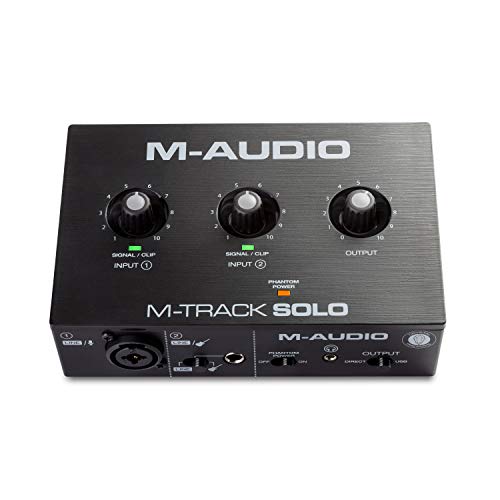
- 10.6-ounce design suits portable recording setups
- Combo mic/line input plus separate line/instrument input
- Includes direct monitoring, phantom power, and MPC Beats
Best For: Solo recording, podcasting, and lightweight streaming rigs
Best All-Rounder

- 24-bit/192kHz recording and 106 dB dynamic range
- 56 dB preamp gain with 48V phantom power
- Routing software with virtual channels and loopback
Best For: Beginners, musicians, podcasters, and streamers
Best for Guitarists

- 24-bit/48kHz guitar recording
- Amp output with FX or THRU modes
- Weighs just 1.9 ounces
Best For: Portable guitar recording, practice, and amp integration
Best for Mobile Streaming

- Dual USB ports for computer and mobile workflows
- Dual XLR inputs with 56 dB gain
- Loopback, mute controls, and ProStudio 2 routing
Best For: Podcasters, streamers, and mobile-first creators
Best Overall – Focusrite Scarlett Solo 4th Gen
The Focusrite Scarlett Solo 4th Gen is a strong all-around choice for shoppers comparing compact audio interfaces. It combines a mic preamp, Hi-Z instrument input, 24-bit/192kHz recording, and a compact desktop footprint for songwriting and home recording.
Best For: Solo musicians, vocalists, and guitarists who want a polished, portable recording setup.
Pros:
- 120dB dynamic range and 24-bit/192kHz support for detailed recordings.
- Air modes add presence and harmonic character to vocals and guitars.
- Includes Pro Tools Intro+, Ableton Live Lite, Cubase LE, and Hitmaker Expansion.
- Compatible with Mac, Windows, and iPad.
Cons:
- Its two-channel layout is designed for solo recording rather than larger sessions.
- Only one XLR mic preamp is listed.
With its updated converters, useful software bundle, and straightforward input configuration, the Scarlett Solo 4th Gen is a well-rounded pick among compact audio interfaces for personal music production.
Best Budget 2-Input Pick – PIYONE Q28 Alloy Red
The PIYONE Q28 is a compact 2×2 option for shoppers seeking compact audio interfaces with USB-C convenience. Its combo inputs, 24-bit/192kHz support, phantom power, and bus-powered design cover common vocal, guitar, and mobile recording needs.
Best For: Beginners and mobile creators who want two inputs and simple USB-C setup.
Pros:
- USB-C connection supports data and bus power without an external supply.
- Two XLR/TRS combo inputs accommodate microphones and instruments.
- Includes 48V phantom power and direct zero-latency monitoring.
- Illuminated gain controls and a 3.5mm headphone output add convenience.
Cons:
- The supplied details list Windows compatibility, so users of other platforms should verify support.
- At 0.74 kg, it is less lightweight than some ultra-portable alternatives.
The Q28 offers a practical feature set for basic two-source recording, especially if USB-C power, combo inputs, and headphone monitoring are priorities.
Best Value – Focusrite Scarlett Solo 3rd Gen
The Focusrite Scarlett Solo 3rd Gen remains a capable choice for compact audio interfaces, offering a mic input, Hi-Z instrument input, 24-bit/192kHz conversion, and balanced outputs in a small desktop unit.
Best For: Songwriters, podcasters, and first-time home recordists seeking a proven two-channel setup.
Pros:
- High-performance preamp and switchable Air mode improve recording clarity.
- Supports up to 24-bit/192kHz recording and mixing.
- Gain Halos help monitor levels and reduce clipping concerns.
- Includes recording software and a three-year warranty.
Cons:
- It is an older generation than the Scarlett Solo 4th Gen.
- The listed configuration provides one XLR mic input and one instrument input.
For buyers who do not need the newest generation, the Scarlett Solo 3rd Gen provides familiar controls, useful recording software, and solid specifications in a compact format.
Best for Mobile Recording – RØDE AI-Micro
The RØDE AI-Micro is purpose-built for highly portable recording, making it a distinctive choice among compact audio interfaces. Its dual 3.5mm inputs, automatic TRS/TRRS sensing, and supplied USB-A, USB-C, and Lightning cables suit phones, tablets, computers, microphones, and filmmaking setups.
Best For: Mobile creators, podcasters, filmmakers, and users of 3.5mm microphones.
Pros:
- Ultra-compact 13-gram design for travel and on-location use.
- Works with computers, smartphones, and tablets through supplied cables.
- Auto-sensing inputs simplify connection of TRS and TRRS microphones.
- Provides high-power headphone monitoring and supports the RØDE app suite.
Cons:
- Its 3.5mm inputs are not designed for direct XLR microphone connections.
- The listed maximum sample rate is 20kHz.
The AI-Micro is a particularly convenient fit when portability and broad device compatibility matter more than traditional studio connectors or higher listed sample rates.
Versatile Two-Input Pick – M-Audio M-Track Duo
The M-Audio M-Track Duo is one of the more flexible compact audio interfaces for creators who need to record two sources at once. Its dual combo inputs support microphones, line-level gear, and instruments, while phantom power accommodates condenser microphones.
Best For: Podcasting, live streaming, home recording, and musicians who need two simultaneous inputs.
Pros:
- Two combo XLR/line/instrument inputs with phantom power
- USB/Direct monitoring switch helps provide zero-latency monitoring
- Includes MPC Beats and supports Ableton Live Lite
- Compact 7.5-inch-wide design with headphone and stereo outputs
Cons:
- Maximum sample rate is 48kHz
- Uses USB Type-B connectivity rather than USB-C
Choose the M-Track Duo when input flexibility matters more than advanced conversion specifications. It is a practical, portable option for two-person recordings, instruments, and streaming setups.
Feature-Rich Studio Upgrade – Focusrite Scarlett 2i2 4th Gen
The Focusrite Scarlett 2i2 4th Gen is a strong choice among compact audio interfaces for creators who want higher-resolution recording and helpful level-management tools. It combines two mic preamps and Hi-Z instrument inputs with Auto Gain, Clip Safe, and Air modes.
Best For: Musicians, vocalists, and home studios seeking 24-bit/192kHz recording with a broad software bundle.
Pros:
- Supports up to 24-bit/192kHz recording and a 120dB dynamic range
- Auto Gain and Clip Safe help manage recording levels
- Air modes add presence and harmonic drive to vocals and guitars
- Includes Pro Tools Intro+, Ableton Live Lite, Cubase LE, and Hitmaker Expansion
Cons:
- Heavier than the M-Audio alternatives listed here
- Software availability and compatibility may vary by operating system
The Scarlett 2i2 4th Gen is the most specification-focused option in this group. Its expanded recording capability and built-in assistance make it especially appealing for developing music-production setups.
Lightweight Single-Source Choice – M-Audio M-Track Solo
The M-Audio M-Track Solo is a compact audio interface for creators who usually record one microphone or instrument at a time. It provides a combo XLR/line input, a separate line/instrument input, and direct monitoring in a notably lightweight enclosure.
Best For: Solo podcasters, streamers, and musicians who want a simple portable interface for one primary source.
Pros:
- Lightweight 10.6-ounce design is easy to carry
- Combo mic/line input includes phantom power
- USB/Direct monitoring switch supports zero-latency monitoring
- Includes MPC Beats and Ableton Live Lite
Cons:
- Maximum sample rate is 48kHz
- Provides one combo input rather than two
- Uses RCA main outputs instead of balanced 1/4-inch stereo outputs
The M-Track Solo makes sense when portability and straightforward operation are the priorities. It covers essential recording and streaming needs without the extra size or inputs of a two-channel interface.
Best All-Rounder – MAONO PS22 Lite
The MAONO PS22 Lite is one of the more versatile compact audio interfaces for creators who record vocals, guitar, podcasts, or live streams. It combines 24-bit/192kHz recording, a 56 dB preamp, 48V phantom power, direct monitoring, and routing software in a small, beginner-friendly design.
Best For: Beginners, vocalists, guitarists, podcasters, and streamers who want one compact interface for recording and broadcasting.
Pros:
- High-resolution 24-bit/192kHz recording with a 106 dB dynamic range.
- Supports condenser and dynamic microphones with 56 dB of preamp gain and 48V phantom power.
- ProStudio Routing Software adds virtual channels and loopback options for streaming.
- Works with Mac, Windows, iPad, and popular DAWs.
Cons:
- Its broader routing features may be more than a first-time user needs.
- The package is centered on USB connectivity and does not list a dedicated mobile power solution.
The PS22 Lite is a strong choice when flexibility matters more than the absolute smallest footprint. Its simple controls suit beginners, while the routing software gives streamers room to build a more advanced setup.
Best for Guitarists – IK Multimedia iRig USB
The IK Multimedia iRig USB is a highly portable pick among compact audio interfaces, built specifically around electric-guitar recording and practice. It offers 24-bit/48kHz audio, direct monitoring, a headphone output, and an amp output with selectable processed or direct signal paths.
Best For: Guitarists who want a lightweight interface for recording, silent practice, amp-and-pedal rigs, and mobile music making.
Pros:
- Compact 1.9-ounce design is easy to carry for mobile recording.
- Includes a dedicated amp output with selectable FX or THRU operation.
- Headphone output and direct monitoring support silent practice.
- Includes USB-C connectivity and software access for AmpliTube and TONEX apps.
Cons:
- Its single 1/4-inch instrument input is less suited to multi-microphone recording.
- Maximum resolution is 24-bit/48kHz rather than the higher sample rates offered by some alternatives.
- The supplied USB-C connection is not intended for Lightning devices.
The iRig USB is the focused option in this group. Guitarists get the connections they are most likely to use without carrying a larger desktop interface, though vocalists and producers needing multiple inputs should look elsewhere.
Best for Mobile Streaming – MAONO P2 Hybrid
The MAONO P2 Hybrid stands out among compact audio interfaces for creators who switch between computer and mobile workflows. Its dual USB ports can connect a computer and phone or iPad simultaneously, while dual XLR inputs, loopback, independent mute controls, and ProStudio 2 support recording and live streaming.
Best For: Podcasters, streamers, and musician-creators who record on a computer but publish or broadcast from a phone or tablet.
Pros:
- Dual USB connectivity supports simultaneous computer and phone or iPad workflows.
- Dual XLR inputs provide 56 dB of gain and 24-bit/192kHz recording.
- Independent mute and monitoring controls help manage live broadcasts.
- Loopback and ProStudio 2 support routing instruments, vocals, backing tracks, and desktop audio.
Cons:
- Its creator-focused routing features may require more setup than a basic recording interface.
- The feature set is likely more extensive than necessary for simple one-input recording.
The P2 Hybrid is the most workflow-oriented choice here. Its mobile and computer connectivity makes it particularly useful for creators who record, stream, and publish across multiple devices rather than staying in a traditional desktop studio.
How We Picked the Best Compact Audio Interfaces
We focused on interfaces that occupy minimal desk space while covering the main needs of home recording, streaming, podcasting, and mobile production. The selection includes single-input and dual-input models, USB-C and USB-compatible options, mobile-friendly devices, and interfaces designed specifically for guitar, vocals, or creator workflows.
We also considered input types, stated resolution and sample rates, compatibility with computers and mobile devices, monitoring features, power requirements, and ease of use. Established options from Focusrite, M-Audio, RØDE, IK Multimedia, and MAONO are included alongside a budget-oriented 2×2 model to give shoppers a range of practical choices.
Quick Comparison
| Best For | Recommended Type | What to Look For |
|---|---|---|
| Solo vocals or guitar | Single-input interface | Quality preamp, instrument input, direct monitoring |
| Two-person recording | 2×2 interface | Two independent inputs and separate gain control |
| Streaming and calls | Creator-focused interface | Simple routing, headphone monitoring, phone compatibility |
| Mobile recording | Bus-powered mobile interface | USB-C or device-ready connection and low power draw |
| Guitar practice and demos | Instrument-oriented interface | High-impedance input, low latency, compact construction |
Key Buying Factors for Compact Audio Interfaces
Inputs and Recording Workflow
A single combo or instrument input is usually enough for one vocalist, guitarist, or streamer. Choose a 2×2 interface if you need to record two microphones, stereo sources, or a microphone and instrument at the same time. Check whether inputs are XLR, 1/4-inch line, high-impedance instrument, or a combination.
Resolution, Latency, and Monitoring
24-bit recording is common in this category and provides useful headroom for editing and mixing. Sample rates such as 48kHz suit video and streaming, while higher rates may appeal to music producers. Direct monitoring can reduce distracting delay when recording through headphones, although software and computer performance still affect latency.
Connections and Compatibility
Confirm that the interface works with your computer, tablet, or phone before buying. USB-C does not always mean the same cable or power arrangement across devices. Mobile users should check whether an adapter, powered hub, or separate power source is required. Also verify driver support and included cables.
Phantom Power and Controls
Condenser microphones require 48V phantom power, while dynamic microphones and passive instruments generally do not. Physical gain knobs, headphone volume, monitor output, and clear level indicators make compact interfaces easier to operate than software-only controls.
Who Should Buy Which Compact Audio Interfaces?
Choose a single-input interface if you mainly record yourself, connect one microphone, or want a small guitar-and-vocal practice setup. Choose a 2×2 model for interviews, duet recording, stereo instruments, or more flexible home-studio work.
Choose a creator-focused model if streaming, phone connections, and straightforward monitoring matter more than extensive studio routing. Choose a mobile-oriented interface if you record on an iPad, iPhone, or laptop and need the smallest practical setup. For beginners, prioritize simple controls and reliable compatibility; experienced users should give more weight to input flexibility, gain range, and long-term expansion.