Choosing a hybrid drum machine for studio production comes down to workflow, sound design depth, and how well the unit fits your setup. The best options balance hands-on sequencing with modern sampling, synthesis, and integration.
Below, we focus on 10 standout picks for producers who want flexible rhythm programming, studio-ready control, and enough creative range to build beats fast.
Best 10 Hybrid Drum Machine for Studio Production Picks for 2026
Studio Starter Hybrid
Behringer LmDrum Hybrid Sampling Drum Machine

- 109 sounds for beat building
- 64-step sequencer for patterns
- Dual-mode filter and Wave Designer
Best For: Producers wanting a straightforward hybrid drum machine with hands-on sound shaping
Flagship MPC Workhorse
Akai MPC Live III Portable Music Production Center
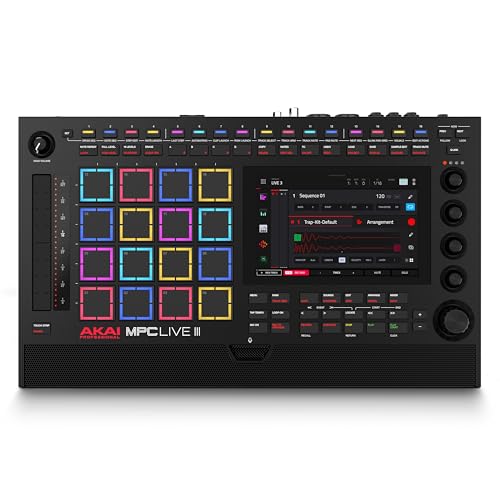
- Standalone production with no computer required
- MPCe Pads with velocity, pressure, and X/Y control
- Wide studio I/O including MIDI, CV/Gate, and USB-C
Best For: Producers wanting a flagship standalone MPC for full studio workflows
Minimal Hardware Pick
Behringer LM Hybrid Drum Machine
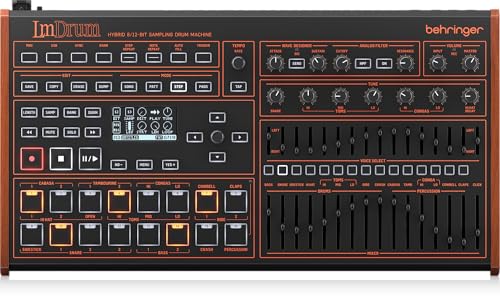
- Hybrid sampling drum machine design
- Compact footprint for small studios
- Bass wood body construction
Best For: Producers wanting a simple, compact hardware-first sampling drum machine
Portable Entry MPC
Akai MPC Sample Portable Sampler

- Standalone battery-powered sampler and sequencer
- 16 pads with 2.4-inch color display
- Over 100 factory kits plus sample chop mode
Best For: Beginners and portable beatmakers who want an approachable standalone MPC
Hybrid Analog/Digital Drum Lab
KORG drumlogue Hybrid Drum Machine

- Analog, digital, and multi-engine sound generation
- 11 parts, 64 steps, and loop/chain sequencing
- Per-part effects plus flexible studio connectivity
Best For: Producers who want hands-on hybrid drum synthesis with flexible routing
Standalone Beat Hub
Akai MPC One G2 Production Center

- Standalone sampling, sequencing, and arranging
- 7-inch touchscreen with 16 MPC pads
- USB-C studio integration and expanded processing power
Best For: Beatmakers who want an all-in-one hardware production center
Classic TR Performance Rack

- Circuit-modeled TR classics plus sampled sounds
- Import user samples and build custom kits
- Per-kit effects and performance-focused workflow
Best For: Producers who want classic Roland drums with modern sampling flexibility
Standalone Studio Workstation
Native Instruments MASCHINE+ Production Workstation
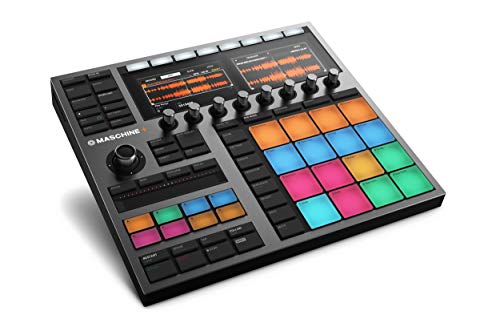
- Standalone workflow for beats, sampling, arranging, and performance
- Includes sounds, effects, and drum/bass synth plugins
- 44.1 kHz / 24-bit audio interface with MIDI and USB connectivity
Best For: Producers who want an all-in-one standalone beat-making workstation
Classic Analog Groove Box

- Analog/digital engine with 11 original drum sounds
- 64-step sequencer with polyrhythm and note-repeat tools
- 10 independent analog outputs for external processing or recording
Best For: Producers who want classic drum-machine sequencing and multi-output studio routing
Song Production Sequencer
Roland VERSELAB MV-1 Song Production Studio
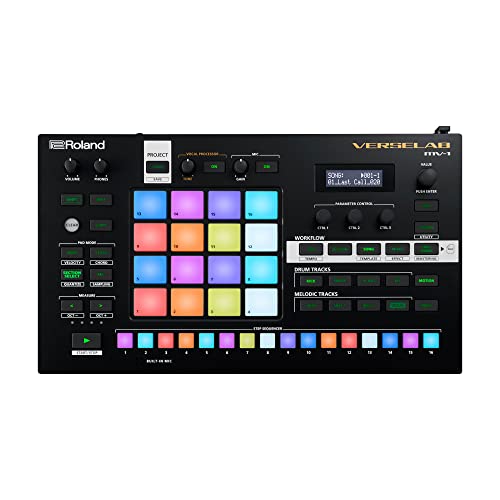
- 4x4 pads and TR-REC sequencer for drums, basslines, and melodies
- Over 3000 curated sounds with ZEN-Core synthesis
- XLR mic input with vocal effects and portable battery power
Best For: Songwriters and beatmakers who want a guided all-in-one production studio
Studio Starter Hybrid – Behringer LmDrum Hybrid Sampling Drum Machine
If you want a hybrid drum machine for studio production that keeps the focus on hands-on beat building, the Behringer LmDrum gives you a straightforward sampling-based workflow with 109 sounds, a 64-step sequencer, and onboard shaping tools. Its dual-mode filter and Wave Designer make it a practical choice for tightening kicks, sculpting hats, or pushing percussion into more aggressive territory.
Best For: Producers who want a compact, studio-friendly hybrid drum machine with sequencing and sound-shaping tools.
Pros:
- 109 sounds give you a useful starting palette for programming beats.
- 64-step sequencer supports pattern creation and arrangement.
- Dual-mode filter and Wave Designer add extra sound design control.
- USB and MIDI cables are included for setup flexibility.
Cons:
- Bulky metal-and-plastic unit may take up noticeable desk space.
- No display or advanced workflow details are listed in the supplied notes.
Overall, the LmDrum reads like a no-frills hardware option for producers who want to program and shape drums directly at the unit. If your priority is a simple hybrid drum machine for studio production rather than a deep production center, it covers the essentials cleanly.
Flagship MPC Workhorse – Akai MPC Live III Portable Music Production Center
The Akai Professional MPC Live III is a powerful hybrid drum machine for studio production if you want standalone beatmaking, sampling, and full-track workflow in one box. With MPC3 OS, an 8-core processor, 8GB RAM, a 16-step sequencer, and expressive MPCe Pads, it is built for producers who need speed, touch control, and serious sound design without relying on a computer.
Best For: Producers who want a fully standalone flagship MPC for sampling, sequencing, and studio integration.
Pros:
- Standalone operation lets you produce, record, mix, and perform without a computer.
- Expressive MPCe Pads add velocity, pressure, and X/Y control for more dynamic playing.
- Built-in mic, stereo monitors, battery power, and touchscreen support mobile studio work.
- Strong connectivity includes USB-C, CV/Gate, MIDI I/O, XLR/TRS inputs, and TRS outputs.
Cons:
- Large, feature-heavy design may be more machine than some beatmakers need.
- The higher-end workflow may be overkill if you only want a basic drum sequencer.
In practice, the MPC Live III is less a simple drum box and more a complete production center. For studios that want a hybrid drum machine with deep sequencing, sampling, and integration options, it offers one of the broadest feature sets in the group.
Minimal Hardware Pick – Behringer LM Hybrid Drum Machine
The Behringer LM is a hybrid drum machine for studio production that keeps the concept simple: a sampling-based drum machine in a compact wooden-bodied format. Based on the supplied details, it is aimed at producers who want a straightforward hardware instrument rather than a feature-heavy workstation.
Best For: Beatmakers who want a compact hybrid sampling drum machine with a simple hardware-first approach.
Pros:
- Hybrid sampling drum machine design keeps the focus on drum creation.
- Compact footprint makes it easier to fit into smaller studio setups.
- Bass wood body gives it a distinct build compared with typical plastic units.
Cons:
- Supplied notes do not list sequencer, sound count, or onboard controls.
- Feature set is less detailed than the other products in this roundup.
If you want a more minimal hardware choice and prefer to build around a sampling drum machine rather than a full production hub, the LM is the most stripped-back option here. It makes sense for studios that value simplicity and compact physical design over an extensive spec sheet.
Portable Entry MPC – Akai MPC Sample Portable Sampler
The Akai Professional MPC Sample is a compact hybrid drum machine for studio production if you want the MPC workflow in an easier, more portable format. It combines 16 pads, standalone operation, sampling tools, and onboard effects, making it a practical option for sketching beats, chopping audio, and building ideas without a computer.
Best For: Beginners and portable creators who want an approachable standalone sampler for beatmaking.
Pros:
- Standalone battery-powered design works without a computer or DAW.
- 16 responsive pads and a 2.4-inch display support quick hands-on workflow.
- Over 100 factory kits, Instant Sample Chop Mode, and resampling help you start fast.
- USB-C audio/MIDI, MIDI I/O, and stereo line connections support studio use.
Cons:
- Smaller form factor and 2.4-inch display are more limited than larger MPC units.
- MIDI DIN adapter is not included for the 1/8-inch MIDI I/O.
As a hybrid drum machine for studio production, the MPC Sample is best when portability and simplicity matter more than deep flagship-level features. It offers enough sampling, sequencing, and effects to get ideas moving quickly while staying easy to carry and integrate.
Hybrid Analog/Digital Drum Lab – KORG drumlogue Hybrid Drum Machine
If you want a hybrid drum machine for studio production that blends analog punch with digital flexibility, the KORG drumlogue is built for hands-on beat making. Its three-part engine combines ANALOG, DIGITAL, and MULTI ENGINE sources, while the front panel gives you instant control over common drum parameters and per-part volume for quick live mixing.
Best For: Producers who want a compact hybrid drum machine with hands-on control, custom sound options, and flexible studio routing.
Pros:
- Threefold hybrid engine: analog, digital, and multi engine
- Dedicated knobs for tuning, attenuation, and part volumes
- 11 parts with 64-step sequencing, plus loop and chain functions
- Per-part reverb and delay, plus master effects and multi effects support
Cons:
- Only 11 parts, so it is less expansive than larger workstation-style units
- External sample loading and controller integration depend on USB-C workflow
- Advanced customization may appeal more to sound designers than casual users
Overall, the drumlogue is a strong fit if you value tactile control and a hybrid sound engine in a focused drum machine. It also stands out for connectivity, with stereo output, four assignable outputs, audio in, DIN MIDI, USB-C, and audio sync for integrating into a studio setup.
Standalone Beat Hub – Akai MPC One G2 Production Center
The Akai MPC One G2 is a strong hybrid drum machine for studio production if you want one box to handle sampling, sequencing, arranging, and performance without a laptop. It pairs the classic MPC pad workflow with a 7-inch touchscreen, an 8-core processor, and USB-C connectivity for fast standalone creation and smooth studio integration.
Best For: Beatmakers and producers who want a standalone production center for drums, sampling, and full song creation.
Pros:
- Standalone workflow with no computer required
- 7-inch touchscreen plus 16 velocity- and pressure-sensitive pads
- USB-C audio streaming, MIDI expansion, and phone/tablet sampling
- Supports up to 16 stereo audio tracks and 32 plugin instruments per project
Cons:
- Its broad feature set may feel more like a production center than a dedicated drum machine
- Best results may take time to learn the MPC3 OS workflow
- Desktop form factor may be less immediate for pure live drum programming than simpler boxes
For studios that need a central hardware hub, the MPC One G2 brings serious power in a compact unit. With expanded plugin support, Ableton Live Control Mode, project import/export, and more than 20GB of factory content, it is built for complete track creation from start to finish.
Classic TR Performance Rack – Roland TR-8S Rhythm Performer
The Roland TR-8S is a practical pick if you want a hybrid drum machine for studio production centered on classic TR sound design and performance workflow. It combines detailed circuit-modeled TR drums with sampled sounds, user sample import, and flexible effects, making it easy to build kits that range from faithful vintage grooves to hybrid custom patterns.
Best For: Producers who want classic Roland drum sounds with modern sample handling and performance-friendly controls.
Pros:
- Includes classic TR drum sounds from the 808, 909, 707, 727, 606, and CR-78
- Supports preset samples and user sample import via SD card
- Kit editing includes decay, tuning, sample start point, speed, and direction control
- Instrument and master effects are saved with each kit for performance-ready setups
Cons:
- Its focus is more on drum programming and performance than broader song production
- Sample management depends on SD card workflow
- Best suited to users who specifically want the TR sound family and workflow
In a studio context, the TR-8S shines when you want fast, genre-flexible drum creation with recognizable Roland character. The free TR-EDITOR also adds a graphical workflow that can make sound organization and detailed editing easier.
Standalone Studio Workstation – Native Instruments MASCHINE+ Production Workstation
If you want a hybrid drum machine for studio production that can also handle beat-making, sampling, arranging, and live performance, MASCHINE+ is built for that all-in-one workflow. Its standalone design, included instruments and effects, and pro-grade audio interface make it a practical hub for sketching ideas or finishing tracks without leaning on a laptop.
Best For: Producers who want a standalone beat-making workstation with sampling, arranging, and performance tools.
Pros:
- Standalone workflow for beats, melodies, sampling, arranging, and performing.
- Includes MASCHINE+ Selection with instruments, sounds, effects, and drum/bass synth plugins.
- Quad-core CPU and 4 GB RAM support fast, seamless creation.
- Built-in 44.1 kHz / 24-bit audio interface with line inputs, mic input, headphone output, MIDI, and USB ports.
Cons:
- Audio interface and sample rate are limited to 44.1 kHz.
- Heavier than a compact controller at 7.5 pounds.
MASCHINE+ fits users who want a self-contained production center with serious connectivity and studio-ready sound tools. The anodized aluminum build also suggests it can handle regular use in both the studio and on the road.
Classic Analog Groove Box – Behringer RD-9 Drum Machine
The RD-9 is a straightforward hybrid drum machine for studio production when you want classic drum-machine workflow with flexible sequencing and routing. Its analog/digital sound engine, 64-step sequencer, and 10 independent analog outputs make it well suited to building and recording rhythmic parts with external processing.
Best For: Studio users who want classic drum sounds, step sequencing, and multi-output routing.
Pros:
- Authentic analog/digital sound engine with 11 original drum sounds.
- 64-step sequencer with poly-meter, step-repeat, note-repeat, real-time triggering, mute, and solo.
- 10 independent analog outputs support external processing or multi-track recording.
- Integrated FX bus with Wave Designer and dual-mode analog filter.
Cons:
- Focused on drum programming rather than full song production.
- Limited to the provided drum sound set and sequencing tools.
RD-9 is a strong choice if your priority is hands-on rhythm programming and routing flexibility rather than an all-in-one workstation. It is aimed at users who want to shape drum parts in detail and capture them cleanly in the studio.
Song Production Sequencer – Roland VERSELAB MV-1 Song Production Studio
VERSELAB MV-1 is a hybrid drum machine for studio production that leans into complete song creation, not just beat programming. With 4×4 pads, a TR-REC step sequencer, curated Roland sounds, vocal recording features, and guided workflow tools, it is designed to help you move from ideas to finished tracks quickly.
Best For: Songwriters, vocalists, and beatmakers who want a guided all-in-one production studio.
Pros:
- TR-REC step sequencer and 4×4 pads for drums, basslines, and melodic parts.
- Over 3000 curated sounds plus ZEN-Core synthesis for high-quality onboard tones.
- Built-in XLR mic input with effects like Auto-Pitch, Harmonizer, and Doubler.
- Compact, portable design with mobile-battery power support and Zenbeats integration.
Cons:
- Workflow is geared toward guided song production rather than freeform sound design.
- Some advanced expansion and mixing features rely on Zenbeats or Roland Cloud integration.
VERSELAB MV-1 is a smart fit for creators who want a structured path from beat ideas to finished songs. It combines drum sequencing, vocal capture, and portable production features in a way that favors speed and simplicity.
How We Picked the Best Hybrid Drum Machine for Studio Production
We focused on machines that offer a practical blend of drum programming, sound-shaping tools, and studio-friendly features. For a Hybrid Drum Machine for Studio Production, that means more than just great presets: it should support detailed sequencing, reliable timing, flexible routing, and enough editing depth to move from idea to finished pattern without friction.
We also prioritized models with clear strengths for different workflows, including sampling, classic drum synthesis, performance-oriented sequencing, and all-in-one production features.
Quick Comparison
Some units are best for classic drum-machine workflows with modern control, while others behave more like compact production centers. If you want fast beat creation and hands-on pattern building, traditional rhythm performers and analog-style machines may fit best. If you need sample management, song arrangement, and broader music production tools, standalone workstations are usually the smarter pick.
Key Buying Factors for Hybrid Drum Machine for Studio Production
Sound Engine and Sample Support
Look for a machine that combines drum synthesis with sampling or sample playback if you want maximum flexibility. Hybrid designs are strongest when they let you layer synthesized hits with recorded material.
Sequencing Workflow
A good sequencer should feel immediate but still allow detailed editing. Step sequencing, probability, parameter automation, and pattern chaining can make a big difference in the studio.
Connectivity and Integration
Check for MIDI, audio outputs, USB, and sync options. These matter if you plan to integrate the unit with a DAW, external synths, or modular gear.
Hands-On Control
Pads, knobs, and dedicated transport controls help speed up beat making. If you work by feel, a layout that encourages live tweaking is worth prioritizing.
Portability and Power Options
Battery power, built-in speakers, and compact size can help with writing away from the studio, but dedicated desktop units may offer better control and connectivity.
Who Should Buy Which Hybrid Drum Machine for Studio Production?
Producers who want deep beat programming and classic drum tones should lean toward performance-focused drum machines. Beatmakers who sample heavily or want a broader production hub should consider standalone MPC-style systems or workstation-style units.
If you want a modern, flexible centerpiece for electronic music, choose a model with strong sequencing and sound design tools. If your priority is fast sketching, live jamming, or classic rhythm machine character, a more focused hybrid drum machine may be the better fit.