The right optical headphone amplifier can turn a TV, game console, computer, or other digital source into a more flexible listening setup. These devices combine digital-to-analog conversion with headphone amplification, while some also add Bluetooth, USB, RCA, speaker outputs, or tone controls.
We selected 10 options spanning compact optical adapters, desktop DAC/headphone amps, and more powerful stereo amplifiers. The best choice depends on your headphones, source connections, listening volume, and whether you also need speakers or wireless playback.
Best 10 Headphone Amplifiers with Optical Input Picks for 2026
Best Entry-Level Pick
Fosi Audio Q4 DAC Headphone Amp

- Optical, USB, and coaxial inputs
- 16Ω–200Ω headphone support
- Bass and treble controls
Best For: Affordable desktop and TV audio upgrades
High-Power Bluetooth Pick
AIYIMA DAC A7 Desktop Headphone Amp
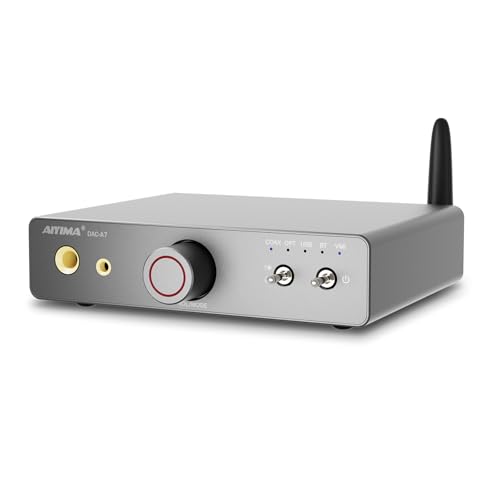
- Up to 1500mW at 32Ω
- 16Ω–600Ω headphone support
- Bluetooth 5.4 with LDAC
Best For: Powerful desktop wired and wireless listening
Best Tone-Control Option
AIYIMA DAC-A2 Desktop Headphone Amp

- Optical, coaxial, and USB inputs
- Bass and treble knobs
- 16Ω–200Ω headphone support
Best For: Desktop, TV, and gaming audio customization
Best Mini Stereo Receiver
M19 Optical-Input Bluetooth Amplifier
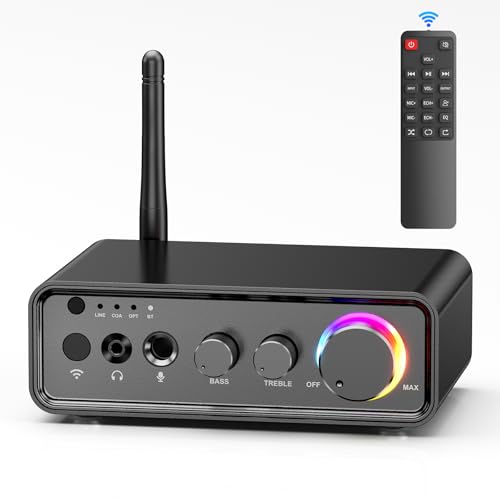
- Optical, coaxial, RCA, AUX, and Bluetooth inputs
- 3.5mm headphone output plus speaker amplification
- Bass/treble controls and remote included
Best For: Mixed headphone and passive-speaker setups
Best Optical Headphone Adapter
eSynic 192kHz Optical-to-3.5mm DAC

- Optical-to-3.5mm conversion for TVs and consoles
- 192kHz/24-bit PCM stereo support
- Compact plug-and-play design with 7-foot cable
Best For: Adding wired or wireless headphones to an optical source
Best Tube Integrated Amp
Fosi Audio MC331 Optical DAC Headphone Amp
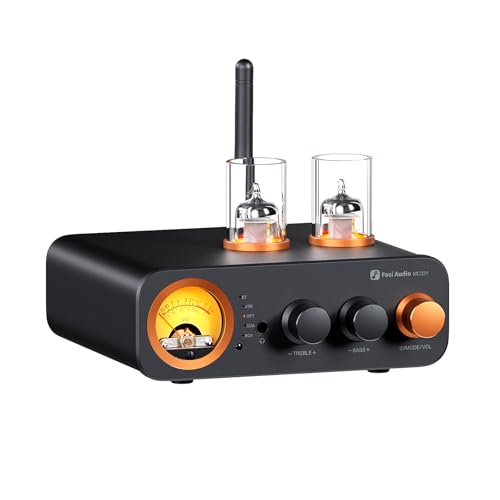
- Integrated DAC, preamp, speaker amp, and headphone amp
- Optical, coaxial, USB, RCA, and Bluetooth inputs
- 3.5mm headphone output with replaceable tubes
Best For: Desktop systems combining headphones and bookshelf speakers
Best High-Resolution Pick

- PCM 32-bit/384kHz and DSD256 support
- USB and optical inputs with multiple outputs
- High/low gain for 16Ω–600Ω headphones
Best For: Desktop listeners seeking high-resolution playback and flexible connectivity
Best for Gaming
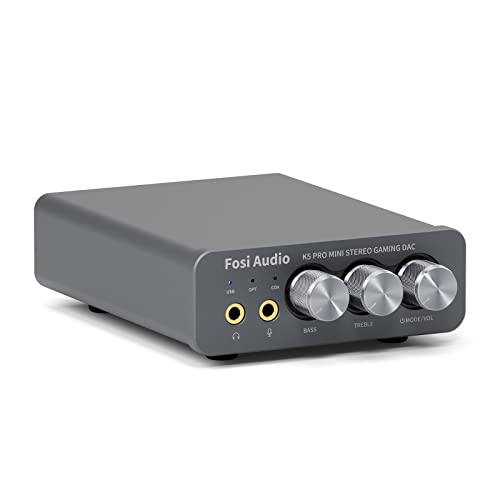
- Optical, coaxial, and USB-C inputs
- Microphone input for gaming setups
- Bass, treble, and volume controls
Best For: PS5, PC, and Mac gaming with microphone support
Best Compact Option

- Optical, coaxial, and PC-USB inputs
- Volume, bass, and treble controls
- Compact aluminum desktop design
Best For: Compact home and desktop stereo setups
Best Entry-Level Pick – Fosi Audio Q4 DAC Headphone Amp
The Fosi Audio Q4 is a practical choice among headphone amplifiers with optical input, combining optical, USB, and coaxial connectivity with headphone and RCA outputs. Its compact metal enclosure, plug-and-play setup, and adjustable bass and treble make it well suited to desktop or TV audio systems.
Best For: Listeners who want an affordable, compact DAC and headphone amp with tone controls and several digital inputs.
Pros:
- Accepts USB, optical, and coaxial inputs.
- Drives headphones rated from 16Ω to 200Ω.
- Offers adjustable bass and treble controls.
- Supports up to 24-bit/192kHz audio and includes an optical cable.
Cons:
- No microphone input.
- Designed for 5V power and is intended for tabletop use.
The Q4 stands out as a straightforward entry-level option when you need optical connectivity, basic headphone amplification, and flexible outputs without a complicated setup.
High-Power Bluetooth Pick – AIYIMA DAC A7 Desktop Headphone Amp
The AIYIMA DAC A7 is a feature-rich desktop amplifier for buyers comparing headphone amplifiers with optical input alongside wireless listening. It combines high-resolution Bluetooth 5.4 with LDAC and aptX-HD support, strong headphone output, and a preamp mode for active speakers or power amplifiers.
Best For: Desktop listeners who want high output power, broad headphone compatibility, and both wired and Bluetooth sources.
Pros:
- Supports headphones from 16Ω to 600Ω and delivers up to 1500mW at 32Ω.
- Bluetooth 5.4 supports LDAC and aptX-HD wireless audio.
- Includes both 3.5mm and 6.35mm headphone jacks.
- Works without drivers across Windows, macOS, Linux, iOS, and Android.
Cons:
- The supplied notes do not identify an optical input.
- Requires a DC 5V power supply rated at least 2A.
With its powerful headphone stage and versatile wireless features, the DAC A7 is compelling for desktop setups, but verify the required input connections if optical source compatibility is essential.
Optical Converter Pick – PROZOR 192kHz Digital-to-Analog DAC
The PROZOR converter is a focused option for shoppers seeking headphone amplifiers with optical input in a TV, console, or home-theater setup. It converts optical or coaxial PCM audio to RCA and 3.5mm analog outputs, allowing direct headphone connection as well as integration with an amplifier or powered speakers.
Best For: TV and gaming setups that need a simple optical-to-analog connection for headphones or stereo equipment.
Pros:
- Accepts Toslink optical and coaxial digital inputs.
- Provides simultaneous RCA and 3.5mm analog outputs.
- Supports PCM audio up to 24-bit/192kHz.
- Includes an optical cable and uses an aluminum-alloy housing.
Cons:
- Supports uncompressed two-channel LPCM/PCM rather than 5.1 decoding.
- Power adapter is not included.
- TV volume may need to be adjusted through the TV settings.
This is best viewed as a compact DAC and signal converter rather than a high-powered headphone amplifier. Set the source to PCM and use a suitable 5V/1A adapter for the intended setup.
Best Tone-Control Option – AIYIMA DAC-A2 Desktop Headphone Amp
The AIYIMA DAC-A2 is a compact choice among headphone amplifiers with optical input, offering optical, coaxial, and USB connectivity plus RCA and 3.5mm analog outputs. Front-panel bass, treble, and volume controls make it useful for tailoring music, movies, podcasts, and games.
Best For: PC, Mac, TV, and gaming users who want a small DAC amp with physical tone controls and straightforward plug-and-play operation.
Pros:
- Accepts optical, coaxial, and USB digital audio.
- Drives headphones from 16Ω to 200Ω with 160mW RMS at 32Ω.
- Offers independent bass and treble adjustment.
- Supports 24-bit/192kHz audio through optical or coaxial inputs.
Cons:
- Requires a compatible 5V power connection.
- The supplied details list the chassis material as plastic.
The DAC-A2 makes a sensible desktop or gaming companion when hands-on tone adjustment matters. Its output range suits many everyday headphones, while its optical input supports high-resolution digital sources.
Best Mini Stereo Receiver – M19 Optical-Input Bluetooth Amplifier
If you need headphone amplifiers with optical input but also want to power passive speakers, the MOREGAX M19 is a versatile compact receiver. It accepts optical, coaxial, RCA, AUX, and Bluetooth sources, with a dedicated 3.5mm headphone output and adjustable bass and treble.
Best For: Home listeners who want one small amplifier for optical audio, passive speakers, Bluetooth playback, and occasional headphone use.
Pros:
- Optical, coaxial, RCA, AUX, and Bluetooth 5.3 connectivity.
- Dedicated 3.5mm headphone output and 6.5mm microphone input.
- Dual-channel Class D design rated up to 100W x2 under specified conditions.
- Remote control, bass and treble knobs, and compact aluminum housing.
Cons:
- Requires a separate 24V/10A adapter to reach the stated 200W playback power with 4-ohm speakers; the included adapter is 24V/5A.
- Active and passive speakers cannot play simultaneously.
- Its speaker-amplifier focus may be more than needed for headphone-only systems.
The M19 stands out when optical headphone connectivity is only part of a broader stereo setup. Choose it if you also need speaker power and multiple source options rather than a dedicated headphone DAC alone.
Best Optical Headphone Adapter – eSynic 192kHz Optical-to-3.5mm DAC
The eSynic adapter is a straightforward option for headphone amplifiers with optical input—or for adding 3.5mm headphone output to an optical source. Its unidirectional optical-to-3.5mm design supports PCM stereo from TVs, Blu-ray players, and gaming consoles, with a 192kHz/24-bit DAC.
Best For: TV and console users who need a simple optical connection to wired headphones, wireless headphone transmitters, or an analog stereo input.
Pros:
- Converts optical audio to a 3.5mm analog output.
- Supports PCM stereo decoding at up to 192kHz/24-bit.
- Plug-and-play setup with a metal housing and 7-foot cable.
- Works with HDTVs, Blu-ray players, DVD players, gaming consoles, and wireless headphone transmitters.
Cons:
- Supports PCM 2.0 only, not Dolby or DTS formats.
- Optical-to-3.5mm conversion is unidirectional and not bidirectional.
- Requires a 5V/1A USB power adapter, which is not included.
This is a converter rather than a high-power headphone amplifier, so it suits systems where the connected headphones or amplifier provide volume control. Confirm that the source can output PCM before buying.
Best Tube Integrated Amp – Fosi Audio MC331 Optical DAC Headphone Amp
For listeners comparing headphone amplifiers with optical input that can also anchor a full desktop stereo system, the Fosi Audio MC331 combines a DAC, headphone amplifier, preamp, and speaker amplifier. It accepts optical, coaxial, USB, RCA, and Bluetooth sources, then adds a 3.5mm headphone output and tube-driven visual character.
Best For: Desktop or small-room listeners who want optical and digital inputs, bookshelf-speaker power, and a dedicated 3.5mm headphone output in one unit.
Pros:
- Combines DAC, amplifier, preamplifier, and headphone amplifier functions.
- Supports optical, coaxial, USB, RCA, and Bluetooth sources.
- Provides a 3.5mm headphone output, pre-out, and up to 105W x2 at 4 ohms.
- Includes remote control, VU meter, and replaceable tubes.
Cons:
- Its integrated speaker-amplifier design may be excessive for headphone-only use.
- Tube-based hardware adds components and setup considerations compared with a basic solid-state adapter.
- The supplied notes specify a 3.5mm headphone output, not a balanced headphone connection.
The MC331 is the most complete choice here for a combined headphone-and-speaker system. Its optical input, broad source support, replaceable tubes, and remote make it flexible, while the compact format keeps it suitable for desktop listening.
Best High-Resolution Pick – Douk Audio K5
For shoppers comparing headphone amplifiers with optical input, the Douk Audio K5 stands out for its broad connectivity, high-resolution support, and adjustable gain. It combines a USB DAC, optical DAC, preamp, and headphone amplifier in a compact aluminum enclosure.
Best For: Listeners who want strong headphone output, high-resolution playback, and flexible USB/optical connections.
Pros:
- Supports PCM up to 32-bit/384kHz and DSD256.
- Offers USB and optical inputs plus optical, RCA, 6.35mm, and 3.5mm outputs.
- High- and low-gain modes support headphones from 16Ω to 600Ω.
- Includes bass and treble controls with a bypass setting.
Cons:
- Its many functions may be more than casual listeners need.
- The listed power and feature specifications may make it a less streamlined choice for simple setups.
The K5 is a feature-rich option for desktop systems where optical compatibility, headphone power, and detailed digital playback matter. Its included optical cable and USB cable also simplify setup.
Best for Gaming – Fosi Audio K5 Pro
The Fosi Audio K5 Pro is a practical choice among headphone amplifiers with optical input, particularly for PS5, PC, and Mac gaming setups. It combines USB-C, optical, and coaxial inputs with microphone support, tone controls, and headphone outputs.
Best For: Gamers and desktop users who need optical connectivity, microphone input, and simple bass and treble adjustment.
Pros:
- Works with USB-C, optical, and coaxial digital inputs.
- Includes a microphone interface for gaming use.
- Provides up to 24-bit/192kHz through optical and coaxial inputs.
- Offers bass, treble, and master-volume controls.
Cons:
- USB audio is limited to up to 24-bit/96kHz.
- Its headphone output is specified for headphones from 16Ω to 300Ω.
- The USB-C port serves as both charging and audio input, requiring the source to connect there.
With up to 1000mW at 16Ω and dedicated microphone connectivity, the K5 Pro is tailored more toward interactive desktop entertainment than a minimalist audio chain. The included optical cable and splitter add setup flexibility.
Best Compact Option – Nobsound Q3 Mini
The Nobsound Q3 Mini is a straightforward option for shoppers seeking headphone amplifiers with optical input in a small desktop format. Its PC-USB, optical, and coaxial inputs connect to several common sources, while RCA and 3.5mm outputs support headphones and stereo equipment.
Best For: Home and desktop listeners who want a compact DAC amp with optical input and hands-on tone controls.
Pros:
- Accepts PC-USB, optical, and coaxial inputs.
- Works with computers, TVs, Apple TV, disc players, and OTG-enabled phones.
- Provides volume, treble, and bass controls.
- Compact aluminum case suits desktop and home stereo use.
Cons:
- Digital processing is limited to 24-bit/96kHz.
- It does not list the broader high-resolution support of the Douk Audio K5.
The Q3 Mini focuses on convenient everyday connectivity rather than extreme specifications. Its small enclosure, included optical cable, and accessible tone controls make it a sensible fit for a compact home audio system.
How We Picked the Best Headphone Amplifiers with Optical Input
We compared these models by looking at connection flexibility, optical compatibility, headphone output capability, size, controls, and overall use case. We also considered whether each unit is best suited to headphones, powered speakers, passive speakers, television audio, PC listening, gaming, or portable use.
Because product specifications and included accessories can vary, confirm the supported optical format, output type, power requirements, and included cables before ordering. An optical connection carries digital audio, but it does not automatically guarantee support for every surround, high-resolution, or multichannel signal.
Quick Comparison
| Type | Best For | Typical Connections |
|---|---|---|
| Compact optical DAC | TV or simple headphone setups | Optical, RCA, 3.5mm |
| Desktop DAC/headphone amp | PC, gaming, and music | Optical, USB, Bluetooth, RCA |
| Integrated stereo amplifier | Headphones plus passive speakers | Optical, RCA, Bluetooth, speaker outputs |
Key Buying Factors for Headphone Amplifiers with Optical Input
Optical Format and Source Compatibility
Check whether the amplifier accepts the signal from your TV, console, or other source. Many optical inputs are intended for two-channel PCM audio. If a TV is set to Dolby Digital, DTS, or another incompatible output mode, you may hear silence until the source is changed to PCM or stereo.
Headphone Output and Power
Easy-to-drive headphones generally need modest power, while high-impedance or low-sensitivity models benefit from a stronger amplifier. Look for a suitable 3.5mm or 6.35mm output and verify whether the volume range is comfortable for your headphones. More rated power is not automatically better if you mainly use efficient headphones.
Extra Inputs and Outputs
USB is useful for computer audio, while Bluetooth adds convenient wireless playback. RCA outputs can feed powered speakers or another amplifier. If you want passive speakers, choose an integrated amplifier with dedicated speaker terminals and confirm its power rating and impedance requirements.
Controls, Size, and Everyday Operation
Front-panel volume control, input selection, bass and treble adjustment, and a visible display can make a desktop setup easier to use. Compact optical adapters save space, but larger desktop units typically provide more connections and simpler access to controls.
Who Should Buy Which Headphone Amplifiers with Optical Input?
Choose a Compact Optical DAC If You Want Simplicity
Small optical-to-analog converters are a practical fit for a TV or basic powered-speaker setup. They are usually the easiest option when you only need optical input and a headphone or analog output.
Choose a Desktop DAC/headphone Amp for PC and Gaming
A desktop model makes more sense when you need USB, optical, multiple outputs, or convenient controls. These units suit listeners who switch between headphones, speakers, music, and games.
Choose an Integrated Amplifier for Speakers and Headphones
If your system includes passive bookshelf speakers, select a stereo amplifier with speaker outputs rather than a headphone-only DAC. This category offers greater flexibility, but it also requires more space and careful attention to speaker compatibility.