The best wireless in-ear monitor systems with earbuds help musicians hear vocals, instruments, and backing tracks clearly without relying on loud stage wedges. The right system can improve mobility, reduce stage clutter, and make live performances easier to control.
This roundup compares ten options across UHF and 2.4GHz or 5.8GHz wireless platforms, mono and stereo monitoring, battery design, range, channel flexibility, and multi-receiver support. Use the guide below to match the system to your stage setup, rehearsal space, or performance needs.
Best 10 Wireless in Ear Monitor Systems with Earbuds Picks for 2026
Best Compact Pick
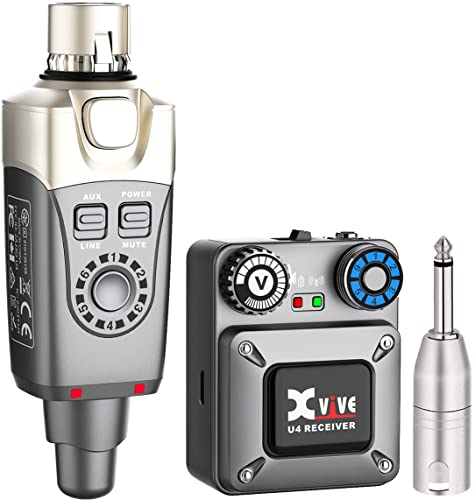
- 2.4GHz wireless with over 90 feet of range
- Less than 5ms latency and six channels
- Up to five hours of rechargeable battery life
Best For: Small venues, rehearsals, and portable personal monitoring
Best UHF Mono System
Phenyx Pro PTM-11 Wireless IEM

- UHF system with 50 adjustable frequencies
- Separate inputs and pass-through outputs
- Includes bodypack receiver, earphone, and rack kit
Best For: Mono monitoring for bands, churches, conferences, and broadcasts
Best High-Resolution Upgrade

- 5.8GHz True Diversity with dual-antenna reception
- 24-bit/48kHz audio and under 5ms latency
- Channel scan and XLR or 1/4-inch connectivity
Best For: Bands and performers needing adaptable, higher-resolution monitoring
Best Stereo Value
LEKATO MS-1 Wireless IEM System
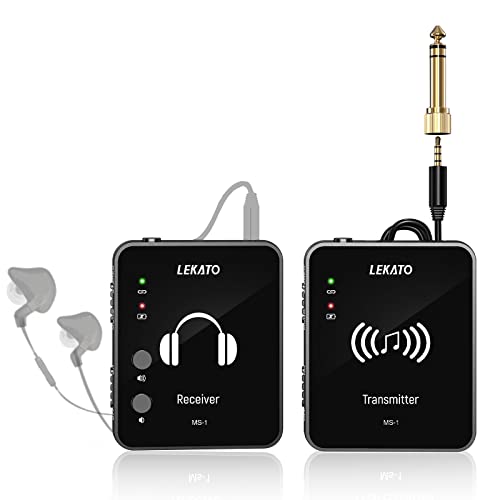
- Stereo or mono transmission with one-key switching
- One transmitter supports up to six sets
- Auto-pairing, five-hour battery, and 100-foot range
Best For: Band rehearsals, churches, studios, and small-stage stereo monitoring
Flexible Multi-User Monitoring
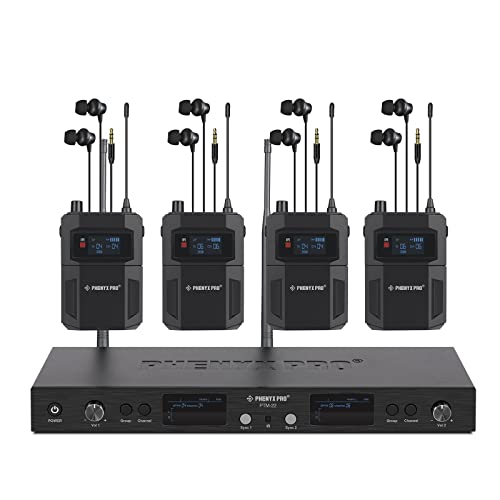
- Four bodypacks and earbuds included
- UHF range reaches up to 164 feet
- Daisy-chain and rack-mount features
Best For: Four-person stage, worship, and presentation setups
Portable Rechargeable Choice

- Up to 30 hours with charging case
- One transmitter supports up to 10 pairs
- Earbuds are not included
Best For: Portable rehearsals, recording, and live performers
Large-Group UHF Coverage

- Eight receivers and earbuds included
- 330-foot open-area range is stated
- 40 channels per group with IR sync
Best For: Large bands, worship groups, and event crews
Best Low-Latency Pick
POGOLAB 7-Channel Wireless IEM

- 1ms transmission latency
- Seven selectable UHF channels
- USB-C rechargeable design
Best For: Live performers needing responsive monitoring and flexible inputs
Best Complete Stereo Kit
Phenyx Pro PTM-10 Wireless IEM

- Stereo/mono monitoring modes
- Includes earbuds and rack kit
- 89 tunable frequencies
Best For: Users wanting a flexible stereo system with included accessories
Best Earbud Bundle

- Includes pro earphone and six ear-tip sets
- 16 adjustable UHF channels
- Up to five hours of rechargeable use
Best For: Performers seeking a portable kit with supplied, noise-isolating earphones
Best Compact Pick – Xvive U4 Wireless IEM System
The Xvive U4 is a straightforward option for shoppers comparing wireless in ear monitor systems with earbuds. Its 2.4GHz connection, sub-5ms latency, and compact transmitter-receiver setup suit performers who want a quick, portable monitoring solution.
Best For: Small clubs, live performers, and personal or team monitoring setups.
Pros:
- Over 90 feet of stated operating range.
- Six channels support simultaneous broadcasts.
- Less than 5ms latency helps keep monitoring responsive.
- Rechargeable transmitter and receiver provide up to five hours of battery life.
Cons:
- The package includes one transmitter and one receiver, so additional performers need more receivers.
- It is not water resistant and includes no stated noise control.
The U4 emphasizes portability and simple operation rather than advanced routing. It is a practical entry point for performers who need reliable wireless monitoring for shorter shows and rehearsals.
Best UHF Mono System – Phenyx Pro PTM-11 Wireless IEM
The Phenyx Pro PTM-11 is a mono-focused choice among wireless in ear monitor systems with earbuds. Its UHF transmission, 50 selectable frequencies, separate outputs, and included bodypack receiver make it suitable for organized stage and speaking applications.
Best For: Bands, church services, conference hosts, broadcasters, and live performers who prefer focused mono monitoring.
Pros:
- Mono monitoring is designed to reduce phase-related blurring and distortion.
- Fifty selectable frequencies support flexible setup, with up to five systems working together.
- Separate inputs and pass-through outputs allow integration with a soundboard.
- Includes a metal transmitter, bodypack receiver, earphone, rackmount kit, and carrying case.
Cons:
- It provides mono monitoring rather than stereo playback.
- The stated operating range is 164 feet and may be affected by walls, glass, and metal.
- The receiver uses two AA batteries.
The PTM-11 is built around dependable UHF operation and practical signal routing. Choose it when mono clarity, frequency adjustment, and installation flexibility matter more than a compact 2.4GHz design.
Best High-Resolution Upgrade – Xvive U45 True Diversity IEM
The Xvive U45 targets shoppers seeking more refined wireless in ear monitor systems with earbuds. Its 5.8GHz True Diversity reception, 24-bit/48kHz audio, channel scanning, and selectable mixer inputs are useful for performers who want a more adaptable stage setup.
Best For: Live performers and bands needing stable RF performance, high-resolution audio, and multi-system flexibility.
Pros:
- True Diversity reception and dual antennas help support a stable wireless connection.
- 24-bit/48kHz audio, 20Hz–20kHz response, and under 5ms latency are specified.
- Smart channel scanning helps identify a suitable local RF channel.
- Supports up to six channels and accepts balanced XLR or 1/4-inch TS connections.
Cons:
- Battery life is listed at about five hours, which may require charging between longer events.
- It is not water resistant and has no stated noise control.
- The system is more feature-focused than a basic plug-and-play monitor kit.
With channel scanning and flexible mixer connectivity, the U45 is a strong choice for more demanding wireless monitoring setups. Its 5.8GHz True Diversity design adds useful RF management for performers moving between stages and venues.
Best Stereo Value – LEKATO MS-1 Wireless IEM System
The LEKATO MS-1 is a practical stereo option for comparing wireless in ear monitor systems with earbuds. It offers automatic pairing, one-to-many operation, selectable stereo or mono input, and a stated 100-foot open-area range for rehearsals and smaller performances.
Best For: Bands, church groups, studio users, and small or medium-sized gigs that need stereo monitoring.
Pros:
- Supports stereo transmission with a one-key stereo/mono input switch.
- One transmitter can pair with multiple receivers, with up to six sets working simultaneously.
- Automatic pairing simplifies setup.
- Provides up to five hours of battery life and a stated 100-foot open-area range.
Cons:
- The stated latency is under 12ms, higher than the sub-5ms systems in this roundup.
- Performance range can vary outside open areas.
- Stereo operation requires a stereo audio source and stereo cable.
The MS-1 stands out for accessible stereo operation and easy receiver expansion. It is a sensible fit for rehearsal rooms and smaller stages where simple pairing and multiple listeners are more important than the lowest possible latency.
Flexible Multi-User Monitoring – Phenyx Pro PTM-22B 4-Pack
For buyers comparing wireless in ear monitor systems with earbuds, the Phenyx Pro PTM-22B is a practical choice for multi-person stage, worship, conference, and broadcast setups. Its mono UHF design focuses on clear, consistent monitoring while four included bodypacks support a group without adding separate systems.
Best For: Bands, churches, presenters, and live performers who need four wireless monitor receivers and daisy-chain flexibility.
Pros:
- Includes one transmitter, four bodypacks, and four in-ear earphones.
- Offers 2×50 selectable frequencies, low-latency UHF transmission, and up to 164 feet of coverage.
- Loop outputs support daisy-chaining additional channels for shared monitoring.
- Rack-mountable metal transmitter includes a carry case and mounting kit.
Cons:
- Provides mono monitoring rather than stereo sound.
- Uses AA batteries in the bodypack receivers.
This system stands out when a group needs a complete four-person package with straightforward mono monitoring and expandable connections. It is less suited to buyers specifically seeking stereo IEM operation.
Portable Rechargeable Choice – LEKATO MS-20 Wireless IEM
The LEKATO MS-20 is a compact option among wireless in ear monitor systems with earbuds, although the earbuds themselves are not included. Its rechargeable transmitter-and-receiver design, automatic pairing, and OTG support make it convenient for rehearsals, recording, live performances, and direct smartphone or USB-C playback.
Best For: Singers, instrumentalists, and bands prioritizing portability, rechargeable operation, and simple 2.4GHz setup.
Pros:
- Supports one transmitter with up to 10 receiver pairs.
- Provides up to 30 hours of use with the charging case.
- Offers OTG support for smartphones and USB-C devices.
- Includes selectable mono/stereo modes and a stated 150-foot open-area range.
Cons:
- Earphones are not included, so compatible earbuds must be supplied separately.
- Uses 2.4GHz wireless rather than UHF.
Choose the MS-20 if portability and charging convenience matter more than receiving a complete earbuds-included kit. Its auto-pairing and one-to-many capability are useful for mobile groups and practice spaces.
Large-Group UHF Coverage – MU-8000 8-Pack IEM System
The MU-8000 is built for larger teams comparing wireless in ear monitor systems with earbuds. It includes eight receivers and eight in-ear earphones, while its UHF transmission, 40 switchable channels per group, IR syncing, and stated 330-foot open-area range support demanding live, worship, conference, and event setups.
Best For: Larger bands, worship groups, event crews, mobile DJs, and presentations requiring eight individual bodypacks.
Pros:
- Includes eight bodypack receivers and eight in-ear earphones.
- UHF system uses a 520–580 MHz range with PLL technology and limiter circuitry.
- Provides 40 switchable channels per group and IR sync for faster setup.
- Rugged metal transmitter includes an LCD display, while receivers show RF strength and battery status.
Cons:
- Its larger eight-pack configuration may be more than a small group needs.
- Mono monitoring may not suit users seeking stereo IEM playback.
For larger productions, the MU-8000 offers a ready-to-use package with extensive channel selection and long stated coverage. It is most compelling when all eight receivers and included earphones will be used.
Best Low-Latency Pick – POGOLAB 7-Channel Wireless IEM
For performers comparing wireless in ear monitor systems with earbuds, the POGOLAB MWB-1 emphasizes fast transmission, flexible inputs, and simple stage control. Its UHF connection offers seven selectable channels, while the receiver connects to standard 3.5mm earbuds or in-ear monitors.
Best For: Singers, bands, worship teams, and live performers who prioritize low latency and a straightforward setup.
Pros:
- 1ms latency with 48kHz/24-bit audio and distortion below 0.5%.
- Seven selectable UHF channels and a stated 164-foot line-of-sight range.
- Rechargeable USB-C transmitter and receiver with up to five hours of operation.
- Balanced XLR input plus AUX/LINE support and a belt-clipped receiver.
Cons:
- Battery life is limited to up to five hours per charge.
- The package includes an XLR-to-6.35mm adapter, but earbuds are not specifically listed among the included items.
The POGOLAB is a practical choice when responsive monitoring and flexible mixer connectivity matter most. Its compact rechargeable design suits mobile performers, though users should plan to supply their preferred earbuds or in-ear monitors.
Best Complete Stereo Kit – Phenyx Pro PTM-10 Wireless IEM
The Phenyx Pro PTM-10 stands out among wireless in ear monitor systems with earbuds by including earbuds, a bodypack receiver, and professional mounting accessories. Its stereo/mono modes, selectable 900MHz frequencies, and onboard controls make it suitable for varied stage and presentation environments.
Best For: Bands, worship teams, studios, lecturers, and performers who want stereo monitoring with included earbuds and rack-ready hardware.
Pros:
- Includes in-ear earbuds, bodypack receiver, carrying case, and rack-mount kit.
- True stereo or mono operation with balance, EQ, limiter, PAD, and lock functions.
- Offers 89 tunable frequencies and supports up to five systems simultaneously.
- 900MHz UHF operation provides a stated range of up to 160 feet.
Cons:
- Uses two AA batteries in the bodypack receiver rather than a fully rechargeable receiver design.
- The feature-rich controls may require more setup than a basic plug-and-play system.
With included earbuds and extensive adjustment options, the PTM-10 is a well-rounded package for users who need stereo flexibility and professional installation options. It is especially compelling for multi-system setups and venues that value rack mounting.
Best Earbud Bundle – BE-3W 16-Channel Wireless IEM
The BE-3W is one of the more earbud-focused wireless in ear monitor systems with earbuds, pairing a portable UHF transmitter and bodypack receiver with a supplied pro earphone. Six ear-tip sets, passive noise isolation, and 16 adjustable channels make it a convenient option for performers who want a ready-to-use kit.
Best For: Singers, DJs, bands, and studio users who want included earphones, adjustable frequencies, and rechargeable portability.
Pros:
- Includes a pro earphone with six sets of S/M/L ear tips.
- Sixteen adjustable channels help users avoid interference from matching devices.
- Rechargeable 1000mAh battery provides up to five hours of use after a stated two-hour charge.
- Passive noise isolation is rated up to 33dB, with an automatic connection feature.
Cons:
- Operating time is limited to up to five hours per charge.
- The supplied notes do not specify a transmission range or detailed latency figure.
- The listed package includes one earphone rather than multiple monitoring pairs.
The BE-3W offers a convenient balance of channel flexibility and included listening hardware. Its multiple ear tips and passive isolation are useful for stage use, while the absence of a stated range or latency specification makes it harder to compare directly with more fully documented systems.
How We Picked the Best Wireless in Ear Monitor Systems with Earbuds
We focused on practical features that affect real-world monitoring: wireless band, transmission range, latency, channel selection, mono or stereo operation, receiver capacity, battery life, connection options, and hardware durability. We also considered whether each system is suited to solo performers, bands, worship teams, theaters, or other setups where dependable personal monitoring matters.
Because included earbuds vary in fit and sound quality, treat them as a starting point rather than the only factor. A system with a useful transmitter and receiver design can remain valuable even if you eventually upgrade to custom or higher-quality in-ear headphones.
Quick Comparison
| Feature | What to look for |
|---|---|
| Wireless band | UHF can offer long range and channel flexibility; 2.4GHz and 5.8GHz systems are often compact and simple to operate. |
| Monitoring format | Mono works for straightforward vocal or instrument feeds; stereo is better for balanced mixes and detailed positioning. |
| Receivers | One-to-many support is useful when several performers need the same monitor mix. |
| Power | Rechargeable systems reduce battery costs, while replaceable batteries may simplify quick changes during a show. |
| Connections | XLR, 1/4-inch, AUX, and line inputs determine how easily the transmitter integrates with a mixer or audio interface. |
Key Buying Factors for Wireless In-Ear Monitor Systems with Earbuds
Choose the Right Wireless Technology
UHF systems commonly provide selectable channels and useful operating range, but they may require more careful frequency planning. Digital 2.4GHz and 5.8GHz models can be convenient and compact, though nearby wireless equipment may affect performance. For crowded venues, prioritize channel options, interference management, and a stable line of sight.
Decide Between Mono and Stereo
Mono is often sufficient for spoken cues, vocals, basic instrument monitoring, and simple live mixes. Stereo systems are preferable when you need spatial separation, a fuller music mix, or more precise control over left and right channels. Confirm that the transmitter, receiver, and source all support the format you want.
Check Latency, Range, and Battery Life
Low latency is important for singers and instrumentalists because noticeable delay can make performance uncomfortable. Compare the advertised range with your venue layout, and allow for walls, people, and other radio equipment. Battery claims are most useful when they reflect a complete performance day, including soundcheck and breaks.
Match Inputs and Expansion Needs
Verify the transmitter’s connectors before buying. XLR is convenient for mixer outputs, while AUX and line inputs suit smaller rigs. If multiple musicians need the same mix, select a model that supports additional receivers or includes more than one receiver in the package.
Who Should Buy Which Wireless in Ear Monitor Systems with Earbuds?
Solo performers and small setups: Choose a compact, easy-to-pair system with rechargeable power and a simple transmitter. Mono may keep operation and troubleshooting straightforward.
Bands and worship teams: Prioritize selectable channels, durable metal hardware, useful range, and support for multiple receivers. A stereo model is worthwhile when the monitor mix contains several instruments or detailed backing tracks.
Professional stages and venues: Look for reliable frequency management, low latency, rack-mounting or robust mounting options, clear input compatibility, and replaceable or dependable power solutions.
Rehearsal and budget buyers: A 2.4GHz system with auto-pairing can provide an accessible entry point, provided the venue has limited wireless congestion and the range meets your needs.