Choosing the right wireless link can make a home studio feel faster, cleaner, and easier to work in. The best options reduce cable clutter while keeping video monitoring responsive.
This roundup of the best video transmitters for home studios in 2026 focuses on latency, range, resolution support, and setup flexibility so you can match the right system to your workflow.
Best 10 Video Transmitters for Home Studios Picks for 2026
Long-Range Home Studio Link
Wireless HDMI for 1080p Monitoring

- 1300 ft open-field range
- 0.05s low latency with 1080p@60Hz
- Loop out and dual HDMI outputs
Best For: home studios needing long-range 1080p monitoring
4K Multi-Receiver Studio Kit
1000 Ft Wireless HDMI with 1 TX to 3 RX

- 4K 30Hz decoding with 1080p support
- 1 transmitter to 3 receivers
- Loop-out and 9 selectable WiFi bands
Best For: multi-screen home studio distribution
Silent Camera-Link Transmitter
Fanless Wireless Video for Quiet Shoots

- Fanless 2W silent design
- 40ms latency for real-time monitoring
- Up to 300m range with 1-9 endpoints
Best For: quiet camera monitoring in home studios
4K-Decoding Distribution Kit
656 Ft Wireless HDMI with 1 TX to 4 RX

- 4K decoding with 1080p@60Hz output
- Supports up to 4 receivers
- IR control and HDMI loop-out
Best For: multi-screen home studio and classroom setups
iOS Monitoring and Streaming
Accsoon SeeMo 4K for iPhone/iPad

- 4K/30 and 1080p/60 HDMI input support
- SEE app adds waveform, LUTs, zebra, and more
- RTMP livestreaming and vertical video mode
Best For: iPhone and iPad users who need portable pro monitoring
Wireless Long-Range HDMI
SVBONY ST1 4K Wireless HDMI Kit

- Claims up to 1000 ft range with ultra-low latency
- Nine 5.8GHz channels help avoid interference
- RX supports dual HDMI out and up to 4 receivers
Best For: Home studio monitoring where wireless range matters
Dual-Display Wireless Sharing
EVATEK Wireless HDMI with 2 Receivers

- One transmitter sends to two receivers at once
- Plug-and-play with no app or Wi-Fi required
- Supports mirror and extend modes over dual-band wireless
Best For: Shared viewing and dual-screen setups at home
Long-Range Live Streaming Pick
Wireless HDMI with UVC Out and 20 Channels
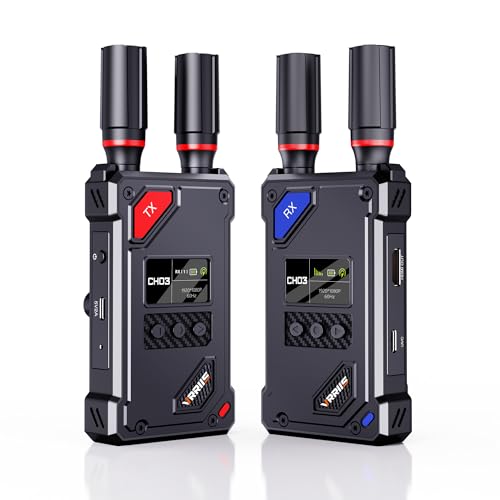
- 1500 ft line-of-sight range
- 0.05s latency with 1080p/60Hz
- UVC out plus HDMI loop out
Best For: home studios that also need OBS streaming and local monitoring
Premium Image-Quality Option
400FT Wireless HDMI with 4K Decode

- 400 ft / 120 m range
- 4K decode with AI noise eraser
- Mirroring and extended screen modes
Best For: studio setups that prioritize picture quality and flexible display modes
Compact Budget-Friendly Choice

- Compact body with built-in antenna
- Auto pairing and plug-and-play setup
- 1080p output with 4K source support
Best For: small home studios and portable plug-and-play setups
Long-Range Home Studio Link – Wireless HDMI for 1080p Monitoring
If you need video transmitters for home studios that can send a clean HDMI feed across a larger space, this 1080p wireless HDMI kit is built around range and low latency. It supports plug-and-play setup, loop out for local monitoring, and IR control for convenient source access from another room.
Best For: home studios, DSLR or laptop-to-TV workflows, and setups that need a long wireless run with local monitoring.
Pros:
- Up to 1300 ft range in open, unobstructed conditions
- 0.05s latency for real-time viewing and sports or game feeds
- Loop out plus dual HDMI output on the receiver for monitoring flexibility
- Multiple power options, including NP-F series batteries and USB-C power
Cons:
- Walls, metal, brick, or glass can reduce range significantly
- Limited to Full HD 1080p@60Hz rather than 4K
- Receiver distance decreases as more RX units are added
For a home studio that values simple setup and strong wireless reach over 4K output, this is a practical pick. The combo of loop out, IR support, and flexible power makes it especially useful when your monitor and source are in different spots.
4K Multi-Receiver Studio Kit – 1000 Ft Wireless HDMI with 1 TX to 3 RX
For video transmitters for home studios that need higher resolution and multi-screen flexibility, this wireless HDMI system combines 4K decoding with a long 1000 ft stated range. It also adds loop-out, IR control, and support for one transmitter to up to three receivers, which is useful when you want one source displayed in multiple rooms or stations.
Best For: home studios, classrooms, and conference-style setups that want 4K decoding and multi-receiver distribution.
Pros:
- Supports 4K 30Hz decoding with lower-latency 1080p 60Hz streaming
- 1 TX to 3 RX capability for multi-room or multi-station viewing
- HDMI loop-out for a local second display at the transmitter
- Dual cooling system with fan plus aluminum heat dissipation plates
Cons:
- Supports progressive scan formats only; no 1080i or 720i
- Remote controller is not included
- Best performance depends on selecting a suitable Wi-Fi band from the available options
This model stands out when you want more than a basic wireless extender. The combination of 4K decoding, multiple receivers, and IR control makes it a strong fit for studios that need to distribute one source efficiently.
Silent Camera-Link Transmitter – Fanless Wireless Video for Quiet Shoots
This SYNCO system is a strong option if you want video transmitters for home studios that stay quiet on set. Its fanless 2W design, 40ms latency, and 300m transmission range are aimed at camera monitoring, live production, and other situations where both silence and responsiveness matter.
Best For: quiet home studio shooting, camera monitoring, and mobile production rigs that need low power draw.
Pros:
- Fanless 2W design for silent operation
- 40ms ultra-low latency for near real-time monitoring
- Up to 300m / 984 ft transmission range
- Receiver supports 1-9 real-time endpoints for team monitoring
Cons:
- NP-F battery is not included
- Designed for 1080P 60FPS monitoring rather than 4K output
- More focused on camera workflows than general TV-room distribution
If your home studio prioritizes silent operation and portable monitoring, this model is easy to recommend. Its low power use, compact body, and multi-endpoint support make it especially useful on quiet shoots.
4K-Decoding Distribution Kit – 656 Ft Wireless HDMI with 1 TX to 4 RX
For buyers comparing video transmitters for home studios, this wireless HDMI extender focuses on stable distribution, 4K decoding, and a flexible multi-room layout. It supports 1080p@60Hz output, loop-out for dual display use, and up to four receivers, making it practical when one source needs to reach several screens.
Best For: home studios, conference rooms, and teaching spaces that need a wireless HDMI hub with multiple receivers.
Pros:
- 4K decoding with 1080p@60Hz full HD output
- Up to 656 ft transmission range
- 1 transmitter to 4 receivers for synchronized display
- IR emitter and receiver for cross-room source control
Cons:
- Wireless performance depends on channel selection and environment
- Remote controller is not included
- As with similar extenders, physical obstructions can affect signal quality
This is a versatile option if you need a distributor rather than a point-to-point extender. The combination of multi-receiver support, loop-out, and dual cooling gives it a practical edge for shared viewing setups.
IOS Monitoring and Streaming – Accsoon SeeMo 4K for iPhone/iPad
If you want video transmitters for home studios that turn an iPhone or iPad into a serious on-set display, the Accsoon SeeMo 4K is built for that role. It accepts HDMI from a camera, supports up to 4K/30 and 1080p/60, and adds monitoring tools like waveform, false color, LUTs, zebra, and overlay support through the SEE app.
Best For: iOS-based creators who want portable monitoring, recording, and livestreaming in one compact setup.
Pros:
- Supports up to 4K/30 and 1080p/60 with H.264 encoding.
- Turns compatible iPhones and iPads into a monitor with pro tools like waveform, histogram, LUTs, and false color.
- Supports RTMP livestreaming over 4G/5G or Wi-Fi through the SEE app.
- Includes vertical video mode and LUT burning for faster creator workflows.
Cons:
- Requires an external NP-F battery for operation; battery not included.
- Needs a separate HDMI cable to connect to the camera.
- Designed for iOS devices, so it is not a universal monitor for every platform.
For solo shooters and small home-studio setups, this is less about cable-free distance and more about adding a flexible mobile monitoring and streaming station. If your workflow centers on an iPhone or iPad, the feature set is unusually strong for the size.
Wireless Long-Range HDMI – SVBONY ST1 4K Wireless HDMI Kit
Among video transmitters for home studios, the SVBONY ST1 stands out if you want true wireless HDMI with a long claimed range and low latency. It transmits up to 1000 ft, supports 4K/30 video, and uses 5.8GHz with nine selectable channels to help avoid congestion from nearby wireless devices.
Best For: Studio users who want wireless HDMI monitoring, flexible receiver setups, and simple plug-and-play operation.
Pros:
- Claims up to 1000 ft transmission with 0.06-second latency.
- Supports 4K/30 and includes a 0.96-inch OLED status screen.
- Offers nine selectable 5.8GHz channels for cleaner signal selection.
- Receiver side includes dual HDMI out and can support up to 1TX to 4RXs.
Cons:
- Additional receivers may reduce effective range in open areas.
- Requires power via DC input, NP-F battery, or Type-C source; batteries not included.
- Wireless performance can be affected by surrounding interference and placement.
This kit is a practical choice when your studio needs flexible monitoring positions without running HDMI across the room. Its strongest appeal is convenience: fast setup, multiple receivers, and monitoring tools that help you keep an eye on signal quality and battery status.
Dual-Display Wireless Sharing – EVATEK Wireless HDMI with 2 Receivers
If you need video transmitters for home studios that can feed more than one screen, this EVATEK kit is built around a one-to-two wireless HDMI layout. It sends HDMI content to two receivers at once, supports mirror or extend mode, and is positioned as a simple plug-and-play option for TVs, projectors, or monitors.
Best For: Users who want one transmitter to feed two displays in a home or office setup.
Pros:
- Includes 1 transmitter and 2 receivers for simultaneous dual-display use.
- Supports plug-and-play setup with no app, Bluetooth pairing, or Wi-Fi required.
- Uses 2.4G/5G dual-band wireless with claimed range up to 328 ft.
- Supports mirror mode and extend mode for flexible viewing setups.
Cons:
- Only works as a one-to-two system and cannot be mixed with other device types.
- Some home devices may need an external charger if USB power is insufficient.
- Obstacles can shorten the transmission distance.
This is a straightforward solution when you want the same source on two screens without extra configuration. It is less specialized for creator monitoring than the other picks, but its dual-receiver design makes it especially useful for simple shared viewing setups.
Long-Range Live Streaming Pick – Wireless HDMI with UVC Out and 20 Channels
If you need video transmitters for home studios that can also handle live streaming, this Vrriis kit is built around long-range, low-latency wireless HDMI. It supports 1080p at 60Hz, offers 20 manual channels for interference control, and adds UVC out so you can feed the receiver straight into OBS without a separate capture device.
Best For: Creators who want a wireless HDMI link for a home studio, plus easy OBS streaming and local monitoring.
Pros:
- Up to 1500 ft line-of-sight range in open areas
- Very low 0.05s latency for near-real-time monitoring
- 20 adjustable channels with LCD signal/interference display
- UVC out and HDMI loop out for streaming and local preview
Cons:
- Walls, metal, brick, or glass can reduce signal range
- RX count affects distance as you add more receivers
- Batteries are not included
For a home studio setup that needs flexibility, this model stands out because it combines wireless video transmission with direct USB-C output for streaming software. The tradeoff is that it works best in cleaner line-of-sight environments, so placement matters.
Premium Image-Quality Option – 400FT Wireless HDMI with 4K Decode
Among video transmitters for home studios, this Ogzvhypl system is geared toward users who care about both wireless convenience and image quality. It supports up to 400 ft / 120 m, uses dual-band 5.8G + 2.4G transmission, and includes 4K decoding with AI noise reduction and a professional color/HDR signal pipeline.
Best For: Home studio users who want a stronger focus on picture quality, low latency, and versatile display modes.
Pros:
- Up to 400 ft / 120 m wireless transmission
- Dual-band design with 20+ frequency bands scanning for interference
- 4K decoding with AI noise eraser and HDR-focused processing
- Mirroring and extended screen modes
Cons:
- Actual range depends on the environment and interference
- Runs as a 4K decode system with 1080p-style wireless delivery details to consider
- Higher-end feature set may be more than simple one-room use requires
This is a strong fit if your studio workflow values clean visuals and flexible screen setup over the simplest possible hardware. Its long-range wireless design and image-processing features make it the most feature-rich option in this group.
Compact Budget-Friendly Choice – Tiny 1080P Wireless HDMI Kit
If you want video transmitters for home studios in a smaller, simpler package, this ZOCIBIHI kit focuses on easy wireless HDMI setup and compact portability. It supports 1080p HD output, auto pairing, and broad compatibility with common HDMI devices, while staying small enough to slip into a bag or drawer.
Best For: Small home studios, portable setups, and users who want a simple plug-and-play wireless HDMI solution.
Pros:
- Compact design with built-in antenna
- Auto pairing and zero-configuration basic operation
- Supports 1080p HD with 4K source decoding
- Works with laptops, TVs, monitors, cameras, and TV boxes
Cons:
- Maximum range drops to about 50 ft / 15 m with obstacles
- Needs a 5V2A power supply for stable performance
- Not designed for the longer reach of larger studio spaces
For tight rooms and simpler workflows, this model offers the most straightforward path to wireless HDMI. It gives up distance, but its tiny size and quick setup make it easy to use for casual studio tasks and portable recording spaces.
How We Picked the Best Video Transmitters for Home Studios
We prioritized systems that are practical for everyday studio use: low latency, stable wireless performance, clear image quality, and a setup process that does not add extra friction. We also looked at real-world range claims, output options, and whether a transmitter can support monitoring, streaming, or multi-display use without unnecessary complexity.
Quick Comparison
For simple camera-to-monitor workflows, compact 1TX+1RX kits are usually the easiest choice. If you need to feed a director monitor, producer screen, or additional viewing station, models with multiple receivers are more flexible. For mobile content creation and live production, options with UVC output or phone/tablet integration can be more useful than raw range alone.
Key Buying Factors for Video Transmitters for Home Studios
Latency
Low latency matters most when you are framing shots, pulling focus, or monitoring live movement. Even a strong wireless signal can be frustrating if the delay is too noticeable for real-time work.
Resolution and Frame Rate
Check the maximum input and output support carefully. Some systems handle 4K input but transmit or decode at 1080p, which may be perfectly fine for monitoring but not ideal if you need full-resolution workflows.
Range and Interference
Manufacturer range numbers are usually best-case estimates. In a home studio, walls, Wi-Fi congestion, and nearby electronics can reduce performance, so dual-band or more robust antenna designs are worth considering.
Monitoring and Connectivity
Look at HDMI loop-out, multi-receiver support, UVC compatibility, and any app-based monitoring features. These are especially helpful in Video Transmitters for Home Studios where multiple devices may need access to the same feed.
Power and Portability
Some kits are built for a fixed studio setup, while others are better for compact rigs, cameras, or hybrid creator workflows. Choose based on whether you need portability, long sessions, or minimal desk footprint.
Who Should Buy Which Video Transmitters for Home Studios?
If you want the simplest upgrade for a desk-based studio, choose a standard low-latency HDMI transmitter and receiver. If you often share the same signal with more than one display, a multi-receiver kit is the better fit. Creators who stream, record remotely, or monitor from a phone or tablet should favor systems with UVC or mobile-device support. For larger rooms or more demanding layouts, prioritize stronger range, better antenna design, and stable dual-band performance over headline resolution alone.