The best MIDI keyboards for production make it easier to play parts, build beats, automate software instruments, and control your DAW without relying entirely on a mouse. The right choice depends on your workspace, playing style, software setup, and need for portability.
Our selection includes compact 25-key controllers, versatile 37-key and 49-key models, and feature-rich options with pads, displays, scales, arpeggiators, and DAW integration.
Best 10 Midi Keyboards for Production Picks for 2026
Best Compact Beat-Making Pick

- 25 velocity-sensitive mini keys with Chord and Scale modes
- Eight RGB MPC pads and eight assignable 360-degree knobs
- USB-C, MIDI Out, display, DAW integration, and bundled software
Best For: Portable beat making and compact production setups
Best All-in-One Workflow

- 25 velocity-sensitive slim keys with arpeggiator
- RGB pads, eight encoders, four faders, and display
- Includes Ableton Live Lite, Analog Lab Intro, and UVI Model D
Best For: Hands-on DAW control in a compact desktop controller
Best for Expanded Performance

- 37 keys provide three full octaves
- Built-in 64-step sequencer works without a computer
- CV/Gate, MIDI I/O, pads, knobs, and DAW transport controls
Best For: Hardware-friendly production and broader keyboard performance
Best Full-Size Keybed Value

- 49 full-size velocity-sensitive keys
- Pitch/modulation wheels, transport buttons, and volume fader
- Plug-and-play USB with bundled DAW and instrument software
Best For: Expressive piano-style playing and songwriting
Studio Command Center

- Full-size 49-key velocity-sensitive keyboard
- Eight pads, arpeggiator, and DAW controls
- OLED display and sustain-pedal input
Best For: Producers wanting full-size keys and broad hands-on control
Beat-Making Favorite

- 25 velocity-sensitive mini keys
- Eight MPC pads and eight assignable knobs
- Arpeggiator, thumbstick, and production software
Best For: Beat makers needing compact pads and plugin control
Portable Learning Hub

- 25 keys with smart scales and OLED display
- Pads, arpeggio, chord, and note-repeat functions
- Includes DAW software and 40 teaching courses
Best For: Beginners and mobile producers building skills
Best Portable Pick

- 25 velocity-sensitive mini keys
- Arpeggiator, sustain, and octave controls
- Eight programmable preset slots
Best For: Portable songwriting and compact production setups
Best Beginner Bundle

- 25 velocity-sensitive mini keys
- Includes 40 teaching courses
- Pitch bend, arpeggiator, and programmable banks
Best For: Beginners learning arrangement and mobile production
Best for Ableton
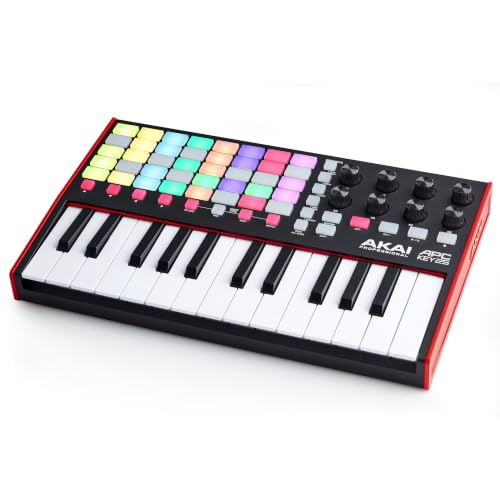
- 40 RGB clip-launching pads
- Eight assignable rotary knobs
- One-to-one Ableton Live mapping
Best For: Ableton Live production and live performance
Best Compact Beat-Making Pick – Akai MPK Mini IV
The Akai MPK Mini IV is a feature-rich choice among midi keyboards for production, combining 25 velocity-sensitive mini keys with MPC pads, assignable knobs, a color display, and hands-on DAW controls. Its compact USB-C design suits desktop, mobile, and travel setups.
Best For: Beat makers, portable producers, beginners, and creators who want pads and performance tools in a small controller.
Pros:
- Eight velocity- and pressure-sensitive MPC pads with RGB feedback support finger drumming.
- Eight assignable 360-degree knobs, a display, and push/turn encoder provide hands-on control.
- Chord, Scale, and advanced Arpeggiator modes help generate ideas quickly.
- Includes DAW integration, instruments, learning tools, and sample resources.
Cons:
- Its 25 mini keys provide less playing space than larger controllers.
- USB-powered operation may require an adapter for some mobile setups.
The MPK Mini IV is especially compelling when beat production, portability, and immediate control matter more than a full-size keybed.
Best All-in-One Workflow – Arturia MiniLab 3
The Arturia MiniLab 3 offers a streamlined approach to midi keyboards for production, pairing 25 velocity-sensitive slim keys with pads, encoders, faders, a display, and an arpeggiator. Its broad control layout is designed to reduce reliance on a mouse during music creation.
Best For: Producers who want a compact controller with hands-on track, instrument, drum, and software control.
Pros:
- Two banks of eight velocity- and pressure-sensitive RGB pads support drum programming.
- Eight rotary encoders, four faders, a clickable browsing knob, and a display offer versatile control.
- Includes Ableton Live Lite, Analog Lab Intro, and UVI Model D.
- Pitch-bend and modulation touch sensors plus a built-in arpeggiator expand performance options.
Cons:
- The 25-key slim-key layout is less suitable for wide two-handed playing.
- It uses USB connectivity rather than the supplied notes’ USB-C specification.
MiniLab 3 is a practical pick for producers who value an organized, mouse-light workflow and a useful included software package.
Best for Expanded Performance – Akai MPK Mini Plus
The Akai MPK Mini Plus brings more playing range to midi keyboards for production with 37 keys across three octaves, while retaining pads, knobs, Chord and Scale modes, and DAW transport controls. Its MIDI and CV/Gate connections also make it useful beyond a computer-based setup.
Best For: Producers who need more melodic and harmonic range, standalone sequencing, or connections to modular and hardware instruments.
Pros:
- Thirty-seven keys provide three full octaves for broader melodic and chord performance.
- Built-in 64-step sequencer supports separate drum and melodic or chord tracks.
- CV/Gate and MIDI I/O connect the controller to modular gear, synthesizers, and sound modules.
- Eight RGB MPC pads, eight assignable knobs, and performance modes support varied workflows.
Cons:
- The larger 37-key format is less compact than 25-key alternatives.
- The supplied notes identify USB connectivity but do not specify USB-C.
The MPK Mini Plus is the strongest fit here for creators who want a compact controller with extra keys and hardware-oriented connectivity.
Best Full-Size Keybed Value – M-Audio Keystation 49 MK3
The M-Audio Keystation 49 MK3 is a straightforward option among midi keyboards for production, emphasizing 49 full-size velocity-sensitive keys over drum pads and extensive onboard controls. It adds pitch and modulation wheels, transport buttons, and a volume fader for practical software control.
Best For: Pianists, songwriters, and producers who prioritize a larger keybed for expressive playing.
Pros:
- Forty-nine full-size velocity-sensitive keys capture performance dynamics.
- Pitch and modulation wheels, octave buttons, sustain input, and transport controls support expressive work.
- Plug-and-play USB operation requires no drivers or power supply with Mac or PC.
- Includes MPC Beats, Ableton Live Lite, AIR instruments, lessons, and other software resources.
Cons:
- It does not include pads, knobs, or an integrated arpeggiator in the supplied specifications.
- The 49-key design takes more desk space than compact mini controllers.
Choose the Keystation 49 MK3 when natural full-size key spacing and simple computer-based control are more important than extensive beat-making features.
Studio Command Center – 49-Key MIDI Controller
For producers who want more playing range than a compact controller, this 49-key option is a practical choice among midi keyboards for production. Full-size velocity-sensitive keys, eight drum pads, DAW controls, an OLED display, and a sustain-pedal input cover both composition and beat-making workflows.
Best For: Home-studio producers and performers who want full-size keys with integrated DAW and beat controls.
Pros:
- 49 full-size keys provide a more familiar playing range and dynamic response.
- Eight velocity-sensitive pads, an arpeggiator, and transpose controls support beat creation.
- OLED feedback, DAW integration, and a sustain-pedal jack add practical workflow control.
- USB connectivity supports Mac, Windows, and compatible iOS setups.
Cons:
- Its 49-key format takes up more space than a 25-key portable controller.
- An adapter is sold separately for iOS devices.
- The listing does not include a warranty.
This controller is a strong fit when hands-on production and a broader keyboard range matter more than minimal desk space. Its combination of keys, pads, display, and DAW controls makes it versatile for studio and live use.
Beat-Making Favorite – Akai MPK Mini MK3
The Akai MPK Mini MK3 is a compact, USB-powered pick for producers who prioritize beat programming and portable control. Its 25 velocity-sensitive mini keys, MPC-style pads, assignable knobs, arpeggiator, and pitch/modulation thumbstick make it well suited to modern production setups.
Best For: Beat makers, mobile producers, and home-studio users who need pads and plugin control in a small footprint.
Pros:
- Eight backlit velocity-sensitive pads include Note Repeat and Full Level functions.
- Eight assignable knobs provide hands-on control over plugins, mixing, and synth parameters.
- The four-way thumbstick combines pitch and modulation control in a compact design.
- Includes MPC Beats, virtual instruments, sound content, and a two-month Splice offer.
Cons:
- The 25 mini keys offer less playing range than a full-size controller.
- It relies on a USB connection and compatible computer or device for operation.
- The included software and promotional bundles require setup and registration.
Choose the MPK Mini MK3 if drum pads, knobs, and portability are more important than a piano-style keybed. It delivers a particularly focused control layout for beat production and virtual instruments.
Portable Learning Hub – Donner DMK 25 Pro
The Donner DMK 25 Pro combines compact production controls with features aimed at learning and mobile use. For creators comparing midi keyboards for production, its 25 velocity-sensitive keys, eight pads, OLED display, smart scales, arpeggio functions, and USB-C connection offer a flexible starting point.
Best For: Beginners and mobile producers who want guided learning features, smart scales, and portable DAW control.
Pros:
- Smart Dynamic Scale Mode and 16 scale options can simplify melody and bass-line creation.
- Arpeggio, note repeat, chord functions, and eight drum pads support varied clip-making workflows.
- USB-C connectivity and included adapter support PC and compatible mobile devices.
- Includes four DAW software options and 40 keyboard-teaching courses.
Cons:
- It does not produce sound independently and requires a phone or computer with DAW software.
- Additional adapters may be needed for some mobile interfaces.
- The 25-key layout provides less range than larger controllers.
The DMK 25 Pro stands out for combining production features with structured instruction. It is a sensible choice for beginners or mobile creators, provided the required device, DAW, and adapter setup are available.
Best Portable Pick – Akai LPK25 MK2
The Akai Professional LPK25 MK2 is a compact choice for producers who want straightforward, portable control. Its 25 velocity-sensitive mini keys, octave buttons, sustain control, arpeggiator, and USB plug-and-play setup make it a practical option for MIDI keyboards for production, songwriting, and mobile studio work.
Best For: Portable songwriting, beat-making, and producers who want a simple controller with programmable presets.
Pros:
- Velocity-sensitive mini keys support expressive melodies, bass lines, and chords.
- Built-in arpeggiator, clock, octave controls, and sustain button add useful performance options.
- Eight programmable preset slots can store mappings for DAWs and virtual instruments.
- USB-powered plug-and-play compatibility works with Mac and PC and popular music software.
Cons:
- The 25-key mini-key layout offers less playing range than a full-size keyboard.
- Its compact control set may be limiting for users who need pads, knobs, or faders.
The LPK25 MK2 focuses on portability and essential keyboard control rather than extensive hands-on mixing. It is a sensible fit when desk space, travel convenience, and quick setup matter most.
Best Beginner Bundle – Donner N-25
The Donner N-25 is designed for beginners who want a small, approachable controller for learning and creating. It combines 25 velocity-sensitive mini keys with an arpeggiator, sustain and octave controls, pitch bend, programmable banks, and included teaching courses, making it an accessible entry among MIDI keyboards for production.
Best For: Beginners learning music arrangement, mobile users, and producers seeking a compact controller with educational content.
Pros:
- Velocity-sensitive mini keys provide a more expressive playing response.
- Beginner-friendly layout includes arpeggiator, sustain, octave, and tap-tempo functions.
- Includes 40 keyboard-teaching courses and music production software.
- Supports Mac, Windows, iOS, Android, smartphones, and tablets with suitable connections.
Cons:
- The 25 mini keys provide limited range for more developed two-handed parts.
- USB connectivity may require an OTG adapter for smartphone music apps.
- The listed warranty is 90 days.
The N-25 stands out by pairing basic production controls with learning resources. It is particularly useful for newcomers who want to start making arrangements without committing to a larger keyboard.
Best for Ableton – Akai APC Key 25 MK2
The Akai APC Key 25 MK2 is built for producers who want keyboard playing and clip launching in one compact controller. With 25 velocity-sensitive mini keys, a 5×8 RGB pad matrix, eight assignable knobs, and one-to-one Ableton Live mapping, it is one of the more performance-focused MIDI keyboards for production.
Best For: Ableton Live users, loop-based production, live clip launching, and hands-on plugin control.
Pros:
- Forty RGB pads provide visual feedback for launching clips, loops, vocals, and samples in Ableton Live.
- Eight assignable rotary knobs support volume, pan, effects sends, automation, and device macros.
- Velocity-sensitive keys handle chords, bass lines, synth leads, and software instruments.
- Includes Ableton Live Lite and additional virtual instruments, with USB plug-and-play operation.
Cons:
- Its strongest integration is with Ableton Live rather than a broad range of listed DAWs.
- The 25-key mini keyboard has a limited range for larger arrangements.
- The combined keyboard, pads, and controls make it less compact than a basic mini-key controller.
The APC Key 25 MK2 is a strong choice when clip launching and live control are as important as playing notes. Ableton users can benefit most from its dedicated pad matrix and pre-mapped workflow.
How We Picked the Best Midi Keyboards for Production
We focused on the features that have the greatest effect on real-world music making: key count, key feel, velocity response, pads and controls, portability, software compatibility, and connection options. We also considered whether each controller suits beat production, melody writing, live performance, learning, or larger studio arrangements.
Because workflows vary, this list balances compact controllers with expanded keyboards rather than treating one layout as universally best. USB connectivity is standard across the selection, while newer USB-C models may be more convenient with current computers and mobile setups.
Quick Comparison
| Keyboard size | Best for | Main advantage |
|---|---|---|
| 25 keys | Portable production and beat making | Small footprint with easy access to pads and controls |
| 37 keys | Compact studios and broader playing | More melodic range without taking up much space |
| 49 keys | Piano-style production and arrangement | Greater range for two-handed parts |
Key Buying Factors for Midi Keyboards for Production
Key Count and Playing Space
Choose 25 keys if portability and desk space matter most. A 37-key controller gives you more room for bass lines, chords, and melodies while remaining relatively compact. A 49-key model is a better fit for two-handed playing, piano parts, and arrangements that require fewer octave changes.
Key Feel and Velocity
Velocity-sensitive keys let software instruments respond to how hard you play, which is important for expressive piano, synth, and drum parts. Mini keys save space but may feel less natural to players accustomed to full-size keys. If piano technique is a priority, look for the largest keybed that fits your setup.
Pads, Knobs, and Software Control
Drum pads are useful for finger drumming, clip launching, and triggering samples, while knobs and buttons can speed up mixing or instrument control. DAW integration is valuable when it is compatible with your software, but basic MIDI mapping can still provide flexible control across most major music applications.
Portability and Connections
USB-powered controllers are convenient for laptops and compact workstations. USB-C can simplify newer setups, but confirm whether the included cable matches your computer. Also check the controller’s dimensions and whether its controls remain comfortable when packed into a travel bag.
Who Should Buy Which Midi Keyboards for Production?
Choose a 25-key controller if you make beats, travel frequently, or work in a small desk setup. These models are also practical for beginners and producers who mainly enter short melodic phrases.
Choose a 37-key controller if you want a useful middle ground between portability and playable range. It is well suited to electronic production, songwriting, and compact home studios.
Choose a 49-key controller if you regularly play piano-style parts, use both hands, or prefer fewer octave shifts. It requires more desk space but can feel substantially more natural for arrangement and performance.
Before buying, verify DAW compatibility, available ports, included software, and the controller’s physical dimensions. The best Midi Keyboards for Production are the ones that fit your room, software, and creative habits closely enough to stay connected and useful every session.