The best looper pedals for beginners make it easier to practice, build layered parts, and create hands-free backing tracks without a complicated setup. The right model should offer intuitive controls, reliable recording, and enough loop time for the way you play.
This roundup compares 10 options ranging from straightforward one-button loopers to pedals with tuners, drum machines, effects, high-fidelity audio, and expanded control layouts.
Best 10 Looper Pedals for Beginners Picks for 2026
Best Value Starter

- Nine loops and 40 minutes total recording time
- Built-in tuner with unlimited overdubbing
- USB WAV transfer and power supply included
Best For: Beginners needing ample loop storage and simple controls
Most Straightforward

- 12 minutes of stereo recording time
- 24-segment LED loop-status indicator
- Stereo I/O and useful accessory bundle
Best For: Beginners wanting clear feedback and uncomplicated operation
Best Simple Design

- Five minutes of loop time
- Unlimited overdubs with undo/redo
- True bypass and analog dry-through
Best For: Guitarists seeking a compact, focused looping pedal
Best for Growing Skills

- 13 hours of stereo recording and 99 memories
- 57 rhythms with variations and seven drum kits
- LCD, USB, MIDI, and reverse playback
Best For: Beginners planning to develop advanced looping setups
Maximum Looping Power
Zoom MS-90LP+ MultiStomp Looper

- Up to 90 minutes per loop and 100 stored loops
- Five dedicated footswitches for intuitive control
- Rhythms, loop effects, MIDI, stereo I/O, and USB-C
Best For: Beginners who want extensive storage and room to grow
Simple Two-Switch Control

- Dedicated start/stop button for simple operation
- USB loop import, export, and backing-track support
- Stop, Reverse, and Half Speed effects
Best For: Beginners who prioritize straightforward looping
Looping With Built-In Drums
MOOER GL100 Looper Pedal Drum Machine

- 100 slots with 300 minutes of total storage
- 220 drum patterns plus automatic DrumMatch
- Auto Rec, count-in, quantized alignment, and touchscreen control
Best For: Beginners who want rhythm accompaniment and timing assistance
Best Long-Memory Pick

- Nine loops and 40 minutes total recording
- Uncompressed 24-bit/48kHz audio
- Built-in tuner and USB WAV transfer
Best For: Beginners needing extra loop storage and recording time
Best Practice Companion
LEKATO Looper With Drum Machine
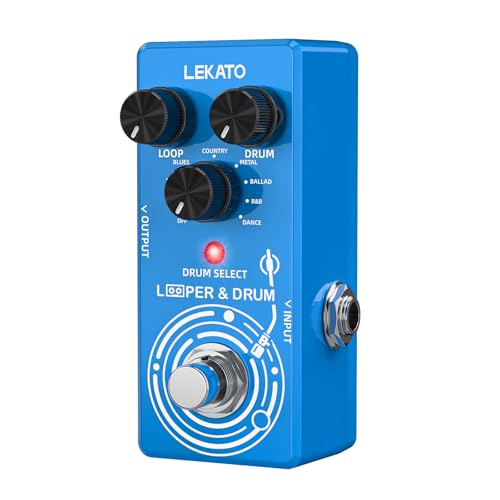
- Looper and drum machine in one pedal
- Eight grooves with tap tempo
- Independent volume controls and auto-save
Best For: Beginners practicing with built-in rhythmic backing
Best Simple Mini Pick

- Five minutes of looping with unlimited overdubs
- Compact aluminum-alloy construction
- USB transfer and simple one-knob operation
Best For: Beginners learning basic looping with minimal controls
Best Value Starter – LEKATO Looper with Tuner
For beginners comparing looper pedals for beginners, the LEKATO offers generous recording capacity and straightforward foot control at an approachable size. Its built-in tuner and USB file transfer make it useful for practicing, experimenting, and organizing loops.
Best For: Beginners who want long recording time, a built-in tuner, and USB loop transfers.
Pros:
- Stores nine loops with up to 40 minutes of total recording time.
- Supports unlimited overdubbing with separate foot commands for undo, redo, stop, and erase.
- Includes a built-in tuner and USB import/export for WAV loop files.
- Comes with a USB cable and selectable power-supply adapter.
Cons:
- Its single-knob design provides less hands-on control than more advanced loop stations.
- USB transfer and extended loop storage may be more functionality than a beginner needs initially.
The LEKATO is a practical entry point when recording time and convenience matter more than a large rhythm or MIDI feature set. The visual time indicator and simple control layout help make basic looping easier to follow.
Most Straightforward – BOSS RC-1 Loop Station
Boss RC-1 Loop Station | Bundle with Gearlux Power Supply, Instrument Cable, Patch Cable, and Picks
Check Price On AmazonThe BOSS RC-1 is a strong choice for beginners who want a recognizable, uncomplicated loop station. Its circular 24-segment LED indicator clearly shows recording, overdub, and playback status, while stereo connections support a range of instruments and effects.
Best For: Beginners who prioritize clear visual feedback, stereo connectivity, and simple operation.
Pros:
- Offers up to 12 minutes of stereo recording time.
- The circular LED indicator makes the current loop mode easy to see.
- Stereo inputs and outputs work with stereo effects, amplifiers, and instruments such as synthesizers.
- The bundle includes a power adapter, instrument cable, patch cable, and picks.
Cons:
- Battery life is approximately 4.5 hours when using a 9-volt alkaline battery.
- The optional PSA AC adapter is separate from the standard pedal, although this bundle includes a power adapter.
The RC-1 keeps the learning curve low without sacrificing stereo flexibility. Its phrase memory retention after power-off is also convenient for practice sessions and repeatable setups.
Best Simple Design – TC Electronic Ditto Looper
The TC Electronic Ditto is designed around the essentials, making it a natural option for beginners learning the fundamentals of looping. It provides five minutes of loop time, unlimited overdubs, and undo/redo controls in a compact pedal with true bypass and analog dry-through.
Best For: Guitarists who want a compact, transparent-sounding pedal focused on basic looping.
Pros:
- Provides five minutes of looping time with unlimited overdubs.
- Includes undo and redo functions for correcting or rebuilding layers.
- True bypass and analog dry-through help preserve the dry signal path.
- Compact design and a single-knob interface keep operation approachable.
Cons:
- A 9V power supply providing 100 mA or more is required and is not supplied.
- Its five-minute loop capacity is lower than the other listed options.
- It has fewer connectivity and storage features than more advanced loop stations.
The Ditto is appealing when you want to start looping without navigating extra menus or rhythm features. Its limited feature set is also its main advantage for players who prefer a focused guitar-practice tool.
Best for Growing Skills – BOSS RC-5 Loop Station
Although the RC-5 is more advanced than many beginner pedals, it gives new loopers room to grow. It combines 13 hours of stereo recording, 99 phrase memories, built-in rhythms, a color LCD, and USB/MIDI connectivity in a compact format.
Best For: Beginners who expect to explore rhythm accompaniment, saved phrases, and expanded control options.
Pros:
- Provides 13 hours of stereo recording and storage for 99 phrase memories.
- Includes 57 rhythms with A/B variations and seven drum kits.
- Offers a multi-color LCD for viewing loop status and parameters.
- Supports reverse playback, USB, MIDI, and external footswitch or expression-pedal control.
Cons:
- The extensive rhythm, MIDI, and control features may feel complex to a first-time looper.
- Advanced operation may require more setup than a basic one-knob pedal.
- The optional PSA adapter is listed alongside battery operation, so power requirements should be checked before purchase.
The RC-5 is a forward-looking choice for a beginner who does not want to outgrow a basic looper quickly. Its display, rhythm library, and phrase storage make it particularly suitable for structured practice and developing live-looping setups.
Maximum Looping Power – Zoom MS-90LP+ MultiStomp Looper
For beginners looking for looper pedals for beginners that can grow with their playing, the Zoom MS-90LP+ offers extensive recording capacity and hands-free controls. It supports up to 90 minutes per loop, 100 stored loops, and stereo connectivity for guitars, basses, synths, and keyboards.
Best For: Beginners who want generous storage, rhythms, effects, and room to develop more advanced looping setups.
Pros:
- Records up to 90 minutes per loop, with 13 hours total capacity and storage for 100 loops.
- Five dedicated footswitches provide separate controls for undo, stop, loop effects, and rhythms.
- Includes 68 rhythm patterns, eight loop effects, quantize, MIDI, stereo I/O, and USB-C connectivity.
Cons:
- The broad feature set may take longer for a complete beginner to learn.
- Its larger footprint may require more pedalboard space than a basic looper.
The MS-90LP+ is a strong choice if you want a beginner-friendly starting point without quickly outgrowing the pedal. Its dedicated switches and quantize function support live use, while the storage and connectivity suit songwriting and studio work.
Simple Two-Switch Control – TC Electronic DITTO X2 LOOPER
The TC Electronic DITTO X2 is a straightforward option for beginners comparing looper pedals for beginners. Its dedicated start/stop button keeps core operation simple, while USB loop import and export and three loop effects add useful flexibility.
Best For: Guitarists who want uncomplicated looping with a dedicated stop control and basic playback effects.
Pros:
- Dedicated start/stop button simplifies hands-free operation.
- Supports loop import, export, and backing tracks through USB.
- Provides Stop, Reverse, and Half Speed loop effects.
Cons:
- The supplied notes do not specify extended loop-storage capacity or built-in rhythm patterns.
- Its feature set is more focused than the larger multi-function loopers in this roundup.
The DITTO X2 is a sensible pick when ease of use matters more than a long list of features. The dedicated stop button can make the basic record-and-play workflow less intimidating for new loopers, while USB support adds options for prepared tracks.
Looping With Built-In Drums – MOOER GL100 Looper Pedal Drum Machine
The MOOER GL100 combines looping and rhythm practice in one pedal, making it an appealing choice among looper pedals for beginners. It offers 100 memory slots, 300 minutes of total storage, automatic recording, count-in, quantized alignment, and 220 drum patterns.
Best For: Beginners who want drum accompaniment, automatic timing help, and substantial loop storage in one compact unit.
Pros:
- Stores up to 300 minutes across 100 memory slots.
- Includes 220 drum patterns and DrumMatch for automatic groove and BPM matching.
- Auto Rec, count-in, end sync, time stretch, and a touchscreen support more accurate practice.
- Offers stereo or mixed inputs, split drum output, and USB-C editor connectivity.
Cons:
- The many drum, timing, storage, and editing functions may feel complex at first.
- Its touchscreen and editor-based workflow may be more than beginners need for basic looping.
The GL100 is especially useful for learning rhythm and building complete practice parts without a separate drum machine. Beginners may need some setup time, but automatic recording, count-in, and quantized alignment can help produce cleaner loops sooner.
Best Long-Memory Pick – 9-Loop LEKATO Looper
If you want looper pedals for beginners with room to grow, this LEKATO model offers a straightforward one-knob design alongside unusually generous memory. It supports nine saved loops, up to 10 minutes per individual recording, and 40 minutes of total recording time.
Best For: Beginners who want simple controls, multiple loop slots, and plenty of recording capacity.
Pros:
- Nine loops and up to 40 minutes of total recording time
- 24-bit/48kHz uncompressed audio with Analog-Dry-Through
- Built-in tuner with continuous switching
- USB import/export for WAV loop files
Cons:
- Requires a 9V, 300mA power source
- Its single-button foot-command system may take practice to master
This is a strong beginner-friendly choice if memory and flexibility matter more than having many dedicated controls. Unlimited overdubbing, Undo/Redo, and the visual time indicator make it practical for learning layered playing.
Best Practice Companion – LEKATO Looper With Drum Machine
For beginners seeking looper pedals with built-in rhythm support, this LEKATO combines a six-minute looper and drum machine in one compact pedal. The two sections can work independently or together, making it useful for practicing timing, building layers, and jamming without a separate backing track.
Best For: Beginners who want drum grooves and looping in a single pedal for practice or solo performance.
Pros:
- Combines a 24-bit/44.1kHz looper with a drum machine
- Eight drum grooves using samples from three acoustic drum kits
- Unlimited overdubbing with automatic saving
- Independent looper and drum volume controls
Cons:
- Power adapter and cable are not included
- Automatic tempo matching supports only 4/4 phrases
- Six minutes of loop time is less than some dedicated loopers
The drum section gives this model a clear advantage for structured practice, while USB-C import/export adds useful file management. Its independent controls also make it easier to balance rhythm backing against recorded guitar parts.
Best Simple Mini Pick – LEKATO ONE Mini Looper
If you prefer a minimal setup, this compact LEKATO ONE focuses on the essential looping functions. It provides five minutes of loop time, unlimited overdubbing, and foot commands for recording, Undo/Redo, stopping, and erasing without adding a complicated control layout.
Best For: Beginners who want a small, uncomplicated looper for learning basic layering.
Pros:
- Compact aluminum-alloy construction
- Simple single-knob playback-volume control
- 24-bit uncompressed audio with Analog-Dry-Through
- USB import/export for loop files
Cons:
- Offers one loop with five minutes of looping time
- Its minimal design provides fewer dedicated controls
- Uses a 9V, 300mA power requirement
This model is a sensible starting point when you want to learn looping without navigating multiple menus or rhythm features. Its small footprint and sturdy construction also suit players who want a portable practice pedal.
How We Picked the Best Looper Pedals for Beginners
We focused on the features that matter most when learning to loop: simple recording and overdubbing, dependable footswitches, clear audio, useful loop storage, and controls that are easy to understand on a dimly lit pedalboard. We also included a range of prices and feature sets, from compact single-function pedals to more advanced loop stations.
Recording time, stop controls, bypass behavior, drum accompaniment, tuner functions, USB connectivity, and power requirements were considered because these details can significantly affect everyday usability. A beginner-friendly pedal should encourage experimentation rather than make basic looping feel like a technical task.
Quick Comparison
Simple loopers such as the TC Electronic DITTO and LEKATO ONE are best for learning the basic record-overdub-stop workflow. The BOSS RC-1 adds a more visual interface, while the BOSS RC-5 and Zoom MS-90LP+ provide more recording capacity and advanced functionality. Models with drum machines, including the MOOER GL100 and LEKATO drum looper, are useful for practicing with a beat instead of a metronome.
Before buying, check the listed loop time carefully. Some pedals offer only a few minutes, while others provide extended recording or multiple saved loops. Also confirm whether the pedal includes the required power supply; many compact loopers use a separately purchased 9V adapter.
Key Buying Factors for Looper Pedals for Beginners
Controls and Footswitch Layout
Look for clearly marked switches and a workflow that separates recording, overdubbing, and stopping when possible. A dedicated stop button can be easier to manage live than a shared switch requiring timed presses.
Loop Time and Memory
Five minutes is generally enough for practice and short song sections. Choose more recording time or multiple memory locations if you want to save complete arrangements, switch between songs, or build longer performances.
Sound Quality and Signal Handling
True bypass and analog-dry-through can help preserve the natural sound of your instrument. If you use a detailed effects chain or record directly into an amp, prioritize a pedal with clean, high-fidelity audio and suitable input and output connections.
Extra Features
A built-in tuner is convenient for a compact practice rig. Drum grooves and tap tempo add rhythmic structure, while USB connectivity may simplify backing up loops or transferring audio, depending on the model.
Who Should Buy Which Looper Pedals for Beginners?
Choose a basic single-function looper if you are learning timing and want the fewest controls possible. A pedal with a visual loop indicator is a strong choice for beginners who want immediate feedback while recording. Select a model with drum patterns if you practice alone and want a more musical rhythm foundation.
Players planning to perform should consider dedicated stop controls, longer loop storage, and sturdy footswitches. Guitarists who expect to expand their pedalboard may prefer a compact model with true bypass and a straightforward signal path. If you want to experiment with layered arrangements, effects, or saved performances, the more advanced BOSS and Zoom options offer greater room to grow.