The best headphone amplifiers with balanced output can deliver more power, lower noise, and greater connection flexibility for demanding headphones and desktop audio systems. However, not every product in this roundup serves the same purpose.
Our selection includes high-power DAC/headphone amps for personal listening alongside multi-channel amplifiers designed to distribute one source to several listeners. Use the guide below to match output type, power, inputs, and features to your equipment.
Best 10 Headphone Amplifiers with Balanced Output Picks for 2026
Best All-in-One Desktop Pick

- 4.4mm balanced and RCA outputs
- 2100mW output with high-resolution decoding
- USB-C, optical, coaxial, and Bluetooth inputs
Best For: Feature-rich desktop listening and gaming setups
Best for Shared Listening

- Four independent headphone outputs
- Individual volume controls
- Compact metal enclosure
Best For: Tracking, rehearsals, and four-person monitoring
Best Compact DAC

- 1100mW balanced output at 32 ohms
- USB-C and optical inputs
- Works as a headphone amp or preamp
Best For: Compact PC and home-audio systems
Best Budget Studio Splitter
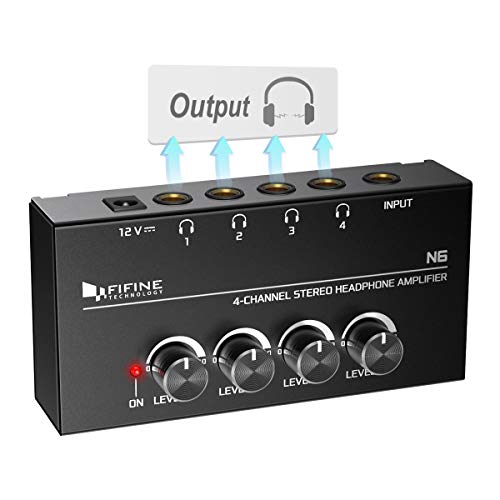
- Four individually controlled outputs
- Balanced TRS input
- Compact metal design with power adapter
Best For: Studio tracking and live monitoring
Best R2R Versatility
FiiO K13 R2R Desktop DAC & Headphone Amp

- 4.4mm balanced headphone and XLR line outputs
- 24-bit R2R DAC with PCM 384kHz/32-bit and DSD256 support
- LDAC Bluetooth, NOS/OS modes, and 10-band PEQ
Best For: Desktop listeners seeking balanced connectivity and extensive tuning options
Best for Group Monitoring
Bolanle PH800 8-Channel Headphone Amplifier

- 16 outputs across 3.5mm and 6.35mm formats
- Supports headphones up to 250Ω
- Independent volume control with mono/stereo switching
Best For: Band rehearsals, studios, and multi-person monitoring
Best Compact Splitter
4-Channel Mini Metal Stereo Headphone Amp

- Four 1/4-inch TRS headphone outputs
- Independent volume control on each channel
- Compact metal housing with included 12V adapter
Best For: Small-group monitoring, podcasts, rehearsals, and home audio sharing
High-Power Desktop Pick

- Up to 4600mW+4600mW via 4.4mm balanced output
- Discrete Class AB amplification
- 5V USB or 12V USB-C PD power
Best For: Demanding planar magnetic and high-impedance headphones
Multi-Listener Studio Pick
Pyle PHA40 4-Channel Headphone Amp

- Four 1/4-inch TRS headphone outputs
- Independent volume controls per listener
- Compact monitor distribution design
Best For: Shared studio monitoring with up to four headphones
Best Simple Pick

- 4600mW+4600mW balanced output at 32Ω
- Class AB discrete amplification
- 4.4mm and 3.5mm headphone outputs
Best For: High-powered desktop listening in a silver finish
Best All-in-One Desktop Pick – Fosi Audio K7
The Fosi Audio K7 is a versatile choice among headphone amplifiers with balanced output, combining a DAC, multiple digital inputs, Bluetooth, microphone connectivity, and substantial power in one desktop unit. Its 4.4mm balanced output complements the 3.5mm and RCA connections.
Best For: Desktop listeners, gamers, and users who want one hub for headphones, powered speakers, and several source devices.
Pros:
- 4.4mm balanced, 3.5mm single-ended, and RCA outputs
- Supports PCM up to 384kHz/32bit and DSD256
- Up to 2100mW output for demanding headphones
- USB-C, optical, coaxial, Bluetooth aptX HD/LL, and microphone input
Cons:
- Larger feature set may be more than needed for a simple headphone setup
- Requires the included 12V power supply for desktop use
The K7 stands out when connectivity and flexibility matter as much as balanced headphone output. Its controls, display, and durable aluminum chassis also make it well suited to a permanent desktop system.
Best for Shared Listening – Mackie HM-4
The Mackie HM-4 is a straightforward four-channel headphone amplifier for distributing one audio source to multiple listeners. While it does not provide a 4.4mm balanced output, it is a practical companion for sessions where individual volume control matters more than balanced headphone connections.
Best For: Tracking sessions, rehearsals, and small monitoring setups with up to four listeners.
Pros:
- Four independent headphone outputs
- Separate volume control for each listener
- Accepts a 1/4-inch or 1/8-inch source connection
- Compact metal build that can be attached to a desk, rack, or stand
Cons:
- No 4.4mm balanced output
- Designed for signal distribution rather than DAC or source switching
The HM-4 is best viewed as a compact headphone distribution amp, not a high-resolution balanced DAC amplifier. Choose it when four-person monitoring and simple operation are the priorities.
Best Compact DAC – Fosi Audio SK02
The Fosi Audio SK02 is a compact DAC and preamp for listeners seeking headphone amplifiers with balanced output without taking up much desk space. It offers a 4.4mm balanced connection alongside 3.5mm output, USB-C and optical inputs, and high-resolution decoding.
Best For: PC and home-audio users who want a small, plug-and-play balanced DAC amp that can also feed active speakers or another amplifier.
Pros:
- 4.4mm balanced output reaches up to 1100mW at 32 ohms
- Supports DSD256 and PCM up to 384kHz/32bit
- USB-C and optical inputs suit computers, TVs, CD players, and projectors
- Useful control knob, gain switching, and sampling-rate indicators
Cons:
- Input selection is limited to USB-C and optical
- Its compact output power is specified at 32 ohms, so headphone matching still matters
The SK02 is a strong fit for a clean, compact desktop system. Its preamp function adds flexibility, while the balanced output and high-resolution support keep it relevant for dedicated headphone listening.
Best Budget Studio Splitter – FIFINE N6
The FIFINE N6 is a simple four-output distribution amplifier for sharing one stereo source. It is not a conventional balanced-output headphone amplifier with a 4.4mm connection, but its balanced TRS input and four 1/4-inch outputs make it useful for studio and stage monitoring.
Best For: Musicians, recording setups, and small live applications that need four independently controlled headphone feeds.
Pros:
- Four outputs with separate volume knobs
- Balanced TRS input and four 1/4-inch stereo outputs
- Metal construction with a compact footprint
- Includes a 12V DC power adapter
Cons:
- No 4.4mm balanced headphone output
- Requires 1/4-inch cables; TRS/TS cables are not included
- Has one input and four outputs, so it is not a mixer
The N6 makes sense when the goal is reliable multi-listener monitoring rather than DAC features or audiophile output options. Confirm your cables and connectors before choosing it for a studio or stage rig.
Best R2R Versatility – FiiO K13 R2R Desktop DAC & Headphone Amp
The FiiO K13 R2R is a strong choice among headphone amplifiers with balanced output if you want a desktop DAC, headphone amp, and preamp in one unit. It combines a 4.4mm balanced headphone output with balanced XLR line output, high-resolution decoding, Bluetooth 5.4 with LDAC, and flexible NOS/OS listening modes.
Best For: Desktop listeners who want balanced connections, extensive format support, and customizable sound.
Pros:
- Provides 4.4mm balanced headphone output plus XLR and RCA outputs.
- Uses a fully differential 24-bit R2R DAC and supports PCM up to 384kHz/32-bit and DSD256.
- Offers NOS and OS modes, along with a 10-band PEQ and app or web control.
- Supports LDAC, AAC, and SBC wireless streaming over Bluetooth 5.4.
Cons:
- Its desktop design and broad feature set may be more than needed for simple headphone splitting.
- The balanced headphone output is 4.4mm, so other plug types may require an adapter.
The K13 R2R stands out for listeners who want a feature-rich desktop setup rather than a basic amplifier. Its combination of balanced output, R2R conversion, wireless streaming, and EQ control gives it broad flexibility for focused listening and system integration.
Best for Group Monitoring – Bolanle PH800 8-Channel Headphone Amplifier
The Bolanle PH800 is designed for sharing one audio source with multiple listeners. While it is not a balanced-output headphone amplifier, its eight 3.5mm and eight 6.35mm outputs, high-impedance support up to 250Ω, and mono/stereo switching make it useful alongside balanced-output equipment in rehearsal, studio, and live-monitoring setups.
Best For: Bands, studios, and production teams that need many individually controlled headphone feeds.
Pros:
- Provides 16 total headphone outputs: eight 3.5mm and eight 6.35mm connections.
- Designed to drive professional headphones up to 250Ω.
- Offers mono/stereo switching for different monitoring situations.
- Each channel has volume control, and the metal housing is powered by a 12V/2A supply.
Cons:
- It does not provide a balanced headphone output.
- Its large output count is unnecessary for individual desktop listening.
- No wireless connectivity is included.
The PH800 is best viewed as a distribution amplifier rather than a personal balanced headphone amp. Its appeal is practical: it can give a group separate headphone connections and volume adjustment from a shared source.
Best Compact Splitter – 4-Channel Mini Metal Stereo Headphone Amp
This compact four-channel unit is a practical option for sharing one stereo source with several listeners. It is not a balanced-output headphone amplifier, but its four 1/4-inch TRS outputs, independent volume controls, low-noise JRC4580 chip, and small metal enclosure make it useful for simple studio, stage, podcast, and home monitoring setups.
Best For: Small groups needing an affordable, compact amplifier with separate headphone volume controls.
Pros:
- Shares one stereo input with four headphone outputs.
- Provides independent volume adjustment for every channel.
- Supports headphones in the listed 32–100Ω range and uses a low-noise JRC4580 operational amplifier.
- Compact 90 × 55 × 40 mm metal design includes a 12V adapter.
Cons:
- It does not offer balanced outputs.
- All connections use 1/4-inch TRS, so other plug sizes may need adapters.
- The listed warranty is limited to 30 days.
The HA400-style design prioritizes straightforward signal distribution and space savings. Choose it when four listeners, individual volume control, and a compact footprint matter more than balanced connectivity or advanced DAC features.
High-Power Desktop Pick – FiiO GIGAS 1 Black
For listeners seeking headphone amplifiers with balanced output, the FiiO JadeAudio GIGAS 1 is a powerful desktop option. Its 4.4mm balanced connection can deliver up to 4600mW+4600mW at 32Ω, making it well suited to demanding planar magnetic and high-impedance headphones.
Best For: Desktop listeners who need substantial power, balanced connectivity, and flexible source support.
Pros:
- Very high-power 4.4mm balanced output for demanding headphones
- Discrete Class AB design with high current capability
- Supports RCA and 3.5mm inputs, plus dual gain modes
- Can use standard 5V USB power or 12V USB-C PD
Cons:
- Its desktop-focused power exceeds what many easy-to-drive headphones require
- Higher output capability depends on using 12V USB-C PD power
The GIGAS 1 stands out when power and headroom matter most. It also remains practical for mixed setups, thanks to its 3.5mm output, microphone pass-through support, and broad analog input compatibility.
Multi-Listener Studio Pick – Pyle PHA40 4-Channel Headphone Amp
The Pyle PHA40 takes a different approach to headphone amplifiers with balanced output, functioning as a compact monitor distribution system rather than a high-power audiophile amp. It provides four 1/4-inch TRS headphone outputs, allowing multiple listeners to monitor one source at the same time.
Best For: Small recording setups, rehearsals, and situations where up to four people need independent headphone volume control.
Pros:
- Drives up to four headphones simultaneously
- Independent rotary volume control for each channel
- Compact design suited to studio or on-the-road use
- Includes a 1/4-inch TRS source input
Cons:
- Uses 1/4-inch TRS connections rather than a 4.4mm balanced output
- Designed for multi-channel monitoring, not maximum power for demanding headphones
The PHA40 is best understood as a practical headphone splitter and monitor amp. Choose it for shared monitoring and individual volume control, but look elsewhere if your priority is a modern 4.4mm balanced headphone connection.
Best Simple Pick – FiiO GIGAS 1 Silver
The silver FiiO JadeAudio GIGAS 1 is a strong choice for shoppers comparing headphone amplifiers with balanced output. It offers up to 4600mW+4600mW through its 4.4mm balanced output at 32Ω, giving power-hungry headphones more drive, dynamics, and headroom.
Best For: Desktop headphone systems needing high output, flexible analog inputs, and a silver finish.
Pros:
- High-power 4.4mm balanced output for demanding headphones
- Discrete Class AB output stage for current capability and control
- Works with DACs, DAPs, phones, computers, and CD players
- Dual gain modes accommodate sensitive and power-hungry headphones
Cons:
- Its output level may be more than necessary for easy-to-drive headphones
- Maximum capability requires compatible 12V USB-C PD power
With the same amplification platform as the black version, this silver GIGAS 1 is primarily a finish preference. Its combination of 4.4mm balanced and 3.5mm outputs makes it a versatile centerpiece for a desktop audio setup.
How We Picked the Best Headphone Amplifiers with Balanced Output
We compared the listed models by looking at their output configuration, amplification power, input options, channel count, portability, and intended use. Because this selection includes both audiophile desktop units and compact multi-channel splitters, we focused on identifying the right use case rather than treating every amplifier as interchangeable.
We also considered practical details such as balanced 4.4mm connectivity, 3.5mm and 6.35mm compatibility, USB and optical inputs, Bluetooth support, size, and whether a model is better suited to one listener or a group. Specifications can vary by input, output, and headphone impedance, so confirm the manufacturer’s current documentation before buying.
Quick Comparison
- Best for high-power personal listening: Choose a desktop DAC/amp with a dedicated balanced output and substantial power reserve.
- Best for modern digital setups: Look for USB-C, optical, Bluetooth, and built-in DAC support.
- Best for several listeners: Select a multi-channel amplifier with multiple independent headphone outputs.
- Best for simple studio distribution: A compact analog headphone splitter can be sufficient when you already have a mixer or audio interface.
- Best for portability: Favor smaller metal units with straightforward analog inputs and low power requirements.
Key Buying Factors for Headphone Amplifiers with Balanced Output
Balanced Output and Connector Type
Balanced headphone connections commonly use a 4.4mm Pentaconn or a 4-pin XLR connector. A 4.4mm output is convenient for many current headphones, while XLR remains common in larger desktop systems. Check your headphone cable before choosing an amplifier; a balanced output does not make a standard single-ended cable balanced without the correct replacement cable.
Power and Headphone Compatibility
Output ratings are often quoted at specific impedances, so wattage alone does not tell the whole story. High-impedance headphones may benefit from strong voltage delivery, while low-impedance planar headphones often need current. Make sure the amplifier supports your headphones comfortably without relying on maximum volume.
Inputs and DAC Features
For computer audio, USB is usually the most direct option. Optical input can help connect televisions, consoles, or other digital sources, while Bluetooth is useful for convenient wireless playback. If you already own a quality DAC, an analog amplifier may be all you need; otherwise, an integrated DAC/amp can reduce cable clutter.
Channel Count and Controls
Multi-channel models are designed for shared monitoring, recording, teaching, or gaming setups. Confirm whether each output has independent volume control and whether the unit uses 3.5mm or 6.35mm connections. These distribution amplifiers are not necessarily substitutes for a high-fidelity balanced desktop amp.
Who Should Buy Which Headphone Amplifiers with Balanced Output?
Choose a high-power balanced desktop amp if you use demanding headphones, want strong dynamics, and primarily listen alone. Integrated DAC models are particularly convenient for PC, console, and streaming setups.
Choose a multi-channel headphone amplifier if several people need to monitor the same source or you are expanding a mixer, interface, or small studio. Prioritize output count, connector compatibility, and independent level controls.
Choose a compact analog unit for a straightforward, affordable way to split one stereo source among multiple headphones. These models make the most sense when balanced audiophile performance is not the main goal.