The best field recorder with timecode can simplify production sound by combining high-quality recording, dependable synchronization, and flexible input options in one compact setup.
These 10 picks range from pocket-sized 32-bit float recorders to multichannel production mixers, helping filmmakers, musicians, and content creators find the right balance of portability, connectivity, and control.
Best 10 Field Recorder with Timecode Picks for 2026
Best Integrated Timecode Recorder

- 32-bit float recording helps avoid clipping
- Internal timecode generation and TC I/O
- Dual XLR/TRS inputs plus 3.5 mm input
Best For: Videographers needing compact, integrated timecode
Best Handheld Timecode Option

- Three microphones with nine recording patterns
- 32-bit float recording with no manual gain adjustment
- Bluetooth timecode sync for multiple units
Best For: Portable interviews, podcasts, music, and lightweight filmmaking
Best Pocket Timecode Recorder

- Compact 32-bit float recorder with timecode
- Locking 3.5 mm mic/line input
- Includes W.Lav Pro lavalier microphone
Best For: Lavalier recording, interviews, and compact film rigs
Best Multitrack Timecode Recorder

- Six XLR inputs and up to 14 tracks
- 32-bit float recording with dual A/D converters
- Timecode I/O for frame-accurate sync
Best For: Professional multi-microphone film and broadcast recording
Compact Timecode Mixer

- Four low-noise Kashmir preamps
- 32-bit float recording up to 192 kHz
- Internal LTC timecode generator
Best For: Portable production and location sound
Professional Timecode Workhorse
- Eight inputs and ten tracks
- 0.2 ppm timecode accuracy
- Dual SD slots for redundant recording
Best For: Professional film and location audio
Wireless Pocket Timecode

- Wireless sync with Deity TC-1 generators
- 24-bit and 32-bit float WAV recording
- 40 g body with nearly 30-hour battery life
Best For: Lavalier, interview, and wearable recording
Best Compact Timecode Bundle

- Two-channel 32-bit float recording
- Includes TCA-1 timecode adapter
- Locking XLR inputs and microSD recording
Best For: Compact audio-for-video rigs and small production setups
Best Wearable Timecode Recorder

- Tiny 35 g wearable design
- 32-bit float mono recording
- IP67 dust and water protection
Best For: Discreet interviews, run-and-gun shoots, and action-camera audio
Best Multichannel Timecode Recorder
- Six locking XLR inputs
- Dedicated timecode I/O with jam sync
- 6-track or 14-track recording modes
Best For: Professional film, ENG, and multicamera production sound
Best Integrated Timecode Recorder – TASCAM FR-AV2
The TASCAM FR-AV2 is a strong choice if you need a field recorder with timecode in a compact, camera-oriented package. It combines 32-bit float recording, dual XLR/TRS inputs, and internal timecode generation, helping streamline location audio without requiring a separate timecode device.
Best For: Videographers who want integrated timecode, flexible professional inputs, and clip-resistant recording.
Pros:
- 32-bit float recording with dual ADCs helps capture audio without clipping.
- Timecode IN/OUT and internal generation support synchronized video workflows.
- Two XLR/TRS combo inputs, a 3.5 mm input, and Ultra HDDA preamps provide flexible connectivity.
Cons:
- Bluetooth monitoring requires the optional AK-BT2 adapter.
- Uses three AA batteries.
Choose the FR-AV2 when built-in timecode and compact size matter more than a larger input count. Its 48, 96, and 192 kHz recording options also give videographers room to match different production requirements.
Best Handheld Timecode Option – Zoom H2 Essential
The Zoom H2 Essential is a versatile handheld recorder for users who want a field recorder with timecode without relying on a traditional multi-input chassis. Its three built-in microphones offer nine recording patterns, while Bluetooth timecode can synchronize multiple H2 Essential units.
Best For: Journalists, podcasters, musicians, and filmmakers needing flexible built-in microphones and wireless multi-recorder synchronization.
Pros:
- Three built-in microphones support nine selectable recording patterns.
- 32-bit float recording captures clip-free audio without constant gain adjustment.
- Can operate as a USB microphone while recording a backup to an SD card.
- Bluetooth supports wireless control and timecode synchronization between multiple units.
Cons:
- Timecode synchronization is described as Bluetooth-based rather than dedicated timecode I/O.
- Built-in microphones may be less suitable than XLR inputs for larger professional microphone setups.
The H2 Essential stands out for portability and ease of use. It is particularly practical when you want several recording patterns in one handheld device or need accessible menu navigation and long battery life.
Best Pocket Timecode Recorder – Deity PR-2
The Deity PR-2 is a pocket-sized field recorder with timecode designed for discreet filmmaking, interviews, and lavalier work. It supports 32-bit float recording, accepts a locking 3.5 mm mic or line input, and can work with compatible Deity timecode products or as a standalone timecoder.
Best For: Filmmakers and interview crews who need a compact recorder for lavaliers, camera feeds, or hidden on-person audio.
Pros:
- 32-bit float recording reduces the need for precise gain staging.
- Locking 3.5 mm stereo mic/line input supports lavaliers, shotgun microphones, and mixer feeds.
- Compatible with Deity timecode products and can function as a standalone timecoder.
- Includes a W.Lav Pro lavalier microphone and offers up to 30 hours of battery life.
Cons:
- Its single 3.5 mm input is less expansive than multi-XLR field recorders.
- Timecode compatibility is centered on Deity products.
The PR-2 is a practical pick when size, lavalier compatibility, and wireless control are priorities. Its included microphone adds value for interview and on-person recording setups, while USB-C connectivity allows use as a sound card.
Best Multitrack Timecode Recorder – Zoom F6
The Zoom F6 is a professional field recorder with timecode for productions that need multiple microphone inputs and extensive track capacity. Six XLR inputs, 32-bit float recording, and timecode I/O make it suited to demanding film, broadcast, and location-recording workflows.
Best For: Filmmakers, broadcasters, and location sound teams recording several microphones at once.
Pros:
- Six XLR inputs support simultaneous multi-microphone recording.
- 32-bit float recording with dual A/D converters handles a wide dynamic range without clipping.
- Up to 14 tracks provide substantial production flexibility.
- Timecode I/O enables frame-accurate synchronization with video.
Cons:
- At 2.4 pounds, it is substantially heavier than pocket and compact handheld options.
- Its larger feature set may be more than needed for simple one- or two-microphone jobs.
The F6 is the strongest fit here for complex location sound. It can serve as either a standalone recorder or USB audio interface, and multiple power options help support extended field use.
Compact Timecode Mixer – Sound Devices MixPre-6 II
The Sound Devices MixPre-6 II is a strong field recorder with timecode for mobile production, location sound, and home-studio work. Its four Kashmir preamps, 32-bit float recording, and compact design provide flexible capture while the internal LTC generator supports synchronized workflows.
Best For: Location sound bags, small film crews, and creators who need a compact recorder that can also serve as a USB audio interface.
Pros:
- Four ultra-low-noise Kashmir microphone preamps with adjustable limiters.
- Supports 16- to 32-bit float recording and sample rates up to 192 kHz.
- Internal LTC timecode generator with timecode input/output options.
- Functions as an 8-in/4-out USB-C audio interface while remaining lightweight.
Cons:
- Its six-channel capacity is lower than larger multitrack field recorders.
- Timecode input/output uses the Aux In and Stereo Out connections.
The MixPre-6 II balances professional preamps, flexible recording formats, and timecode features in a small package. It is particularly practical when portability matters as much as synchronized audio.
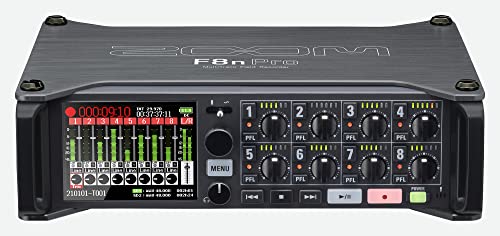
Professional Timecode Workhorse – Zoom F8n Pro Field Recorder
The Zoom F8n Pro is a field recorder with timecode designed for professional film and location audio. It combines eight inputs, ten tracks, 32-bit float capture, highly sensitive preamps, and accurate timecode for demanding production workflows.
Best For: Film crews, production sound mixers, and projects requiring multiple inputs, redundant media recording, and dependable synchronization with picture.
Pros:
- Eight-channel, ten-track recording with 32-bit float and dual AD converters.
- Timecode accuracy down to 0.2 ppm via a TCXO.
- Dual SD card slots support redundant recording, with capacities up to 1 TB each.
- Can operate as an 8-in/4-out USB interface while recording to an SD card.
Cons:
- At 1.8 kg, it is less lightweight than compact pocket recorders.
- Its professional feature set may be more than needed for simple interviews or single-source recording.
With broad input capacity, precise timecode, and redundant recording, the F8n Pro is the most production-focused option in this roundup. It is best suited to crews that need room to expand and added recording security.
Wireless Pocket Timecode – Deity PR-2 Pocket Recorder
The Deity PR-2 is a pocket-sized field recorder with timecode for lavalier recording, interviews, news, and lightweight video production. It records in 24-bit or 32-bit float, accepts a locking 3.5mm input, and wirelessly syncs with Deity TC-1 timecode generators.
Best For: Wearable lavalier capture, interviews, creators, and productions that prioritize minimal size, remote control, and long battery life.
Pros:
- Wireless timecode synchronization with Deity TC-1 generators.
- Supports 24-bit and 32-bit float WAV recording.
- Very compact 40 g design with a locking 3.5mm mic/line input.
- Offers Sidus Audio app control from up to 250 feet and nearly 30 hours of battery life.
Cons:
- Its single 3.5mm input is less suited to multichannel production than larger recorders.
- Wireless timecode synchronization requires compatible Deity TC-1 generators.
The PR-2 is the most discreet and wearable choice here. Its 32-bit float recording and wireless timecode make it convenient for talent-mounted audio, while the limited input format keeps it focused on compact setups.
Best Compact Timecode Bundle – Zoom F3 + TCA-1
If you need a compact field recorder with timecode for video production, this Zoom F3 bundle combines two-channel 32-bit float recording with the included TCA-1 timecode adapter. It is well suited to dialogue, interviews, and small production setups where portable, flexible audio capture matters.
Best For: Compact audio-for-video rigs, interviews, and productions using compatible cameras or timecode equipment.
Pros:
- 32-bit float recording with dual A/D converters helps handle changing sound levels.
- Two locking XLR inputs support mic and line sources with 24/48V phantom power.
- Included TCA-1 provides 3.5 mm TRS timecode input/output for compatible workflows.
- Runs on AA batteries, USB power, or an optional AC adapter and records to microSD cards.
Cons:
- Limited to two recording tracks and two XLR inputs.
- Timecode operation depends on compatible firmware and external equipment.
The F3 bundle is a practical choice when you want the safety of 32-bit float audio and timecode capability without moving to a larger multichannel recorder. Its two-input design keeps the setup portable, though larger productions may need more inputs.
Best Wearable Timecode Recorder – Instamic Pro Plus C
The Instamic Pro Plus C is a highly portable field recorder with timecode designed to stay unobtrusive on camera. Its wearable mono design, built-in MEMS microphones, and 32-bit float recording make it a convenient option for run-and-gun shoots, interviews, and content creation.
Best For: Discreet wearable recording, outdoor shoots, and smartphone or action-camera workflows.
Pros:
- Small 35 g design can be placed discreetly during interviews and on-camera shoots.
- 32-bit float capture helps reduce the risk of clipped audio.
- IP67-rated construction provides dust and water protection.
- Can sync and control up to 10 units through the companion app with compatible systems.
Cons:
- Mono recording and built-in microphones offer less input flexibility than an XLR recorder.
- Timecode integration relies on compatible apps or systems such as Atomos or Tentacle Sync.
- Records in AIFF format rather than WAV.
This recorder prioritizes convenience and discretion over traditional production-recorder connectivity. Choose it when a tiny, weather-resistant device and wireless-friendly workflow matter more than multiple external microphone inputs.
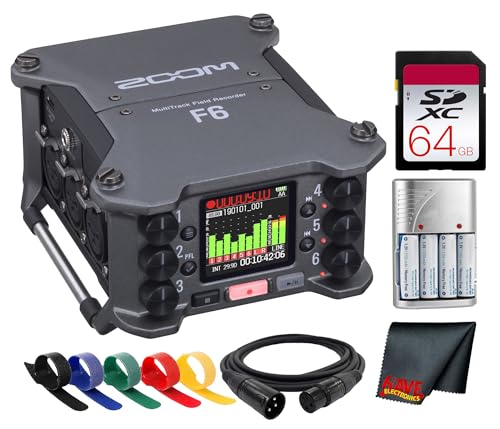
Best Multichannel Timecode Recorder – Zoom F6 Bundle
For larger productions needing a field recorder with timecode, the Zoom F6 bundle offers six locking XLR inputs, multitrack recording, and dedicated timecode I/O. Its 32-bit float design and high-gain preamps make it a strong fit for filmmaking, ENG, location recording, and complex dialogue setups.
Best For: Professional production sound, multicamera shoots, location recording, and multichannel microphone setups.
Pros:
- Six XLR inputs and 6-track or 14-track recording support more elaborate productions.
- 32-bit float recording and dual A/D converters provide broad dynamic-range handling.
- Dedicated 3.5 mm TRS timecode I/O, TCXO accuracy, and jam sync support stable synchronization.
- Works as a 6-in/4-out USB audio interface while recording to SD for backup.
Cons:
- Larger and heavier than compact two-input recorders.
- The bundle includes assorted accessories, so some items may not match every production kit.
The F6 is the most capable option here for crews that need multiple inputs and dependable synchronization. Its timecode tools and multitrack flexibility justify the larger form factor, while USB operation adds versatility for computer-based recording.
How We Picked the Best Field Recorder with Timecode
We compared these recorders based on timecode support, recording resolution, input and track capacity, portability, power options, monitoring controls, and suitability for real-world production. We also considered whether each model is best for a single lavalier, a compact camera rig, or a larger multi-microphone setup.
32-bit float recording received particular attention because it provides substantial protection against unexpectedly loud peaks when gain is difficult to manage. However, timecode workflow, connector type, battery life, and physical controls can matter just as much on set.
Quick Comparison
| Best For | Recommended Type | What to Prioritize |
|---|---|---|
| Solo filmmakers | Compact 2-channel recorder | Simple timecode setup and portability |
| Lavalier recording | Pocket or wearable recorder | Small size, mic compatibility, and secure mounting |
| Documentary and run-and-gun work | Portable multichannel recorder | Battery life, ruggedness, and fast level control |
| Professional production sound | Recorder-mixer with multiple inputs | Track count, monitoring, routing, and timecode reliability |
Key Buying Factors for a Field Recorder with Timecode
Timecode Compatibility
Check whether the recorder includes a built-in timecode generator, requires an external adapter, or supports timecode through a dedicated accessory. Confirm compatibility with your camera, slate, wireless system, and editing workflow before buying.
Inputs, Tracks, and Connectors
Two inputs may be enough for a compact interview or camera-mounted kit, while larger productions may need four or more microphone inputs and separate isolated tracks. XLR/TRS combination inputs are versatile, but pocket recorders may use smaller connectors or dedicated lavalier inputs.
32-Bit Float Recording
32-bit float is useful when levels change quickly or the operator cannot monitor continuously. It does not replace good microphone placement, and it does not fix clipping that occurs before the signal reaches the recorder, so front-end quality still matters.
Size, Power, and Controls
For handheld or wearable work, prioritize low weight, secure mounting, accessible record controls, and long battery life. Larger units generally provide better metering, routing, and monitoring, but they may require a bag, external power, or more setup time.
Monitoring and Workflow Features
Look for clear meters, headphone monitoring, limiter options, track arming, metadata support, and reliable file handling. If you record directly into a camera workflow, confirm the recorder’s output and synchronization options match your production equipment.
Who Should Buy Which Field Recorder with Timecode?
Choose a compact model such as the TASCAM FR-AV2, Zoom F3, or Deity PR-2 when portability and straightforward synchronization are more important than a high input count. These options suit interviews, small crews, creator rigs, and isolated lavalier recording.
The Zoom F6 and similar six-input options are a strong middle ground for filmmakers who need multiple microphones without carrying a full-size mixer. For larger crews, multi-mic shoots, or more demanding routing and monitoring, the Zoom F8n Pro and Sound Devices MixPre-6 II offer greater production flexibility.
Wearable options such as the Instamic Pro Plus C are best when the recorder must stay close to the talent and remain unobtrusive. Finally, a recorder bundle can be worthwhile if it includes the timecode hardware, cables, or accessories needed to make the system usable immediately.