The right field recorder can make production audio cleaner, safer, and easier to manage—especially when you need two professional microphones, wireless receivers, or line-level sources connected at once.
We selected 10 standout models for 2026, ranging from compact 32-bit float recorders to multitrack systems built for larger film crews. Compare their inputs, recording formats, timecode features, portability, and workflow before choosing.
Best 10 Field Recorder with Dual Xlr Picks for 2026
Best for Timecode Workflows

- 32-bit float recording for no-clip capture
- Dual XLR/TRS combo inputs
- Built-in timecode generation and sync
Best For: Videographers managing timecode-based productions
Best Modular Handheld
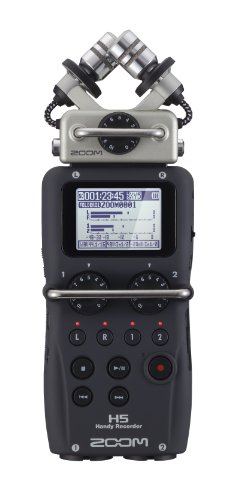
- Interchangeable input capsules
- Dual XLR/TRS inputs with phantom power
- Four-track recording and USB interface mode
Best For: Filmmakers and musicians seeking a flexible handheld recorder
Best for Four-Input Camera Rigs
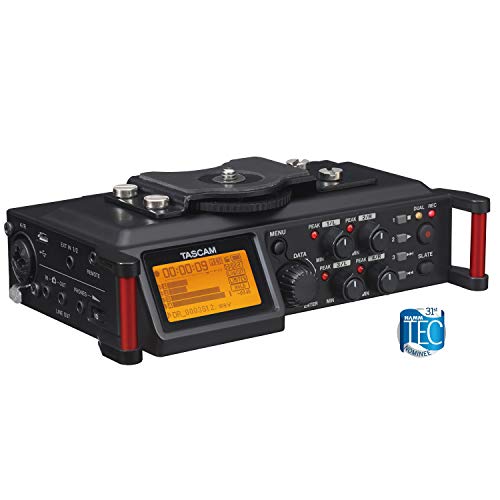
- Four balanced XLR inputs
- Camera-mountable design with built-in mics
- Dual Recording safety copy mode
Best For: Videographers handling multiple microphones on camera rigs
Best Compact 32-Bit Float Option

- 32-bit float recording with dual A/D converters
- Dual locking XLR/TRS inputs
- Low-noise preamps and flexible power options
Best For: Run-and-gun filmmakers and demanding location recordists
Versatile Creator Pick
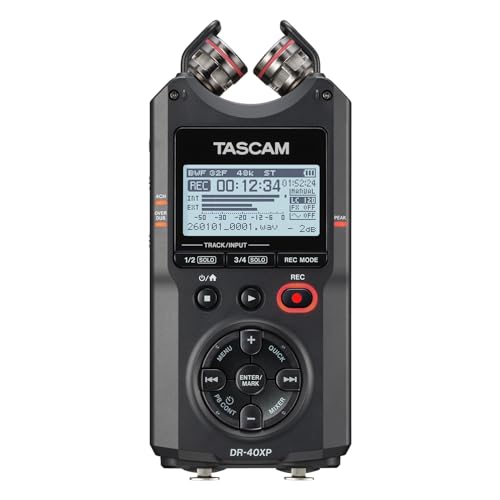
- 32-bit float recording and adjustable stereo microphones
- Two XLR/TRS inputs with four-channel recording
- USB-C interface for computer or compatible mobile setups
Best For: Musicians and creators needing flexible stereo and external-input recording
Professional Multitrack Choice

- Six XLR inputs and up to 14 tracks
- 32-bit float recording with dual A/D converters
- Timecode I/O for frame-accurate video sync
Best For: Film, broadcast, and music productions with multiple microphones
Compact Audio-for-Video Pick

- Two locking XLR inputs with phantom power
- 32-bit float recording and low-noise preamps
- Includes TCA-1 adapter for timecode connections
Best For: Two-channel video production and portable location recording
Professional Production Pick
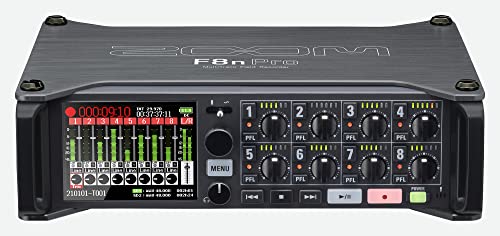
- 8 inputs and 10 tracks for complex film setups
- 32-bit float capture with 75dB gain and -127dBu EIN preamps
- Dual SD recording and 0.2ppm timecode
Best For: Professional filmmakers and location sound teams
Compact Dual-Input Pick
Zoom H1 XLR 2-Channel Recorder

- Two locking XLR/TRS combo inputs
- 32-bit/96kHz recording with waveform display
- Compact 6.4-ounce design with SDXC support up to 1TB
Best For: Portable interviews, podcasts, and two-source recording
Musician’s Creative Pick

- Two XLR/TS combo inputs with four-track recording
- Bounce tracks, effects, and built-in stereo microphones
- 80-plus rhythm patterns and USB interface mode
Best For: Portable songwriting, layering, and instrument recording
Best for Timecode Workflows – TASCAM FR-AV2
If you need a field recorder with dual XLR for video production, the TASCAM FR-AV2 combines two XLR/TRS combo inputs with 32-bit float recording and built-in timecode generation. Its compact design is aimed at videographers who want faster setup and added protection against clipped recordings.
Best For: Videographers needing dual-input recording with integrated timecode.
Pros:
- 32-bit float recording with dual ADCs helps support no-clip capture.
- Two XLR/TRS combo inputs use Ultra HDDA preamps.
- Built-in timecode input, output, generation, and synchronization reduce dependence on external timecode gear.
- Supports 48, 96, and 192 kHz recording.
Cons:
- Wireless monitoring requires the optional AK-BT2 adapter.
- Requires three AA batteries.
The FR-AV2 is a particularly practical choice when timecode is central to your production workflow. It offers a strong combination of compact size, flexible inputs, and recording headroom for location work.
Best Modular Handheld – Zoom H5
The Zoom H5 is a versatile field recorder with dual XLR inputs, interchangeable input capsules, and four-track simultaneous recording. It suits filmmakers and musicians who want a handheld recorder that can also function as a USB audio interface.
Best For: Filmmakers and musicians who want flexible mic configurations in a portable recorder.
Pros:
- Two XLR/TRS combo inputs include selectable phantom power and a -20 dB pad.
- Interchangeable capsule system expands recording options.
- Supports four-track simultaneous recording.
- Works as a multichannel or stereo USB audio interface for PC, Mac, and iPad.
Cons:
- Records to SD or SDHC cards up to 32GB.
- Uses two AA batteries.
The H5 is a well-rounded option if you value adaptability more than the latest float-recording design. Its capsule system and USB functionality make it useful across location recording, music, and video setups.
Best for Four-Input Camera Rigs – TASCAM DR-70D
For productions that need more than two connections, the TASCAM DR-70D is a field recorder with dual XLR capability and four balanced XLR inputs. It is designed for videographers, with camera-mountable construction, built-in microphones, individual gain controls, and a safety recording mode.
Best For: Filmmakers and documentarians recording several microphones around a camera setup.
Pros:
- Four balanced XLR inputs provide more simultaneous connections than typical two-input recorders.
- Individual gain controls and phantom power support production sound workflows.
- Dual Recording mode creates a lower-level safety copy to help protect against distortion.
- Can mount above or below a camera and includes two built-in microphones.
Cons:
- At 1.2 pounds, it is heavier than the more compact options listed here.
- Requires four AA batteries.
- Does not list 32-bit float recording in the supplied specifications.
The DR-70D makes the most sense when input count and camera integration matter. Its four-channel layout and safety recording feature are useful for multi-mic shoots, though its larger size favors rig-based work over minimal run-and-gun setups.
Best Compact 32-Bit Float Option – Zoom F3
The Zoom F3 is a compact field recorder with dual XLR, locking connectors, and 32-bit float recording. It is built for filmmakers and recordists working in unpredictable conditions who need clean audio capture without continually adjusting levels.
Best For: Run-and-gun filmmakers and location recordists who prioritize compact, clip-resistant recording.
Pros:
- 32-bit float recording and dual A/D converters help handle quiet dialogue and sudden peaks.
- Dual locking XLR inputs keep microphone connections secure.
- Ultra-low-noise preamps support clean recordings in demanding environments.
- Flexible power options support standalone or USB workflows.
Cons:
- Provides two XLR/TRS inputs rather than the four inputs found on the DR-70D.
- Uses microSD media rather than standard SD cards.
The F3 is a strong fit when portability and recording headroom are more important than built-in microphones or a larger input count. Locking XLR connectors and flexible power options also make it suitable for rigs where the recorder may be mounted out of reach.
Versatile Creator Pick – TASCAM DR-40XP
If you need a field recorder with dual XLR inputs for music, interviews, or audio for video, the TASCAM DR-40XP offers a flexible setup in a compact handheld design. Its two XLR/TRS inputs work alongside adjustable built-in stereo microphones, while 32-bit float recording helps provide clip-free capture in changing environments.
Best For: Musicians, interviewers, and creators who want built-in microphones, external inputs, and USB-C connectivity in one portable recorder.
Pros:
- 32-bit float recording with 24-bit and 16-bit WAV options.
- Adjustable A-B or X-Y microphones handle up to 125 dB SPL.
- Four-channel recording can combine the built-in microphones and external inputs.
- Works as a 2-in/2-out USB-C audio interface.
Cons:
- microSD card and batteries are not included.
- Its two-input design is less suited to larger microphone setups than six-input recorders.
The DR-40XP is a practical all-rounder for creators who want dual XLR/TRS connectivity without giving up quick stereo recording from built-in microphones.
Professional Multitrack Choice – Zoom F6
For professional location work, the Zoom F6 is a field recorder with dual XLR capability and a much larger six-input layout. Its 32-bit float recording, dual A/D converters, timecode I/O, and support for up to 14 tracks make it suited to complex film, broadcast, and music productions.
Best For: Filmmakers, broadcast crews, and musicians recording several microphones while maintaining accurate video synchronization.
Pros:
- Six XLR inputs support simultaneous multichannel recording.
- 32-bit float recording captures a broad dynamic range without clipping.
- Timecode I/O enables frame-accurate synchronization with video.
- Can operate as a standalone recorder or USB audio interface.
Cons:
- Its 2.4-pound weight is substantially greater than compact handheld options.
- The larger feature set may be more than needed for simple two-microphone recording.
The F6 is the strongest choice here for productions that need multiple XLR inputs, timecode, and extensive track flexibility in a rugged portable recorder.
Compact Audio-for-Video Pick – Zoom F3 Bundle
The Zoom F3 bundle is a compact field recorder with dual locking XLR inputs, 32-bit float recording, and an included TCA-1 timecode adapter. It is designed for audio-for-video workflows where two microphone channels, dependable level handling, and camera synchronization matter more than a large input count.
Best For: Video creators and location recordists who need two locking XLR inputs plus timecode connectivity in a portable setup.
Pros:
- 32-bit float recording with dual A/D converters and low-noise preamps.
- Two locking XLR mic/line inputs provide 24/48V phantom power.
- Included TCA-1 adapter adds 3.5 mm TRS timecode input and output.
- Supports AA batteries, USB power, or the AD-17 AC adapter.
Cons:
- Only two recording tracks are available.
- Timecode functionality depends on compatible firmware and connected equipment.
With its focused two-channel design and bundled timecode adapter, the F3 is a strong fit for streamlined video shoots that need reliable XLR capture and sync without a larger multitrack recorder.
Professional Production Pick – Zoom F8n Pro Field Recorder
For demanding film and location work, the Zoom F8n Pro is a field recorder with dual XLR capability that goes far beyond a basic two-input setup. Its eight inputs, 10-track recording, 32-bit float capture, high-gain preamps, timecode support, and redundant dual-SD recording make it suited to complex production workflows.
Best For: Professional filmmakers, location sound teams, and productions needing multiple inputs, timecode, and backup recording.
Pros:
- Eight inputs and 10-track recording support larger location setups.
- 32-bit float recording and dual AD converters help capture clip-free audio across a wide dynamic range.
- Dual SD slots enable redundant recording, while 0.2ppm timecode helps keep audio aligned with video.
- Can operate as an 8-in/4-out USB interface while recording to SD.
Cons:
- Its 1.8 kg weight and larger design are less convenient for lightweight run-and-gun kits.
- The extensive professional feature set may be more than casual users need.
- Battery life is listed at approximately 8.5 hours.
The F8n Pro is the strongest choice here for professional production, especially when channel count, timecode accuracy, and recording redundancy matter more than portability.
Compact Dual-Input Pick – Zoom H1 XLR 2-Channel Recorder
The Zoom H1 XLR is a compact field recorder with dual XLR inputs for interviews, podcasts, music, and everyday production. Its two locking XLR/TRS combo inputs, 32-bit/96kHz recording, waveform display, and 3.5mm connectivity provide a practical setup without the size of a larger multitrack recorder.
Best For: Filmmakers, podcasters, musicians, and interview creators who need two flexible inputs in a portable recorder.
Pros:
- Two locking XLR/TRS combo inputs accept microphones, instruments, and other sources.
- 32-bit/96kHz recording supports detailed, clip-free captures.
- OLED waveform display makes level monitoring straightforward.
- Supports SDXC cards up to 1TB and offers about 10 hours of battery life.
Cons:
- Two-channel recording is limiting for larger production setups.
- The 0.96-inch screen is compact and may provide less viewing space than larger recorders.
- It requires two AA batteries.
With a 6.4-ounce body and straightforward controls, the H1 XLR is an appealing option when portability and dual-input flexibility are more important than extensive routing or multitrack capacity.
Musician’s Creative Pick – Zoom R4 Multi-Track Recorder
The Zoom R4 is a field recorder with dual XLR/TRS combo inputs designed around songwriting and portable music creation. It combines four-track recording, stereo bouncing, built-in microphones, effects, rhythm patterns, 32-bit float capture, and USB interface functionality in a battery-powered unit.
Best For: Musicians and creators who want to layer ideas, record instruments, and build arrangements away from a computer.
Pros:
- Two XLR/TS combo inputs connect microphones, instruments, keyboards, and other sources.
- Four-track recording with bouncing and undo supports layered compositions.
- More than 80 built-in rhythm patterns provide accompaniment for practice and songwriting.
- Works as a 32-bit float 2-in/2-out USB interface and runs on four AA batteries or USB-C.
Cons:
- Its four-track format is less suited to large location recording sessions.
- The feature set is focused on music creation rather than timecode-based film production.
- Four AA batteries are required for battery operation.
The R4 stands out as a self-contained creative workstation rather than a conventional production recorder. Choose it when layering, rhythm tracks, and portable music-making are central to your workflow.
How We Picked the Best Field Recorder with Dual Xlr
We focused on recorders that offer two or more professional microphone inputs through XLR or XLR/TRS combo connectors. The selection also considers recording quality, gain flexibility, portability, monitoring, battery practicality, and how easily each model fits a real production workflow.
Some picks are compact two-channel tools, while others provide extra inputs for future expansion. We also included models with 32-bit float recording, timecode support, multitrack capability, USB audio functionality, or built-in microphones where those features add practical value.
Quick Comparison
| Best For | What to Look For |
|---|---|
| Compact filmmaking | Small body, two XLR inputs, reliable headphone monitoring |
| Run-and-gun recording | 32-bit float capture and simple controls |
| Camera-based production | Timecode, camera connectivity, and secure mounting options |
| Music and podcasts | Combo inputs, overdubbing, effects, and USB interface support |
| Larger film crews | More inputs, multitrack recording, routing, and timecode |
Key Buying Factors for a Field Recorder with Dual Xlr
Input Type and Channel Count
Confirm whether you need two dedicated XLR inputs or combo XLR/TRS connections. Combo inputs provide more flexibility for microphones, mixers, instruments, and line-level gear. If you expect to record several microphones or wireless receivers, choosing four or more inputs can prevent an early upgrade.
32-Bit Float Versus Conventional Recording
32-bit float recording provides substantial protection against unexpectedly loud or quiet sources when the recorder’s front-end supports it. It is especially useful for unpredictable dialogue, documentary work, and location recording. It does not replace good microphone placement, proper monitoring, or a clean signal path.
Timecode and Sync
For video work, timecode can simplify synchronization across cameras and external audio. If you regularly shoot with multiple cameras, look for a recorder with built-in timecode or a compatible timecode accessory. Casual interviews and single-camera shoots may not need this feature.
Portability, Power, and Monitoring
Check size, mounting options, battery type, estimated runtime, headphone output, display readability, and control layout. A compact recorder is easier to carry, but larger models may offer better metering, routing, connectors, and physical controls.
Storage and Workflow
Consider the supported media, file formats, track layout, USB-C functions, and whether files are easy to transfer and organize. A recorder that can also act as an audio interface may be valuable for editing, streaming, or home-studio work.
Who Should Buy Which Field Recorder with Dual Xlr?
Choose a Compact Two-Channel Model
Choose a small dual-XLR recorder if you prioritize low weight, quick setup, interviews, solo filmmaking, or portable music recording.
Choose a 32-Bit Float Recorder
Choose a 32-bit float model if sound levels are difficult to predict or you often work without a dedicated sound mixer. It offers more recovery flexibility during post-production.
Choose a Multitrack Recorder
Choose a higher-input recorder if you run multiple wireless systems, boom and lavalier microphones, several musicians, or a larger production. Extra channels and routing options are worth the added size when expansion matters.
Choose Timecode Capability
Choose a timecode-equipped recorder or compatible bundle if you regularly sync external audio with multiple cameras. For simpler setups, prioritize input quality, portability, and battery life instead.