Choosing the right lighting controller can make a show feel tighter, faster, and more professional. The best DMX controllers simplify cue timing, scene changes, and fixture management without adding unnecessary complexity.
Below, we focus on dependable options for DJs, clubs, bars, and stage crews that need practical control in 2026.
Best 10 Dmx Controllers Picks for 2026
Entry-Level 192-Channel Console
CO-Z 192 DMX 512 Stage Light Controller

- 192 channels for up to 12 intelligent lights
- Supports up to 240 scenes
- Voice control and easy 7-section layout
Best For: Amateur users and small event setups
Hybrid DJ Lighting Interface
SoundSwitch Control One DMX Lighting Controller

- 1:1 control for SoundSwitch software
- Dual-USB with 2 DMX universes and Thru option
- Works directly with Engine DJ hardware
Best For: DJs using software-linked lighting setups
Proven Universal Console
CHAUVET DJ Obey 70 Universal DMX-512 Controller

- 384 DMX channels for larger rigs
- Up to 12 intelligent lights and 240 scenes
- Rack-mount metal design
Best For: Larger stage setups needing deeper scene control
Pro-Grade 384-Ch Board
Rockville ROCKFORCE 384 DMX Lighting Controller with MIDI

- 384 channels for up to 24 fixtures
- 30 scene banks and 6 chases
- MIDI, mic input, and metal housing
Best For: DJs and stage setups needing a classic programmable DMX console
Compact 384-Channel Console
DMX512 DJ Controller for Bar and Club Lights

- 384 channels with support for 24 fixtures
- 30 banks of 8 programmable scenes
- Lightweight build with LED gooseneck lamp
Best For: Bars, clubs, and small stages needing straightforward DMX scene control
App-Controlled Wireless Interface
ADJ MyDMX Go Wireless DMX Lighting Controller

- App-based control from iPad or Android tablets
- 256 channels with Wi-Fi and USB
- 15,000+ fixture library and preset effects
Best For: Tablet users who want wireless DMX control with minimal setup
Budget-Friendly 192-Channel Control
192-Channel DMX Board with Cables
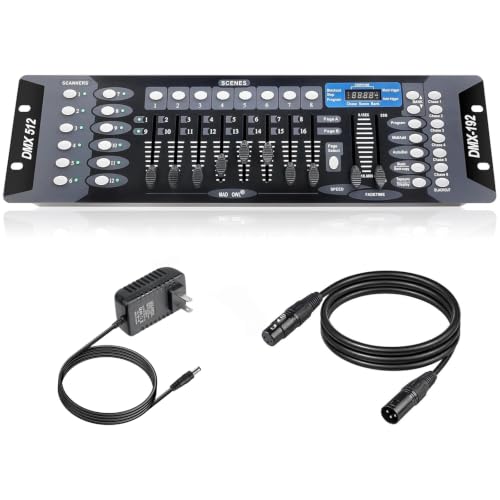
- 192 channels for up to 12 fixtures
- 23 banks of 8 programmable scenes
- Includes 6.6 ft DMX cable
Best For: Small stage and DJ setups needing basic programmable control
Wireless Versatility
384-Channel Dual-Mode Controller

- 384 channels for up to 12 intelligent lights
- 2.4G wireless and 3-pin wired connection
- Sound-activated and MIDI control modes
Best For: DJs and event setups needing wireless and sound-reactive control
Easy-Start Scene Programming
192-Channel DMX Lighting Console

- 192 channels for up to 12 smart devices
- 23 scenario banks and 6 programmable chases
- 8 sliders for manual channel control
Best For: Beginners and small-event lighting setups
Entry-Level 192-Channel Console – CO-Z 192 DMX 512 Stage Light Controller
If you want a straightforward way to manage dmx controllers for smaller clubs, weddings, church events, or home DJ setups, this CO-Z console keeps the basics accessible. It offers 192 channels, supports up to 12 intelligent lights, and includes scene and chase control for building simple to moderately complex shows.
Best For: Amateur users and event hosts who want an easy-to-learn DMX controller with voice control.
Pros:
- 192 channels and support for up to 12 fixtures
- Up to 240 scenes for building show looks
- Voice control for switching lighting scenes
- Clear 7-section layout aimed at easier operation
Cons:
- Plastic build may feel less rugged than metal units
- Best suited to lighter-duty setups rather than large rigs
This is a practical pick if you need a compact controller with enough flexibility to program scenes without a steep learning curve. It focuses on simple operation, broad fixture support, and reliable day-to-day control.
Hybrid DJ Lighting Interface – SoundSwitch Control One DMX Lighting Controller
If you want dmx controllers that bridge software and live performance, the SoundSwitch Control One is built around fast DJ workflow. It acts as a DMX controller and interface for SoundSwitch software, adds dual-USB support, and works directly with Engine DJ hardware for computer-free lighting control.
Best For: DJs and performers who want software-linked lighting control with tactile, performance-focused controls.
Pros:
- 1:1 control for SoundSwitch software
- Dual-USB and 2 DMX universes with Thru option
- Works with Engine DJ devices without a computer
- Includes a 3-month SoundSwitch subscription
Cons:
- After the trial, desktop app subscription fees apply
- Most useful if you are already in the SoundSwitch/Engine DJ ecosystem
This controller stands out when you need responsive hands-on control for live DJ lighting and software integration. It is less of a traditional standalone console and more of a performance tool for synchronized light shows.
Proven Universal Console – CHAUVET DJ Obey 70 Universal DMX-512 Controller
Among dmx controllers, the CHAUVET DJ Obey 70 is a straightforward universal console for programming fixture-heavy setups. It offers 384 DMX channels, controls up to 12 intelligent lights, and includes banks of scenes and chases for building repeatable lighting looks.
Best For: Users who need a rack-mount DMX controller for larger light rigs and scene programming.
Pros:
- 384 DMX channels for broader fixture control
- Up to 12 intelligent lights with 32 channels each
- 30 banks of 8 scenes and 6 chase sets
- Rack-mount design with a sturdy metal build
Cons:
- Heavier than compact tabletop options
- Best for users who need more programming depth than basic controllers
If your setup needs more channels and more stored scenes, this is a dependable step up from entry-level boards. It favors control depth and fixture capacity over portability.
Budget 192-Channel Stage Board – MINGJIE DMX512 Controller
If you are comparing dmx controllers for events, clubs, or mobile DJ work, the MINGJIE DMX512 Controller covers the core features in a simple layout. It delivers 192-channel control, supports up to 12 intelligent fixtures, and adds sound-activated mode plus stored scenes and chases for flexible show programming.
Best For: Beginners and working DJs who want a practical 192-channel controller with sound mode and solid build quality.
Pros:
- 192-channel DMX512 control for up to 12 fixtures
- Sound-activated mode plus 240 scenes and 6 chases
- Includes a 3-pin DMX cable and wide voltage input
- Rugged alloy chassis for protection and heat dissipation
Cons:
- Not as feature-rich as higher-end software-first controllers
- Best suited to standard DMX lighting setups, not advanced ecosystem control
This model is a sensible buy if you want essential programming tools without extra complexity. It balances fixture compatibility, scene storage, and durable construction for regular use.
Pro-Grade 384-Ch Board – Rockville ROCKFORCE 384 DMX Lighting Controller with MIDI
If you want one of the more hands-on dmx controllers for DJ, club, or stage use, the Rockville ROCKFORCE 384 gives you full control over up to 24 intelligent lights with 16 channels each. It focuses on practical programming features like scene banks, chases, MIDI control, and music-reactive operation, making it a strong fit for building repeatable shows without overcomplicating setup.
Best For: DJs and stage users who want a traditional 384-channel controller with scene and chase programming.
Pros:
- 384 channels support up to 24 fixtures with 16 channels each
- Stores 30 banks of 8 scenes and 6 chases for show building
- Built-in mic and MIDI control add flexible triggering options
- Metal housing, LED display, and gooseneck lamp suit dark venues
Cons:
- More manual and programming-focused than app-based controllers
- Best suited to users comfortable working with DMX scenes and channels
Overall, this is a straightforward, feature-rich hardware controller for users who want dependable tactile control and clear scene management. If your lighting setup benefits from a classic console layout, this model covers the essentials well.
Compact 384-Channel Console – DMX512 DJ Controller for Bar and Club Lights
Among budget-friendly dmx controllers, this 384-channel DMX512 DJ controller covers the basics for bar, club, and live light shows. It offers 30 banks of 8 scenes, support for 24 fixtures, and a built-in LED gooseneck light, so it is geared toward practical show control and straightforward programming.
Best For: Users who want a compact 384-channel console for scene-based lighting control.
Pros:
- 384 DMX channels and support for 24 fixtures
- 30 banks of 8 programmable scenes for show building
- Built-in LED gooseneck light helps in dark setups
- Compact, lightweight design with side handles
Cons:
- Product details are more minimal than some competing controllers
- Focuses on standard DMX operation rather than advanced software control
This controller makes sense if you want a simple hardware console with enough channels for common stage and venue fixtures. Its feature set is practical rather than flashy, which can be exactly what many small lighting rigs need.
App-Controlled Wireless Interface – ADJ MyDMX Go Wireless DMX Lighting Controller
If you prefer app-based dmx controllers over a traditional console, the ADJ MyDMX Go is built around wireless control from an iPad or Android tablet. It supports 256 channels, works over Wi-Fi and USB, and includes a large fixture library, making it a flexible option for users who want quick setup and less manual programming.
Best For: Tablet-based lighting control for users who want wireless operation and fast setup.
Pros:
- App-based control for iPad or Android tablets
- 256 channels with Wi-Fi and USB connectivity
- 15,000+ fixture library supports many brands and types
- 50 user presets and 21 automatic effects for quick shows
Cons:
- Less hands-on than a traditional fader-based console
- Requires a tablet for core operation
For users who want to skip heavy programming and move to a more modern workflow, this interface is a strong fit. Its wireless design and broad fixture support make it especially appealing for portable lighting systems and fast-turnaround events.
Budget-Friendly 192-Channel Control – 192-Channel DMX Board with Cables
If you need dmx controllers for a compact stage, club, or DJ setup, this 192-channel board gives you straightforward control without unnecessary complexity. It supports up to 12 lighting fixtures with 16 channels or fewer, and the included 6.6 ft DMX cable makes basic hookup easier right out of the box.
Best For: Small to mid-size lighting setups that need simple programmable control for stage and DJ effects.
Pros:
- 192 channels with support for up to 12 fixtures
- 23 banks of 8 programmable scenes for custom looks
- 6 programmable chases and 240-step scene editing
- Includes a 6.6 ft DMX cable for connection
Cons:
- Limited to fixtures with 16 channels or fewer
- Basic layout may not suit users wanting advanced modern features
This is a practical choice if your priority is hands-on scene programming and dependable wired control. It focuses on the essentials, which makes it a sensible fit for users who want a conventional DMX board for repeatable lighting cues.
Wireless Versatility – 384-Channel Dual-Mode Controller
For buyers comparing dmx controllers with more flexibility, this 384-channel unit stands out for its wireless and wired dual-mode design. It also adds sound-activated operation and MIDI support, making it a useful fit when you want lighting that can respond to music as well as manual programming.
Best For: DJs, wedding setups, bars, and stage users who want wireless convenience plus sound-reactive control.
Pros:
- 384 channels with support for up to 12 intelligent lights
- 2.4G wireless mode plus traditional 3-pin XLR wired connection
- Sound-activated, auto, manual, and MIDI control modes
- 30 banks and 240 preset static scenes with edit functions
Cons:
- Requires a 9V battery in addition to corded use
- More features may be more than needed for simple setups
This controller makes sense if you want a more adaptable lighting console for changing venues and performance styles. The combination of wireless operation, sound activation, and scene storage gives it strong value for live event use.
Easy-Start Scene Programming – 192-Channel DMX Lighting Console
This dmx controller is aimed at users who want a simple way to edit stage lighting programs for parties, shows, and seasonal events. It offers 192 channels, manual sliders, and a clear control layout, making it approachable for beginners who still want programmable lighting control.
Best For: Beginners and small-event users who want an easy-to-operate DMX console for stage and effect lighting.
Pros:
- 192 channels for up to 12 smart devices
- 23 sets of 8 programmable scenarios and 6 chases
- 8 sliders for manual channel control
- Includes a 3-pin cable for compatible stage equipment
Cons:
- Designed around smaller setups rather than large productions
- Specifications and layout are more basic than higher-end controllers
Its strength is simplicity: the controls are laid out for quick learning, and the scene programming tools cover the basics well. If you want a straightforward controller for recurring small events, this is a practical option.
How We Picked These Dmx Controllers
We focused on control capacity, ease of programming, fixture compatibility, build quality, and features that matter in real setups. That means looking at channel count, scene and chase support, MIDI or wireless options, and whether the controller suits simple plug-and-play use or more advanced programming.
Quick Comparison
For basic lighting rigs, a 192-channel controller can be enough for simple scenes and a few fixtures. If you need more flexibility, 384-channel models offer extra room for larger rigs, more banks, and more detailed programming. App-based and wireless controllers are especially useful when you want faster setup or remote control from a mobile device.
Key Buying Factors for Dmx Controllers
Channel Count and Fixture Size
Match the controller to your lighting inventory. Smaller rigs often work well with 192-channel units, while expanded club or event setups benefit from 384 channels or more. Make sure the controller can handle the number of fixtures and attributes you expect to use.
Programming Workflow
Look for straightforward access to scenes, banks, and chases if you want fast operation during live events. If you build complex looks in advance, prioritize controllers with clearer editing controls and better memory management.
Connectivity and Control Style
Some Dmx Controllers rely on traditional wired DMX operation, while others add MIDI, app control, or wireless support. Wired models are usually the most predictable, while wireless and app-based options can improve convenience in mobile or temporary setups.
Compatibility and Reliability
Check that the controller supports your fixtures and typical show environment. DJs and venue operators should favor stable performance, readable controls, and hardware that feels durable enough for repeated transport and setup.
Who Should Buy Which Dmx Controllers?
DJs and small venues usually do well with a simple 192-channel controller that is easy to learn and quick to deploy. Clubs, touring acts, and users with bigger lighting layouts should lean toward 384-channel or hybrid wireless models for more flexibility. If you want mobile-first operation, app-controlled and wireless Dmx Controllers can be the most convenient choice. For the most dependable live use, choose the most straightforward controller that still gives you enough headroom for future fixtures.