If you want tighter control over live lighting, DMX controllers with MIDI can make cue changes faster and far more intuitive. They’re a smart fit for DJs, small venues, mobile rigs, and anyone syncing lights to a performance.
Below, we’ve rounded up 10 options that balance channel count, portability, wireless features, and ease of use so you can find the right controller for your setup.
Best 10 Dmx Controllers with Midi Picks for 2026
Classic 384-Channel MIDI DMX Controller

- 384 channels for up to 24 intelligent lights
- 30 banks, 6 chases, and 240 scenes
- MIDI control with built-in music mode
Best For: DJs and stage setups needing direct manual control
Compact MIDI-to-DMX Converter
MTD-1024 MIDI to DMX Converter
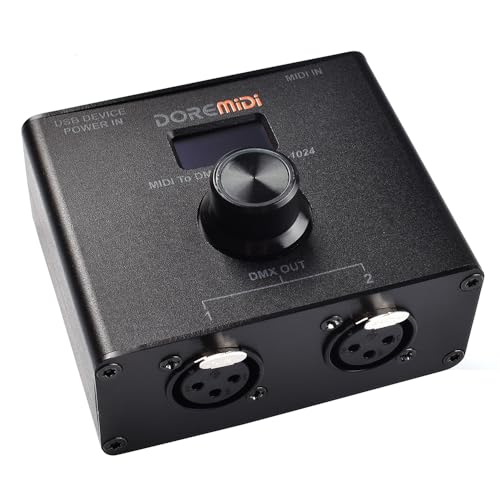
- Converts MIDI messages into DMX output
- Configurable by knob with backup upload
- Works with Windows and Ableton Live
Best For: Computer-based MIDI control and DMX conversion
Software-Ready DMX Interface Controller

- 1:1 control for SoundSwitch software
- Two DMX universes with input/output
- Touch strip, encoders, and RGB pads
Best For: Mobile DJs using software-based lighting control
Wireless 384-Channel MIDI DMX Controller
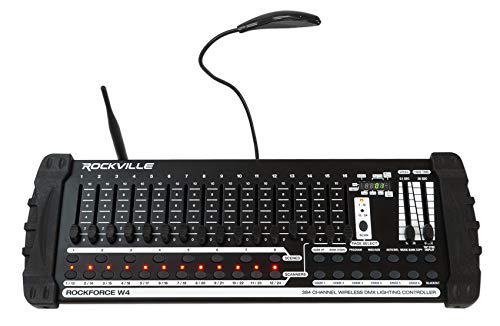
- Built-in 2.4GHz wireless DMX transmitter
- 384 channels with 30 banks and 6 chases
- MIDI, music mode, and manual override
Best For: Wireless event setups that still need MIDI control
Budget-Friendly 192-Channel Console
CO-Z 192 DMX 512 Stage Light Controller

- 192 channels and up to 240 scenes
- Voice control for easier scene switching
- Works with fog machines and 3-pin stage lights
Best For: beginner DJs and event lighting on a budget
MIDI-Ready Compact Board
Monoprice 16-Channel Universal DMX-512 Controller

- MIDI compatible with DIN, USB, and XLR connections
- Controls 12 lights with 16 channels each
- 6 chases and 240 scenes with beat and tap sync
Best For: compact MIDI-enabled control for smaller lighting rigs
Portable Battery Console With MIDI
Battery DMX Controller with Midi

- Built-in battery lasts up to 72 hours
- MIDI beat activation plus tap sync and sound activation
- 192 channels with 240 scenarios and multiple chases
Best For: mobile gigs and battery-powered lighting control
Pro 384-Channel Wireless Console
384 Channel DMX512 Controller with MIDI

- 384 channels for up to 12 intelligent lights
- 2.4G wireless and wired dual-mode connection
- 30 banks and 240 preset static scenes
Best For: DJs, weddings, bars, and compact stage lighting
Club-Ready MIDI Operator
384 Channel DMX Lighting Controller

- MIDI control for banks, chases, and blackout
- Built-in microphone for automatic light syncing
- 30 banks, 240 scenes, and 6 chases
Best For: DJ, club, theater, and party lighting control
Portable 192-Channel MIDI Board
Wireless 192 Channel DMX Console
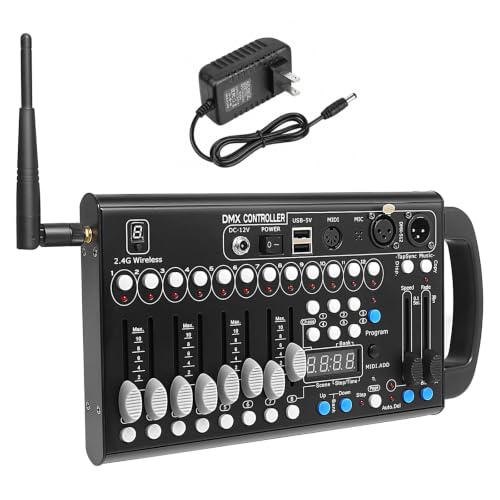
- 192 channels for up to 12 smart lights
- MIDI beat activation, tap sync, and auto mode
- 23 groups of scenes plus 6 chase sets
Best For: Mobile DJs and smaller event lighting setups
Classic 384-Channel MIDI DMX Controller – Rockville ROCKFORCE 384
If you want one of the more straightforward dmx controllers with midi for hands-on lighting control, the Rockville ROCKFORCE 384 focuses on the core features DJs and stage users actually need. It offers 384 channels, support for up to 24 intelligent lights, programmable scenes and chases, plus MIDI control over banks, chases, and blackout.
Best For: DJs, clubs, and small stage setups that need simple manual control with MIDI support.
Pros:
- 384 channels support up to 24 lights with 16 channels each
- Stores 30 banks of 8 scenes and 6 chases with 240 scenes total
- MIDI control plus built-in microphone for music-triggered modes
- Metal housing, LED display, and included gooseneck lamp for dark spaces
Cons:
- Wired 3-pin XLR DMX only, with no wireless option
- Focused on manual programming rather than software integration
Overall, this is a practical pick if you want a durable, knob-and-slider controller that keeps lighting operation simple while still adding MIDI and automatic music mode support.
Compact MIDI-to-DMX Converter – MTD-1024 MIDI to DMX Converter
DOREMiDi MIDI To DMX Controller (MTD-1024) Can Convert MIDI Messages To DMX Messages
Check Price On AmazonFor users searching for dmx controllers with midi that bridge software or instruments to lighting gear, the MTD-1024 is a compact conversion tool rather than a traditional lighting desk. It converts MIDI messages to DMX messages, includes a DMX output port, and can be configured with a knob for MIDI-to-DMX mapping.
Best For: Computer-based MIDI setups and users who need a simple MIDI-to-DMX conversion device.
Pros:
- Converts MIDI messages to DMX messages
- DMX output with 3-pin XLR connectivity
- Configurable via knob for custom mapping
- Software configuration data can be uploaded as a backup file
Cons:
- Not a full-featured lighting console with faders and scene banks
- Listed support is tied to Windows and Ableton Live
This is best viewed as a MIDI-to-DMX interface for a specific workflow, especially if you want to translate performance or software commands into lighting control without a larger console.
Software-Ready DMX Interface Controller – SoundSwitch Control One
The SoundSwitch Control One is aimed at users who want dmx controllers with midi-style performance control tied closely to software. It provides 1:1 control for SoundSwitch software, dual DMX universes, plug-and-play support with Engine DJ devices, and tactile controls for live adjustments during a set.
Best For: Mobile DJs and software-driven lighting setups that need hands-on control.
Pros:
- 1:1 controller and interface for SoundSwitch software
- Two DMX universes with input/output and thru option
- Dual-USB design supports seamless DJ transitions
- Touch strip, encoders, and RGB pads for live performance control
Cons:
- Desktop app subscription fees apply after the 3-month trial
- Built around SoundSwitch software rather than standalone use
It stands out when your lighting workflow is already software-led and you want a compact controller that can react quickly on stage while still supporting a broad range of lighting effects.
Wireless 384-Channel MIDI DMX Controller – Rockville ROCKFORCE W4
If you want dmx controllers with midi and prefer a cleaner setup, the Rockville ROCKFORCE W4 adds wireless DMX to the familiar 384-channel layout. It includes a built-in 2.4GHz transmitter, support for up to 25 receivers, MIDI control over banks and chases, and the same kind of scene storage and manual control found in larger desk-style units.
Best For: Event operators who want wireless DMX plus MIDI control in one controller.
Pros:
- Built-in 2.4GHz wireless DMX transmitter with up to 25 receivers
- 384 channels with support for up to 24 intelligent lights
- 30 banks of scenes and 6 chases for show programming
- MIDI control, music mode, and manual override for flexible operation
Cons:
- Wireless capability is limited to compatible receiver setups
- Still includes wired DMX in/out for setups that need cabling
This model makes sense if you need the control style of a traditional DMX board but want fewer cables and a more flexible event setup thanks to the wireless transmitter.
Budget-Friendly 192-Channel Console – CO-Z 192 DMX 512 Stage Light Controller
If you need a straightforward DMX controllers with midi setup for smaller stage rigs, the CO-Z 192 DMX 512 controller covers the basics with enough room for creative scene building. It supports up to 12 intelligent lights with up to 16 channels each, plus 240 scenes and 7 clearly divided control sections to help amateur users manage shows more easily.
Best For: DJs, churches, family events, and beginner-friendly lighting control.
Pros:
- Controls up to 12 fixtures with 192 channels and 240 scenes.
- Includes voice control for switching lighting scenes.
- Designed with separate sections for lights, scenes, channels, and functions.
- Works with fog machines and other compatible stage effects through 3-pin connections.
Cons:
- No detailed MIDI features are listed in the supplied notes.
- Plastic build may not feel as rugged as higher-end consoles.
This is a practical option if you want a simple controller that can still handle layered scenes and common stage fixtures. Its added voice control and layout-friendly design make it a decent pick for users who want control without a steep learning curve.
MIDI-Ready Compact Board – Monoprice 16-Channel Universal DMX-512 Controller
For buyers comparing DMX controllers with midi support, this Monoprice Stage Right model stands out for its MIDI DIN compatibility alongside standard DMX-512 control. It manages up to 12 intelligent lights with 16 channels each, and its chase and scene functions give you a compact way to build simple stage looks or run repeating effects.
Best For: Users who want MIDI connectivity in a compact DMX controller.
Pros:
- MIDI compatible with MIDI DIN, USB, and XLR connections listed.
- Controls up to 12 intelligent lights with 16 channels each.
- Offers 6 chases with 240 scenes and multiple chase playback.
- Includes beat-activation, tap sync, and auto run functions.
Cons:
- No built-in battery or portable power option is listed.
- Limited to 16 channels, so larger rigs may need a more advanced controller.
This is a solid choice if MIDI compatibility matters more than extra hardware features. Its compact format and scene/chase tools make it useful for smaller setups where you want reliable control and simple triggering.
Portable Battery Console With MIDI – Battery DMX Controller with Midi
If portability is a priority in your search for DMX controllers with midi, this battery-powered DMX512 console is built to run without being tied to an outlet. It supports 192 channels, up to 12 smart lights, 240 scenarios, and multiple chase playback, while adding MIDI beat activation, tap synchronization, and sound-activated operation.
Best For: Mobile DJs, portable events, and setups that need battery power.
Pros:
- Built-in battery provides up to 72 hours of operation.
- MIDI beat activation, tap sync, and sound activation are included.
- Supports 192 channels, 12 smart lights, and 240 scenarios.
- Rack-mount design suits portable and installed setups.
Cons:
- Only 12 lights are supported according to the supplied notes.
- No detailed information on software or external computer integration is listed.
This model is the strongest fit if you need freedom from wall power and want MIDI-triggered control options in the same unit. It combines portability with standard DMX scene handling, making it practical for gigs and temporary event rigs.
Pro 384-Channel Wireless Console – 384 Channel DMX512 Controller with MIDI
If you want dmx controllers with midi that can handle both simple setups and more involved lighting shows, this 384-channel console is built around that need. It supports up to 12 intelligent lights, offers 2.4G wireless plus 3-pin XLR wired operation, and includes sound-activated, auto, and manual control modes for flexible use at events.
Best For: DJs, wedding setups, bars, and stage users who want a compact controller with wireless and MIDI control options.
Pros:
- 384-channel DMX512 control for up to 12 intelligent lights
- 2.4G wireless and wired dual-mode connection
- Sound-activated, auto, and manual operation with MIDI support
- 30 banks and 240 preset static scenes for quick recall
Cons:
- Requires a 9V battery
- Designed for indoor stage and event use rather than larger production rigs
This is a practical choice if you want a versatile controller that can save and recall scenes while still staying straightforward to operate. The mix of wireless flexibility, MIDI support, and programmable memory makes it useful for DJs and small event lighting setups.
Club-Ready MIDI Operator – 384 Channel DMX Lighting Controller
Among dmx controllers with midi, this model is aimed at users who want broad fixture compatibility and straightforward live operation. It works with 3-pin DMX cable setups, offers MIDI control over banks, chases, and blackout, and adds a built-in microphone for music-triggered automatic lighting modes.
Best For: DJs, clubs, theaters, and party setups that need a compact controller with MIDI and sound-activated features.
Pros:
- 384 channels and support for up to 24 intelligent lights
- MIDI control over banks, chases, and blackout
- Built-in microphone for sound-activated modes
- 30 banks of 8 programmable scenes plus 6 chases
Cons:
- Uses 3-pin DMX cable connections for compatible fixtures
- Focuses on compact operation rather than advanced console features
This console is a solid fit if you need a lightweight, rack-mount DMX controller that still covers programming, playback, and live operation. The included LED gooseneck lamp and reversible DMX channels add convenience for fast setups and creative control.
Portable 192-Channel MIDI Board – Wireless 192 Channel DMX Console
If you need dmx controllers with midi in a smaller, more portable format, this 192-channel board is a practical option. It supports 3-pin DMX cable compatibility, can control up to 12 smart lights, and includes built-in microphone, MIDI beat activation, tap sync, and automatic operation for common event workflows.
Best For: Mobile DJs, house parties, bars, clubs, and weddings that want a compact 192-channel controller.
Pros:
- 192-channel control for up to 12 smart lights
- Built-in microphone with MIDI beat activation and tap synchronization
- 23 groups of 8 scenarios for a total of 240 scenarios
- Six chase sets with simultaneous chase playback
Cons:
- Fewer channels than the 384-channel options
- Uses a smaller control layout than larger stage consoles
This controller makes sense when portability matters more than maximum channel count. It still gives you scene storage, chase playback, and MIDI-based control features, which is enough for many smaller stage and party lighting setups.
How We Picked These Dmx Controllers with Midi
We focused on controllers that offer practical MIDI integration, solid DMX channel support, and features useful in real-world live environments. Priority went to units that are easier to program, fit common DJ and stage workflows, and cover a range of budgets and setup sizes.
We also considered portability, wireless capability, power options, and compatibility with moving heads, fog machines, and other intelligent fixtures. The goal was to highlight controllers that solve common buyer needs without overcomplicating the selection.
Quick Comparison
If you need simple hands-on control, smaller channel-count controllers can be enough for basic DJ rigs and compact lighting setups. If you manage more fixtures or want more complex scenes and cues, look for higher channel counts, expanded programming options, and stronger MIDI workflow support.
Wireless models are especially appealing for mobile setups, while battery-powered units can be useful when AC power is limited. For studio or synchronized performance use, MIDI-friendly controllers with dependable mapping and responsive playback usually deliver the best results.
Key Buying Factors for Dmx Controllers with Midi
Channel Count and Fixture Size
Choose a controller based on how many fixtures you run now, plus room for future growth. A 192-channel model may suit smaller systems, while 384-channel and higher options are better for larger lighting plots.
MIDI Workflow
Look for clear MIDI assignment, responsive input, and easy mapping to scenes, faders, or playback triggers. Strong MIDI support matters most if you want lights to follow music, cues, or external control surfaces.
Wired Vs. Wireless
Wireless DMX can reduce cable clutter and speed up setup, especially for mobile DJs and temporary installs. Wired control is still a dependable choice when maximum stability is the top priority.
Portability and Power
If you travel often, weight, size, and battery operation can matter as much as raw feature count. Portable controllers are easier to integrate into compact rigs and quick-load event environments.
Who Should Buy Which Dmx Controllers with Midi?
Buy a compact controller if you need straightforward control for a small venue, bar, or mobile DJ setup. Choose a mid-range 384-channel unit if you want more flexibility for intelligent fixtures and scene building.
If you rely on performance sync, a controller with stronger MIDI integration is the better fit. And if your setup changes often, wireless or battery-powered Dmx Controllers with Midi can save time while keeping the rig adaptable.