Direct boxes with speaker simulation can send a more convincing amp-style signal straight to a mixer, interface, or recording rig without relying on a miked cabinet. The right model can also simplify live setups, improve consistency, and add useful tone-shaping controls.
Our 2026 roundup covers dedicated speaker simulators, amp-style DI pedals, programmable preamps, and straightforward passive or active DI solutions. Use the guide below to match features, connectivity, and tonal flexibility to your setup.
Best 10 Di Boxes with Speaker Simulation Picks for 2026
High-Power Guitar DI

- Switchable authentic speaker simulation
- Handles amplifier outputs up to 3,000 watts
- Battery or phantom powered
Best For: High-output guitar amplifier connections
Professional Passive DI
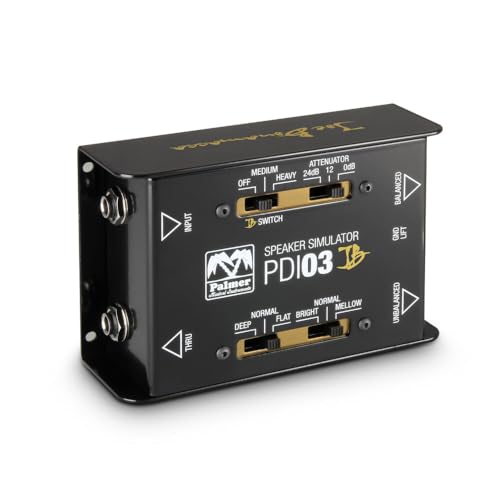
- Passive guitar amplifier DI box
- Speaker simulation for consistent tone
- 6.3mm jack and XLR connections
Best For: Professional guitar amplifier routing
Preset-Rich Cab Simulator

- 12 speaker algorithms with four variations each
- 48 cabinet and speaker sounds
- Speaker simulation bypassable for DI use
Best For: Players wanting varied mono cabinet tones
Versatile Bass Preamp DI

- Bass DI, preamp, and speaker emulation
- Character control for versatile bass tones
- Parallel and XLR outputs
Best For: Bassists seeking shaped DI tones
Rack-Ready Speaker Simulation

- Speaker and line-level inputs and outputs
- Speaker simulation with microphone and room emulation
- XLR and 3.5mm connections; 2-year warranty
Best For: Direct guitar signal routing with flexible speaker emulation
Programmable Amp Shaping

- 49 programmable presets
- Speaker simulation with active DI preamp
- 2-band EQ and Buzz Drive controls
Best For: Preset-based overdrive and preamp tone shaping
Flexible Cabinet Simulation

- 4x12 cabinet and combination-amp simulation
- 15k-ohm input and 600-ohm balanced XLR output
- 9V battery, DC9V, or 48V phantom power
Best For: Portable guitar DI use with flexible power options
Compact Active DI Pick
Rowin LEF-331 Cab-Sim DI Pedal

- Switchable cabinet simulator
- Adjustable -20dB to +20dB gain
- XLR out, thru, ground lift, and true bypass
Best For: Compact direct rigs and home recording
Rugged Passive Standard

- Passive mono transformer-based design
- Rugged I-beam construction
- For live or studio instrument connections
Best For: Reliable passive DI duties without onboard cab simulation
Advanced Bass Direct Rig

- Bass preamp, EQ, DI, and analog cab simulation
- Three cabinet types with speaker-color controls
- Dual effects loops and parallel signal routing
Best For: Bassists building detailed direct and recording tones
High-Power Guitar DI – Behringer GI100
Behringer ULTRA-G GI100 Professional Battery/Phantom Powered DI-Box with Guitar Speaker Emulation
Check Price On AmazonThe Behringer GI100 is a practical choice among DI boxes with speaker simulation for guitarists who need to connect an amplifier output directly to a recording or PA system. Its switchable speaker emulation, high power handling, and attenuation control make it especially flexible for amplifier-based setups.
Best For: Guitarists needing a durable DI box for high-output amplifier connections and live or studio use.
Pros:
- Switchable, authentic speaker simulation.
- Handles amplifier outputs rated up to 3,000 watts.
- Phantom power automatically switches off the internal battery.
- Ground lift helps address typical ground-loop problems.
Cons:
- Its 1-channel design is intended for mono setups.
- Speaker simulation and attenuation require manual switch settings.
The GI100 stands out when power handling and straightforward amplifier integration matter most. Its battery or phantom-powered operation adds useful flexibility, while the ground lift and attenuation controls help accommodate varied stage and studio connections.
Professional Passive DI – Palmer PDI 03 JB
The Palmer PDI 03 JB is a professional passive option among DI boxes with speaker simulation, designed to provide a consistent guitar tone in different venues or studio environments. It combines speaker simulation with 6.3mm jack and XLR connectivity.
Best For: Guitarists and studios seeking a passive DI solution for consistent amplifier-based tones.
Pros:
- Passive DI box designed for guitar amplifiers.
- Provides speaker simulation for consistent guitar tone.
- Offers both 6.3mm jack and XLR connections.
- Includes a 5-year warranty.
Cons:
- Rated output wattage is limited to 200 watts.
- As a passive unit, it does not offer battery-powered operation.
The PDI 03 JB is a focused, professional tool rather than a feature-heavy pedal. Its passive design and dual connector types suit straightforward guitar amplifier routing where repeatable speaker-simulated tone is the priority.
Preset-Rich Cab Simulator – GOPEO Cabzeus Mono
The GOPEO Cabzeus Mono combines a compact pedal format with DI functionality, making it a versatile choice among DI boxes with speaker simulation. It provides 12 speaker algorithms, four variations for each, and the option to bypass speaker simulation for standard DI use.
Best For: Players who want a compact mono DI with multiple cabinet sounds and preset flexibility.
Pros:
- Offers 12 speaker algorithms with four variations each.
- Provides 48 speaker and cabinet sounds in total.
- Speaker simulation can be bypassed for straightforward DI operation.
- Includes a MIDI controller alongside the simulator and DI box.
Cons:
- It is a single-channel mono unit.
- Requires corded electric power.
- The expanded sound library may be more than needed for simple DI duties.
Cabzeus Mono is the most tone-shaping-oriented option in this group. Its broad algorithm selection suits players who change cabinet flavors often, while the bypass function preserves a simpler DI workflow when desired.
Versatile Bass Preamp DI – Tech 21 VT Bass DI
The Tech 21 SansAmp VT Bass DI is tailored to bassists looking for DI boxes with speaker simulation and added preamp control. Its Character control, speaker emulation, parallel output, and XLR output support flexible bass tone shaping in live and recording setups.
Best For: Bass players who want a speaker-emulated DI with analog preamp-style tone control.
Pros:
- Combines bass DI, preamp, and speaker emulation.
- Character control supports versatile bass tones.
- Includes parallel and XLR outputs.
- Runs from a battery and uses an analog signal format.
Cons:
- Designed specifically around bass tones rather than general guitar use.
- Its controls require hands-on adjustment to shape the sound.
- The supplied details list a 9-volt power requirement, so suitable power planning is needed.
The VT Bass DI is a strong fit when a bassist wants more than a neutral direct box. Its preamp approach and Character control make it useful for shaping a range of bass sounds before sending the signal through the XLR output.
Rack-Ready Speaker Simulation – Red Box 5
The Hughes & Kettner Red Box 5 is a practical choice for players comparing DI boxes with speaker simulation. It accepts speaker or line-level signals and provides speaker-emulated output for direct connection to recording or live sound equipment.
Best For: Guitarists and engineers who want speaker emulation, direct-box functionality, and flexible signal connections in a compact unit.
Pros:
- Supports speaker and line-level inputs and outputs.
- Includes speaker simulation controls and microphone- and room-emulating software.
- Offers XLR and 3.5mm connectivity and can be phantom powered.
- Backed by a 2-year warranty.
Cons:
- Its listed 9V corded-electric power requirement may need setup planning.
- The supplied notes do not specify detailed cabinet-voicing options.
With its combination of direct-box operation and speaker simulation controls, the Red Box 5 is a straightforward solution when you need to route an amplified signal directly into a sound system or recording setup.
Programmable Amp Shaping – SansAmp PSA 2.0
The Tech 21 SansAmp PSA 2.0 combines a programmable instrument preamp with speaker simulation, making it a versatile option among DI boxes with speaker simulation. Its 49 presets and analog controls support repeatable tones for guitar or compatible drum setups.
Best For: Players who want preset-based overdrive and preamp tones with speaker simulation in a pedal format.
Pros:
- Provides 49 programmable presets.
- Includes speaker simulation and active DI preamp functionality.
- Offers overdrive, Buzz Drive controls, and a 2-band EQ.
- Compact pedal dimensions make it easy to integrate into a rig.
Cons:
- The supplied notes do not list balanced XLR connectivity.
- Requires a 9V corded-electric power source.
The PSA 2.0 is more tone-focused than a basic passive DI, pairing programmable presets with analog preamp and speaker-simulation features for players who need quick access to multiple sounds.
Flexible Cabinet Simulation – RiToEasysports 01 DI Box
The RiToEasysports 01 is a passive DI box with amp simulation for electric guitar. For shoppers comparing DI boxes with speaker simulation, it stands out with selectable 4×12 speaker-cabinet or combination-amplifier analog options, plus battery, adapter, and phantom-power support.
Best For: Electric guitarists who need an affordable, flexible DI and amp-simulation solution for PA systems, audio interfaces, or pedalboards.
Pros:
- Offers 4×12 speaker-cabinet and combination-amplifier simulation.
- Provides a 15k-ohm line input and 600-ohm balanced XLR output.
- Supports DC9V adapter, 6F22 9V battery, and 48V phantom power.
- Includes a ground-lift switch and sturdy metal housing.
Cons:
- Coverage is limited to the listed cabinet and amplifier selections.
- The manufacturer warranty is listed as 90 days.
- The supplied notes list only an XLR connector.
The 01 offers unusually flexible power options for a passive DI-style unit, while its cabinet and amplifier selections make it a practical compact alternative to carrying a larger guitar rig.
Compact Active DI Pick – Rowin LEF-331 Cab-Sim DI Pedal
For players seeking DI boxes with speaker simulation, the Rowin LEF-331 combines an active direct box with a switchable cabinet simulator in a compact pedal format. Its adjustable gain, balanced XLR output, and thru connection make it practical for direct rigs, monitoring, and small recording setups.
Best For: Guitarists and other instrumentalists who want an affordable, compact DI pedal with basic cab simulation.
Pros:
- Switchable cabinet simulator helps shape a more amp-like direct tone.
- Adjustable -20dB to +20dB gain accommodates different pickup output levels.
- Balanced XLR output, 1/4-inch thru, ground lift, and true bypass support flexible setups.
- Small metal housing suits pedalboards, practice, home recording, and small gigs.
Cons:
- Requires a 9V DC adapter, which is not included.
- The compact control layout may offer less fine-tuning than larger preamp or cab-sim units.
The LEF-331 is a straightforward choice when you need DI connectivity and speaker-style filtering without adding much board space. Its gain range is useful, but careful adjustment is important to avoid unwanted overdrive.
Rugged Passive Standard – Radial Pro DI
The Radial Pro DI is a passive mono direct box built around a custom transformer and rugged I-beam construction. While it does not include speaker simulation, it is a dependable option for sending instrument signals to professional consoles, snakes, and recording systems.
Best For: Live and studio users who prioritize durable passive DI performance for acoustic guitar, bass, keyboards, or drum machines.
Pros:
- Passive mono design uses a custom transformer for direct signal conversion.
- Rugged I-beam construction and stainless-steel enclosure are suited to regular use.
- Compatible with musical instruments and professional snake systems or consoles.
- Backed by a stated two-year warranty.
Cons:
- It does not provide a built-in speaker or cabinet simulator.
- Passive design has no listed onboard gain, EQ, or tone-shaping controls.
Choose the Pro DI when clean, durable signal interfacing matters more than cab-sim features. It is a sensible companion to a separate preamp or speaker-simulation device rather than an all-in-one direct-toning solution.
Advanced Bass Direct Rig – BS BOX Speaker-Sim Preamp DI
Among DI boxes with speaker simulation, the BS BOX is the most expansive bass-focused option here. It combines a preamp, EQ, DI function, parallel signal path, analog cabinet simulation, and two effects loops for detailed direct tones at the front of house or in the studio.
Best For: Bassists who want extensive amp, cabinet, blending, and effects-routing control in one metal pedal.
Pros:
- Provides preamp, DI, three-band EQ, semi-parametric mids, and analog cabinet simulation.
- Offers three cabinet choices plus speaker color, resonance, and microphone-position controls.
- Parallel routing with selectable low-pass filtering can retain low-end clarity while blending preamp tones.
- Two effects loops allow separate processing of the preamp and parallel signal paths.
Cons:
- The extensive routing and tone controls may be more complex than needed for simple DI use.
- Its feature set is specifically centered on bass preamp and cabinet tones.
The BS BOX is best viewed as a complete bass front end rather than a basic DI box. Its broad control set can support highly customized direct sounds, though players wanting a simple plug-and-play solution may prefer a less elaborate design.
How We Picked These Di Boxes with Speaker Simulation
We focused on products that combine direct-injection functionality with cabinet, speaker, or amp simulation, while also considering how useful they are in real recording and live-sound situations. The selection includes active and passive designs, compact pedals, rack-style units, and amp-specific solutions.
Key considerations included output quality, connection options, power requirements, speaker-simulation character, controls, noise management, portability, and suitability for guitar, bass, or broader instrument use. Because these products serve different roles, the best choice depends on whether you need a simple DI, a convincing cabinet replacement, or a complete preamp-style signal path.
Quick Comparison
| Best For | Look For | Typical Advantage |
|---|---|---|
| Simple live DI | Reliable XLR output and ground lift | Fast, clean connections to a mixer |
| Recording direct | Useful cabinet or speaker emulation | More natural amp-style tone without a microphone |
| Pedalboard rigs | Compact enclosure and footswitch control | Easy integration with effects and amplifiers |
| Bass setups | Low-frequency headroom and bass-focused voicing | Fuller direct tones with controlled articulation |
| Flexible studio use | Multiple outputs, adjustable filtering, or presets | More routing and tone-shaping options |
Key Buying Factors for Di Boxes with Speaker Simulation
Speaker-Simulation Quality
Speaker simulation should soften the harsh, full-range character of a raw preamp or distortion signal. Check whether the unit uses a fixed voicing, selectable cabinet types, adjustable filtering, or more detailed controls. A simple analog simulator can sound effective, while a more flexible design may suit varied recording needs.
Active or Passive Operation
Passive DI boxes are often simple, dependable, and well suited to strong output sources. Active models can provide more headroom, gain control, and tone-shaping features, but may require batteries or phantom power. Confirm the power method before buying, especially for pedalboards and remote gigs.
Connections and Signal Routing
Look for the inputs and outputs your rig actually needs: instrument input, balanced XLR out, parallel or thru output, line output, and amplifier or speaker connections. A ground-lift switch can help reduce hum, while separate routing options make it easier to feed both a stage amplifier and the front-of-house system.
Controls, Headroom, and Noise
Gain, level, pad, presence, bass, treble, and cabinet controls can make a substantial difference when matching the unit to pickups, pedals, or an amplifier. Prioritize adequate headroom and low noise if you use high-output pickups, aggressive distortion, or a busy pedal chain.
Who Should Buy Which Di Boxes with Speaker Simulation?
Choose a dedicated speaker simulator if you already like your preamp or pedalboard tone and mainly need a more natural direct output. Choose an amp-style DI pedal if you want preamp character, gain, and cabinet simulation in one compact unit. Choose a programmable or highly adjustable model if you record several instruments or need multiple repeatable sounds.
Choose a straightforward passive DI for dependable signal conversion and simple live routing, but verify how much speaker emulation it actually provides. Choose a bass-focused unit when low-end response and an amp-like bass voice matter more than extensive guitar-oriented controls. For home recording, prioritize balanced output, useful cabinet filtering, and quiet operation; for touring, prioritize rugged construction, simple controls, and dependable power options.