The best DI boxes under $200 make it easier to connect instruments and line-level sources to mixers, interfaces, and PA systems while reducing noise and preserving signal quality.
This roundup compares passive, stereo, dual-channel, and feature-focused options for musicians, home studios, worship teams, venues, and live-sound setups.
Best 10 Di Boxes Under 200 Picks for 2026
Rugged Passive Choice
Radial Pro DI Passive Direct Box

- Passive mono DI with custom transformer
- Rugged stainless-steel I-beam construction
- Suitable for instruments, live, and studio use
Best For: Acoustic guitars, bass, keyboards, and professional sound systems
Stereo Hum Control
Mackie MDB-2P Passive Stereo DI Box

- Dual 1/4-inch inputs for stereo sources
- Ground lift helps reduce ground-loop buzz
- 15 dB pads handle hot signals
Best For: Stereo keyboards, DJ controllers, and backing-track rigs
Simple Instrument Interface
Passive DI Direct Box with Pad and Ground Lift

- Passive 1/4-inch to balanced XLR design
- Through jack supports signal pass-through
- Pad and ground-lift controls included
Best For: Guitar and keyboard mono connections
Flexible Active Stereo Option
Dual-Input Active DI Box with Stereo Outputs

- Dual inputs support stereo or mixed-mono audio
- Stereo XLR and 1/4-inch through outputs
- USB-C charging and 9V battery options
Best For: Instruments, processors, submixers, and consumer stereo sources
Compact Stereo Control

- Passive two-channel DI with isolation transformer
- 15 dB pad and ground-lift switch
- 1/4-inch and XLR connectors
Best For: Stereo sources needing compact isolated connections
Dual-Channel Feature Set

- Two passive transformer-balanced channels
- 0, -20, and -40 dB attenuation
- Phase, filter, and ground-lift controls
Best For: Flexible two-channel live and recording setups
Budget Hum-Elimination Option

- Passive DI for instruments and consumer sources
- Input attenuator and ground-lift function
- Steel chassis with balanced and unbalanced connectivity
Best For: Basic instrument, PA, and consumer-audio connections
Simple Signal Matching

- Balanced XLR output from unbalanced sources
- Ground lift helps reduce hum
- Attenuation switch for level matching
Best For: Live sound and PA setups
Two-Channel Utility
PYLE-PRO PDC22 Passive DI Unit
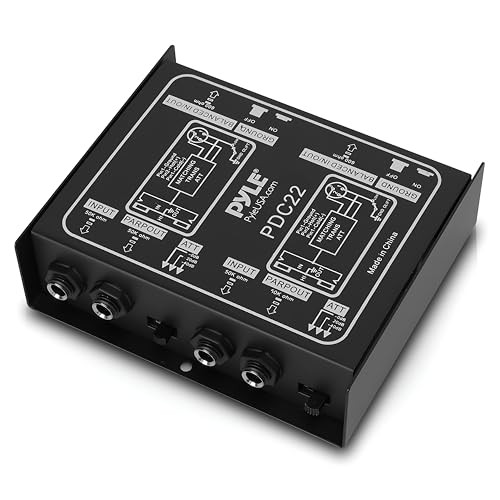
- Two-channel passive DI design
- Ground lift and hum cancellation
- Steel chassis for durability
Best For: Live and recording setups with multiple sources
Pedal-Style Flexibility

- Balanced and unbalanced I/O
- Three-position gain switch
- Built-in cabinet simulator
Best For: Guitarists and bassists needing a compact DI pedal
Rugged Passive Choice – Radial Pro DI Passive Direct Box
For musicians comparing DI boxes under 200, the Radial Pro DI is a practical passive mono option for routing instruments into professional sound systems. Its transformer-based design, XLR connectivity, and durable I-beam construction suit both live and studio setups.
Best For: Acoustic guitar, bass, keyboards, drum machines, and professional snake or console systems.
Pros:
- Passive mono operation requires no separate power source.
- Custom transformer supports instrument-to-XLR signal conversion.
- Rugged stainless-steel I-beam construction is designed for durable use.
- Backed by a 2-year warranty.
Cons:
- Mono rather than stereo operation.
- Its passive design may be less suitable when active DI features are specifically needed.
The Radial Pro DI is a strong fit when durability and straightforward passive signal handling matter more than extra controls or stereo connectivity.
Stereo Hum Control – Mackie MDB-2P Passive Stereo DI Box
Among DI boxes under 200, the Mackie MDB-2P stands out for stereo sources such as keyboards and DJ controllers. Its dual 1/4-inch inputs, ground lift, and 15 dB pads help manage stereo routing, hum, and hotter signals without requiring power.
Best For: Stereo keyboards, DJ rigs, backing-track systems, and other dual-channel setups.
Pros:
- Dual 1/4-inch high-impedance inputs support stereo sources.
- Ground lift helps address ground-loop buzz.
- 15 dB pads accommodate hot signals.
- Passive design needs no power and uses a roadworthy steel case.
Cons:
- Designed around stereo use, which may be unnecessary for simple mono setups.
- Includes a 1-year warranty rather than the longer coverage listed for some alternatives.
The MDB-2P is a sensible choice when stereo connectivity and practical noise-control features are priorities in a compact passive DI.
Simple Instrument Interface – Passive DI Direct Box with Pad and Ground Lift
If you are shopping for DI boxes under 200 and want a straightforward passive interface, the Yovus DB-1 provides 1/4-inch input and through connections with a balanced XLR output. A pad switch and ground lift add useful control for instrument signals and electrical noise.
Best For: Guitar and keyboard players needing a basic passive connection to balanced audio equipment.
Pros:
- Passive operation requires no power.
- 1/4-inch input and through jacks support signal pass-through.
- Pad switch helps soften hot sources.
- Ground lift can help reduce grounding-related buzz.
Cons:
- Single-channel design limits it to mono applications.
- Supplied notes identify fewer application-specific features than some stereo DI options.
The DB-1 keeps the job simple: connect an instrument, balance the output through XLR, and use the pad or ground lift when the source or electrical setup calls for it.
Flexible Active Stereo Option – Dual-Input Active DI Box with Stereo Outputs
For buyers comparing DI boxes under 200, this active dual-input model offers flexible stereo or mono routing for instruments and consumer audio sources. It provides 1/4-inch through outputs, stereo XLR outputs, ground-lift functionality, and two stated power methods.
Best For: Guitar, bass, keyboards, processors, submixers, and consumer stereo sources used in live or recording setups.
Pros:
- Dual high-impedance 1/4-inch inputs support stereo or mixed-mono signals.
- Provides dual 1/4-inch through outputs and stereo XLR outputs.
- Offers ground lift for hum reduction.
- Supports USB-C charging and a built-in 9V battery slot.
Cons:
- 9V batteries are not included.
- Its listed 2.01-pound weight is heavier than the compact passive options here.
- Requires power for active operation.
This model is the most flexible pick of the group for users who need stereo routing, active operation, and multiple power choices rather than a minimal passive box.
Compact Stereo Control – Radial ProD2
The Radial ProD2 is a practical option for shoppers comparing DI boxes under 200 who need passive stereo connectivity in a compact enclosure. Its isolation transformer, ground-lift switch, and 15 dB pad support flexible live or recording setups.
Best For: Stereo keyboards, instruments, or other sources needing isolated balanced connections.
Pros:
- Passive two-channel design requires no listed power source.
- Isolation transformer and ground-lift switch help separate connected equipment.
- 15 dB pad adds input-level flexibility.
- Compact 1.2-pound stainless-steel enclosure with 1/4-inch and XLR connectors.
Cons:
- Its passive design may not suit setups requiring active gain or phantom-powered operation.
- The listed attenuation is limited to a 15 dB pad.
The ProD2 stands out when stereo operation and isolation are more important than extra control features. It is a focused, compact choice for straightforward signal conversion.
Dual-Channel Feature Set – ART DualZDirect
The ART DualZDirect is a strong contender among DI boxes under 200 for users who want two passive channels and more signal-shaping controls. It combines transformer balancing with selectable attenuation, filtering, phase, and grounding options.
Best For: Two-channel live or recording rigs that benefit from adjustable input and signal-management controls.
Pros:
- Dual-channel passive transformer design needs no battery.
- Selectable 0, -20, and -40 dB input attenuation.
- Includes low-pass filter, phase invert, and ground-lift controls.
- Converts 50k-ohm inputs to 600-ohm balanced outputs and includes a three-year defect warranty.
Cons:
- Its broader control set may be unnecessary for simple one-channel setups.
- The supplied notes do not list specific dimensions or connector types.
Choose the DualZDirect when flexibility is the priority. Its dual channels and selectable controls make it especially useful for adapting varied sources without adding a battery-powered stage.
Budget Hum-Elimination Option – Pyle PDC21
The Pyle PDC21 is a compact passive DI unit for shoppers seeking DI boxes under 200 to connect unbalanced instruments and consumer audio sources to balanced or unbalanced equipment. Its impedance transformer, input attenuator, and ground-lift functionality target common buzz and hum concerns.
Best For: Guitars, basses, keyboards, effects processors, and consumer stereo sources feeding a PA or recording mixer.
Pros:
- Supports instrument and line-output connections, including guitars, basses, keyboards, and consumer stereo devices.
- Impedance transformer helps connect unbalanced sources to balanced or unbalanced XLR equipment.
- Ground-lift design is intended to help reduce buzz and hum.
- All-steel chassis and compact 11.8-ounce build support portable use.
Cons:
- The supplied notes do not specify the attenuation value or provide separate channel controls.
- It is a passive unit, so it does not provide active signal gain.
The PDC21 makes sense for basic source conversion and hum-management duties. Its broad connection use cases and steel chassis keep it practical for simple live, rehearsal, or sampling setups.
Simple Signal Matching – Passive DI Box/Merge Function
For shoppers comparing DI boxes under 200, this passive model is a straightforward option for converting high-impedance, unbalanced instrument signals into low-impedance, balanced XLR output. Its ground lift and attenuation controls address common setup issues in live and PA systems.
Best For: Live sound, clubs, PA systems, monitor systems, and DJ setups needing practical signal conversion.
Pros:
- Converts unbalanced signals to balanced XLR output to help reduce noise and signal loss.
- Ground lift switch can help reduce hum from multiple connected devices.
- Attenuation switch supports level matching with connected equipment.
- Rugged housing is designed for steady indoor or outdoor use.
Cons:
- Passive design may be less suitable when additional signal gain is needed.
- Its feature set is focused on basic DI and signal-routing duties.
This is a sensible pick when you want a durable, no-frills DI box with ground lift and attenuation controls for common live-audio connections.
Two-Channel Utility – PYLE-PRO PDC22 Passive DI Unit
Among DI boxes under 200, the PYLE-PRO PDC22 stands out as a practical two-channel passive unit for connecting guitars, basses, keyboards, processors, and other unbalanced sources to a PA or recording mixer. Its steel chassis and hum-cancellation features suit frequent use.
Best For: Musicians and small live or recording setups needing two channels and broad source compatibility.
Pros:
- Two-channel design supports multiple instrument or line-level connections.
- Connects guitars, basses, keyboards, processors, submixers, and consumer stereo sources.
- Ground lift and hum-cancellation functions help provide cleaner connections.
- All-steel chassis offers a durable, heavy-duty build.
Cons:
- The product is a larger option than a compact pedal-style DI box.
- Its supplied details emphasize passive impedance transformation rather than onboard gain.
Choose the PDC22 when flexible inputs and two-channel operation matter more than the smallest possible footprint, especially for instrument and mixer connections.
Pedal-Style Flexibility – Rowin Guitar Bass Passive DI
Rowin Guitar Bass Passive DI Box Instrument to Balanced and Unbalanced Micro Direct Box Pedal
Check Price On AmazonFor guitarists comparing DI boxes under 200, this compact Rowin pedal combines balanced and unbalanced connectivity with selectable gain and a cabinet simulator. It is designed to send bass or guitar signals directly to an audio system while keeping the footprint small.
Best For: Guitar and bass players wanting a compact pedal with gain options and cabinet simulation.
Pros:
- Offers balanced and unbalanced input/output options.
- Gain switch provides -20 dB, 0 dB, and +20 dB settings.
- Cabinet simulator can replicate an onstage speaker setup.
- Zinc-alloy construction is described as durable and sturdy.
Cons:
- It is focused primarily on guitar and bass use rather than broad multi-source routing.
- It requires a DC power source.
The Rowin is a strong fit for players who want DI connectivity in a pedal format, particularly when adjustable gain and cabinet simulation are useful to the setup.
How We Picked the Best Di Boxes Under 200
We evaluated these DI boxes by focusing on the features that matter most in real-world recording and performance: input and output flexibility, passive or active design, channel count, ground-lift functionality, attenuation, impedance handling, construction, and ease of use. We also considered whether each unit is better suited to guitars and basses, stereo keyboards and playback devices, or broader studio and stage applications.
Because prices and configurations can vary, treat the $200 limit as a practical buying range rather than a guarantee for every seller or bundle. Always confirm the current specifications, included accessories, and connector layout before ordering.
Quick Comparison
| Best For | What to Look For |
|---|---|
| Guitar and bass | High-impedance input, dependable transformer isolation, and a ground lift |
| Keyboards and stereo sources | Two channels or stereo inputs with matched left/right outputs |
| Ground-loop problems | Transformer isolation and an accessible ground-lift switch |
| Multiple routing options | Thru outputs, merge functions, or flexible input/output switching |
| Portable live rigs | Rugged metal housing, simple controls, and no required power |
Key Buying Factors for Di Boxes Under 200
Passive Vs. Active Design
Passive DI boxes typically require no battery or phantom power and are simple, durable choices for many active instruments and live applications. Active models can offer greater input sensitivity and may be preferable for passive guitar or bass pickups, depending on the rest of the signal chain.
Inputs, Outputs, and Channel Count
A single-channel box is usually enough for a mono guitar, bass, or microphone-level source. Choose a dual or stereo DI for keyboards, DJ equipment, playback devices, and other stereo sources. Check whether the unit includes a thru output if you need to send the original signal to an amplifier while feeding the mixer separately.
Noise Control and Signal Handling
Ground lift can help resolve hum caused by connected equipment, while transformer isolation separates electrical paths between devices. An input attenuator is useful when a source produces a stronger signal than the DI input can comfortably handle. Balanced XLR outputs are important for long cable runs to a mixer or stage box.
Build Quality and Setup
Metal enclosures, firm switches, clear labeling, and secure connectors are valuable for frequent stage use. For a home studio, prioritize clean routing and compatibility with your interface. Confirm that the DI’s input impedance and maximum input level suit your instrument or source.
Who Should Buy Which Di Boxes Under 200?
Guitarists and bassists should start with a straightforward passive DI offering a high-impedance input, ground lift, and thru connection. Keyboard players and stereo-source users will benefit from a dual-channel model that preserves left/right routing. Live engineers and venues should favor rugged units with transformer isolation, attenuation, and consistent balanced outputs. Home-studio users can choose a compact, affordable box with the necessary connectors rather than paying for unused routing features.
Before choosing among these DI boxes under $200, map your entire signal path: source, amplifier or monitor feed, mixer or interface, cable length, and power availability. The best match is the box that solves your specific connection or noise problem without adding unnecessary complexity.