The best compact studio monitors deliver a clearer, more balanced alternative to typical computer speakers without taking over your desk. This roundup compares 10 powered pairs suited to home studios, editing setups, and close-range listening.
We focused on practical differences such as speaker size, connectivity, placement flexibility, tonal accuracy, and value so you can choose monitors that fit both your workspace and your workflow.
Best 10 Compact Studio Monitors Picks for 2026
Flexible Desk Production
Ortizan C7 Powered Studio Monitors

- USB DAC plus Bluetooth 5.3
- Balanced TRS and multiple inputs
- Front headphone output
Best For: Small creative desks needing broad connectivity
Premium Desktop Monitoring
ADAM Audio D3V Active Monitors
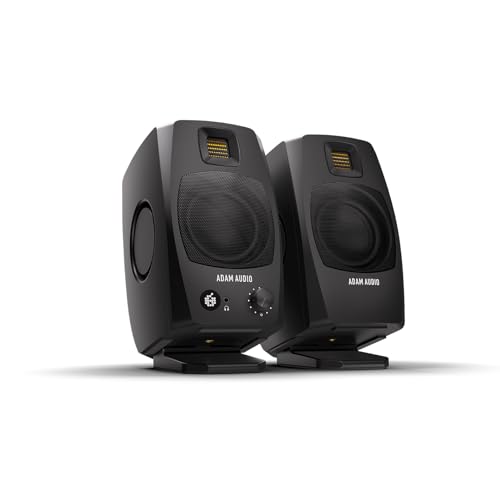
- 80-watt active stereo system
- D-ART tweeters and 45 Hz extension
- USB-C, balanced inputs, and mounting options
Best For: Producers wanting detailed, positionable desktop monitors
Everyday Studio Value

- 50-watt stereo pair
- Room-adjustment high and low controls
- TRS, RCA, AUX, and headphone output
Best For: Budget-conscious mixed-use desktop setups
Wide-Sweet-Spot Reference
JBL Professional 104-BT Monitors
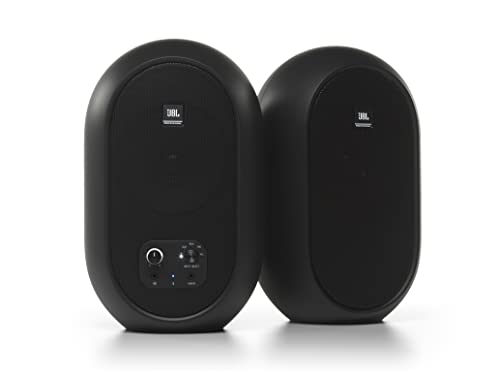
- 4.5-inch coaxial driver
- 60-watt Class D stereo amplification
- Bluetooth plus TRS, RCA, and AUX
Best For: Desktop reference listening with multiple source options
Balanced Near-Field Precision

- 5-inch woofer and 1-inch dome tweeter
- 70W bi-amplified monitoring system
- XLR and TRS inputs
Best For: Accuracy-focused home studios and music production
Desktop-Friendly Flexibility

- 3.5-inch Kevlar woofers
- RCA, 1/4-inch, and 1/8-inch inputs
- Front headphone output and EQ controls
Best For: Compact desktop production, streaming, and podcasting
Connected Hi-Res Monitoring

- Hi-Res 52Hz–40kHz response
- Bluetooth 5.4 and balanced TRS input
- 36W RMS output with app-based EQ
Best For: Hybrid home studios and flexible desktop listening
Best All-Rounder

- 4.5-inch Kevlar woofers
- Multiple analog inputs
- Front headphone access and EQ controls
Best For: Flexible desktop production, streaming, and gaming setups
Best for Focused Monitoring

- Compact 3.5-inch woofer design
- XLR/TRS, RCA, and stereo mini inputs
- Room control and high-trim adjustments
Best For: Small studio desks and nearfield music monitoring
Best Budget Desktop Option
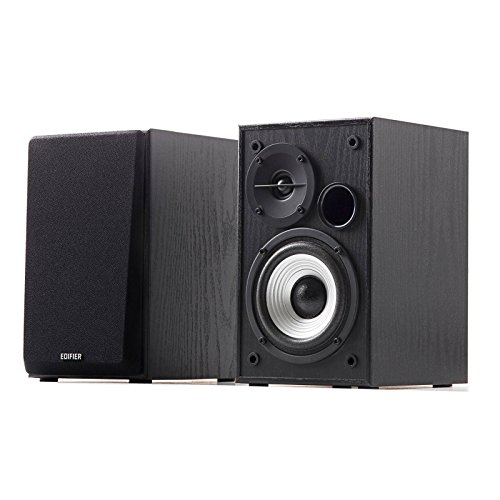
- 24 W RMS powered pair
- Two simultaneous AUX inputs
- 4-inch drivers with front bass reflex ports
Best For: Computer audio, home entertainment, and casual creative work
Flexible Desk Production – Ortizan C7 Powered Studio Monitors
The Ortizan C7 is a versatile option for compact studio monitors, combining a 3.5-inch carbon-fiber mid-bass driver with a 0.75-inch silk-dome tweeter. Its USB, Bluetooth, RCA, AUX, and balanced TRS connections make it suitable for both everyday listening and a small music-production setup.
Best For: Creators who need flexible connectivity and a compact monitoring system for music, gaming, movies, or content production.
Pros:
- USB connection uses a built-in 24-bit DAC for direct digital audio playback.
- Includes Bluetooth 5.3, RCA, 3.5mm AUX, and 6.35mm TRS balanced input options.
- Front headphone output supports convenient private monitoring.
- Professional tuning is intended to provide a balanced, flat-response presentation.
Cons:
- The 3.5-inch woofer may offer less low-end reach than larger monitors.
- It is corded rather than battery powered.
The C7 stands out when connectivity is a priority. It is a practical choice for a compact desk where one pair of speakers needs to handle both production equipment and consumer devices.
Premium Desktop Monitoring – ADAM Audio D3V Active Monitors
The ADAM Audio D3V brings a more specialized monitoring design to the compact studio monitors category. Its 3.5-inch aluminum woofers, passive radiators, and D-ART tweeters are backed by 80 watts of amplification, while USB-C connectivity makes direct computer and mobile-device integration straightforward.
Best For: Songwriters, producers, and listeners who want detailed desktop monitoring with flexible placement options.
Pros:
- D-ART tweeters are designed for precise, unfatiguing high-frequency reproduction.
- Dual-sided passive radiators help extend response as low as 45 Hz.
- Includes balanced 1/4-inch inputs and DSP-powered placement controls.
- Detachable angled stands and 3/8-inch microphone-stand mounting support flexible positioning.
Cons:
- The system is positioned as a specialized desktop monitor rather than a general-purpose wireless speaker.
- Its 12.2-pound listed weight may make it less convenient to move frequently.
The D3V is a strong fit for a serious desktop setup. Its stand and mounting options are especially useful when desk placement, listening angle, and monitor positioning need careful attention.
Everyday Studio Value – PreSonus Eris 3.5 Monitors
The PreSonus Eris 3.5 is a straightforward pair of compact studio monitors for desks, bookshelves, and near-field listening. With 3.5-inch woven-composite woofers, 1-inch silk-dome tweeters, 50 watts of amplification, and adjustable high- and low-frequency controls, it covers production and everyday entertainment in a small footprint.
Best For: Home producers, gamers, streamers, and listeners who want one affordable stereo pair for several desk-based uses.
Pros:
- Sold as a complete stereo pair with 50 watts of built-in amplification.
- High- and low-frequency controls help adapt the sound to the room.
- Balanced TRS, RCA, and front-panel AUX inputs connect to varied equipment.
- Front headphone output enables private listening.
Cons:
- The listed frequency range begins at 80 Hz, so deep bass may be limited without a subwoofer.
- It is a corded system rather than a wireless desktop solution.
The Eris 3.5 is a sensible all-rounder for buyers who want studio-oriented features without a complicated setup. Its adjustment controls and broad input selection make it easy to integrate into a mixed-use desk.
Wide-Sweet-Spot Reference – JBL Professional 104-BT Monitors
The JBL Professional 104-BT is a compact desktop reference system built around a coaxial 4.5-inch woofer and 0.75-inch soft-dome tweeter. For buyers comparing compact studio monitors, it offers Bluetooth 5.0 alongside balanced TRS, RCA, and AUX inputs, plus front-panel controls for convenient source switching.
Best For: Desktop users who want a larger compact woofer, broad source compatibility, and a wide listening sweet spot.
Pros:
- Coaxial driver design combines the woofer and tweeter for transparency and a wide sweet spot.
- Integrated 60-watt Class D amplification distributes 30 watts to each speaker.
- Supports Bluetooth, AUX, RCA, and balanced TRS sources.
- Front headphone jack automatically mutes the speakers for private listening.
Cons:
- The system uses a wired connection between the master and extension speaker.
- Bluetooth is version 5.0 rather than the newer Bluetooth versions found on some competing models.
The 104-BT is a practical choice when desk placement and source flexibility matter. Its coaxial driver and desktop-optimized cabinet make it particularly appealing for close-range listening and reference work.
Balanced Near-Field Precision – Yamaha HS5 Pair
The Yamaha HS5 pair is a strong choice for compact studio monitors when accurate, minimally colored sound is the priority. Each speaker combines a 5-inch woofer and 1-inch dome tweeter with bi-amplified power, making this setup well suited to close-range music production and studio monitoring.
Best For: Home studios and producers who want a straightforward, accuracy-focused wired monitoring setup.
Pros:
- Designed to emphasize sonic purity without altering the original sound.
- Bi-amplified 70-watt system with 45W LF and 25W HF amplification.
- Balanced or unbalanced XLR and TRS inputs support varied studio connections.
- 54Hz–30kHz frequency response covers a broad monitoring range.
Cons:
- Does not include Bluetooth or other wireless listening features in the supplied specifications.
- The 5-inch design may provide less low-end reach than larger monitors.
The HS5 pair is best suited to buyers who value dependable, honest near-field monitoring over convenience features. Its focused design and flexible inputs make it a practical foundation for a compact production desk.
Desktop-Friendly Flexibility – M-Audio BX3 Pair
The M-Audio BX3 pair brings compact studio monitors to smaller desks with 3.5-inch Kevlar woofers, silk dome tweeters, and an acoustically inert MDF cabinet. Its mix of studio and multimedia connections makes it especially practical for computer-based production, streaming, gaming, and podcasting.
Best For: Desktop creators who need compact speakers with broad connectivity and easy front-panel headphone access.
Pros:
- 3.5-inch Kevlar woofers provide a compact, punchy low-frequency platform.
- Includes 1/4-inch, 1/8-inch, and RCA inputs for flexible hookups.
- Front-panel headphone output and AUX input support quiet listening sessions.
- Rear high- and low-EQ controls allow basic sound tailoring.
Cons:
- Smaller 3.5-inch woofers may not deliver the low-end scale of larger monitors.
- The supplied specifications describe a wired setup rather than wireless connectivity.
The BX3 pair is a versatile pick when desk space and connection options matter as much as monitoring. It is less specialized than a larger near-field system, but its included accessories and desktop-friendly controls add useful convenience.
Connected Hi-Res Monitoring – Edifier MR3 Powered Monitors
The Edifier MR3 combines compact studio monitor features with everyday listening convenience. Its 3.5-inch mid-low drivers, 1-inch tweeters, balanced TRS input, and Hi-Res certification support monitoring, while Bluetooth 5.4, app-based EQ, and multiple inputs make it flexible for a modern desktop setup.
Best For: Home studio users who want compact monitors that also handle wireless listening, video editing, and daily media playback.
Pros:
- Hi-Res certified response is specified from 52Hz to 40kHz.
- Offers balanced TRS, RCA, AUX, Bluetooth, and headphone connectivity.
- Music, Monitor, and Custom modes support different listening needs.
- EDIFIER ConneX app provides additional EQ and sound customization.
Cons:
- Its 36W RMS output is more modest than that of larger studio monitors.
- Wireless and lifestyle features may be unnecessary for a strictly wired monitoring workflow.
The MR3 is a compelling option for buyers who want compact studio monitors without giving up consumer-friendly features. It offers useful input flexibility and customization while retaining a dedicated balanced connection for studio equipment.
Best All-Rounder – M-Audio BX4
The M-AUDIO BX4 is a versatile pick for shoppers seeking compact studio monitors with useful desktop features. Its 4.5-inch Kevlar woofers, silk dome tweeters, MDF cabinets, multiple inputs, and front headphone access suit music production, streaming, gaming, and podcasting.
Best For: Desktop users who want flexible connectivity and a fuller low-end response from compact monitors.
Pros:
- 4.5-inch Kevlar woofers and silk dome tweeters provide detailed stereo sound.
- Includes 1/4-inch, 1/8-inch, and RCA inputs for broad equipment compatibility.
- Front-panel headphone access and rear high/low EQ controls add convenience.
- Includes cables, foam feet, and MPC Beats software.
Cons:
- The wired design does not provide wireless audio convenience.
- Its larger 4.5-inch drivers may need more desk space than smaller monitors.
The BX4 stands out when you want compact studio monitors that can also handle everyday computer audio. Its practical connections and adjustment controls make it especially adaptable for mixed desktop setups.
Best for Focused Monitoring – Yamaha HS3
The Yamaha HS3 is a compact studio monitor pair designed for focused music production and studio monitoring. Its 3.5-inch woofer, 0.75-inch dome tweeter, room controls, and professional XLR/TRS inputs make it a straightforward fit for smaller workspaces.
Best For: Musicians and producers who prioritize a compact, purpose-built monitoring setup with professional connections.
Pros:
- Space-conscious 3.5-inch woofer and 0.75-inch dome tweeter configuration.
- Offers XLR/TRS combo, RCA, and stereo mini inputs.
- Room control and high-trim response controls help tailor the sound.
- Includes speaker cable, stereo mini-to-RCA cable, and anti-slip pads.
Cons:
- The 70 Hz–22 kHz frequency response provides less stated low-end extension than some larger monitors.
- With 26 W output, it is better suited to nearfield desktop use than larger rooms.
The HS3 is a sensible choice when desk space is limited but you still want studio-oriented inputs and adjustment controls. Its compact format favors close listening positions and small production environments.
Best Budget Desktop Option – Edifier R980T
Edifier R980T 4" Active Bookshelf Speakers - 2.0 Computer Speaker - Powered Studio Monitor (Pair)
Check Price On AmazonThe Edifier R980T offers an accessible route into compact studio monitors for computer and home-entertainment setups. This powered pair combines 4-inch drivers, 24 W RMS output, front-facing bass reflex ports, wood-finish enclosures, and two simultaneous AUX inputs.
Best For: Computer users who want simple, compact powered speakers for music, movies, and everyday desktop listening.
Pros:
- 24 W RMS total output supports general desktop listening.
- Front bass reflex ports help deliver a fuller presentation.
- Two AUX inputs allow two connected devices without swapping cables.
- Includes RCA, 3.5mm, and speaker-wire cables with a 110V–240V power supply.
Cons:
- The supplied notes position it more for computers and home entertainment than dedicated studio monitoring.
- It lacks the XLR/TRS inputs and dedicated acoustic controls found on more studio-focused options.
The R980T makes the most sense for buyers who value simplicity and convenient desktop connectivity over advanced studio adjustment features. It is a practical entry-level option for everyday audio and casual creative work.
How We Picked the Best Compact Studio Monitors
We selected models that are designed for nearfield or desktop listening and can operate without a separate power amplifier. The lineup spans compact 3.5- and 4-inch speakers, larger 4.5- and 5-inch monitors, and options with useful features such as Bluetooth, front-panel controls, and flexible inputs.
Our priorities were practical for small rooms and desks: a balanced presentation, usable low-end extension for the cabinet size, low listening fatigue, straightforward setup, and enough connection options for computers, interfaces, mixers, or mobile devices. Bluetooth can be convenient, but wired inputs remain important when accuracy and low latency matter.
Quick Comparison
| Best For | What to Look For |
|---|---|
| Small desks and basic production | 3.5-inch models with compact cabinets and simple controls |
| More low-end authority | 4- to 5-inch monitors, provided your room has suitable placement space |
| Computer and mobile listening | Bluetooth plus analog inputs |
| Mixing and critical monitoring | A neutral response, controlled placement, and a wired connection |
| Flexible desktop setups | Front-panel volume, headphone output, or multiple input choices |
Key Buying Factors for Compact Studio Monitors
Size and Bass Response
Smaller drivers save space but generally produce less deep bass and maximum volume. A 3.5-inch pair works well for close listening, voice work, and modest rooms. Moving to 4 or 5 inches can provide a fuller balance, but it also increases cabinet size and may expose room-related bass problems.
Accuracy Versus Everyday Convenience
Studio monitors should reveal detail rather than simply emphasize bass or treble. For mixing, prioritize a predictable, balanced sound and use a wired source. For general desktop use, Bluetooth and easy-access controls may matter more, especially when the speakers also serve as computer or media speakers.
Inputs, Controls, and Placement
Check whether the pair supports the connections you already use, such as TRS, RCA, 3.5mm, or Bluetooth. Keep monitors at roughly ear height, form an equal-sided triangle with your listening position, and leave space behind rear-ported cabinets. Isolation pads or stands can reduce desk vibration.
Room Size and Listening Distance
Compact monitors are intended for nearfield use, not filling a large room at party volume. In a small bedroom, office, or editing desk, moderate output and careful placement are usually more valuable than maximum power.
Who Should Buy Which Compact Studio Monitors?
Choose a smaller 3.5-inch pair if desk space is limited or you mainly produce podcasts, videos, electronic music, or general content. Consider 4- to 5-inch models if you want stronger low-end information and have enough room to position them correctly. Buyers who switch between music production and casual listening should favor models with Bluetooth and convenient desktop controls, while dedicated mixers should prioritize neutral wired monitoring and a reliable audio interface connection.
Whatever you choose, remember that monitor placement, room acoustics, and listening level can affect results as much as the speaker itself. A well-positioned compact pair will usually outperform a larger set placed too close to a wall or angled incorrectly.