Choosing the right cine light meter for video production studio work can speed up lighting setup, improve consistency, and reduce guesswork on set.
Below, we focus on meters that are practical for filmmakers, studio crews, and hybrid photo-video workflows, with options ranging from simple handheld models to advanced wireless tools.
Best 10 Cine Light Meter for Video Production Studio Picks for 2026
Studio-Grade Touchscreen Meter
Sekonic LiteMaster Pro L-478D-U
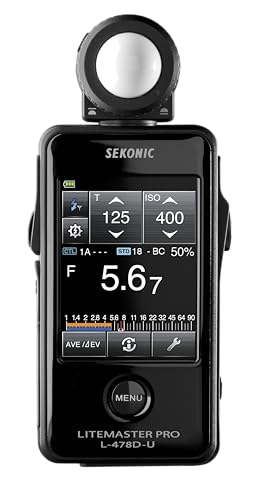
- Touchscreen meter with incident and flash readings
- Cine mode supports frame rate and shutter angle control
- Measures illuminance, luminance, and optional spot metering
Best For: Studio and film users who need a versatile touchscreen meter
Compact Cine Pocket Meter

- Pocket-sized meter with Cine and HD Cine modes
- Measures ambient, flash, and reflected light
- Shows lux and foot-candle readings for set work
Best For: Cinematographers who want a small, fast meter for video
High-Range LED Meter
Triplett LT66 Digital Light Meter

- Measures up to 40,000 Fc / 400,000 Lux
- Works with many LED and conventional light sources
- Min/Max/Avg and Data Hold functions support logging
Best For: Studios measuring varied lighting types and high light levels
Wireless Cine Meter
Sekonic L-478DR-U PocketWizard

- Adds built-in PocketWizard wireless flash control
- Touchscreen meter with incident, flash, and cine modes
- Optional 5° spot attachment expands reflected metering
Best For: Teams that want wireless flash control plus cine metering
Studio-Grade Precision
Sekonic L-858D-U Speedmaster Light Meter
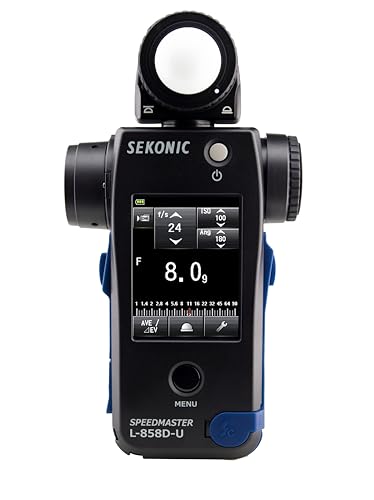
- Incident and flash metering in one meter
- Built-in 1∞ spot viewfinder for analysis
- Flash duration and HSS measurement support
Best For: Studio filmmakers who need advanced exposure and flash analysis
Retro On-Camera Pick

- Cold shoe mount with adjustable positioning
- Up to 60 hours of continuous metering
- Lightweight aluminum body with click dials
Best For: Film-camera users wanting a compact, easy-to-mount meter
Touchscreen Cine Control
Sekonic LiteMaster Pro L-478DR-U-EL

- Touchscreen meter with cine frame rate controls
- Built-in Elinchrom Skyport transmitter
- Incident, flash, and flash analyzing functions
Best For: Studio and motion shooters using Elinchrom lighting
Flagship Digital Meter
Sekonic L-858D Speedmaster for Photographers and Filmmakers

- 2.7-inch color touch screen
- Measures flash duration and ambient exposure down to 0.1 lx
- Wireless compatible with Elinchrom, Phottix, and PocketWizard
Best For: Filmmakers and studio crews who want a premium digital meter with broad exposure control
Battery-Free Studio Meter
Sekonic L-398A Studio Deluxe III Analog

- Battery-free amorphous photocell
- Incident and reflected ambient measurement
- Full dial readout with included accessories
Best For: Users who want a simple analog meter without worrying about batteries
Compact Cine Meter
Sekonic L-308X-U Flashmate for Photo and Video

- Photo, Cine, and HD Cine modes
- Tenth-stop ambient and flash accuracy
- Pocket-sized design with LCD auto backlight
Best For: Videographers and hybrid shooters who need a compact meter with cine modes
Studio-Grade Touchscreen Meter – Sekonic LiteMaster Pro L-478D-U
For buyers comparing a cine light meter for video production studio use, the Sekonic LiteMaster Pro L-478D-U stands out as a flexible all-in-one meter for ambient, flash, and motion work. Its touchscreen interface, cine frame rate and shutter angle controls, and illuminance/luminance modes make it a practical fit for set lighting and exposure checks.
Best For: Filmmakers and studio shooters who want a touchscreen meter with cine controls and expanded measurement options.
Pros:
- Incident ambient and flash metering with flash analyzing function
- Dedicated cine mode with frame rate and shutter angle control
- Illuminance and luminance measurement for broader lighting evaluation
- Optional 5° reflected spot capability for selective metering
Cons:
- Optional spot metering requires an added attachment
- AAA battery format may not suit every kit preference
This model is a strong choice when you need more than a basic exposure meter and want clear, touchscreen-driven control on set. It is especially useful for production environments where both still and motion lighting measurements matter.
Compact Cine Pocket Meter – Sekonic FLASHMATE L-308X
Sekonic FLASHMATE L-308X Photographers and Film Makers Exposure Meter - Black/Blue
Check Price On AmazonIf you want a cine light meter for video production studio work that is easy to carry and quick to use, the Sekonic FLASHMATE L-308X is built for fast ambient, flash, and video exposure checks. Its dedicated Cine and HD Cine modes, along with a sliding lumisphere and reflected-light capability, make it a practical on-set companion.
Best For: Cinematographers and creators who need a compact meter for scouting and fast on-set readings.
Pros:
- Pocket-sized design for easy carry on set or during scouting
- Dedicated Cine and HD Cine modes for video work
- Measures ambient, flash, and reflected light with a 40° reception angle
- Lux and foot-candle readouts for practical lighting checks
Cons:
- Less feature-rich than larger touchscreen meters
- AA battery requirement may be a consideration for some users
This meter makes sense if portability and speed matter more than advanced system features. It gives filmmakers a dependable, lightweight tool for quick exposure decisions in studio and location settings.
High-Range LED Meter – Triplett LT66 Digital Light Meter
For a cine light meter for video production studio environments focused on LED and mixed-source lighting, the Triplett LT66 offers wide-spectrum measurement and a high ceiling for intensity readings. It is designed to handle LED colors, fluorescent, metal halide, high-pressure sodium, and incandescent lighting while giving you a clear digital display and recorded data functions.
Best For: Studios and production teams measuring varied lighting types with a straightforward digital meter.
Pros:
- Measures up to 40,000 Fc / 400,000 Lux
- Supports a wide range of light sources, including many LED colors
- Min/Max/Avg and Data Hold functions help capture readings
- Includes a sensor cable, USB cable, and software
Cons:
- Built more for general light measurement than cine-specific exposure control
- Larger body may be less convenient than pocket meters
This is a practical pick when your priority is reading diverse studio lighting accurately rather than using film-specific exposure tools. Its broader measurement focus makes it useful for technical lighting checks and setup verification.
Wireless Cine Meter – Sekonic L-478DR-U PocketWizard
When you need a cine light meter for video production studio workflows that also helps manage lighting remotely, the Sekonic L-478DR-U adds built-in PocketWizard transmitter support to a touchscreen exposure meter. It combines incident and flash metering with cine frame rate and shutter angle control, making it a strong fit for streamlined production setups.
Best For: Shooters who want wireless flash control and cine exposure tools in one meter.
Pros:
- Built-in PocketWizard transmitter for wireless flash triggering and remote power adjustment
- Touchscreen interface for fast exposure changes
- Incident ambient and flash metering with flash analyzing function
- Cine mode with frame rate and shutter angle configuration
Cons:
- Requires a nonstandard battery
- Optional 5° spot metering attachment is not included
This model is especially appealing if your lighting workflow benefits from wireless control at the meter itself. It keeps the core Sekonic touchscreen and cine features while adding convenience for more complex lighting environments.
Studio-Grade Precision – Sekonic L-858D-U Speedmaster Light Meter
If you need a cine light meter for video production studio work, the Sekonic L-858D-U is built for serious exposure control. It combines incident ambient and flash metering with a built-in 1∞ spot viewfinder, plus flash duration analysis and HSS measurement for more detailed lighting decisions.
Best For: Filmmakers and studio shooters who want advanced metering, spot analysis, and flash timing tools in one meter.
Pros:
- Measures incident ambient and flash light in one unit.
- Built-in 1∞ spot viewfinder helps with highlight and shadow analysis.
- Flash duration measurement supports t.1/t.5 evaluation and HSS output.
- Optional radio module compatibility adds wireless triggering flexibility.
Cons:
- More feature-heavy than a basic meter, so it may be more than some users need.
- Wireless control depends on optional radio modules.
This is a strong choice when your lighting workflow calls for precision and expandable control rather than simple exposure readings. The broad EV range and digital interface make it especially useful in demanding studio conditions.
Retro On-Camera Pick – TTARTISAN Light Meter II
The TTARTISAN Light Meter II is a compact option for anyone who wants a cine light meter for video production studio setups with a simple, camera-mounted feel. Its cold shoe mount, adjustable ISO/aperture/shutter controls, and long battery life make it practical for fast exposure checks without extra bulk.
Best For: Creators who want a lightweight, camera-mounted meter with straightforward manual controls.
Pros:
- Cold shoe mount with 3-position flexibility fits many cameras.
- Up to 60 hours of continuous metering supports long sessions.
- Click-adjusted dials help prevent accidental changes.
- Lightweight aluminum body keeps setup minimal.
Cons:
- Designed more for basic metering than advanced studio analysis.
- Battery is not included.
This model makes sense if you value portability and a simple interface over deep cinematic features. It is a practical fit for film-camera users or anyone wanting a small, reliable exposure tool on hand.
Touchscreen Cine Control – Sekonic LiteMaster Pro L-478DR-U-EL
For a cine light meter for video production studio use, the Sekonic LiteMaster Pro L-478DR-U-EL brings together incident and flash metering with dedicated cine controls. Its touchscreen interface, cine frame rate and shutter angle settings, and built-in Elinchrom Skyport transmitter are aimed at streamlined studio and motion workflows.
Best For: Motion shooters and studio teams that want touchscreen metering with integrated Elinchrom control.
Pros:
- Incident ambient and flash metering with flash analyzing function.
- Built-in Skyport transmitter supports wireless flash triggering and power adjustment.
- Cine mode includes frame rate and shutter angle control.
- Optional 5∅ reflected spot capability expands measurement options.
Cons:
- Spot metering requires an optional attachment.
- Uses 3 AA batteries.
This meter is a practical fit when you want one device to handle exposure reading and integrated Elinchrom studio control. The touchscreen layout and cine functions make it well suited to production environments where speed and clarity matter.
Flagship Digital Meter – Sekonic L-858D Speedmaster for Photographers and Filmmakers
If you need a cine light meter for video production studio work that can keep up with demanding lighting setups, the Sekonic L-858D is built for precision. Its 2.7-inch color touch screen, extended ISO and shutter speed ranges, and support for very low ambient readings make it a strong fit when you need fast, accurate exposure decisions on set.
Best For: Filmmakers and studio crews who want a feature-rich digital meter with flash and ambient flexibility.
Pros:
- Measures flash duration and ambient exposure, including dim scenes as low as 0.1 lx
- 2.7-inch color touch screen for quick operation
- Wireless compatibility with Elinchrom, Phottix, and PocketWizard products
- Dust-proof and splash-proof design for on-set reliability
Cons:
- Requires AA batteries
- More advanced than a basic meter if you only need simple readings
Overall, this is the most capable option in the group for users who want modern digital controls and broad lighting measurement support. It stands out when your studio workflow includes both flash and ambient work, plus wireless triggering compatibility.
Battery-Free Studio Meter – Sekonic L-398A Studio Deluxe III Analog
The Sekonic L-398A is a practical cine light meter for video production studio environments where simplicity matters more than screens and menus. Its battery-free amorphous photocell, incident and reflected capability, and full dial readout make it a dependable analog choice for studio or field use.
Best For: Users who want a battery-free analog meter with straightforward exposure readout.
Pros:
- Battery-free operation from an amorphous photosensor
- Incident and reflected ambient measurement with interchangeable accessories
- Full aperture and shutter dial readout for quick exposure checks
- Includes lumisphere, lumidisc, lumigrid, high slide, strap, soft case, and manual
Cons:
- Analog workflow is less immediate than a digital touchscreen meter
- Uses a swivel head and accessories rather than advanced electronic features
For crews that value reliability and a no-battery workflow, this meter offers a straightforward way to handle exposure measurement in studio lighting setups. It is especially appealing if you prefer a classic dial-based approach over digital menus.
Compact Cine Meter – Sekonic L-308X-U Flashmate for Photo and Video
If you want a compact cine light meter for video production studio work, the Sekonic L-308X-U is designed for portability without giving up key exposure tools. It covers photo, Cine, and HD Cine modes, and its tenth-stop accuracy makes it useful for videographers who need precise ambient and flash readings in a small package.
Best For: Videographers and hybrid shooters who want a pocket-sized meter with cine-specific modes.
Pros:
- Photo, Cine, and HD Cine modes for different shooting needs
- Measures ambient and flash exposure with tenth-stop accuracy
- Pocket-sized body with LCD auto backlight
- Useful shutter-speed and frame-rate control for cinema workflows
Cons:
- Smaller feature set than the top-end L-858D
- Requires AAA batteries
This is the most travel-friendly option here and a strong fit if you want cine features in a small, easy-to-carry meter. It is a smart pick for creators who split time between stills, DSLR video, and cinema-style exposure control.
How We Picked the Best Cine Light Meter for Video Production Studio Use
For this roundup, we prioritized meters that make real-world studio lighting easier: accurate incident readings, cine-specific frame rate and shutter angle controls, readable displays, and reliable handling in controlled lighting environments. We also favored models that support both video and stills when that flexibility adds value.
We gave extra weight to workflow speed, because a Cine Light Meter for Video Production Studio work should help you set levels quickly without slowing down talent, cameras, or lighting adjustments.
Quick Comparison
In general, the compact digital meters are best for fast setup and portability, while advanced models with wireless triggering or spot metering are better for larger studios and more precise control. Analog meters still appeal to users who want simple, battery-free operation and a classic workflow.
Key Buying Factors for Cine Light Meter for Video Production Studio
Incident Vs. Reflected Metering
Incident metering is usually the most useful choice in studio video production because it measures the light falling on the subject, not the subject’s reflectance. Reflected and spot modes can still be helpful for checking contrast, background levels, and highlight detail.
Cine-Specific Settings
Look for frame rate, shutter angle, and cine mode support if you work in narrative, commercial, or multicam production. These controls make exposure readings more relevant to video workflows than standard photo-only meters.
Display, Speed, and Portability
A large, clear screen and simple controls matter when you are moving between lights, camera positions, and talent marks. Smaller meters are easier to carry, while larger models often provide more advanced tools and faster access to settings.
Wireless and Flash Integration
If your studio uses wireless strobe or remote triggering systems, compatibility can save time and improve coordination. For mixed media teams, flash analysis and radio integration may be worth paying for even if your main focus is video.
Who Should Buy Which Cine Light Meter for Video Production Studio?
If you want a straightforward, affordable option, choose a compact digital meter with cine modes. If your studio needs advanced exposure control, wireless triggering, or spot metering, step up to a higher-end model. If you prefer simplicity and don’t need batteries or digital extras, an analog meter can still be a solid studio tool.
For most buyers, the best Cine Light Meter for Video Production Studio use is the one that matches your lighting style, camera workflow, and how often you need to move between fast setups and precision measurements.