Clear speech and consistent vocals are central to a successful church sound system, but microphones rarely arrive perfectly balanced at the mixer. The right channel strip can add useful gain control, filtering, compression, de-essing, and tone shaping before the signal reaches the house mix or stream.
This roundup compares 10 channel strips for church sound systems, from accessible vocal processors and USB-equipped units to premium tube and transformer-based designs. The best choice depends on your room, volunteer workflow, input requirements, and whether you need live-system flexibility or studio-style character.
Best 10 Channel Strips for Church Sound Systems Picks for 2026
Vocal Control Workhorse

- Mic and instrument preamp with four processor sections
- Compression, de-esser, enhancer, and expander/gate
- 1U rack-mount design with XLR and TRS connectivity
Best For: Dedicated processing for one worship vocal, speech mic, or instrument
USB Vocal Processing Hub

- One-channel mic/line preamp and USB interface
- Compression, gate, expander, and de-esser functions
- Supports Windows and Mac systems with up to 192 kHz listed
Best For: Single-channel vocal processing with computer-based recording or streaming
System Tuning Command Center

- 2-in/6-out loudspeaker-management processor
- EQ, crossover, limiter, filter, phase, and delay controls
- PC control with USB, RS485, and RS232 interfaces listed
Best For: Church PA systems needing multi-output speaker management and alignment
Tube-Tone Vocal Shaper

- Class A 12AX7 tube mic/instrument preamp
- VCA compressor with adjustable attack, release, and knee
- Three-band EQ plus pad, phantom power, and high-pass filter
Best For: Featured worship vocals or instruments needing tube character and control
Premium Analog Control

- Class A mic/line preamp
- Transformer outputs with Silk enhancement
- Compressor and 8-segment LED meters
Best For: Premium processing on a key church input
Flexible Tube Connectivity

- Tube preamp with warmth and definition
- Compressor, expander, de-esser, and gate
- ADAT, USB, and multiple digital outputs
Best For: Church live sound and recording workflows
Classic Preamp and Digital I/O

- Class A preamp/EQ channel-strip design
- USB and ADAT connectivity
- 24-bit/192 kHz AD/DA with insert and headphone amp
Best For: Church systems combining analog processing and digital routing
Flexible Tube Control
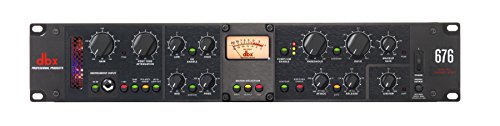
- Class-A tube preamp
- Compressor/limiter with side-chain insert
- Sweepable-mid parametric EQ
Best For: Churches needing broad live sound-shaping control
Versatile Vocal Shaping

- Mono tube channel strip
- Selectable Opto/FET compression
- 4-band semi-parametric EQ
Best For: Single-source vocal and instrument processing
Classic Tube Compression

- Vacuum-tube mic, instrument, and line preamp
- Built-in EQ
- Optical compressor
Best For: Dedicated processing for one priority source
Vocal Control Workhorse – dbx 286s Channel Strip
For church sound systems needing hands-on vocal control, the dbx 286s combines a microphone preamp with compression, de-essing, enhancement, and an expander/gate. Its rack-ready 1U design and status LEDs make it practical for a worship vocal, speech, or instrument channel.
Best For: Churches that want dedicated processing for a lead vocal, spoken-word microphone, or single instrument channel.
Pros:
- Combines four independent processing sections in one unit.
- Compression can help bring vocals forward with greater consistency.
- Includes XLR and 1/4-inch inputs, insert/loop-out capability, and rack mounting.
Cons:
- Provides processing for only one channel.
- It is a wired, corded unit without the USB interface included on some competing options.
The dbx 286s is a focused choice when a church needs reliable, dedicated vocal or instrument processing rather than multi-channel system management. Its controls and metering support straightforward setup at the rack.
USB Vocal Processing Hub – Behringer Ultravoice UV1
The Behringer Ultravoice UV1 is a one-channel mic/line preamp and USB audio interface with compression, gate, and an expander/de-esser function. For church sound systems that also record or stream through a computer, its USB connectivity adds a useful workflow option.
Best For: Small church setups or ministry teams that need one processed microphone channel plus computer-based USB connectivity.
Pros:
- Combines a mic/line preamp and USB audio interface.
- Includes compression, gate, expander, and de-esser processing functions.
- Supports Windows 10 and Mac OS X 10.4 or higher, with up to 192 kHz sample-rate support listed.
Cons:
- It is limited to one channel.
- Its supplied features are centered on computer connectivity, so it may be more than needed for a purely analog rack setup.
The UV1 is a practical option when a church combines live vocal processing with recording, streaming, or computer-based audio work. Confirm compatibility with the team’s computer workflow before purchasing.
System Tuning Command Center – DP-26 DSP Processor
The DP-26 is not a traditional vocal channel strip, but it can be valuable in larger church sound systems as a 2-in/6-out DSP loudspeaker-management processor. It combines equalization, crossover, limiting, delay, filtering, mixing, and effects-related functions for shaping the overall PA signal path.
Best For: Installed or portable church PA systems using line arrays or multiple speaker zones that need crossover, delay, and loudspeaker management.
Pros:
- Provides two inputs and six outputs in a 1U rack-mountable chassis.
- Offers per-channel EQ, crossover filters, delay, phase, mute, and level metering.
- Supports front-panel operation and PC control, with USB, RS485, and RS232 interfaces listed.
Cons:
- It does not replace a dedicated microphone preamp/channel strip for a single vocalist.
- Its extensive routing and DSP controls may require more setup knowledge than a basic channel processor.
Choose the DP-26 when the priority is consistent loudspeaker coverage and system alignment rather than individual mic coloration. Its delay and crossover flexibility can suit complex worship venues and multi-speaker configurations.
Tube-Tone Vocal Shaper – PreSonus StudioChannel
The PreSonus StudioChannel pairs a high-voltage Class A 12AX7 tube preamplifier with a VCA compressor and three-band EQ. For church sound systems, it offers a hands-on way to shape a featured vocal, instrument, keyboard, or synth channel before it reaches the mixer.
Best For: Worship teams seeking tube preamp character and detailed compression and EQ control on a key vocal or instrument.
Pros:
- Combines tube preamplification, VCA compression, and three-band EQ.
- Includes phantom power, polarity reverse, high-pass filter, and a -20 dB pad.
- Accepts microphone, line, and instrument sources in a rugged 1U rack-mount chassis.
Cons:
- It provides processing for one channel at a time.
- The tube-based design is a specialized choice for systems that prefer straightforward solid-state processing.
The StudioChannel makes the most sense on a featured input where tonal shaping is part of the goal. Its flexible EQ and compressor controls provide more sound-design options than a basic preamp, while the rack format suits permanent installations.
Premium Analog Control – Newton Channel Strip
The Rupert Neve Designs Newton is a premium option for church sound systems that need a focused mono channel strip with Class A microphone/line preamplification, transformer outputs, harmonic enhancement, metering, and compression. Its feature set suits churches seeking polished control over an important vocal or instrument input.
Best For: Churches wanting premium analog processing on a key mono input.
Pros:
- Class A mic/line preamp for a dedicated mono channel.
- Custom transformer outputs and Silk harmonic enhancement.
- Built-in compressor and 8-segment LED meters.
Cons:
- Provides one channel rather than a multichannel solution.
- The supplied notes do not specify digital connectivity.
The Newton is a strong fit when sound quality and hands-on analog shaping matter more than channel count or integrated digital I/O.
Flexible Tube Connectivity – ART VoiceChannel
The ART VoiceChannel is a versatile choice among channel strips for church sound systems, combining a tube preamp with compressor, expander, de-esser, and gate controls. Its broad digital connectivity and USB connection can suit churches that record services or route audio to computer-based systems.
Best For: Churches needing tube-style preamplification, dynamics control, and multiple digital output options.
Pros:
- ART tube preamp design provides warmth and definition.
- Includes compressor, expander, de-esser, and gate.
- Offers ADAT, AES/EBU, S/PDIF, TOSLink, and USB connectivity.
- Supports sample rates up to 192 kHz.
Cons:
- It is a single-channel unit.
- Its listed weight is 5.5 kg, which may matter for portable setups.
For churches balancing live vocal processing with recording and digital routing, the VoiceChannel offers a particularly broad feature set in one channel.
Classic Preamp and Digital I/O – Neve 1073SPX-D
The Neve 1073SPX-D combines a Class A preamp/EQ channel-strip design with USB audio interfacing, ADAT I/O, insert send/return, and a headphone amplifier. For church sound systems that also connect to a computer or digital setup, it provides a practical bridge between classic-style processing and modern routing.
Best For: Churches needing Class A preamp/EQ processing with USB and ADAT integration.
Pros:
- Class A circuitry in a preamp/EQ channel-strip format.
- 24-bit/192 kHz AD/DA conversion.
- Includes USB, ADAT I/O, insert send/return, and headphone amp.
- Compatible with Windows, macOS, and several major DAWs.
Cons:
- The supplied notes identify two channels but do not detail the complete channel layout.
- At 16.3 pounds, it may be less convenient for frequently moved rigs.
This model is best suited to churches that want Neve-style Class A processing while maintaining a direct path to computer recording and ADAT-based equipment.
Flexible Tube Control – dbx 676FX
The dbx DBX676FX is a versatile choice for church sound systems that need preamp warmth, dynamics control, and frequency shaping in one rackmount unit. Its high-voltage Class-A tube design, compressor/limiter, and sweepable-mid parametric EQ can help shape microphones, instruments, or other sources for live use.
Best For: Churches needing a feature-rich, rackmount channel strip for vocals, instruments, and complex live mixes.
Pros:
- High-voltage Class-A tube preamp supports warm, clear, or more saturated tones.
- Built-in compressor/limiter and side-chain insert provide additional dynamics and frequency-control options.
- 3-band parametric EQ with sweepable mids offers precise tonal shaping.
- XLR and 1/4-inch connectivity, plus a front-panel instrument input, support flexible setups.
Cons:
- Its 2U rackmount size may require more rack space than simpler channel strips.
- At 13 pounds, it is not the lightest option for portable systems.
For churches wanting extensive hands-on control in a single unit, the 676FX combines preamp, dynamics, and EQ features effectively. Its rackmount format makes it especially suitable for a more permanent sound-system installation.
Versatile Vocal Shaping – ART Pro Channel III
The ART Pro Channel III is a mono tube channel strip for church sound systems that need a focused processing path for a vocal, instrument, or other single source. Switchable microphone impedance, selectable Opto/FET compression voicings, and a 4-band semi-parametric EQ provide practical control over tone and dynamics.
Best For: Churches looking for a single-channel tube strip with flexible compression choices and detailed EQ control.
Pros:
- Tube-based mono channel-strip design offers a dedicated signal-processing path.
- Switchable microphone impedance adds setup flexibility for compatible microphones.
- Selectable Opto and FET compression voicings provide two compression approaches.
- 4-band semi-parametric EQ supports targeted tonal adjustment.
Cons:
- It provides one channel, so multiple sources require additional processing units.
- The supplied dimensions indicate a relatively large unit for a single-channel strip.
The Pro Channel III is a good fit when a church wants hands-on control over one important source rather than a compact multi-channel solution. Its compression voicing options and four-band EQ make it adaptable to different performers and instruments.
Classic Tube Compression – Universal Audio LA-610 Mk II
The Universal Audio LA-610 Mk II is a single-channel tube option for church sound systems that want a microphone, instrument, or line preamp paired with EQ and optical compression. Its focused feature set suits applications where one key source deserves dedicated tube-based processing.
Best For: Churches prioritizing a dedicated tube preamp and optical compressor for one vocal, instrument, or line-level source.
Pros:
- Combines vacuum-tube microphone, instrument, and line preamp functions.
- Includes EQ for tonal adjustment.
- Optical compressor provides dedicated dynamics processing.
- Supplied notes list a 2-year warranty.
Cons:
- It has one channel, limiting its usefulness for processing several sources at once.
- The supplied information identifies XLR as the audio input, so connection requirements should be checked against the system.
The LA-610 Mk II makes the most sense when a church wants to invest in one specialized channel for a lead vocal, featured instrument, or other priority source. It offers the essential preamp, EQ, and optical-compression combination without positioning itself as a multi-channel solution.
How We Picked the Best Channel Strips for Church Sound Systems
We focused on features that matter during worship services, spoken-word programs, rehearsals, and livestreams: clean microphone gain, practical dynamics control, useful equalization, reliable connectivity, straightforward operation, and rack-friendly construction. We also considered whether each unit suits a single vocal channel, a broader front-of-house setup, or a hybrid live-and-recording workflow.
Because these products vary substantially, “best” does not mean the most expensive. A simple processor may be a better fit for a volunteer-operated system, while a premium channel strip can make sense for a dedicated broadcast, recording, or lead-vocal path.
Quick Comparison
| Best for | Look for |
|---|---|
| Lead vocals and speech | Low-noise preamp, compressor, de-esser, and flexible EQ |
| Volunteer-friendly operation | Clear controls, useful presets or simple signal flow, and metering |
| Livestream and recording | Digital outputs, USB, ADAT, or dependable line-level routing |
| Premium vocal character | High-quality tube or transformer-based preamps and detailed EQ |
| Multiple system zones | DSP routing, matrix control, and loudspeaker-management features |
Key Buying Factors for Channel Strips for Church Sound Systems
Input and Output Compatibility
Confirm the unit accepts your microphone type and provides the outputs your console, stagebox, interface, or recorder needs. Balanced XLR connections are important for long cable runs. USB, ADAT, or digital outputs can simplify livestream and recording setups, but they may introduce clocking, driver, or routing considerations.
Dynamics and Vocal Control
Compression helps keep sermons and vocals intelligible without large level swings. A de-esser can reduce harsh “s” sounds, while an expander or gate can limit stage noise between phrases. Choose controls that are easy to adjust without over-processing natural speech.
EQ and Tonal Character
Parametric EQ offers precise control over rumble, muddiness, feedback-prone frequencies, and vocal presence. Tube and transformer-based designs may add desirable warmth, but transparent solid-state processing is often easier to manage across changing speakers and microphones.
Room, Workflow, and Service Demands
A church environment may require fast changes, multiple operators, and consistent results week after week. Prioritize clear metering, sturdy construction, recallable settings where available, and enough headroom for unexpected peaks. A channel strip cannot replace proper microphone placement, acoustic treatment, gain staging, or feedback control.
Who Should Buy Which Channel Strips for Church Sound Systems?
Choose a straightforward vocal processor if your priority is dependable speech and singing control with minimal training. Consider a USB- or digitally equipped model if the same source feeds a livestream, recording rig, or digital production workflow. Premium tube or transformer-based strips are best reserved for a lead vocal, pastor’s microphone, broadcast chain, or recording channel where their additional cost and character are worthwhile.
If your main challenge is distributing signals to loudspeaker zones or managing a line-array system, a dedicated DSP loudspeaker processor may be more appropriate than a traditional microphone channel strip. For larger churches, combining a few high-quality vocal strips with the console’s onboard processing can provide better value than outfitting every input with external hardware.