Choosing the right flash can make a small studio feel far more polished, even when you do not have room for large lighting setups. The best options give you control, consistency, and enough power to shape portraits, products, and content with confidence.
This roundup focuses on practical camera flashes for small studios, from compact speedlights to stronger monolights and pocket strobes, so you can match the flash to your space, camera system, and shooting style.
Best 10 Camera Flashes for Small Studios Picks for 2026
Compact Bowens Studio Workhorse

- 300W monolight with Bowens mount
- 2.4G wireless X system for remote control
- Stable output with anti-preflash support
Best For: Small studios needing a dependable, modifier-friendly studio flash
Upgraded LED Studio Strobe

- Upgraded LED modeling lamp with brightness control
- Wireless remote control via Godox X system
- Compact 300W Bowens-mount studio strobe
Best For: Small studios wanting a compact strobe with an upgraded modeling lamp
Manual Hot Shoe Value Pick

- LCD display with 22-level manual adjustment
- Manual, multi, S1/S2 modes plus 3.5mm sync
- Includes stand, pouch, and color filters
Best For: Beginners wanting a manual flash with simple off-camera control
Portable power pick
GODOX AD100 Pro II 100Ws pocket flash

- 100Ws output in a compact 564g body
- TTL, manual, and HSS up to 1/8000s
- Built-in battery with USB-C charging
Best For: Small studios needing a portable off-camera flash with more power
Budget wireless choice
Godox TT600 manual wireless speedlite

- GN60 output with stable 5600K color temperature
- Built-in 2.4G wireless system for off-camera use
- Up to about 230 full-power flashes per set
Best For: Budget studio users who want a simple manual speedlite
Ultra-compact pick
Godox iM20 mini hot-shoe flash

- 31g mini flash with built-in battery
- Five power levels and USB-C charging
- Up to 440 full-power flashes
Best For: Tiny studio setups and photographers who prioritize portability
Top Canon Studio Choice
NEEWER Z2PRO-C Canon Round Head Flash

- 76Ws output with TTL and 1/8000s HSS
- Dual LED modeling lights and fast 1.5s recycle
- Built-in wireless control for studio-style setups
Best For: Canon studio shooters needing power, TTL, and modeling lights
Lightweight Manual Pick
NEEWER Z120 SE Mini Manual Flash
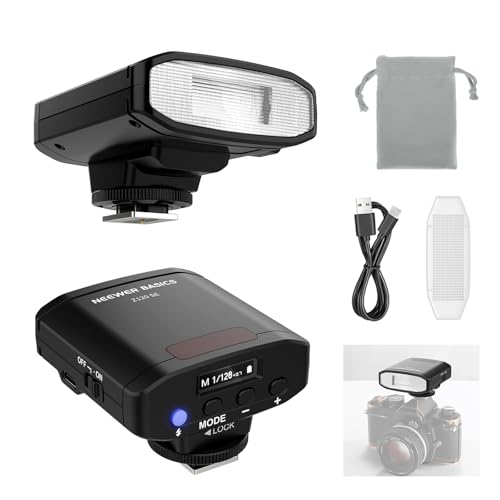
- Compact 128g body for small setups
- GN12 daylight flash with built-in battery
- Manual plus S1/S2 optical slave modes
Best For: Beginners needing a tiny manual flash for simple studio fill
Compact Bowens Studio Workhorse – Godox MS300 300W Monolight
If you’re shopping for camera flashes for small studios, the Godox MS300 is built for controlled, repeatable lighting rather than speedlite portability. Its 300W output, Bowens mount, and built-in wireless X system make it a practical choice for portraits, product work, and other studio setups where you want consistent power and modifier flexibility.
Best For: Small studios that want a reliable Bowens-mount monolight with wireless control and stable output.
Pros:
- Built-in 2.4G wireless X system for remote control of power, modeling lamp, and buzzer.
- 300W output with 1/32 to 1/1 power adjustment in 50 steps.
- Stable output with no more than 2% tolerance during long working sessions.
- Anti-preflash support helps with cameras that fire a preflash.
Cons:
- Manual flash only, so there’s no automatic exposure control.
- Not water resistant.
- Designed for studio use, so it is not as portable as a speedlite.
This is a straightforward studio flash for creators who want dependable output and Bowens compatibility without paying for extra features they may not use.
Budget Manual Speedlite – NEEWER TT560 Manual Flash
For photographers comparing camera flashes for small studios on a budget, the NEEWER TT560 is a basic manual speedlite with the core controls needed for simple off-camera setups. It does not offer TTL or HSS, but it does provide manual power adjustment, optical slave modes, and a hotshoe design that works with many cameras that use a standard center-contact mount.
Best For: Budget-minded shooters who want a simple manual flash for basic studio or off-camera lighting.
Pros:
- Manual power control with 8 levels from 1/128 to 1/1.
- Supports S1/S2 optical slave modes and PC sync for off-camera lighting.
- 5600K daylight color temperature and GN38 output.
- Tilts 0°-90° and rotates 0°-270° for flexible bounce positioning.
Cons:
- No TTL, no HSS, and no automatic flash exposure.
- Requires a camera with a standard center-contact hotshoe.
- Uses 4 AA batteries, which are not included.
The TT560 makes sense if you want an inexpensive manual flash and are comfortable setting power yourself. It’s less feature-rich than modern TTL speedlites, but it covers the basics well for simple studio work.
Upgraded LED Studio Strobe – Godox MS300V 300W LED Strobe
The Godox MS300V is a strong pick if you want camera flashes for small studios with a little more convenience built in. It keeps the 300W studio-strobe format but upgrades the modeling lamp to LED, adds wireless control, and still uses the Bowens mount, so it fits well into a compact portrait or product-lighting kit.
Best For: Small studios that want a compact Bowens strobe with an upgraded LED modeling lamp.
Pros:
- Upgraded LED modeling lamp with 150W power and 5% to 100% brightness adjustment.
- Wireless remote control for power, modeling lamp, and buzzer via Godox X system triggers.
- 300W output with GN58 and 0.1 to 1.8 second recycle time.
- Lightweight, compact design at about 1.3 kg and 28.3 cm length with lamp cover.
Cons:
- No HSS function.
- Requires removing the lamp cover before use.
- Manual flash only, so it is aimed at controlled studio shooting.
This upgraded version keeps the MS300’s core studio strengths while adding a more practical LED modeling lamp. It’s a sensible pick for small studios that want a compact, modifier-ready strobe with remote control.
Manual Hot Shoe Value Pick – PHOTOOLEX FK310 LCD Speedlite
If you need camera flashes for small studios and want something simple rather than fully automated, the PHOTOOLEX FK310 is a manual speedlite with a clear LCD and useful off-camera tools. Its GN33 output, multi mode, and optical S1/S2 triggering make it a flexible entry-level option for portraits, small product setups, and creative lighting experiments.
Best For: Beginners and budget users who want a manual hot-shoe flash with LCD controls and basic off-camera options.
Pros:
- LCD display shows mode, power level, and battery status at a glance.
- 22-level power adjustment from 1/128 to 1/4 for fine manual control.
- Supports manual, multi, and S1/S2 modes with 3.5mm sync port.
- Includes a stand, pouch, and 12 color filters.
Cons:
- Manual-only design with no TTL or automatic flash exposure.
- GN33 output is lower than larger studio strobes.
- Requires 4 AA batteries, which are not included in the listing details.
The FK310 is a good fit if you want an affordable flash with enough controls to learn lighting without extra complexity. It is better suited to light studio work than demanding professional setups.
Portable power pick – GODOX AD100 Pro II 100Ws pocket flash
If you’re comparing camera flashes for small studios, the GODOX AD100 Pro II is a compact 100Ws option that brings TTL, HSS, and wireless control into a very portable body. It’s a practical pick when you want more power than a mini flash, but still need something easy to move between a desk setup, a home studio, or an off-camera light stand.
Best For: Small studios that need a lightweight off-camera flash with TTL and wireless control.
Pros:
- 100Ws output with stable performance and support for about 60–100 full-power continuous flashes
- TTL, manual power control from 1/256 to 1/1, and high-speed sync up to 1/8000s
- Built-in 2.4GHz X wireless system for quick sync with compatible Godox triggers
- Lightweight 564g design with built-in battery and USB-C charging
Cons:
- Uses a specialized system, so full wireless convenience depends on compatible Godox triggers
- Higher output and feature set may be more than needed for very casual tabletop work
The AD100 Pro II makes sense if your small studio needs flexibility and headroom without a bulky monolight. It balances portability and serious flash features well for creators who work across portraits, products, and mixed on-location setups.
Budget wireless choice – Godox TT600 manual wireless speedlite
For camera flashes for small studios on a tighter budget, the Godox TT600 is a straightforward manual speedlite with built-in 2.4G wireless support. It’s useful when you want reliable light output, simple controls, and the ability to work with compatible Godox triggers for more flexible off-camera setups.
Best For: Studio beginners or budget-minded users who want a dependable manual flash with wireless expansion.
Pros:
- Built-in Godox 2.4G X wireless system with support for remote control when paired with compatible triggers
- GN60 output and stable 5600±200K color temperature across the power range
- Up to about 230 full-power flashes with 0.1–2.6s recycling time
- Compatible with many major camera brands using a standard hot shoe
Cons:
- No on-camera HSS support, even though HSS is possible with a compatible TTL trigger
- Runs on 4 AA batteries, which are not included
The TT600 is a practical entry point if you mainly need a solid manual flash for controlled studio lighting. It offers good output and wireless flexibility without adding the cost or complexity of a higher-end TTL unit.
Ultra-compact pick – Godox iM20 mini hot-shoe flash
If you need camera flashes for small studios but want the smallest possible footprint, the Godox iM20 is a tiny hot-shoe flash with built-in battery and five power levels. It’s aimed at photographers who want a lightweight, easy-to-carry light for basic controlled shooting, as long as their camera is on the compatibility list.
Best For: Small-studio shooters who need an ultra-compact manual flash for basic lighting.
Pros:
- Very compact and lightweight at 31g, making it easy to pack or leave on the camera
- Built-in battery with USB-C charging and up to 440 full-power flashes
- Five adjustable power levels for simple output control
- Works with many Canon, Sony, Nikon, Fujifilm, Panasonic, and Olympus models with a single-contact hot shoe
Cons:
- No TTL or high-speed sync, so it’s best for slower, manual shooting setups
- Compatibility is limited and some specific camera models are excluded
- Recommended shutter speed is below 1/200 to avoid edge issues
The iM20 is the most minimal option here, which makes it appealing for simple studio use or occasional flash needs. It’s a good fit if compact size matters more than advanced exposure features.
Top Canon Studio Choice – NEEWER Z2PRO-C Canon Round Head Flash
If you’re comparing camera flashes for small studios, the NEEWER Z2PRO-C is a strong Canon option when you want TTL convenience, fast recycle times, and enough power for portraits, product work, and bounce lighting. Its round head, 76Ws output, and built-in LED modeling lights make it easier to shape light in tighter spaces.
Best For: Canon shooters who want a high-power studio-friendly speedlite with TTL, wireless control, and modeling lights.
Pros:
- 76Ws output with 1/8000s HSS and TTL support for flexible shooting
- Round head with 330° rotation and -7° to 120° tilt for bounce and shaping
- 600 full-power flashes, 1.5s recycle, and a 2.5-hour Type-C charge
- Dual 2W LED modeling lights help preview shadows and placement
Cons:
- Designed for Canon users, so it is not a universal fit for every system
- Some wireless features depend on compatible transmitters and firmware
- R50 users need the AD-E1 adapter sold separately
For a small studio, this is the most feature-rich option in the group, especially if you value TTL plus the ability to switch into manual control quickly. It is best suited to photographers who want one flash that can handle both controlled indoor sessions and faster-paced shoots.
Best Manual Budget Flash – Godox TT600 GN60 Speedlite
For camera flashes for small studios, the Godox TT600 is a practical manual speedlite that brings strong output, simple controls, and broad system compatibility. It is a good fit when you already know your lighting ratios and want a dependable flash for portrait, event, or bounce-light setups.
Best For: Shooters who want an affordable manual flash with strong power and a large wireless ecosystem.
Pros:
- GN60 power with consistent 5600K color temperature
- 2.4G Godox X wireless system supports master/slave control
- HSS up to 1/8000s when used off-camera with a compatible trigger
- Flexible head tilts -7° to 90° and rotates 360°
Cons:
- HSS requires an external compatible trigger and off-camera use
- Runs on 4 AA batteries, which are not included
- Not compatible with some cameras listed in the notes, including Canon R6 and R50
This is a solid studio pick if you prefer manual flash control over TTL and want to build a simple, expandable lighting setup. The included diffuser kit also makes it easier to soften the look in smaller rooms.
Lightweight Manual Pick – NEEWER Z120 SE Mini Manual Flash
If you need camera flashes for small studios but want to keep things simple, the NEEWER Z120 SE is a compact manual speedlite built around the basics. It is a lightweight option for controlled fill light, creator setups, and straightforward portrait work where you can adjust power manually.
Best For: Beginners and travel-friendly creators who want a small manual flash for basic studio lighting.
Pros:
- Very compact and lightweight at 128g for easy handling
- GN12 output with a 5600K daylight color temperature
- Built-in 2000mAh battery delivers up to 500 full-power flashes
- Manual, S1, and S2 modes support simple optical triggering
Cons:
- No TTL, no HSS, and no camera menu control
- Works only with standard single-contact hot shoe cameras
- Sync speed is limited to 1/200s, so it is less flexible in bright light
This flash is best when you want an inexpensive, easy-to-carry tool for learning off-camera basics or adding soft fill in a small room. It is not feature-heavy, but it stays focused on practical manual lighting.
How We Picked These Camera Flashes for Small Studios
We focused on flashes that make sense in tight shooting spaces: reliable output, manageable size, easy controls, and wireless or off-camera flexibility. For small studios, the best flash is not always the most powerful one; it is the one that balances light quality, recycle speed, and setup simplicity.
We also considered compatibility across major camera brands, battery or AC convenience, and whether the flash is better suited to portraits, product work, or hybrid use.
Quick Comparison
As a fast rule: monolights are usually the best fit for static studio work, standard speedlights are better for portability and budget-conscious setups, and compact battery flashes are ideal when you want a studio-capable light that can also travel.
Key Buying Factors for Camera Flashes for Small Studios
Power and Modulation
Look for enough output to light your subject without pushing the flash to its limit. More watt-seconds or a stronger guide number can help, but adjustability matters just as much in a small room where light can easily become harsh.
Recycle Time and Shooting Speed
If you shoot portraits, ecommerce, or social content in bursts, faster recycle times reduce downtime and keep sessions moving. This matters especially when working with multiple poses or quick expression changes.
Triggering and Off-Camera Use
Wireless triggering is a major advantage in small studios because it lets you place the light where it works best instead of where the camera is. Built-in radio systems or common trigger support can simplify your setup.
Size, Heat, and Power Source
Compact flashes save space, while battery-powered units offer more placement freedom. AC-powered monolights can be excellent for studio desks or permanent setups, but they are less convenient if you need to rearrange often.
Compatibility and Control
Make sure the flash supports your camera brand and offers the control you need, whether that is manual-only operation for consistency or TTL support for faster exposure changes.
Who Should Buy Which Camera Flashes for Small Studios?
If you want a dedicated studio light, choose a monolight-style flash. If you need portability and occasional off-camera flexibility, a standard speedlight is often the most efficient choice. If you shoot on location as well as in a small studio, a compact battery flash can give you the best all-around value.
For most buyers, the sweet spot is a flash that is easy to position, quick to recycle, and powerful enough to stay versatile as your studio grows.