Choosing the right battery powered recorder for mobile studio work comes down to inputs, power flexibility, and how you plan to record on the move.
Whether you need a compact songwriter tool, a podcast hub, or a field-ready multitrack recorder, the best picks balance portability with clean, reliable capture.
Best 10 Battery Powered Recorder for Mobile Studio Picks for 2026
Clip-Free Field Recording

- 32-bit float reduces clipping risk.
- Two locking XLR/TRS inputs.
- Battery powered with USB workflow.
Best For: Filmmakers and mobile recordists in unpredictable environments.
Portable Songwriting Studio
BOSS BR-800 Multitrack Recorder

- 4-track recording with 8-track playback.
- Built-in mics, effects, and drum machine.
- Battery, USB, or AC power options.
Best For: Songwriters who want portable multitrack recording and onboard creative tools.
Simple Pro Capture
Zoom H1 XLR 2-Channel Recorder

- 32-bit / 96kHz recording.
- Two XLR/TRS combo inputs.
- OLED waveform display and 3.5mm I/O.
Best For: Creators needing a compact two-channel recorder for interviews and podcasts.
Pocket Multitrack Sketchpad
Tascam DP-006 Pocketstudio Recorder

- Six-track portable recording.
- Built-in microphones for quick capture.
- Runs on four AA batteries.
Best For: Songwriters who want a lightweight pocket recorder for demos and ideas.
Portable Songwriting Bundle

- Includes 32GB microSDHC card and AA batteries
- Records 4 tracks in 32-bit float WAV at 48 kHz
- Also works as a USB-C audio interface
Best For: Songwriters and mobile recordists who want an all-in-one starter bundle
Podcast Hub Recorder

- 4 XLR mic inputs with phantom power
- 4 headphone outputs with individual volume control
- Battery powered with mix-minus for remote interviews
Best For: Portable podcast and interview recording
Camera Rig Recorder

- Fits under a DSLR camera rig
- Records up to 4 channels to SD card
- Uses 4 AA batteries and includes XLR/3.5mm inputs
Best For: DSLR and location recording setups
Portable Multitrack Hub
Zoom LiveTrak L-8 Battery Powered Mixer/Recorder

- 12-track recording to SD card at 24-bit/96kHz
- Four headphone outputs and three monitor mixes
- Records to SD card and computer at once
Best For: Musicians and podcasters needing a compact mobile studio mixer-recorder
Clip-Free Field Capture
TASCAM DR-40XP Portable Handheld Recorder
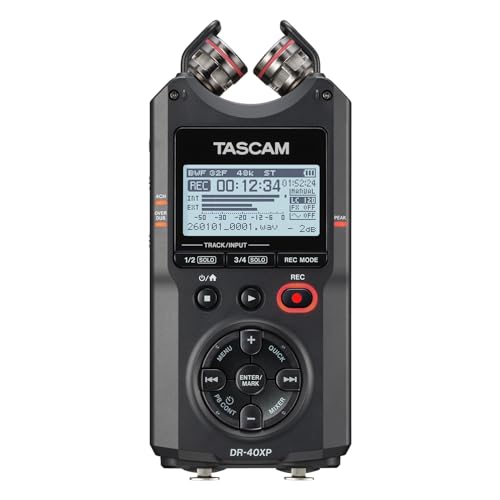
- 32-bit float recording for cleaner capture
- Built-in adjustable mics plus 2 XLR/TRS inputs
- USB-C interface for computer or mobile use
Best For: Creators who want a portable recorder for music, interviews, and video
Ultra-Compact Creator Recorder
Zoom H1 Essential Stereo Recorder

- 32-bit float stereo recording with X/Y mics
- USB-C microphone mode for streaming and calls
- Very lightweight at 92 g
Best For: Solo creators needing a tiny recorder for fast mobile studio capture
Clip-Free Field Recording – Zoom F3 32-Bit Float Recorder
If you need a battery powered recorder for mobile studio work that can handle sudden level changes, the Zoom F3 is built for exactly that kind of use. Its 32-bit float recording and dual A/D converters are aimed at run-and-gun sessions where you want clean capture without constantly riding gain.
Best For: Filmmakers, recordists, and musicians working in unpredictable locations.
Pros:
- 32-bit float recording helps avoid clipping when levels jump unexpectedly.
- Dual locking XLR/TRS inputs are secure for mounted or larger rigs.
- Ultra-low-noise preamps support cleaner audio in uncontrolled environments.
- Flexible power and USB workflows suit long days on set or on location.
Cons:
- Only two inputs, so it is not built for larger multi-source sessions.
- Designed more for capture than for built-in creative features.
The Zoom F3 focuses on reliable, clip-free recording rather than extra bells and whistles, which makes it a strong choice when portability and audio safety matter most.
Portable Songwriting Studio – BOSS BR-800 Multitrack Recorder
The BOSS BR-800 is a battery powered recorder for mobile studio users who want an all-in-one songwriting and demo tool. It combines multitrack recording, built-in effects, a drum machine, and USB interface features in a compact portable recorder.
Best For: Songwriters and musicians who want a portable sketchpad with production tools.
Pros:
- Records up to 4 tracks simultaneously with 8-track playback.
- Built-in stereo condenser microphone supports instant capture.
- Includes guitar, bass, and vocal effects plus a drum machine.
- Runs on six AA batteries, USB bus power, or AC adaptor.
Cons:
- Battery life is listed at about 6 hours, which may feel short for long sessions.
- Uses an older 32 GB storage limit compared with newer recorders.
- Not as simple or focused as a bare-bones field recorder.
If you want a portable studio unit that supports both recording and idea-building, the BR-800 brings more creative tools into the mix than most basic handheld recorders.
Simple Pro Capture – Zoom H1 XLR 2-Channel Recorder
The Zoom H1 XLR is a practical battery powered recorder for mobile studio setups that need simple handling and clean capture. With 32-bit / 96kHz recording, two combo inputs, and a waveform display, it is geared toward quick interviews, podcasts, and compact field work.
Best For: Podcasters, interviewers, and creators who want a straightforward two-channel recorder.
Pros:
- 32-bit / 96kHz recording supports detailed, clean audio capture.
- Two XLR/TRS combo inputs handle microphones and instruments.
- OLED waveform display helps monitor levels at a glance.
- 3.5mm input and headphone output add useful flexibility.
Cons:
- Two channels only, so it is not suited to bigger multi-input sessions.
- Battery-powered operation relies on AA batteries.
This recorder keeps the workflow focused and portable, making it a good fit when you need dependable audio without the complexity of a larger mobile rig.
Pocket Multitrack Sketchpad – Tascam DP-006 Pocketstudio Recorder
The Tascam DP-006 is a battery operated recorder for mobile studio use when portability and straightforward songwriting matter most. Its built-in microphones, six-track recording, and pocket-friendly design make it a simple way to capture song ideas anywhere.
Best For: Songwriters who want a lightweight multitrack recorder for rough demos.
Pros:
- Records up to six tracks for basic multitrack demo work.
- Built-in omni condenser microphones make it easy to start recording.
- Uses four AA batteries, which keeps it portable.
- Supports USB connection for working with a computer.
Cons:
- 16-bit/44.1kHz recording is more basic than newer 32-bit models.
- Two-track simultaneous recording limits more complex capture.
- Small 4 GB storage capacity may require frequent file management.
The DP-006 is best seen as a simple idea-catcher rather than a full-featured studio replacement, but that focus can be exactly what mobile songwriters need.
Portable Songwriting Bundle – Zoom R4 4-Track Starter Kit
If you want a battery powered recorder for mobile studio use, this Zoom R4 bundle is set up to get you recording immediately. It combines the R4 MultiTrak with a 32GB microSDHC card, SD adapter, and five AA batteries, so you have the storage and power you need right out of the box.
Best For: Songwriters, touring musicians, and home recordists who want a hardware-first sketchpad with everything included.
Pros:
- Includes a 32GB microSDHC card and SD adapter, so it can record immediately.
- Runs on AA batteries and also supports USB-C bus power for flexible mobile sessions.
- Records 4 tracks at once in 32-bit float WAV at 48 kHz.
- Works as a class-compliant USB-C audio interface for Mac, Windows, iOS, and Android.
Cons:
- Requires 4 AA cells for battery operation, so you’ll still need to manage power on longer sessions.
- It is aimed at songwriting and demo capture, not a full-featured studio workflow.
- The included card is 32GB, which may be limiting for very long recording days.
The big advantage here is convenience: the bundle removes the common first-run problem of buying a recorder and then discovering you still need media and batteries. For mobile studio users who want to capture ideas fast, the R4’s 32-bit float recording and bounce workflow make it a practical portable sketchpad.
Podcast Hub Recorder – Zoom PodTrak P4
The Zoom PodTrak P4 is a battery powered recorder for mobile studio work when your sessions center on voices, calls, and quick multi-mic setups. It gives you four XLR mic inputs, four headphone outputs, sound pads, and USB/TRRS connectivity, making it easy to build a compact recording rig without a computer.
Best For: Podcasters and interview teams who need a portable, battery-powered voice recording hub.
Pros:
- Four high-quality mic inputs with phantom power support.
- Four headphone outputs with individual volume control.
- Automatic mix-minus for call-in and remote interviews via TRRS or USB.
- Runs on 2 AA batteries and can record multiple inputs and sound pads.
Cons:
- Battery life is listed at up to 3.5 hours on 2 AA batteries.
- Its feature set is centered on speech and podcast workflows rather than music-first tracking.
- The compact format makes it less suited to larger production setups.
For mobile podcasting, the P4 is appealing because it combines portable power with the kind of input and monitoring options teams actually use. If your priority is recording interviews on the go, the battery-powered design and built-in routing tools are the main selling points.
Camera Rig Recorder – TASCAM DR-60DmkII
If your battery powered recorder for mobile studio work needs to sit under a camera setup, the TASCAM DR-60DmkII is built for that role. It records up to four channels to an internal SD card, adds locking XLR inputs with phantom power, and includes dual 3.5mm inputs for wireless or lavalier mics.
Best For: Videographers and compact location recordists building a DSLR-friendly audio rig.
Pros:
- Designed to fit under a DSLR camera rig.
- Records up to 4 channels at up to 96 kHz/24-bit WAV.
- Two locking XLR inputs include 48V phantom power.
- HDDA preamps offer up to 64 dB of gain with low noise performance.
Cons:
- Uses 4 AA batteries, so portable power still needs planning.
- The dual 3.5mm inputs are separate from the XLR inputs, which may not suit every setup.
- It is clearly geared toward camera rigs rather than general-purpose music production.
The DR-60DmkII is a strong pick when you want straightforward multichannel capture in a camera-friendly form factor. For mobile production where the recorder has to live under a rig, its mix of XLR, 3.5mm, and phantom power support makes it highly practical.
Portable Multitrack Hub – Zoom LiveTrak L-8 Battery Powered Mixer/Recorder
If you want a battery powered recorder for mobile studio work that can handle both tracking and monitoring, the Zoom LiveTrak L-8 is built for flexible sessions. It captures up to 12 tracks at 24-bit/96kHz to SD card, while also recording to a computer over USB, so it fits podcasting, live music, and small production setups.
Best For: Musicians, podcasters, and streamers who need a compact battery powered recorder for mobile studio sessions with multitrack capture.
Pros:
- Records 12 tracks simultaneously to SD card at 24-bit/96kHz.
- Six preamps with a -121dBu noise floor and up to +54dB gain.
- Four headphone outputs with three independent monitor mixes.
- Can record to SD card and computer at the same time via USB.
Cons:
- Larger and more mixer-like than a simple handheld recorder.
- Designed for expanded workflows, so it may be more than casual users need.
The L-8 makes sense when your mobile studio needs real routing and monitoring, not just a basic capture device. Its battery-powered design and simultaneous SD/computer recording give it strong versatility for creators who move between rehearsal, streaming, and on-location sessions.
Clip-Free Field Capture – TASCAM DR-40XP Portable Handheld Recorder
The TASCAM DR-40XP is a practical battery powered recorder for mobile studio use when you need a portable unit that can move from music to interviews and video work. It combines adjustable built-in mics, two XLR/TRS inputs, and 32-bit float recording for flexible capture in a wide range of environments.
Best For: Creators, musicians, and videographers who want a compact battery powered recorder for mobile studio and field recording.
Pros:
- 32-bit float recording helps reduce clipping concerns.
- Built-in adjustable A-B or X-Y microphones add flexible stereo capture.
- Two XLR/TRS inputs support external mics and sources.
- USB-C audio interface mode works with computer or compatible mobile setups.
Cons:
- microSD card and batteries are not included.
- Fewer channels than larger mixer-recorder options.
This recorder is a strong fit if portability and clean capture matter more than mixing complexity. Its combination of handheld convenience, 4-channel recording, and USB-C interface support makes it a versatile tool for mobile production.
Ultra-Compact Creator Recorder – Zoom H1 Essential Stereo Recorder
The Zoom H1 Essential is a simple battery powered recorder for mobile studio tasks when you need fast, clean stereo capture in a tiny package. With 32-bit float recording, X/Y stereo mics, and USB-C microphone mode, it works well for content creation, rehearsals, interviews, and quick recording sessions.
Best For: Solo creators and musicians who need a lightweight battery powered recorder for mobile studio and everyday content capture.
Pros:
- 32-bit float recording helps keep audio clip-free.
- Built-in X/Y stereo microphones make setup fast.
- USB-C microphone mode supports streaming, calls, and desktop or mobile recording.
- Compact 92 g design is easy to carry anywhere.
Cons:
- Uses 2 AAA batteries rather than a built-in rechargeable system.
- Best for stereo capture, not multitrack production.
If your mobile studio priority is speed and portability, the H1 Essential keeps things straightforward. It is best when you want dependable stereo recording without carrying a larger recorder or mixer.
How We Picked the Best Battery Powered Recorder for Mobile Studio
We focused on recorders that make mobile recording practical: battery operation, dependable input options, usable onboard controls, and features that reduce clipping or simplify editing. For a Battery Powered Recorder for Mobile Studio use, we also prioritized models that can handle a variety of sources such as microphones, instruments, and line-level devices.
Quick Comparison
As you compare the list, think in terms of workflow. Some models are best for straightforward stereo capture, others are built for podcasting with multiple mic inputs and headphone monitoring, and a few are better suited to songwriting or lightweight multitrack production. 32-bit float support is especially helpful if you want more headroom and less concern about surprise peaks.
Key Buying Factors for Battery Powered Recorder for Mobile Studio
Input Count and Connector Types
Start with how many sources you need to record at once. Solo creators may only need one or two inputs, while interviewers, podcasters, and small music setups often benefit from four or more. Combo XLR/TRS inputs add flexibility for mics, instruments, and mixers.
Power and Battery Life
Battery options matter when recording away from outlets. Some units use AA batteries, while others support rechargeable packs or USB power. If you travel often, choose a recorder with an easy-to-manage power setup and realistic runtime for your sessions.
Recording Quality and Safety Features
Look for 32-bit float recording, quality preamps, and limiters or high-pass filters when available. These features help preserve usable audio in unpredictable environments and can save time during setup.
Monitoring, Workflow, and Expansion
Headphone outputs, onboard mix controls, USB audio interface mode, and remote-phone or computer connectivity can make a big difference. For mobile studios, the best recorder is the one that fits both your capture needs and your editing workflow.
Who Should Buy Which Battery Powered Recorder for Mobile Studio?
If you want the simplest portable solution, choose a compact stereo recorder. If you need podcast or interview flexibility, look for multiple mic inputs and strong monitoring options. Songwriters and musicians should prioritize multitrack recording, input versatility, and easy overdubbing. Videographers and creators who move between locations should lean toward rugged, low-profile units with dependable power and clean gain staging.
In short, the best Battery Powered Recorder for Mobile Studio work is the one that matches your source count, power needs, and recording style without adding unnecessary complexity.