The right equalizer can make spoken-word audio clearer, more balanced, and easier to understand. These 10 picks span simple desktop tone controls, full recording interfaces, mixers, and professional rack-mount EQs.
Whether you record at home, stream live, or manage a multi-microphone podcast, this roundup helps you match features, connectivity, and control range to your setup.
Best 10 Audio Equalizers for Podcasting Picks for 2026
Budget EQ Control

- Seven bands with ±12dB adjustment
- Dual-channel design with 3.5mm connectivity
- Aluminum-alloy housing and headphone support
Best For: Entry-level podcasting and compact voice setups
All-in-One Production Choice
- Two combo inputs with 76dB of gain
- Faders, touchscreen, and six SMART pads
- APHEX effects and USB connectivity
Best For: Integrated podcast recording and production
Rack-Mount Precision
- 15 bands per channel with ±12dB adjustment
- Low-cut filter for rumble and hum
- Balanced XLR and unbalanced TRS I/O
Best For: Rack-based studios and detailed stereo EQ control
Portable Recording Hub

- 24-bit/192kHz USB-C recording
- Two combo inputs with 48V phantom power
- Zero-latency monitoring and 3.5mm output
Best For: Portable home and mobile podcast recording
Best Rackmount Precision
15-Band Stereo Graphic Equalizer

- 15 bands per channel with ±12dB adjustment
- Low-cut control for unwanted low-end noise
- XLR and 1/4-inch TRS connectivity
Best For: Rack-based podcast studios needing detailed manual EQ
Best All-in-One Podcast Mixer

- Eight combo inputs for microphones and instruments
- Master 7-band EQ plus channel 3-band EQ
- USB recording, streaming, effects, and phantom power
Best For: Multi-mic podcasts and livestream setups
Best Compact Stereo EQ

- Seven bands with ±6dB adjustment
- XLR and RCA inputs and outputs
- Compact aluminum design with no volume knob
Best For: Simple analog podcast chains with separate recording hardware
Best Rack-Style Choice
- Dual 21-band EQ per channel
- Spectrum display and dual VU meters
- RCA and front-panel 3.5mm inputs
Best For: Dedicated home studios needing detailed, visual EQ control
Best Clean-Signal Preamp

- Nine bands from 20Hz to 16kHz
- 111dB SNR and 0.001% THD
- Dual RCA inputs and outputs
Best For: Compact RCA-based podcast and stereo chains
Best Compact Bluetooth Option

- Five-band tone shaping
- Bluetooth 5.0 wireless playback
- Dual 45mm VU meters
Best For: Small, flexible stereo podcasting setups
Budget EQ Control – 7-Band Sound Equalizer
For shoppers comparing audio equalizers for podcasting, this compact two-channel unit offers hands-on control over seven frequency bands. Its 3.5mm connections, headphone support, and adjustable gain make it a practical option for basic recording, streaming, and voice-call setups.
Best For: Entry-level podcasting, streaming, and simple headphone-based voice setups.
Pros:
- Seven adjustable bands from 60Hz to 15kHz with a ±12dB range.
- Supports 5V to 12V DC power and uses a compact aluminum-alloy housing.
- Includes 3.5mm input and headphone output support, including headset microphones.
Cons:
- Offers fewer bands and less connection flexibility than studio rack equalizers.
- Requires an external DC power source.
- Its listed specifications are oriented toward basic, compact setups rather than full studio routing.
This is a straightforward choice when you want inexpensive physical EQ controls and 3.5mm connectivity. It is less suitable for podcast studios that need extensive balanced I/O or advanced production features.
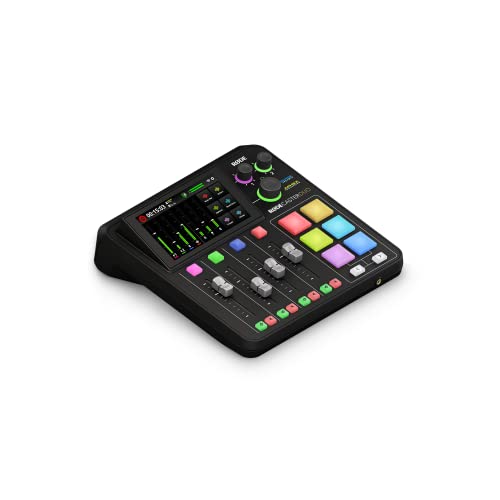
All-in-One Production Choice – RØDECaster Duo Podcast Studio
Although it is more than a standalone EQ, the RØDECaster Duo is a powerful option for creators comparing audio equalizers for podcasting as part of a complete production setup. It combines microphone inputs, faders, SMART pads, monitoring, and APHEX processing in one desktop studio.
Best For: Podcasters who want integrated recording, mixing, streaming, and vocal-processing controls.
Pros:
- Two Neutrik combo inputs feature high-gain, low-noise Revolution Preamps.
- Provides four broadcast-quality faders, six SMART pads, and a touchscreen.
- Includes studio-grade effects and APHEX processing such as Aural Exciter and Big Bottom.
- Supports USB connectivity and 3.5mm TRRS headset monitoring or recording.
Cons:
- It is a full production studio rather than a dedicated standalone equalizer.
- Its corded-electric design is less portable than a compact USB interface.
- Its four-channel configuration may be more equipment than a simple single-microphone setup requires.
The RØDECaster Duo makes sense when EQ and voice processing are only part of your workflow. Its broader feature set can simplify podcast production, but buyers seeking only frequency-band adjustment may prefer a dedicated equalizer.
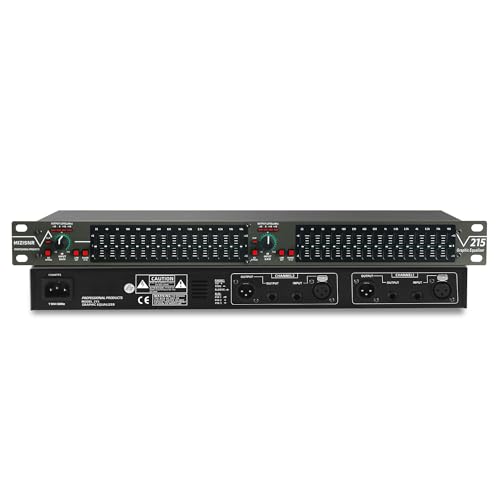
Rack-Mount Precision – 15-Band Stereo Graphic EQ
For a more traditional studio or live-sound approach to audio equalizers for podcasting, this dual-channel 15-band graphic equalizer provides extensive manual adjustment. Its low-cut filter, bypass switch, and rack-mount format are useful when integrating EQ into a larger audio chain.
Best For: Rack-based podcast studios, audio installations, and creators managing rumble or hum.
Pros:
- Provides 15 adjustable bands per channel with a ±12dB range.
- Low-cut filtering helps attenuate wind noise, floor rumble, and electrical hum.
- Offers XLR balanced and 1/4-inch TRS unbalanced inputs and outputs.
- Standard 1U rack-mount design and bypass switch support studio integration and troubleshooting.
Cons:
- Its 18.9-inch-wide rack format is less convenient for compact desktop setups.
- It requires external equipment for microphone preamplification and recording.
- Manual graphic controls may be more involved than software-based EQ.
This model is a strong fit when precise stereo shaping and physical rack integration matter. It is best paired with an existing mixer or interface rather than used as an all-in-one podcast console.
Portable Recording Hub – Q2 2×2 USB Audio Interface
For podcasters who need an interface alongside their audio equalizers for podcasting, this 2×2 USB-C model focuses on clean capture, monitoring, and flexible microphone connectivity. It supports 24-bit/192kHz recording, two combo inputs, and direct monitoring for a portable setup.
Best For: Mobile and home podcasters recording one or two microphones through a computer or compatible mobile setup.
Pros:
- Records at up to 24-bit/192kHz through a USB-C connection.
- Two XLR/TRS combo inputs support microphones, instruments, and Hi-Z sources.
- Includes 48V phantom power for compatible condenser microphones.
- Direct monitoring provides zero-latency tracking, with a built-in 3.5mm headphone jack.
Cons:
- It is an audio interface, not a dedicated multi-band hardware equalizer.
- Its two-channel design may not suit larger panel discussions.
- USB bus power means operation depends on the connected computer or device.
This interface is a sensible foundation for podcast recording when EQ can be handled in software or downstream processing. Its compact 2×2 layout keeps the setup simple while retaining microphone and instrument flexibility.
Best Rackmount Precision – 15-Band Stereo Graphic Equalizer
For podcast studios using balanced connections and wanting detailed tonal control, this 15-band stereo unit is a flexible choice among audio equalizers for podcasting. Its dual-channel design, low-cut control, and rack-ready form make it suited to more permanent audio setups.
Best For: Podcasters and audio enthusiasts who need detailed, channel-by-channel EQ in a rack-mounted system.
Pros:
- Provides 15 adjustable bands per channel with up to ±12dB of control.
- Low-cut control helps reduce unwanted low-end noise.
- Offers XLR balanced and 1/4-inch TRS connections, plus a dedicated bass output.
- Includes bypass operation and a 1U rack-mount design.
Cons:
- Its rackmount format may be more equipment than a simple desktop podcast setup needs.
- It is a dedicated equalizer rather than a mixer or USB audio interface.
The EQX-215S is most compelling when you want hands-on, precise frequency shaping and already have the rest of your podcast signal chain in place. Its connectivity and low-cut adjustment add practical flexibility for studio or live applications.
Best All-in-One Podcast Mixer – 8-Channel Mixer with DSP
This 8-channel mixer is a practical option for creators who want audio equalizers for podcasting alongside recording, monitoring, effects, and connectivity. It combines per-channel 3-band EQ with a master 7-band graphic EQ and a USB audio interface for computer recording or streaming.
Best For: Podcasters, livestreamers, and home studios managing multiple microphones or instruments from one console.
Pros:
- Connects up to eight microphones, instruments, or line-level devices through combo inputs.
- Provides independent channel controls plus a master 7-band EQ.
- USB supports computer recording and live-streaming audio interface use.
- Includes 99 DSP effects, Bluetooth input, USB playback, and +48V phantom power.
Cons:
- Bluetooth supports input only, not wireless output to a speaker.
- The console is larger and heavier than a basic single-microphone interface.
- Its built-in channel EQ is less extensive than a dedicated multi-band rack equalizer.
The G98X is a strong fit when EQ is only one part of your workflow. Its combination of multiple inputs, monitoring, effects, phantom power, and USB recording can simplify a podcast or livestream rig.
Best Compact Stereo EQ – Douk Audio T7 7-Band Preamp
The Douk Audio T7 is a compact analog option for listeners and podcasters who want straightforward tone shaping without a full mixer. Among audio equalizers for podcasting, its seven fixed frequency bands, XLR/RCA connectivity, and small enclosure make it appropriate for compatible stereo systems.
Best For: Users who need simple stereo EQ between a source and amplifier or powered audio system.
Pros:
- Offers seven frequency bands from 64Hz through 8kHz with ±6dB adjustment.
- Provides both XLR and RCA inputs and outputs.
- Compact aluminum enclosure is designed for shielding and durability.
- Lists a signal-to-noise ratio above 104dB and distortion as low as 0.003%.
Cons:
- It has no volume control knob.
- It does not provide USB recording, microphone inputs, or built-in effects.
- Its seven-band layout offers less detailed control than a 15-band equalizer.
The T7 suits a simple analog chain where you want quick, manual frequency adjustments. Verify that your podcast setup has compatible XLR or RCA connections and a separate recording interface, since this unit is not an all-in-one mixer.
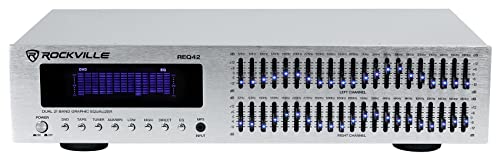
Best Rack-Style Choice – Rockville REQ42-S
Rockville REQ42-S 2 x 21 Band Home Theater Equalizer w/Audio Spectrum Analyzer
Check Price On AmazonFor podcasting setups that need extensive hands-on control, the Rockville REQ42-S is a rack-style option among audio equalizers for podcasting. Its dual 21-band layout provides detailed adjustment across two channels, while the spectrum display and VU meters make level and frequency monitoring more visible.
Best For: Podcasters who want a full-size, highly visual equalizer for a home studio or rack-mounted audio system.
Pros:
- Dual 21-band graphic equalization provides 42 total bands of control.
- Includes a multi-color spectrum display, dual VU meters, and individual LED indicators.
- Offers RCA stereo inputs, a front-panel 3.5mm input, and RCA recording outputs.
- Removable rack-mount brackets support installation flexibility.
Cons:
- Its 19-inch rack-style design is less convenient for compact or portable podcast setups.
- Connection options are centered on RCA rather than newer digital interfaces.
The REQ42-S is a strong fit when visual feedback and detailed channel-by-channel shaping matter more than portability. Its broad control layout may be more than a simple spoken-word setup needs, but it offers considerable adjustment potential for a dedicated studio system.
Best Clean-Signal Preamp – Nobsound EQ9
The Nobsound EQ9 is a compact preamp-style choice for audio equalizers for podcasting, particularly when clean signal handling is a priority. Its nine adjustable bands cover 20Hz to 16kHz, and the bypass, balance, and dual RCA input/output controls make it adaptable to an existing stereo chain.
Best For: Podcasters integrating a compact RCA equalizer into an amplifier, active-speaker, or computer-based stereo setup.
Pros:
- Nine bands provide control over bass, mids, and treble across 20Hz to 16kHz.
- Specified 111dB signal-to-noise ratio and 0.001% THD support a clean-signal design.
- Two RCA inputs and outputs allow multiple-source and amplifier connections.
- Bypass and balance controls make quick comparison and channel centering simple.
Cons:
- RCA-only connectivity may require adapters in microphone-focused or USB-based workflows.
- Its nine-band layout offers less detailed control than a 21-band equalizer.
The EQ9 emphasizes compact integration and low-noise specifications rather than extensive visual monitoring. It is a sensible choice for users who already work with RCA equipment and want straightforward tonal shaping with an easy bypass option.
Best Compact Bluetooth Option – Douk Audio EQ5 Tone
The Douk Audio EQ5 Tone is a compact, flexible pick among audio equalizers for podcasting when Bluetooth playback and quick tone adjustments are useful. Its five independently processed frequency bands, bypass control, balance adjustment, and dual VU meters provide a simple way to shape and monitor a connected stereo system.
Best For: Podcasters who want a small equalizer with Bluetooth 5.0, visible level meters, and basic frequency shaping.
Pros:
- Five bands target 75Hz, 400Hz, 800Hz, 4kHz, and 10kHz.
- Bluetooth 5.0 supports wireless audio streaming from compatible devices.
- Dual 45mm VU meters offer real-time visual signal monitoring.
- Compact all-metal construction includes aluminum knobs, gold-plated interfaces, and 5V DC power.
Cons:
- Five bands provide less precise shaping than the other listed models.
- The notes do not specify the included input/output connector layout.
- Its feature set is oriented toward stereo listening and may not replace a dedicated microphone interface.
The EQ5 Tone suits users who value portability, wireless playback, and visual feedback in a small enclosure. Its limited five-band design is easy to manage, though podcasters needing very fine corrective EQ may prefer a model with more bands.
How We Picked the Best Audio Equalizers for Podcasting
We focused on equipment that can shape vocal tone in practical recording, streaming, and monitoring setups. The selection includes dedicated graphic equalizers, audio interfaces, production consoles, and mixer-based solutions because podcast workflows vary widely.
Key considerations included input and output compatibility, channel count, frequency-band control, noise performance, ease of operation, monitoring options, and whether a unit fits a desktop or rack-based studio. We also considered features such as phantom power, Bluetooth, digital effects, spectrum displays, and balanced connections where relevant.
Quick Comparison
| Best For | Look For | Typical Choice |
|---|---|---|
| Solo podcasters | Simple controls and compact connections | Small desktop EQ or audio interface |
| Interview podcasts | Multiple inputs and independent monitoring | 2×2 interface or multi-channel mixer |
| Live streaming | Fast adjustments, routing, and effects | Digital production studio or mixer |
| Permanent studio racks | Balanced I/O and detailed band control | 15- or 21-band rack EQ |
| Hi-fi playback systems | RCA connectivity and tone shaping | Home-audio EQ preamp |
Key Buying Factors for Audio Equalizers for Podcasting
Frequency Control
A graphic equalizer with more bands offers finer adjustments, but more controls can slow down setup. For speech, useful shaping often involves reducing muddiness in the low-mid range and adding presence carefully rather than making large boosts across the spectrum.
Connections and Signal Path
Check whether your microphones, interface, mixer, and speakers use XLR, TRS, RCA, or 3.5mm connections. Balanced XLR or TRS connections are generally preferable for longer cable runs and electrically noisy environments. Also confirm that the EQ can be inserted into your actual recording chain; many home-audio models are designed around RCA line-level equipment rather than microphones.
Gain, Noise, and Headroom
An EQ should not introduce noticeable hiss, distortion, or clipping. Look for sensible input and output levels, adequate headroom, and transparent operation. Avoid excessive boosts, which can raise noise and overload the next device.
Workflow and Monitoring
For live shows, accessible controls, headphone monitoring, routing, and onboard processing may matter more than maximum band count. For editing recorded episodes, a simpler EQ can be enough because detailed corrections can be made in software.
Who Should Buy Which Audio Equalizers for Podcasting?
Choose a compact EQ if you want straightforward tone adjustments for a desktop or small streaming setup. Choose an audio interface if microphone preamps, computer recording, low-latency monitoring, and high-resolution conversion are priorities.
Choose a mixer or production studio for guest interviews, live podcasting, multiple microphones, Bluetooth playback, or built-in effects. Choose a rack-mount graphic EQ when you need precise, hands-on control in a fixed studio or PA-style signal chain.
Choose a home-audio EQ preamp only when your system is primarily RCA-based and you are comfortable working with line-level signals. Before buying, map every source, microphone, monitor, and cable in your setup so the equalizer improves the chain instead of creating a compatibility bottleneck.