Finding the best wireless in-ear monitor system for church can make worship services easier to mix, perform, and manage. The right setup gives musicians consistent monitoring without filling the stage with extra speaker volume.
These 10 systems range from compact stereo kits to multi-bodypack UHF systems designed for larger worship teams. Use the guide below to compare coverage, channel capacity, latency, frequency options, and practical church-stage features.
Best 10 Wireless in Ear Monitor System for Church Picks for 2026
Best Multi-Receiver Value

- Eight bodypack receivers for larger teams
- Two channels and 40 preset UHF frequencies
- 300-foot-plus range with dual-antenna reception
Best For: Church bands and ensembles needing multiple monitor packs
Best Easy Setup

- Four bodypacks and earphones included
- IR sync speeds up receiver setup
- 330-foot claimed open-space coverage
Best For: Four-person church bands and sound teams
Best Premium Stereo Choice

- Stereo or MixMode two-channel monitoring
- One-touch scan and transmitter sync
- SE215 sound-isolating earphones included
Best For: Single worship leaders or musicians needing a polished stereo setup
Best Expandable Church Setup

- Four bodypacks with earphones and cables
- 2x40 frequencies for flexible coordination
- Designed to support 6+ IEM systems
Best For: Growing churches planning multiple monitoring systems
Flexible UHF Coverage
SG-40NA Mono Wireless IEM System

- 85 selectable UHF frequencies and antenna diversity
- Three audio inputs, including XLR and 1/4-inch
- Up to 262 feet of stated coverage; expandable receivers
Best For: Church teams needing flexible mono monitoring and extended range
Compact Low-Latency Pick

- Under-4.5ms mono latency with 24-bit/48kHz audio
- One transmitter supports up to four receivers
- 6–8-hour battery rating and 100-foot open-area range
Best For: Portable worship rehearsals and small-stage monitoring
Multi-Performer Worship Setup
Phenyx Pro PTM-33-4B 4-Channel IEM

- Four UHF channels with four bodypack receivers
- Supports up to four standalone monitor mixes
- Includes earphones, rackmount kit, antennas, and batteries
Best For: Worship bands needing separate mono mixes for four performers
Best RF Flexibility
HHLPRO F10P Wireless IEM System
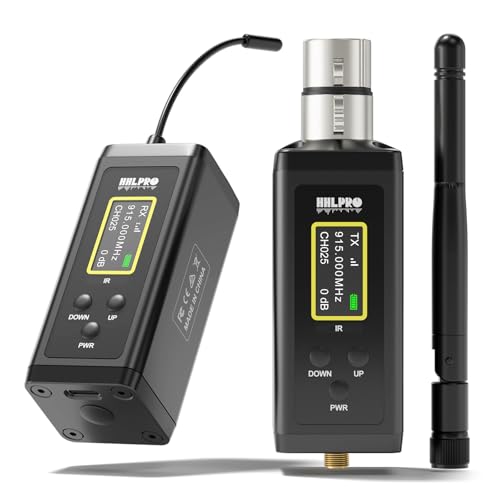
- 902–927MHz UHF with 50 channels
- Under-5ms latency and auto-scan setup
- 300-foot range; one TX and one RX included
Best For: Worship teams needing quick, flexible mono monitoring
Best Two-Pack Starter Kit

- Two bodypacks and earphones included
- Stereo monitoring with 100 preset frequencies
- 530–580MHz UHF; 80-meter stated range
Best For: Two-person worship, speech, and rehearsal setups
Best for Full Worship Teams

- Two-channel transmitter with eight bodypacks
- Under-5ms latency and 300-foot stated range
- Limiter, PLL technology, and flexible inputs
Best For: Large worship bands and church production teams
Best Multi-Receiver Value – 8-Pack Wireless IEM System
For churches needing several monitor feeds, this wireless in ear monitor system for church use includes eight bodypack receivers, two channels, and 40 preset frequencies. Its UHF design, dual antennas, limiter circuitry, and claimed range beyond 300 feet make it suited to larger stages and mobile performers.
Best For: Church bands, ensembles, and productions that need monitoring for up to eight users.
Pros:
- Includes eight bodypack receivers for shared stage monitoring.
- Two-channel operation with 40 preset frequencies supports flexible setup.
- Metal transmitter, dual-antenna reception, and built-in limiter circuitry.
- Front-panel 1/4-inch monitoring output and 300-foot-plus reception range.
Cons:
- Each receiver requires two AA batteries, which are not included.
- Provides mono monitoring rather than stereo.
- Not water resistant.
This is a practical choice when a church needs many receivers from one system and values coverage and straightforward frequency selection over stereo monitoring.
Best Easy Setup – 4-Pack Mono IEM System
This wireless in ear monitor system for church applications combines four bodypack receivers with IR syncing, 2×40 preset frequencies, and a claimed 330-foot open-space range. The mono design is focused on dependable stage monitoring, while receiver indicators help users track battery and RF status.
Best For: Church bands, MCs, and sound teams wanting a relatively simple four-person setup.
Pros:
- Includes four receivers, four earphones, antennas, and a power adapter.
- IR sync helps connect multiple receivers quickly.
- PLL UHF operation, limiter circuitry, and a 32MHz tuning band.
- Metal transmitter with lightweight ABS receivers and status indicators.
Cons:
- Mono monitoring may not suit users seeking stereo mixes.
- Range can be reduced by thick walls, glass, and metal obstructions.
- The supplied details do not specify receiver battery type or runtime.
With four included packs and convenient IR syncing, this system is a sensible middle-ground option for churches that want multi-user monitoring without a more complex deployment.
Best Premium Stereo Choice – Shure PSM300 P3TRA215CL
Shure PSM300 P3TRA215CL Pro Wireless in-Ear Personal Monitoring System with SE215-CL Earphones
Check Price On AmazonFor churches prioritizing established-brand hardware and a more refined listening experience, the Shure PSM300 is a wireless in ear monitor system for church stages with stereo or MixMode operation. One-touch frequency scan and sync simplify setup, while the included SE215 sound-isolating earphones help reduce ambient stage noise.
Best For: Worship leaders, musicians, and churches seeking stereo monitoring with sound-isolating earphones.
Pros:
- Supports stereo mode or MixMode for a personalized two-channel mix.
- One-touch frequency scan and sync simplify finding a usable channel.
- Includes SE215 sound-isolating earphones and a rack-mount kit.
- All-metal components and optional receiver recharge capability add practicality.
Cons:
- This package includes one personal receiver rather than multiple bodypacks.
- Its listed G20 version operates in the 488–512 MHz band, so frequency compatibility should be checked locally.
- It is not water resistant.
The PSM300 is the strongest fit for a single performer or worship leader who wants stereo flexibility, sound isolation, and a more complete professional package.
Best Expandable Church Setup – XTUGA RW2080 4-Pack IEM
The XTUGA RW2080 is a wireless in ear monitor system for church use that provides four bodypacks, dual-channel mono monitoring, and up to 300 feet of stated coverage. Its 2×40 adjustable frequencies, metal transmitter, rack-mount kit, and support for 6+ systems make it useful for growing church productions.
Best For: Churches building a multi-system monitoring setup for bands, singers, or stage teams.
Pros:
- Includes four receivers, four earphones, cables, and a power adapter.
- 2×40 adjustable frequencies support interference management and multi-set operation.
- UHF operation is designed for delay-free monitoring compared with 2.4GHz systems.
- Rack-mountable metal transmitter and lightweight ABS bodypacks suit installed or portable use.
Cons:
- Monitoring is mono rather than stereo.
- Specified operating range is 902–928MHz, so local frequency requirements should be confirmed.
- The stated one-year warranty is shorter than some competing options.
This system stands out for churches that may expand beyond one IEM rig, offering four initial packs and frequency capacity intended for multiple systems.
Flexible UHF Coverage – SG-40NA Mono Wireless IEM System
The SG-40NA is a practical wireless in ear monitor system for church teams that need dependable UHF transmission, flexible mixer connections, and room to expand. Its metal transmitter offers 85 selectable frequencies, antenna diversity, and up to 262 feet of stated coverage.
Best For: Worship teams, bands, and small-to-medium venues needing a single mono monitor feed with flexible inputs.
Pros:
- Antenna diversity helps reduce reception dead spots.
- UHF operation and 85 selectable frequencies support crowded RF environments.
- Three inputs, including XLR and 1/4-inch connections, simplify mixer integration.
- One transmitter can connect to multiple receivers, with adjustable power modes and LCD display.
Cons:
- The system is mono rather than stereo.
- The bodypack battery is rated for about six hours of average use.
- The included earphones are not water resistant.
Choose this model when range, UHF flexibility, and broad input compatibility matter more than a compact 2.4GHz design. It is especially useful for churches that may add receivers as the monitoring setup grows.
Compact Low-Latency Pick – LEKATO MS-02 Wireless IEM
The LEKATO MS-02 is a compact wireless in ear monitor system for church singers, rehearsals, and small-stage setups. Its 2.4GHz connection supports mono or stereo operation, under-4.5ms mono latency, and one transmitter paired with up to four receivers.
Best For: Small worship teams, singers, and rehearsal spaces that prioritize portability and quick setup.
Pros:
- Mono mode provides stated latency below 4.5ms.
- One transmitter can support up to four receivers.
- Offers mono/stereo switching, one-key mute, and LED status indicators.
- Compact clip-on units provide approximately 6–8 hours of operation and a 100-foot open-area range.
Cons:
- Earbuds are not included and must be purchased separately.
- The 2.4GHz system has a shorter stated range than the UHF alternatives here.
- It is less suited to long-distance or complex venue installations.
This is a convenient choice for portable worship rigs and practice rooms where simple pairing, low latency, and lightweight hardware are valuable. Budget separately for compatible earbuds when planning the system.
Multi-Performer Worship Setup – Phenyx Pro PTM-33-4B 4-Channel IEM
The Phenyx Pro PTM-33-4B is a four-channel wireless in ear monitor system for church worship teams that need separate monitoring for several performers. It includes four transmit channels, four bodypacks, individual left/right inputs and loop outputs, and UHF frequency selection for each channel.
Best For: Four-member worship bands, stage productions, and churches needing multiple dedicated mono monitor mixes.
Pros:
- Four bodypacks and four monitor channels support multiple performers at once.
- Each channel offers 25 UHF frequencies, with IR sync for quick receiver linking.
- Loop outputs enable flexible signal daisy chaining and up to four standalone mixes.
- Includes four earphones, rackmount hardware, antennas, and eight AA batteries.
Cons:
- Monitoring is mono only.
- The system requires four auxiliary mixer outputs for its integrated four-channel setup.
- Its stated 140–164-foot line-of-sight range can be reduced by walls, glass, or metal.
For a church with several singers or musicians, this package provides a more complete multi-user solution than a single-set system. Its rack-friendly design and separate mixes can help reduce stage volume while keeping the setup organized.
Best RF Flexibility – HHLPRO F10P Wireless IEM System
For churches seeking a wireless in ear monitor system for church use, the HHLPRO F10P emphasizes quick setup, low latency, and flexible channel selection. Its 902–927MHz UHF operation, auto-scan, and one-touch sync are practical for worship teams working in changing RF environments.
Best For: Small-to-medium worship teams, rehearsals, and musicians who need one transmitter with multiple compatible receivers.
Pros:
- Under-5ms latency helps drummers and other musicians stay in time.
- 50 channels, auto-scan, and one-touch frequency matching simplify setup.
- Advertised 300-foot range and 5–8-hour battery life support mobile performances.
- Metal construction, a hard case, and included XLR adapter improve portability.
Cons:
- This listing includes one transmitter and one receiver, so additional beltpack receivers are needed for a full worship team.
- The mono design may be less suitable for musicians who specifically want stereo monitoring.
- Battery life is listed as up to 8 hours, with the details also citing a 5-hour average.
The F10P is a sensible choice when setup speed and RF flexibility matter more than stereo operation. Confirm the number of receivers required before buying, especially for larger worship teams.
Best Two-Pack Starter Kit – D Debra PRO ST-102 Stereo IEM
The D Debra PRO ST-102 is a practical wireless in ear monitor system for church teams that want stereo monitoring and two bodypacks in one package. Its 530–580MHz UHF band, preset frequency options, and included headsets make it a straightforward starter setup for worship, speech, or rehearsal applications.
Best For: Two performers, worship leaders, or small church production teams needing stereo monitoring from a single transmitter.
Pros:
- Includes one transmitter and two bodypack receivers with earphones.
- Stereo monitoring provides audio separation for stage and studio use.
- Offers 100 switchable preset frequencies in the 530–580MHz band.
- The system can connect to an unlimited number of bodypack receivers, according to the listing.
Cons:
- The stated range is 80 meters, with up to 300 meters only in open environments.
- Product details contain mixed wireless specifications, listing UHF operation while also referencing infrared and Bluetooth.
- The included headset format may not suit musicians who prefer their own in-ear monitors.
The ST-102 stands out as a ready-to-use two-person stereo package. Churches should verify local frequency compatibility and confirm how expansion receivers work before building a larger system.
Best for Full Worship Teams – W IN-MIX EM200 8-Bodypack IEM
For larger churches, the W IN-MIX EM200 is a wireless in ear monitor system for church teams that need several performers connected at once. Its two-channel transmitter feeds up to eight included bodypacks, while PLL technology, 40 frequencies per channel, and a stated 300-foot range support larger stages and sanctuaries.
Best For: Full worship bands, theater productions, and church sound teams outfitting up to eight performers.
Pros:
- Includes a two-channel transmitter and eight bodypack receivers.
- Under-5ms latency and 50Hz–20kHz response support timing-sensitive performances.
- PLL technology, 40 preset frequencies per channel, and a stated 300-foot range help manage crowded stages.
- Built-in limiter, real-time status display, and 3.5mm/6.35mm plus USB inputs add useful system controls.
Cons:
- Bodypacks require two AA batteries each, which are user-supplied.
- The listing specifies no noise control, so isolation depends on the connected earphones.
- Eight bodypacks may be more equipment than a small worship team needs.
The EM200 is the strongest fit here for churches equipping an entire band from one kit. Its larger receiver count and dual-channel design can reduce the need for separate starter systems, but budget for AA batteries and suitable earphones.
How We Picked the Best Wireless in Ear Monitor System for Church
We focused on the factors that matter most in worship environments: dependable wireless transmission, usable range, bodypack capacity, mono or stereo operation, latency, frequency flexibility, and setup simplicity. We also considered whether a system can scale from a solo musician or small worship team to a larger band with multiple performers.
Because church stages vary considerably, no single system is ideal for every congregation. UHF systems may offer useful range and penetration, while 2.4GHz systems can be easier to deploy but may face more congestion in busy wireless environments. Product listings should be checked carefully for included earphones, bodypacks, frequency regulations, and transmitter outputs.
Quick Comparison
| Best For | What to Look For | Recommended System Type |
|---|---|---|
| Small worship teams | Simple setup and one or two receivers | Compact mono or stereo kit |
| Medium bands | Several bodypacks and stable range | Multi-pack UHF system |
| Larger churches | Independent mixes and more channels | Multi-channel rack or expandable system |
| Stereo monitoring | Left/right separation and compatible outputs | Stereo IEM system |
Key Buying Factors for a Wireless In-Ear Monitor System for Church
Channel Count and Bodypacks
Count the musicians who need wireless monitoring now, then allow room for growth. A system with multiple bodypacks can be more economical than adding separate transmitters later, but confirm whether all receivers share one mix or support independent channels.
Mono Versus Stereo
Mono is often sufficient for vocals, instruments, and spoken-word ministry, while stereo can provide a more spacious mix and improved separation. Stereo systems may require more compatible mixer outputs and careful routing.
Range, Frequency, and Interference
Check the stated operating range against the size of the sanctuary, stage, and rehearsal areas. UHF models can be attractive for longer coverage, but local frequency rules and nearby wireless microphones must be considered. Systems using 2.4GHz are convenient, though Wi-Fi and other devices can compete for spectrum.
Latency and Monitoring Quality
Low latency helps singers and musicians stay in time, especially when they rely heavily on vocals or click tracks. Also check whether the system offers adequate volume, clear signal transmission, adjustable levels, and a secure bodypack connection.
Installation and Reliability
Look for sturdy transmitters, clear controls, dependable antenna connections, rechargeable or easily replaceable batteries, and included accessories. For permanent church installations, rack compatibility and straightforward cable management can save considerable setup time.
Who Should Buy Which Wireless in Ear Monitor System for Church?
Small churches, solo worship leaders, and occasional performers should prioritize a compact system that is easy to configure and does not require complex channel coordination. Growing worship teams should consider multi-bodypack UHF systems with enough capacity for current musicians plus substitutes. Churches running larger bands or multiple services may benefit from systems with more channels, stronger frequency management, and stereo capability. If the stage is crowded with wireless microphones, instruments, and networking equipment, prioritize frequency coordination and test the system in the actual building before committing to a permanent setup.