The best graphic audio equalizers give you hands-on control over frequency balance, helping correct room issues, refine a listening system, or shape a live performance mix.
We compare 10 options ranging from compact car-audio units to rack-mount 15-, 20-, and 31-band models, focusing on control, connectivity, display features, noise performance, and setup flexibility.
Best 10 Graphic Audio Equalizers Picks for 2026
Professional Studio Control
31-Band Stereo Graphic Equalizer

- 31 bands per channel for detailed tonal adjustment
- Low-cut filter reduces unwanted low-frequency noise
- XLR and 1/4-inch connections for flexible integration
Best For: Studios, live sound, DJ systems, and audio installations
Trusted Rack-Mount Performance

- Dual 31-band constant-Q frequency control
- Selectable ±6 dB or ±12 dB boost/cut ranges
- TRS and XLR inputs and outputs
Best For: Rack-based live sound and studio systems
Connected Visual EQ
EQ8100 Spectrum Analyzer Equalizer
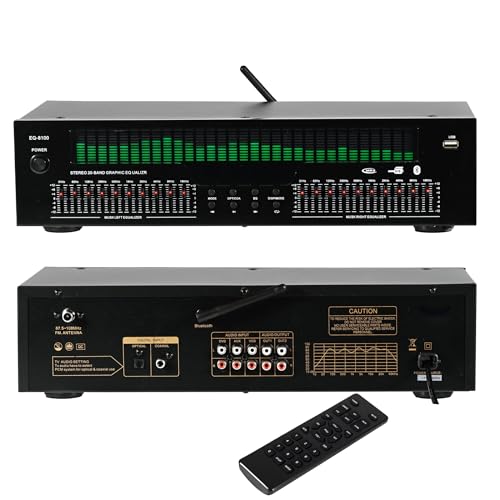
- 20-band EQ with 31-band spectrum display
- Bluetooth, USB, optical, coaxial, and RCA connectivity
- Presets and 1U rack-style construction
Best For: Home theaters, studios, DJs, and digital-source systems
Car Audio Signal Shaping
Stetsom EQX764 7-Band Equalizer

- Seven bands from 50 Hz to 16 kHz
- Four inputs and six outputs for multi-amp systems
- Dedicated subwoofer level and frequency controls
Best For: Multi-amplifier car audio installations
Feature-Rich Home Theater Pick
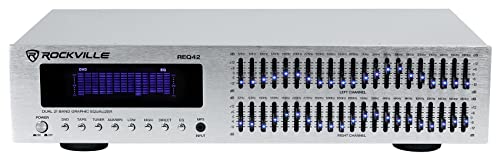
- Dual 21-band control
- Spectrum analyzer and dual VU meters
- RCA and front 3.5mm inputs
Best For: Home theater systems with multiple RCA sources
Professional Connectivity Pick

- 15 bands per channel with ±12dB adjustment
- XLR and 1/4-inch TRS connectivity
- Low-cut filter and adjustable bass output
Best For: Rack-based home, DJ, and live audio systems
Versatile Rack-Mount Pick

- 15-band stereo graphic control
- Spectrum analyzer and subwoofer adjustment
- XLR and 1/4-inch connections
Best For: Home audio and DJ systems needing flexible integration
Best Rack-Mount Value
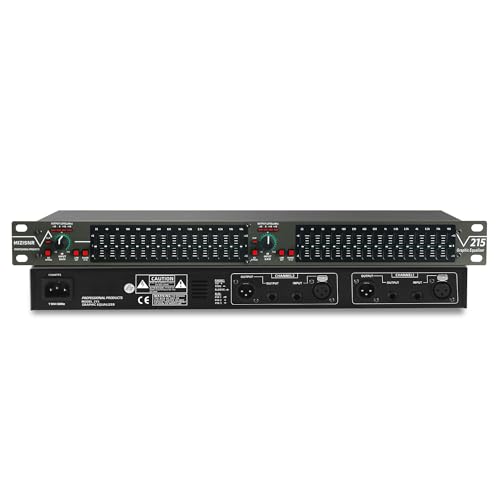
- Dual-channel 15-band control
- Low-cut filter and bypass switch
- XLR and 1/4-inch connections
Best For: Straightforward stereo EQ in rack-mounted systems
Best Feature-Packed Option

- 31-band control with LED spectrum display
- 10 presets plus EQ bypass
- Bluetooth 5.2 and USB playback
Best For: Detailed digital tuning and flexible source connectivity
Best Silver Finish

- Silver dual-channel rack-mount design
- 15 bands with ±12dB adjustment
- Low-cut filter and bypass control
Best For: Manual stereo EQ with a silver component finish
Professional Studio Control – 31-Band Stereo Graphic Equalizer
This professional dual-channel unit is a strong choice among graphic audio equalizers for live applications, audio installations, and studio work. Its 31 bands per channel, selectable adjustment range, low-cut filter, and balanced or unbalanced connections provide detailed control across a range of setups.
Best For: Audiophiles, live sound systems, studios, and professional DJ installations needing detailed stereo EQ control.
Pros:
- 31 bands per channel with adjustable ±12 dB range and selectable ±6 dB or ±12 dB gain/decay control.
- Low-cut switch helps attenuate wind noise, floor rumble, electrical hum, and other low-frequency noise.
- XLR balanced and 1/4-inch TRS unbalanced inputs and outputs support varied audio configurations.
- Bypass switch and four-segment LED ladders simplify testing and level monitoring.
Cons:
- Its rack-style size and 6.69-pound weight may be more than a compact home setup requires.
- The extensive 31-band control layout can take time to configure correctly.
Choose this model when precise two-channel shaping and practical signal monitoring matter more than a minimal control panel.
Trusted Rack-Mount Performance – dbx 231s 31-Band Equalizer
The dbx 231s is a straightforward professional option among graphic audio equalizers, pairing dual 31-band, 1/3-octave constant-Q control with familiar rack-system connections. Its front-panel bypass, selectable boost/cut ranges, and LED output monitoring suit users who want hands-on analog-style system tuning.
Best For: Live sound operators, studio users, and rack-based audio systems requiring dual-channel 31-band equalization.
Pros:
- Dual 31-band, 1/3-octave constant-Q frequency bands provide detailed stereo adjustment.
- Switchable ±6 dB or ±12 dB boost/cut ranges accommodate different tuning needs.
- Front-panel bypass and four-segment LED ladders make comparison and output monitoring convenient.
- TRS and XLR inputs and outputs support common professional audio connections.
Cons:
- It provides fewer connectivity and feature details than more digitally equipped equalizers.
- At 7.9 pounds, it is primarily suited to a permanent or rack-based installation.
This is a sensible pick for buyers who prioritize established dual-channel rack functionality and clear, manual frequency control.
Connected Visual EQ – EQ8100 Spectrum Analyzer Equalizer
The EQ8100 expands the usual graphic audio equalizers format with digital connectivity, Bluetooth 5.4, USB playback, optical and coaxial inputs, and a real-time spectrum display. Its 20-band EQ, 31-band analyzer, presets, and rack-friendly 1U design make it suitable for users who want both visual feedback and flexible source integration.
Best For: Home theaters, DJ booths, recording studios, stage systems, and mobile setups using digital and wireless sources.
Pros:
- Combines 20-band graphic EQ adjustment with a 31-band real-time spectrum analyzer.
- Supports Bluetooth, USB, optical, coaxial, and RCA connections for varied sources and systems.
- Auto-save presets and 12 customizable jump modes help users switch between EQ configurations.
- Ultra-thin 1U chassis, oversized display, and color-coded controls support rack and mobile use.
Cons:
- Its broad feature set may be more complex than needed for simple analog EQ tasks.
- The supplied dimensions and rack-oriented design may not suit every compact home installation.
Consider this model if spectrum visualization, multiple input formats, and preset-based operation are central to your audio workflow.
Car Audio Signal Shaping – Stetsom EQX764 7-Band Equalizer
The Stetsom EQX764 is a compact car-focused option among graphic audio equalizers, with seven frequency bands, four inputs, six outputs, and dedicated subwoofer controls. Its line-driver capability and separate front, rear, and sub outputs make it useful for building and fine-tuning multi-amplifier vehicle systems.
Best For: Car audio installations using multiple sources, amplifiers, front/rear speakers, and a dedicated subwoofer channel.
Pros:
- Seven adjustable bands cover 50 Hz through 16 kHz, with a 12 dB range for each band.
- Four inputs and six outputs support multiple sources and amplifiers.
- Dedicated subwoofer level and frequency controls simplify bass-system adjustment.
- Outputs can reach up to 10 VRMS and function as a line driver to supply more voltage to amplifiers.
Cons:
- Seven bands provide less detailed frequency control than 20- or 31-band units.
- Its feature set is tailored to car audio rather than general home or studio rack systems.
This lightweight model is a practical fit when the priority is flexible vehicle signal routing, dedicated sub control, and compact installation.
Feature-Rich Home Theater Pick – Rockville REQ42-S
Rockville REQ42-S 2 x 21 Band Home Theater Equalizer w/Audio Spectrum Analyzer
Check Price On AmazonThe Rockville REQ42-S is a practical choice among graphic audio equalizers for home theater users who want extensive tone control and a visual display. Its dual 21-band design, spectrum analyzer, RCA connectivity, and front-panel 3.5mm input suit a broad range of home audio sources.
Best For: Home theater systems needing detailed stereo adjustment, multiple RCA inputs, and visual level monitoring.
Pros:
- Provides 21 bands per channel for a total of 42 adjustable bands.
- Includes a multicolor LED spectrum display, dual VU meters, and individual LED indicators.
- Offers RCA inputs for DVD, tape, tuner, and auxiliary/MP3 sources, plus a front 3.5mm input.
- Includes removable rack-mount brackets for flexible installation.
Cons:
- Its RCA-focused connectivity may be less suitable for professional balanced-audio setups.
- The 19 x 12 x 6-inch dimensions may require more installation space than a compact unit.
Choose this model if you value maximum band control and an engaging visual front panel for a home entertainment setup. Its 20–20,000 Hz frequency response and 80dB signal-to-noise ratio support everyday stereo and theater applications.
Professional Connectivity Pick – EQX-215S 15-Band Equalizer
The EQX-215S is one of the more flexible graphic audio equalizers for rack-based home audio, DJ, and live setups. It combines 15-band-per-channel control with low-cut filtering, XLR and 1/4-inch TRS connections, and a dedicated adjustable bass output.
Best For: Users who need rack-mount installation, professional input/output options, and focused low-frequency control.
Pros:
- Offers 15-band precision adjustment on each channel with a ±12dB range.
- Includes a low-cut feature with adjustable cutoff frequency for reducing unwanted low-end noise.
- Provides XLR balanced and 1/4-inch TRS unbalanced connections.
- Features a dedicated bass output with adjustable frequency and a 1U rack-mount form factor.
Cons:
- It provides fewer bands per channel than 21-band-per-channel alternatives.
- Its professional connector layout may be more than casual home listeners need.
For buyers prioritizing installation flexibility and signal-routing options, this equalizer has a strong feature set. The bypass/normal EQ switch and included power, XLR, and 1/4-inch TRS cables also simplify setup.
Versatile Rack-Mount Pick – MUSYSIC MU-EQ15B
The MUSYSIC MU-EQ15B is a versatile option among graphic audio equalizers for home audio systems and professional sound setups. Its 15-band stereo layout, spectrum analyzer capability, dual line inputs and outputs, and balanced or unbalanced connections support detailed system tuning.
Best For: Home audio users, DJs, and installers seeking a compact rack-mount equalizer with flexible connectivity.
Pros:
- Uses 15-band graphic control for detailed bass-to-treble adjustment.
- Includes a spectrum analyzer for visual monitoring of the audio signal.
- Supports both 1/4-inch and balanced XLR connections for broader system compatibility.
- Provides adjustable subwoofer capability and input gain control.
Cons:
- The supplied notes do not specify the adjustment range for each band.
- Its 19 x 7 x 2-inch rack-mount format may not suit tabletop-only systems.
This model is a balanced choice when you want professional-style connections without a particularly deep chassis. Its low-noise circuitry, spectrum analyzer, and subwoofer adjustment make it suitable for users refining a home entertainment or DJ system.
Best Rack-Mount Value – 15-Band Stereo EQ
This 15-band stereo unit is a practical choice among graphic audio equalizers for listeners, DJs, and installers who want hands-on frequency control without a more complex digital interface. Its dual-channel layout, selectable adjustment range, low-cut filter, and standard 1U rack format suit home audio, live applications, and studio setups.
Best For: Buyers wanting straightforward, rack-mountable EQ control for stereo systems, live sound, or installations.
Pros:
- 15 adjustable bands per channel with up to ±12dB of control.
- Low-cut switch helps reduce wind noise, floor rumble, and electrical hum.
- XLR balanced and 1/4-inch TRS unbalanced inputs and outputs support varied setups.
- Bypass switch and 1U rack-mount design simplify testing and installation.
Cons:
- Offers fewer bands and built-in features than the 31-band digital model.
- Does not list Bluetooth or USB playback.
Choose this model if you prefer physical controls and essential noise-reduction tools over presets, spectrum lighting, and wireless connectivity. Its balanced connections and compact rack format make it a flexible foundation for conventional audio systems.
Best Feature-Packed Option – 31-Band Digital Equalizer
For shoppers comparing graphic audio equalizers with modern convenience features, this 31-band digital model adds real-time LED spectrum monitoring, presets, Bluetooth 5.2, and USB playback. It is designed for home theaters, KTV venues, studios, DJ equipment, and other systems where visual feedback and flexible source options are useful.
Best For: Users who want detailed digital adjustment, visual frequency monitoring, and Bluetooth or USB playback.
Pros:
- 31-band equalization provides detailed frequency control.
- Ten preset modes and EQ bypass support quicker adjustments and comparisons.
- LED spectrum indication displays frequency changes in real time.
- Includes Bluetooth 5.2, USB playback, varied audio connections, and an adjustable bass output.
Cons:
- Its greater feature set may be more than needed for a simple analog EQ setup.
- The supplied notes do not specify a product dimension or rack height beyond its rack-mount design.
This is the strongest match for buyers who value detailed control and on-device visual feedback. Presets and wireless or USB playback add convenience, while the XLR and 1/4-inch connections help it integrate with broader audio systems.
Best Silver Finish – 15-Band Stereo EQ
This silver-finish 15-band model delivers the same practical core approach as a conventional professional stereo EQ: dual-channel adjustment, low-frequency noise reduction, bypass testing, and rack-ready installation. It fits buyers seeking graphic audio equalizers for home audio, DJ systems, live applications, or studios with a lighter-colored component finish.
Best For: Buyers who want a silver 1U rack-mount stereo equalizer with physical 15-band controls.
Pros:
- Dual-channel 15-band design allows detailed stereo shaping.
- Adjustable gain and decay range extends from ±6dB to ±12dB.
- Low-cut switch targets wind noise, floor rumble, and electrical hum.
- Supports XLR balanced and 1/4-inch TRS unbalanced connections.
Cons:
- Provides fewer bands than the 31-band digital equalizer.
- Does not include the listed Bluetooth, USB, or preset features of the digital model.
Functionally, this is a straightforward alternative to the black 15-band version, with the same core controls in a silver finish. It makes sense when appearance matters alongside dependable manual EQ adjustment and standard rack integration.
How We Picked These Graphic Audio Equalizers
We selected models across the main use cases: home stereo, home theater, DJ and stage systems, and car audio. Our comparison emphasizes the number of bands, channel configuration, available inputs and outputs, rack-mount practicality, spectrum displays, noise-reduction features, and signal-driving capability. Because equalizer specifications can vary by version and seller, verify the current manual and listing before purchase.
Quick Comparison
- 31-band models: Best for detailed room correction, live sound, and precise frequency shaping.
- 15-band models: A practical middle ground for home audio and DJ systems.
- 20-band models with analyzers: Useful when visual feedback and modern connectivity matter.
- Car-audio equalizers: Look for RCA and high-level inputs, multiple outputs, and a suitable line-driver voltage.
- Dual-channel units: The right choice for conventional stereo systems and many rack-based installations.
Key Buying Factors for Graphic Audio Equalizers
Band Count and Control Range
More bands provide finer adjustment but can make setup slower. A 15-band unit is often sufficient for broad tonal changes, while a 31-band equalizer offers more precise control over room resonances and feedback-prone frequencies.
System Compatibility
Check whether the equalizer uses the connections your system requires. RCA inputs and outputs suit many home and car systems, while balanced connections are preferable for longer professional cable runs. Confirm that the unit is designed for line-level signals rather than speaker-level output unless it specifically includes high-level inputs.
Outputs, Subwoofer Support, and Signal Level
Multiple outputs can simplify routing to amplifiers, speakers, and subwoofers. Car installations may benefit from a higher-voltage line driver, but gain structure still matters: excessive output can create clipping or noise if the amplifier input is not matched correctly.
Displays and Noise Performance
A spectrum analyzer can make troubleshooting and adjustment easier, especially in a live or DJ setup, but it does not replace careful listening or measurement. Prioritize low noise, clean bypass operation, reliable controls, and adequate headroom over decorative display features.
Installation and Daily Use
For rack systems, confirm the unit’s width, height, depth, ventilation needs, and power requirements. Front-panel sliders are convenient for live adjustments; digital controls may offer presets or flexible settings but can be less immediate during a performance.
Who Should Buy Which Graphic Audio Equalizers?
Choose a 31-band stereo model if you need detailed control for a home listening room, venue, studio-style rack, or live sound system. Choose a 15-band equalizer for straightforward home audio or DJ tone shaping without excessive adjustment complexity.
Choose a model with a spectrum analyzer if visual monitoring is useful during setup or performance. Choose the car-focused Stetsom option when your installation needs high-level input support, several outputs, and a line-driver design. For buyers who want modern convenience, the Bluetooth-equipped EQ8100-style model may be more flexible, provided its connection options match the rest of the system.
Before ordering, map the signal path from source to amplifier, count the required channels and outputs, and decide whether you need analog immediacy, digital features, or both. The best Graphic Audio Equalizers are the ones that fit that signal path cleanly and provide the amount of control you will actually use.