The best synthesizers for live performances need to sound great while remaining quick to control under stage pressure. Key feel, patch access, connectivity, portability, and reliable hands-on controls can matter just as much as raw synthesis power.
This roundup covers a broad range of live-ready options, including polyphonic analog synths, hybrid instruments, FM models, grooveboxes, samplers, and performance-focused setups. Use the guide below to narrow the list by playing style, stage role, and workflow.
Best 10 Synthesizers for Live Performances Picks for 2026
Analog Powerhouse

- Four VCOs create thick analog tones
- Four-voice mono, unison, and poly modes
- Sequencer, arpeggiator, chorus, and distortion
Best For: Hands-on analog live performers
Portable Groove Station

- Battery-powered standalone sampler and sequencer
- 16 pads, microphone, speaker, and color display
- Onboard effects, sampling, and microSD storage
Best For: Mobile beatmakers and DAWless performers
Hybrid Sound Designer

- Wavetable and virtual analog synthesis
- Motional Pad for expressive movement
- Sequencer and extensive onboard effects
Best For: Live keyboardists shaping modern hybrid sounds
Live Rig Command Center

- 10-track SD recording plus stereo mix
- 32-bit float clip-free recording
- MIDI, USB, effects, and assignable sound pads
Best For: Mixing and recording compact live synth rigs
Analog Performance Choice

- Hands-on monophonic analog controls
- 32 full-size velocity and aftertouch keys
- Sequencer, arpeggiator, CV, MIDI, and USB-C
Best For: Expressive analog bass and lead performance
Sequencing Powerhouse

- 16-voice polyphony across 16 tracks
- 128-step sequencer with parameter locks
- Built-in effects, MIDI, USB Audio, and Overbridge
Best For: Pattern-driven electronic live sets
Portable Stage Workstation
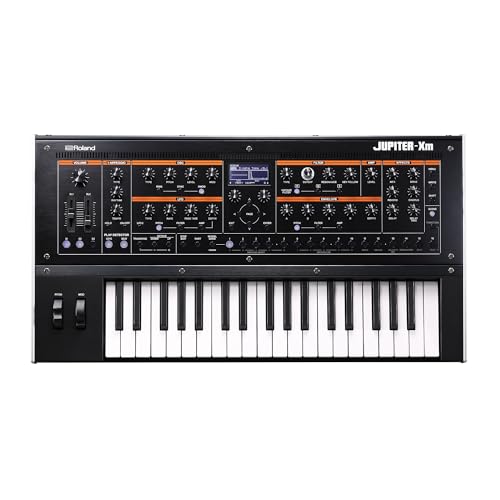
- 37-key design with multiple sound generators
- Balanced XLR and 1/4-inch outputs
- Large preset library and extensive effects
Best For: Versatile stage players needing broad connectivity
Acid Bass Performer

- Analog acid-style bass engine
- 128 patterns with Song Mode
- Haptic pads, sequencer, and effects
Best For: Live acid basslines and hands-on pattern performance
Pocket FM Companion
M-VAVE Wireless FM Synthesizer

- Battery-powered with built-in speaker
- Six-operator FM engine and 128 presets
- Wireless, USB, and 3.5mm MIDI
Best For: Portable FM performance and mobile music creation
Long-Life FM Workstation

- Six-operator FM with 12-voice polyphony
- Sequencer, arpeggiator, and six effects
- Up to 12 hours of battery-powered play
Best For: Portable live sets requiring a complete FM workstation
Analog Powerhouse – Behringer POLY D
The Behringer POLY D is a strong choice among synthesizers for live performances when you want hands-on analog control, substantial low end, and playable full-size keys. Its four-voice design, sequencer, arpeggiator, chorus, and distortion cover everything from bass lines to layered parts onstage.
Best For: Performers seeking warm analog tones, full-size keys, and flexible mono, unison, or polyphonic operation.
Pros:
- Four VCOs deliver thick, bass-forward analog sounds.
- Four-voice mono, unison, and polyphonic modes support varied live parts.
- Includes a 32-step sequencer, arpeggiator, stereo chorus, and distortion.
- 37 velocity-sensitive, semi-weighted full-size keys are suitable for expressive playing.
Cons:
- At 26.1 pounds, it is relatively heavy for transporting to gigs.
- Its analog-focused workflow may be less convenient for players wanting broad digital sound variety.
The POLY D is best suited to players who value immediate knob-based sound shaping and classic analog character over maximum portability. Its substantial build and performance features make it a compelling centerpiece for a hands-on live setup.
Portable Groove Station – Akai MPC Sample
The Akai MPC Sample brings sampling, sequencing, effects, and performance controls into a compact, battery-powered unit. For synthesizers for live performances setups that also rely on samples and beats, its built-in speaker, microphone, pads, storage, and standalone operation make it easy to create without a computer.
Best For: Beatmakers, DAWless performers, and mobile musicians who need portable sampling and sequencing.
Pros:
- Standalone battery-powered design includes a speaker, microphone, and rechargeable battery.
- Sixteen MPC pads and a color display support fast finger drumming and sample chopping.
- Built-in effects, real-time timestretching, repitching, and resampling expand live creativity.
- Offers line, headphone, MIDI, sync, USB-C, and microSD connectivity.
Cons:
- The MIDI connection requires a separately sold 1/8-inch-to-DIN adapter.
- Its pad-based workflow is aimed more at samples and beats than traditional keyboard synthesis.
The MPC Sample is a practical performance companion when portability and quick sample manipulation matter more than conventional synth-keyboard control. Its standalone operation can simplify compact live rigs and spontaneous production.
Hybrid Sound Designer – Roland GAIA 2
The Roland GAIA 2 is a versatile pick among synthesizers for live performances, combining wavetable and virtual analog synthesis in an approachable, performance-focused layout. Full-size keys, assignable modulation, a Motional Pad, sequencer, and extensive effects give players multiple ways to shape sounds in real time.
Best For: Keyboardists who want modern hybrid synthesis, hands-on controls, and expressive live modulation.
Pros:
- Hybrid wavetable and virtual analog engine covers a broad sound-design range.
- Full-size keys and a logically arranged panel support live playability.
- Motional Pad adds real-time movement and expression.
- Includes a sequencer, 53 MFX types, chorus, delay, and reverb options.
Cons:
- Its feature-rich synthesis and effects sections may require more preparation than a simpler performance synth.
- The supplied notes do not specify battery operation, so it is better suited to powered setups.
With its 10-pound aluminum-bodied design and broad synthesis engine, the GAIA 2 balances stage-friendly portability with deep control. It is particularly appealing to performers who want evolving textures and immediate modulation rather than a strictly vintage sound.
Live Rig Command Center – Zoom LiveTrak L6
The Zoom LiveTrak L6 is not a synthesizer, but it can be a valuable companion for synthesizers for live performances. This compact mixer/recorder handles multiple sources, adds channel effects and EQ, syncs external gear via MIDI or USB, and records clip-free tracks to an SD card or computer.
Best For: Solo performers and bands mixing synths, instruments, backing tracks, and live recordings in one compact setup.
Pros:
- Records 10 discrete tracks plus a stereo mix to SD cards up to 1TB.
- 32-bit float operation helps provide clip-free recording without traditional gain setting.
- Every channel includes EQ, pan, aux sends, and onboard delay, echo, or reverb.
- MIDI, USB, and four assignable sound pads support connected live rigs.
Cons:
- It is a mixer and recorder rather than a sound-generating synthesizer.
- The compact input configuration may require planning for larger or more complex ensembles.
The LiveTrak L6 makes the most sense as the control and recording hub around a live synth setup. Its lightweight, battery-powered design and simultaneous SD-card and computer recording are useful for performers who want reliable routing and documentation.
Analog Performance Choice – MOOG Messenger
For musicians seeking synthesizers for live performances, the MOOG Messenger combines hands-on knob-per-function control with a portable monophonic analog design. Its full-size keys, expressive controls, sequencer, arpeggiator, and broad connectivity make it practical for both stage work and sound design.
Best For: Performers who want classic MOOG bass and lead sounds with expressive keyboard control.
Pros:
- Two wavefolding VCOs, a sub-oscillator, and a versatile ladder filter deliver substantial analog sound.
- 32 semi-weighted full-size keys include velocity and aftertouch.
- Integrated 64-step sequencer, arpeggiator, 256 presets, and CV, MIDI, and USB-C connectivity support flexible setups.
Cons:
- Monophonic architecture limits simultaneous note playing.
- Its 27.6-inch width and 5.14 kg weight may be less convenient for highly mobile rigs.
The Messenger is a strong stage-focused option when expressive leads, basses, and immediate analog control matter more than polyphony. RES BASS compensation also helps retain a full low end across its filter settings.
Sequencing Powerhouse – Elektron Digitone II
The Elektron Digitone II is a compact choice among synthesizers for live performances when deep sequencing and layered digital textures are priorities. Its 16 tracks, 16-voice polyphony, parameter locks, performance-oriented trig controls, and built-in effects support complex live arrangements.
Best For: Electronic performers who build detailed patterns, evolving textures, and layered polyphonic parts.
Pros:
- Four synth machines provide wavetable-style, swarm, FM, and FM drum-focused sound options.
- The 128-step sequencer includes parameter locks, probability, micro-timing, Euclidean mode, and page loops.
- Built-in effects, full MIDI integration, USB Audio, and Overbridge support broaden live and studio use.
Cons:
- The extensive sequencing and modulation system may require a learning period.
- It does not provide a traditional piano-style keyboard for direct keyed performance.
Digitone II is especially compelling for performers who treat the sequencer as the center of the show. Chord mode, note editing, assignable modulation, and flexible filters make it capable of moving well beyond basic FM sounds.
Portable Stage Workstation – Roland JUPITER-XM
Roland JUPITER-XM Professional Iconic Portable Synthesizer with Legendary Sound and Design.
Check Price On AmazonThe Roland JUPITER-XM brings broad sound coverage and stage-ready connections to the synthesizers for live performances category. Its 37-key format, multiple sound generators, extensive preset library, balanced XLR outputs, microphone input, effects, and pedal connections make it suited to varied performance roles.
Best For: Players who need a versatile keyboard setup with strong connectivity and a large range of sounds.
Pros:
- 37 keys and multiple ZEN-Core and MODEL sound generators cover diverse performance parts.
- Balanced XLR and 1/4-inch main outputs, MIDI, USB audio/MIDI, and pedal inputs support stage integration.
- More than 4,000 preset tones, 256 user tones, and extensive multi-effects provide substantial variety.
Cons:
- At 6,000 g, it is less lightweight than some compact performance synthesizers.
- Its broad feature set may feel more involved than a simple hands-on monosynth.
JUPITER-XM is a practical choice for performers who need one instrument to cover many sonic duties. The balanced outputs, microphone input, pedal support, and large preset selection are particularly useful in a full live setup.
Acid Bass Performer – Donner Essential B1
For musicians looking at synthesizers for live performances, the Donner Essential B1 focuses on hands-on acid basslines, pattern-based playing, and straightforward control. Its analog signal path, haptic pads, sequencer, and built-in effects make it suited to live electronic sets where quick access matters.
Best For: Acid basslines, live pattern performance, and beginners who want an intuitive analog-style workflow.
Pros:
- Fully analog 1 VCO, 1 VCF, and 1 VCA signal path for warm, lower-focused bass sounds.
- 128 pattern memory, Song Mode, an intuitive step sequencer, and an 8-mode arpeggiator support live idea building.
- Haptic pads with color-changing backlights make bassline performance more immediate.
- Analog saturation and delay are built into the end of the signal path.
Cons:
- The focused single-oscillator architecture is less versatile than a broader polyphonic synthesizer.
- Its strongest sounds and workflow center on bass and acid-style performance.
- The compact dimensions listed may require careful placement in a crowded live rig.
The Essential B1 is a practical choice when live playability and classic acid character matter more than extensive synthesis complexity. USB-C, MIDI, and Sync connections also make it easier to integrate with a DAW or other hardware.
Pocket FM Companion – M-VAVE Wireless FM Synthesizer
The M-VAVE Wireless FM Synthesizer is a compact option for performers who want synthesizers for live performances without a large setup. Battery operation, a built-in speaker, 27 silicone keys, and wireless MIDI make it convenient for portable practice, improvisation, and small performance rigs.
Best For: Portable FM sound design, travel practice, and compact live or impromptu performance setups.
Pros:
- Battery-powered design with a built-in speaker supports playing away from a full studio setup.
- Six operators and 32 algorithms cover classic FM-style pianos, strings, brass, basses, and synth sounds.
- Includes 128 presets, six effects, a seven-mode arpeggiator, and a 16-step sequencer.
- USB MIDI, Bluetooth MIDI, and 3.5mm MIDI connectivity allow flexible integration.
Cons:
- The 27-key compact format offers less physical playing range than a full-size keyboard.
- Its plastic and silicone construction prioritizes portability over a larger stage-oriented chassis.
- The built-in speaker is convenient, but larger performance systems will still need external amplification.
This model stands out for mobility and immediate access to FM sounds. It is a sensible pick for performers who value a self-contained instrument with sequencing, effects, and several MIDI connection options.
Long-Life FM Workstation – M-VAVE FM-1 Orange
For performers comparing synthesizers for live performances, the M-VAVE FM-1 Orange combines a six-operator FM engine with sequencing, effects, multiple MIDI options, and a rechargeable battery. Its compact keyboard and built-in speaker make it especially useful when portability and self-contained operation are priorities.
Best For: Portable live sets, street or café performance, and players who need FM sounds with sequencing and effects in one unit.
Pros:
- Six operators, 32 algorithms, 128 presets, up to 12-voice polyphony, and DX7 SysEx patch import provide broad FM options.
- Seven-mode arpeggiator, 16-step sequencer, MIDI sync, and six effects support complete live parts.
- USB-C, Bluetooth BLE MIDI, and 3.5mm MIDI can work simultaneously with compatible devices.
- Built-in 2000mAh battery provides up to 12 hours of continuous wireless play, according to the supplied notes.
Cons:
- The 27-key silicone keyboard is compact and may feel limited for two-handed live playing.
- Its small form factor favors portability over the controls and connectivity space of a larger workstation.
- Advanced FM editing may require more time to learn than a simpler preset-focused instrument.
The FM-1 Orange is the most complete portable option in this group, bringing polyphonic FM synthesis, looping, effects, audio playback, and long battery life into one compact instrument. It is a strong fit for mobile performers who want more than a basic sound module.
How We Picked the Best Synthesizers for Live Performances
We evaluated these instruments and performance tools by considering the features that matter most on stage: sound flexibility, hands-on control, playability, patch or pattern access, portability, connectivity, and the ability to fit into a larger live rig. The selection includes traditional keyboards as well as compact instruments that can serve as sound modules, sequencers, samplers, or rhythm-and-bass stations.
Because live setups vary widely, we did not treat one synthesis type as universally best. Analog instruments can deliver immediate controls and strong character, while digital, hybrid, and FM designs often provide greater preset variety, sequencing, or sound-design range.
Quick Comparison
| Best For | Look For |
|---|---|
| Lead and bass players | Fast control access, strong filter response, and dependable mono performance |
| Chord and pad players | Polyphony, comfortable keys, layered sounds, and quick patch changes |
| Electronic live sets | Sequencing, pattern memory, effects, and multitrack control |
| Portable performers | Compact dimensions, battery operation, built-in speakers, or minimal cabling |
| Hybrid stage rigs | MIDI, audio connectivity, flexible routing, and compatibility with mixers or samplers |
Key Buying Factors for Synthesizers for Live Performances
Playability and Control Layout
Choose a keyboard size and action that suit your role. Full-size keys are useful for expressive chord work, while smaller keyboards can leave more room for controllers and other gear. Dedicated knobs, sliders, pads, and performance controls reduce menu diving during a set.
Polyphony, Presets, and Sound Changes
Polyphony determines how comfortably an instrument handles chords, sustained pads, and layered parts. For live work, also check how quickly you can save, organize, and recall sounds. Pattern memory and an onboard sequencer are especially valuable when one performer needs to cover several parts.
Connections and Reliability
Confirm the available audio outputs, MIDI connections, USB features, pedal inputs, and synchronization options before buying. A mixer or recorder may be useful for routing several instruments, but it does not replace a synthesizer’s sound engine. Consider power requirements and whether the controls are sturdy enough for frequent transport.
Who Should Buy Which Synthesizers for Live Performances?
Keyboard players seeking classic hands-on synthesis should prioritize an analog or hybrid model with accessible controls and enough polyphony for their repertoire. Producers performing electronic sets may prefer a digital synthesizer, groove-oriented instrument, or sampler with sequencing and pattern recall. Bass-focused performers should look for a dedicated mono or bass synth with a responsive filter and immediate modulation controls.
Traveling musicians and beginners may benefit from a compact FM instrument or battery-friendly model, particularly when space and setup time are limited. If your rig includes multiple sound sources, pair the chosen synth with a suitable mixer and verify that its outputs, MIDI timing, and monitoring setup match the rest of your equipment. The right choice is the instrument that lets you reach essential sounds quickly and perform confidently throughout an entire set.