The best digital synthesizers make it easier to explore sound design, build complete tracks, and perform without a complicated studio setup. This lineup spans compact grooveboxes, keyboard synths, MIDI controllers, and approachable instruments for beginners.
Whether you want deep FM programming, expressive hybrid synthesis, sample-based beats, or a portable instrument for quick ideas, these picks cover a wide range of workflows and budgets.
Best 10 Digital Synthesizers Picks for 2026
Experimental Hybrid Pick
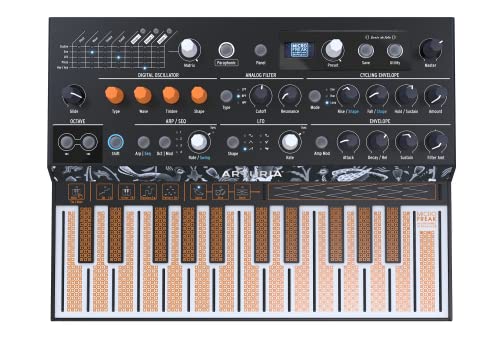
- Hybrid digital oscillator and analog-filter architecture
- 25-key keyboard with poly-aftertouch
- CV, USB, MIDI, and creative sequencing tools
Best For: Advanced players exploring experimental sound design
Portable Sample Sequencer
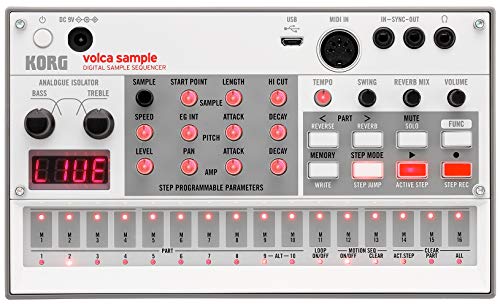
- Eight-voice sample-based polyphony
- 16-step sequencing with pattern chaining
- Battery-powered design with speaker and headphone output
Best For: Mobile beatmaking and sample-driven electronic production
Polyphonic Hybrid Keyboard

- Six-voice polyphony for chords and layered parts
- 37-key portable keyboard format
- Includes a matching VST software counterpart
Best For: Beginners and producers wanting hardware-software hybrid synthesis
Quirky Beginner Instrument

- Touch-sensitive stem for sliding between notes
- Wah and vibrato effects from physical gestures
- 3.5mm output with batteries and strap included
Best For: Beginners, gifts, and playful expressive performance
Best All-Around Creator Keyboard

- 61 touch-sensitive keys
- 1,000+ ZEN-Core sounds
- Built-in speakers and Bluetooth
Best For: All-around music creation and accompaniment
Best Portable FM Synthesizer

- Six-operator FM engine
- 128 presets and 16-step sequencer
- Rechargeable battery and speaker
Best For: Portable FM sound design and pattern creation
Best Mini Keyboard for Beat Makers

- 25 velocity-sensitive keys
- Built-in sounds and speaker
- Eight MPC pads and four knobs
Best For: Compact beat making and portable MIDI control
Best Pocket Pick

- Pocket-size, battery-powered design
- Three octaves with optional vibrato
- Built-in speaker and headphone socket
Best For: Beginners and portable retro-synth experimentation
Best DAW Controller

- 25 velocity-sensitive synth-action keys
- Pads, encoders, faders, and arpeggiator
- Includes software for Mac and Windows
Best For: Computer-based music production and software instruments
Best Portable FM Synth

- Six-operator FM engine with 32 algorithms
- Sequencer, arpeggiator, effects, and 12-voice polyphony
- USB-C, Bluetooth MIDI, and rechargeable battery
Best For: Portable FM sound design, guitar rigs, and mobile production
Experimental Hybrid Pick – Arturia MicroFreak
The Arturia MicroFreak is a strong choice for musicians seeking digital synthesizers with an experimental edge. Its hybrid architecture combines multiple digital oscillator modes with a resonant analog filter, while the touch-sensitive 25-key surface, modulation matrix, and sequencing tools encourage hands-on sound design.
Best For: Advanced players who want compact, expressive, experimental synthesis with CV, MIDI, and USB connectivity.
Pros:
- Offers a broad selection of digital oscillator modes, including wavetable, vocoder, noise, and physical-modeling options.
- 25-key touch-plate keyboard supports individual poly-aftertouch.
- Includes sequencing, automation, Spice and Dice randomization, and a 5×7 modulation matrix.
- Connects to modular gear through CV pitch, gate, and pressure outputs.
Cons:
- The 25-key touch-plate design may feel less familiar than a conventional keyboard.
- Its advanced features may be better suited to experienced synthesizer users.
MicroFreak stands out among digital synthesizers for its unusual playing surface and flexible hybrid sound engine. It is especially appealing if creative modulation and unconventional textures matter more than traditional keyboard feel.
Portable Sample Sequencer – Korg Volca Sample 2
Korg Volca Sample 2 Digital Sample Sequencer Drum Machine w/Pattern Chain Mode and 16-step Sequencer
Check Price On AmazonThe Korg Volca Sample 2 is a compact option for beatmakers who want sample-based digital synthesizers and sequencing in a highly portable format. Its 16-step sequencer, pattern chaining, expanded memory, and built-in speaker make it practical for sketching ideas without a full studio setup.
Best For: Portable beatmaking, sample-based production, and genres such as future bass, trap, and lo-fi hip-hop.
Pros:
- Provides eight-voice polyphony and a 16-step sequencer with pattern chain mode.
- Has double the memory of the previous model for additional samples and longer recordings.
- Includes digital reverb, a double filter, Librarian software, and micro USB connectivity.
- Built-in speaker, headphone output, battery operation, and a weight under one pound support mobile use.
Cons:
- Its 16-step sequencing format is more focused than a full workstation workflow.
- It is a sample sequencer and drum machine rather than a conventional keyboard synthesizer.
The Volca Sample 2 makes a practical companion for quick rhythmic ideas and portable production. Choose it when sample manipulation and pattern sequencing are more important than keys or broad synthesis engines.
Polyphonic Hybrid Keyboard – Arturia MiniFreak
Arturia MiniFreak 37 Key Polyphonic 6-Voice Hybrid Synthesizer Keyboard (Standard, 37 Key)
Check Price On AmazonThe Arturia MiniFreak is a versatile digital synthesizer for players who want a larger keyboard and polyphonic hybrid capabilities. Its 37-key design, six-voice polyphony, and included VST counterpart make it suitable for exploring layered sounds both with hardware and in a computer-based setup.
Best For: Beginners and developing players who want a portable 37-key hybrid synthesizer for studio or performance use.
Pros:
- Offers six-voice polyphony for playing chords and layered parts.
- Provides a 37-key format with a hybrid digital-and-analog sound profile.
- Includes a VST counterpart for integrating the instrument with software workflows.
- USB connectivity and a portable design support computer-based and mobile setups.
Cons:
- The supplied specifications list USB connectivity but do not detail additional audio or MIDI connections.
- Its 37-key layout is more portable than full-sized but still larger than compact mini-key instruments.
MiniFreak is a balanced pick among digital synthesizers for users who want expressive polyphony without moving to a full-sized keyboard. The included software counterpart also adds value for producers who work partly in a DAW.
Quirky Beginner Instrument – Otamatone Deluxe
The Otamatone Deluxe is a playful alternative to conventional digital synthesizers, using a touch-sensitive stem and expressive physical controls instead of standard keys. Its larger neck, three pitch ranges, and 3.5mm output make it approachable for beginners while still offering musicians a distinctive instrument for experimentation.
Best For: Beginners, gift buyers, and musicians seeking a fun portable instrument with unusual pitch and expression controls.
Pros:
- Touch-sensitive stem lets players slide between notes across roughly four octaves per pitch setting.
- Squeezing the face adds a wah effect, while shaking the stem produces vibrato.
- Connects to headphones, amplifiers, and speakers through a 3.5mm stereo jack.
- Includes an aux cable, three AA batteries, an English instruction manual, and a strap.
Cons:
- Its unconventional control method may not replace a traditional keyboard for precise chord playing.
- The whimsical design and sound are more specialized than those of studio-focused digital synthesizers.
The Otamatone Deluxe is best viewed as an expressive novelty instrument rather than a standard production synthesizer. It earns consideration for casual playing, gifts, and performers who want a memorable visual and sonic addition to their setup.
Best All-Around Creator Keyboard – Roland GO:KEYS 3
The Roland GO:KEYS 3 is a practical choice among digital synthesizers for beginners and experienced players who want a broad sound library, accompaniment tools, and straightforward music creation in one keyboard. Its 61 touch-sensitive keys and built-in speakers make it suitable for playing, practicing, and sketching ideas without a complicated setup.
Best For: All-around music creation, beginners, and players who want accompaniment styles and Roland sounds.
Pros:
- Over 1,000 sounds from Roland’s ZEN-Core sound engine.
- 61 touch-sensitive keys support expressive playing.
- More than 200 accompaniment styles and over 300 chord-sequencer presets.
- Built-in speakers plus Bluetooth audio/MIDI and USB audio/MIDI connectivity.
Cons:
- Its 15.5-pound weight is less travel-friendly than compact mini keyboards.
- The wide feature set may be more than casual players need.
The GO:KEYS 3 stands out as a flexible digital synthesizer and music-creation keyboard, especially if you value full-size playing space, onboard accompaniment, and easy connections to computers or mobile devices.
Best Portable FM Synthesizer – M-VAVE FM-1
The M-VAVE FM-1 is a compact digital synthesizer for musicians who want classic FM tones, hands-on controls, and portable operation. Its six-operator engine, onboard presets, sequencer, rechargeable battery, and built-in speaker create a self-contained setup for experimenting at home, in the studio, or while traveling.
Best For: Portable sound design, FM synthesis, pattern creation, and electronic musicians on the move.
Pros:
- Six-operator FM engine with 32 algorithms and 128 presets.
- Rechargeable battery and built-in speaker support cable-free playing.
- Includes 27 full-size silicone keys, effects, and a seven-mode arpeggiator.
- 16-step sequencer, TFT color display, and USB, Bluetooth, and 3.5mm MIDI.
Cons:
- The 27-key layout offers less playing range than a larger keyboard.
- FM synthesis may require more sound-design exploration than simpler preset-focused instruments.
With its portable design and dedicated FM architecture, the FM-1 is a compelling digital synthesizer for quick ideas, distinctive electric-piano and bell sounds, and compact sequencing sessions.
Best Mini Keyboard for Beat Makers – Akai MPK Mini Play MK3
The Akai MPK Mini Play MK3 is a compact option for shoppers comparing digital synthesizers and MIDI controllers for beat making. It combines 25 velocity-sensitive keys, MPC pads, knobs, an arpeggiator, built-in sounds, and a speaker, so you can create ideas independently or connect to a Mac or Windows computer over USB.
Best For: Beat makers, songwriters, and mobile producers who need a compact controller with built-in sounds.
Pros:
- Includes over 100 internal drum and instrument sounds.
- Eight velocity-sensitive MPC pads and four encoder knobs provide hands-on control.
- Built-in speaker, arpeggiator, OLED display, and battery operation support portable use.
- Includes MPC Beats, AIR instruments, Melodics lessons, and other software offers.
Cons:
- Its 25-key format is less suitable for extended two-handed keyboard parts.
- Batteries are not included.
- USB is the listed computer connectivity option, so it has fewer connection types than some standalone instruments.
The MPK Mini Play MK3 is a strong space-saving choice when pads and computer control matter as much as keys. Its internal sounds and speaker also let you sketch without relying entirely on external software.
Best Pocket Pick – Stylophone Original
The Original Stylophone is a compact, battery-powered choice for shoppers exploring digital synthesizers in a simple, playful format. Its touch-sensitive metal surface, stylus control, vintage analog sound, and built-in speaker make it easy to experiment with anywhere.
Best For: Beginners, portable music-making, retro-synth fans, and gifts for musicians.
Pros:
- Compact design measures less than 12 cm wide and weighs 8.8 ounces.
- Offers three octaves, optional vibrato, a built-in speaker, and a headphone socket.
- Can connect to a computer or other gear through a 3.5mm stereo cable.
Cons:
- Runs on three AA batteries rather than a rechargeable battery.
- Its stylus-and-touch-surface layout may be less familiar than a standard keyboard.
The Stylophone stands out for portability and personality rather than extensive sequencing or sound-design controls. Choose it when an approachable retro instrument matters more than a full production workstation.
Best DAW Controller – Arturia MiniLab 3
The Arturia MiniLab 3 is a hands-on MIDI controller for computer-based digital synthesizers and software instruments. Its 25 velocity-sensitive keys, pads, encoders, faders, arpeggiator, and included software suite provide practical control for composing and producing.
Best For: Home-studio producers, Ableton users, and musicians who want tactile software control.
Pros:
- Combines 25 slim synth-action keys with velocity sensitivity.
- Includes 16 RGB-backed pads, eight rotary encoders, four faders, and pitch/modulation touch controls.
- Features a built-in arpeggiator, display, clickable browsing knob, MIDI out, and bundled software.
Cons:
- It is a controller rather than a standalone synthesizer with its own sound engine.
- USB connectivity is central to its computer-based workflow.
The MiniLab 3 is a strong fit for producers who prefer controlling virtual instruments with dedicated hardware. It offers more expressive control than a mouse while remaining compact at 3.1 pounds.
Best Portable FM Synth – M-VAVE FM-1
The M-VAVE FM-1 is a self-contained option for digital synthesizers, built around a six-operator FM engine with 32 algorithms and 128 factory presets. Its rechargeable battery, color display, sequencing tools, effects, and broad MIDI connectivity make it suitable for portable production and performance.
Best For: Guitarists, producers, and performers who want portable FM synthesis with MIDI flexibility.
Pros:
- Provides six-operator FM synthesis, 32 algorithms, 128 presets, and FM SYSEX import.
- Includes a seven-mode arpeggiator, 16-step sequencer, 12-voice polyphony, and six effects.
- Supports USB-C, Bluetooth BLE MIDI, and 3.5mm MIDI IN, with up to 12 hours of battery life.
Cons:
- The 27-key silicone keyboard may feel different from a conventional keyboard.
- Its feature-rich FM architecture may require a learning period for beginners.
The FM-1 offers considerably deeper standalone synthesis and performance tools than a basic pocket instrument. Its lightweight 251-gram design and rechargeable battery are especially useful for guitar cases, backpacks, and mobile setups.
How We Picked the Best Digital Synthesizers
We compared these Digital Synthesizers by looking at their sound engines, available voices, sequencing and sampling features, keyboard or pad layouts, portability, connectivity, and ease of use. We also considered whether each instrument is best suited to sound design, beat-making, live performance, learning, or controlling software instruments.
Because “synthesizer” can describe several types of hardware, this roundup includes standalone instruments alongside MIDI controllers with built-in sounds and compact electronic instruments. The right choice depends on whether you need an all-in-one device or a controller for a computer, tablet, or larger setup.
Quick Comparison
| Best For | Look For | Recommended Type |
|---|---|---|
| Deep sound design | Flexible oscillators, modulation, and effects | MicroFreak, MiniFreak |
| Sample-based beat-making | Sample memory, sequencing, and pattern chaining | Korg Volca Sample 2 |
| Portable FM synthesis | Multiple operators, presets, and battery power | M-VAVE FM-1 |
| Beginner-friendly music creation | Built-in sounds, guidance, and simple controls | Roland GO:KEYS 3 |
| Software production | MIDI controls, pads, and USB connectivity | Akai MPK Mini Play MK3, Arturia MiniLab 3 |
Key Buying Factors for Digital Synthesizers
Sound Engine and Voice Count
Choose the synthesis style that matches your goals. Analog-modeled and hybrid instruments are useful for evolving leads and pads, while FM synthesis excels at metallic tones, digital keys, bells, and precise basses. Polyphony determines how many notes can play together, so higher voice counts matter for chords and layered parts.
Controls and Playability
A full keyboard is helpful for learning and traditional performance, while mini keys, touch strips, pads, and compact layouts save space. Consider whether you prefer hands-on knobs for shaping sounds or a controller designed to operate music software.
Sequencing, Sampling, and Connectivity
A built-in sequencer can turn a small instrument into a complete sketchpad. If you make beats, check for sample sequencing, pattern chaining, tempo controls, and onboard effects. USB MIDI is important for computer-based production; traditional MIDI, audio output, and headphone connections are valuable for hardware setups and live use.
Portability and Power
Battery-powered models are ideal for travel, practice, and spontaneous ideas. Larger keyboards offer more comfortable playing but take up more room. Also check whether the instrument has a built-in speaker or requires headphones, an amplifier, or an audio interface.
Who Should Buy Which Digital Synthesizers?
Choose the Arturia MiniFreak if you want a capable hybrid keyboard for serious sound design and polyphonic playing. The MicroFreak is a strong fit for experimental musicians who value unusual textures and a compact footprint. For sample-driven rhythms, the Korg Volca Sample 2 is the most focused option.
Beginners and casual players should consider the Roland GO:KEYS 3 for an accessible music-creation workflow. Producers who mainly work in a DAW may prefer the Akai MPK Mini Play MK3 or Arturia MiniLab 3, depending on whether built-in sounds or software control matters more.
For inexpensive portable experimentation, the M-VAVE FM-1, Stylophone, and Otamatone Deluxe offer distinctive entry points. Choose the second M-VAVE model if its built-in keyboard and independent voice features suit your playing style, but verify the exact controls and output requirements before buying.