Hybrid synthesizers combine the character of analog circuitry with the flexibility of digital oscillators, wavetable engines, FM, sampling, or advanced effects. That makes them a versatile choice for musicians who want more tonal range than a traditional analog synth without giving up hands-on control.
We selected 10 hybrid synthesizers for different workflows, from compact portable instruments and bass-focused sequencers to expressive performance keyboards and semi-modular sound-design tools. The right option depends on how you create, perform, and connect your gear.
Best 10 Hybrid Synthesizers Picks for 2026
Balanced Hybrid Creativity

- 37-key hybrid keyboard with digital and analog sound
- Portable design with USB connectivity
- Includes MiniFreak VST counterpart
Best For: Beginners wanting a compact, computer-friendly hybrid synthesizer
Vocal Performance Specialist

- Analog modeling with up to 18-voice polyphony
- Built-in vocoder and included gooseneck microphone
- 256 presets, Animate buttons, and arpeggiator
Best For: Performers exploring presets, vocal effects, and expressive live controls
Experimental Sound Lab
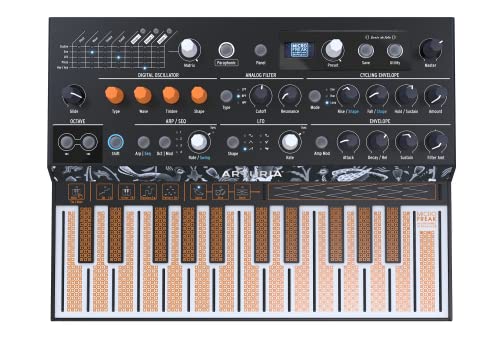
- Digital oscillator modes paired with an analog filter
- 25-key touch keyboard with poly-aftertouch
- Sequencer, modulation matrix, CV, USB, and MIDI
Best For: Advanced users creating unconventional sounds and evolving sequences
Full-Size Hybrid Control

- Wavetable and virtual analog hybrid engine
- Full-size keys with knobs, sliders, and Motional Pad
- Sequencer and 53 onboard MFX types
Best For: Performers wanting full-size playability and hands-on sound shaping
Atmospheric Explorer
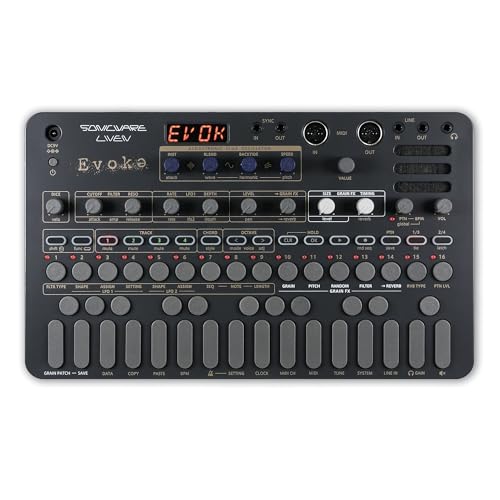
- Acoustic tones, wavetables, and granular synthesis
- Four-track sequencer with probability playback
- Battery-powered with built-in speaker
Best For: Cinematic ambient and portable sound design
Patchable Powerhouse

- 24 digital oscillators and 10 percussion/noise engines
- 14 synth engines with analog ladder filter
- 32-step sequencer and semi-modular design
Best For: Experimental patching and rhythmic sound design
Acid Bass Specialist

- Fully analog one-VCO bass synthesis path
- 128 patterns with Song Mode and arpeggiator
- USB-C, MIDI, and Sync connectivity
Best For: Classic acid basslines and live pattern performance
Exploration Engine

- Dual oscillators with FM and wavefolding textures
- Generative sequencers and 32-jack patch bay
- Morphing resonant filter for flexible tone shaping
Best For: Exploratory sound design and generative electronic music
Portable FM Workstation

- Six-operator FM engine with 32 algorithms
- Rechargeable battery, speaker, and 27 full-size keys
- 16-step sequencer plus USB, Bluetooth, and 3.5mm MIDI
Best For: Portable FM performance, songwriting, and sound sketching
Vector Pocket Synth

- Four vector-morphing oscillators per voice
- Wavetable synthesis with analog low-pass filter
- Portable battery/USB design with sequencer and arpeggiator
Best For: Compact vector textures, sequencing, and portable production
Balanced Hybrid Creativity – Arturia MiniFreak
Arturia MiniFreak 37 Key Polyphonic 6-Voice Hybrid Synthesizer Keyboard (Standard, 37 Key)
Check Price On AmazonThe Arturia MiniFreak is a portable choice for musicians who want an approachable entry into hybrid synthesizers. Its 37-key format, USB connectivity, and included MiniFreak VST counterpart make it practical for both hands-on playing and computer-based production.
Best For: Beginners seeking a compact hybrid synthesizer with a playable keybed and software integration.
Pros:
- Hybrid sound profile combines digital and analog character.
- 37 keys offer more playing room than many compact models.
- Includes the MiniFreak VST counterpart and a two-year manufacturer warranty.
Cons:
- USB is the listed connectivity option, so broader hardware connections may require additional equipment.
- Its compact key count may not suit players who prefer a full-size keyboard.
With beginner-friendly positioning, portable dimensions, and a corded-electric power source, the MiniFreak is a sensible all-around option for exploring hybrid synthesis without committing to a larger instrument.
Vocal Performance Specialist – Novation MiniNova
The Novation MiniNova is a versatile option for shoppers comparing hybrid synthesizers with strong performance features. Its analog-modeling engine offers up to 18-voice polyphony, 256 presets, Animate buttons, an arpeggiator, and a built-in vocoder with an included gooseneck microphone.
Best For: Performers and producers who want broad preset coverage, vocal processing, and hands-on sound manipulation.
Pros:
- Up to 18 voices support substantial polyphonic playing.
- Built-in vocoder and included microphone enable vocal effects and VocalTune.
- Offers 256 presets, five effects per voice, Animate buttons, and arpeggiator functions.
Cons:
- Its 37 mini-key layout may feel less substantial than full-size keys.
- The plastic body keeps it light but may feel less premium than metal-bodied alternatives.
The MiniNova stands out when immediate access to sounds and vocal experimentation matter more than an expansive physical control surface. MIDI and USB connections also support integration with a broader setup.
Experimental Sound Lab – Arturia MicroFreak
The Arturia MicroFreak is aimed at adventurous users who want hybrid synthesizers to deliver unusual textures in a very compact format. Its digital oscillator modes pair with a resonant analog filter, while the 25-key touch-plate keyboard adds individual pressure and aftertouch control.
Best For: Advanced sound designers and electronic musicians interested in experimental synthesis, sequencing, and modular connectivity.
Pros:
- Offers numerous oscillator modes spanning physical modeling, wavetable, vocoder, noise, and more.
- 25-key keyboard provides poly-aftertouch and pressure sensitivity.
- Includes a modulation matrix, step sequencer, arpeggiator, and CV, USB, and MIDI connectivity.
Cons:
- The touch-plate keyboard may require adjustment for players accustomed to conventional keys.
- Its advanced feature set is positioned for advanced users rather than beginners.
- The compact 25-key format limits traditional keyboard range.
MicroFreak is a strong choice when experimentation takes priority over conventional playability. Its sequencer tools, extensive digital engine, analog filter, and CV outputs give it unusual flexibility for both standalone and modular-oriented setups.
Full-Size Hybrid Control – Roland GAIA 2
The Roland GAIA 2 is a performance-oriented option for musicians who want hybrid synthesizers with a familiar control layout. Its engine combines wavetable and virtual analog synthesis, while full-size keys, assignable modulation routings, a Motional Pad, and an onboard sequencer support hands-on sound creation.
Best For: Players seeking a full-size hybrid synthesizer for sound design, performance, and real-time modulation.
Pros:
- Combines wavetable and virtual analog synthesis in one engine.
- Full-size keys and a panel of knobs and sliders support hands-on playing.
- Includes a Motional Pad, sequencer, 53 MFX types, chorus, and delay/reverb sections.
Cons:
- At 10 pounds, it is less portable than the smaller keyboards in this roundup.
- The supplied notes list USB Type-C and USB Type-A connectivity but do not specify MIDI or CV connections.
GAIA 2 is the most performance-focused choice here, pairing a logical synthesis workflow with substantial onboard effects and expressive control. It makes sense for players who value full-size keys and immediate access to modulation and effects.
Atmospheric Explorer – Liven Evoke
For producers seeking hybrid synthesizers with an organic, evolving character, the Sonicware Liven Evoke combines acoustic instrument tones, wavetables, granular processing, and deep reverb in a portable format. Its battery power, built-in speaker, chord mode, and four-track sequencer make it practical for sketching cinematic and ambient ideas away from the studio.
Best For: Cinematic ambient, post-classical textures, portable sound design, and immersive live sketching.
Pros:
- Acoustronic Flux engine blends 34 acoustic tones with 20 wavetables and two noise types.
- Granular effect supports up to 12 grains, tempo-synced harmonization, and external input processing.
- Four-track sequencer includes parameter locking and random/probability playback.
- Battery power, built-in speaker, MIDI, and SYNC support flexible use.
Cons:
- Its plastic body may feel less substantial than metal-bodied instruments.
- The sound engine and effects are especially focused on atmospheric textures rather than straightforward classic-synth duties.
The Liven Evoke is a distinctive choice among hybrid synthesizers when evolving, dreamlike soundscapes matter more than conventional subtractive versatility. Its compact sequencing and performance features add value for mobile composition.
Patchable Powerhouse – Behringer Grind
The Behringer Grind is a strong fit for players comparing hybrid synthesizers that combine digital sound sources with analog signal-shaping tools. Its 14 synth engines, percussion and noise options, analog ladder filter, semi-modular design, and 32-step sequencer offer a broad platform for experimental patches and rhythmic programming.
Best For: Experimental synthesis, percussion-heavy sequences, semi-modular patching, and hands-on sound exploration.
Pros:
- Offers 24 digital oscillators and 10 percussion/noise engines.
- Includes 14 synth engines for varied sound creation.
- Analog ladder filter and LFO add familiar hands-on shaping tools.
- Built-in 32-step sequencer supports pattern-based performance.
Cons:
- The semi-modular design may be more involved for beginners seeking immediate presets.
- At about 1,502 g and over 16 inches wide, it is less travel-friendly than smaller portable units.
Grind stands out for users who want hybrid synthesizers with both digital engine variety and analog filtering. It is best approached as an exploratory performance instrument rather than a minimal bass-only module.
Acid Bass Specialist – Donner Essential B1
The Donner Essential B1 is a focused option for shoppers considering hybrid synthesizers alongside dedicated analog bass instruments. Its fully analog one-VCO, one-VCF, and one-VCA signal path targets classic acid tones, while the intuitive step sequencer, 128-pattern memory, haptic pads, saturation, delay, and MIDI connectivity support live performance and production.
Best For: Acid basslines, beginner-friendly sequencing, pattern performance, and hardware-based electronic production.
Pros:
- Fully analog signal path is designed for warm, organic bass textures.
- 128 pattern slots and Song Mode support longer musical arrangements.
- Haptic pads, eight-mode arpeggiator, and live pattern controls encourage performance.
- USB-C, full-size MIDI I/O, and Sync I/O simplify hardware and DAW integration.
Cons:
- The single-oscillator architecture is less flexible for complex layered synthesis.
- Its feature set is specialized toward bass and acid-style patterns.
The Essential B1 is a practical, approachable choice for acid-focused producers who prioritize an analog signal path and straightforward sequencing. It offers more performance and connectivity features than its compact synthesis architecture suggests.
Exploration Engine – Moog Labyrinth
The Moog Labyrinth is a strong choice for hybrid synthesizers shoppers who want an adventurous semi-modular instrument with hands-on patching and generative sequencing. Its dual oscillators, wavefolder, resonant filter, and extensive patch bay encourage evolving textures rather than straightforward preset playback.
Best For: Sound designers and electronic musicians who enjoy exploratory patching, metallic tones, and generative patterns.
Pros:
- Dual low-harmonic oscillators support FM and wavefolding textures.
- Includes a voltage-controlled wavefolder and morphing lowpass/bandpass filter.
- Dual eight-step sequencers and a 32-jack patch bay offer substantial routing flexibility.
Cons:
- Its semi-modular, exploratory design may be less immediate for preset-focused users.
- It does not include a built-in keyboard.
Labyrinth is best viewed as a compact sound-design workstation for creating motion and variation. Choose it when patch exploration and generative behavior matter more than portability or conventional keyboard performance.
Portable FM Workstation – M-VAVE FM-1 FM Synthesizer
The M-VAVE FM-1 suits hybrid synthesizers buyers who want a portable digital instrument with classic six-operator FM sounds, onboard sequencing, and multiple ways to connect. Its rechargeable battery, speaker, full-size silicone keys, and preset library make it practical for sketching away from a studio.
Best For: Mobile producers and beginners seeking portable electric piano, bell, bass, and other FM sounds.
Pros:
- Six operators, 32 algorithms, and 128 presets provide a broad FM starting point.
- Built-in battery and speaker support cable-free playing.
- Includes a 16-step sequencer, arpeggiator, effects, TFT display, and real-time controls.
- USB, Bluetooth, and 3.5mm MIDI support controller and sound-module use.
Cons:
- The FM architecture may require more programming familiarity for deep sound design.
- It is a digital instrument rather than an analog or semi-modular synth.
The FM-1 is a practical, self-contained option for portable composition and classic digital timbres. Its connectivity and battery power broaden its usefulness, while the sequencer and presets keep the workflow approachable.
Vector Pocket Synth – Behringer Pro VS Mini
The Behringer Pro VS Mini is a compact pick for hybrid synthesizers shoppers who want wavetable and vector-style synthesis paired with an analog low-pass filter. Battery or USB power, a sequencer, and an arpeggiator make this small module suitable for portable programming and pattern-based performance.
Best For: Producers who want compact vector morphing, wavetable sounds, and analog-filtered sequences.
Pros:
- Four vector-morphing oscillators per voice support layered digital movement.
- Combines wavetable synthesis with an analog low-pass filter.
- Includes a 16-step sequencer, arpeggiator, envelopes, and sync input.
- Small battery- or USB-powered format includes headphone output.
Cons:
- The listed four-voice design offers less polyphony than larger synthesizers.
- Its compact module format may be less suitable for players seeking a conventional keyboard.
The Pro VS Mini emphasizes dense vector textures and compact sequencing rather than a full keyboard experience. It is a sensible choice when portability, hybrid synthesis, and an analog filter are higher priorities than extensive hands-on controls.
How We Picked These Hybrid Synthesizers
We focused on instruments that combine at least two synthesis approaches or pair digital sound generation with analog signal processing. Selection also considered playability, sequencing, portability, sound-design depth, onboard effects, connectivity, and overall usefulness for the price. The list includes keyboards, desktop-style instruments, semi-modular systems, and compact groovebox-friendly options so different types of musicians can find a practical fit.
Because features vary widely, compare each model’s key count, voice architecture, editing controls, preset storage, and included accessories before buying. A compact synth may offer fewer keys but greater portability, while a larger keyboard can be better for performance and melodic work.
Quick Comparison
| Best For | What to Look For |
|---|---|
| Live performance | Playable keys, expressive controls, reliable presets, and immediate access to effects |
| Sound design | Multiple oscillator engines, modulation, morphing, granular processing, or patchability |
| Bass and sequencing | Dedicated sequencer, pattern memory, solid low-end architecture, and hands-on parameter controls |
| Portable production | Compact size, battery operation, built-in sequencing, and straightforward preset management |
| Modular setups | Patch points, semi-modular routing, MIDI, and synchronization options |
Key Buying Factors for Hybrid Synthesizers
Synthesis Engine
Check whether the instrument uses wavetable, virtual analog, FM, granular, vector, sampling, or a combination of these methods. More engines can increase versatility, but they may also require a deeper menu system or more time to learn.
Voices and Keyboard Format
Polyphony matters for chords, pads, and layered parts, while monophonic or paraphonic designs can be excellent for bass and leads. Consider whether you need full-size keys, a compact keyboard, touch plates, or no keyboard at all.
Sequencing and Effects
A built-in sequencer can turn a small synth into a complete sketching tool. Look for pattern storage, motion sequencing, arpeggiation, automation, and synchronization. Delay, reverb, saturation, and granular effects can also reduce the need for external processors.
Workflow and Connectivity
Hands-on knobs and buttons are valuable for live use, while deep modulation and patch memory benefit studio sound design. Confirm the available MIDI, USB, audio, sync, CV, and gate connections match your existing setup.
Who Should Buy Which Hybrid Synthesizers?
Choose a compact keyboard synth if you want immediate playability for live sets or songwriting. A portable battery-powered model suits travel, quick sketches, and minimal setups. Bass-focused instruments are a strong choice for electronic producers who prioritize patterns and low-end sequencing, while semi-modular models are better for experimentation and external control.
For evolving pads, unusual textures, and cinematic work, prioritize granular, wavetable, vector, or multi-engine synthesis. If you are new to hybrid instruments, choose a model with accessible controls and preset storage before moving to a more complex semi-modular design. Experienced sound designers should prioritize modulation depth, patching options, oscillator variety, and integration with the rest of the studio.