The right audio mixer can make a podcast studio easier to control, improve recording flexibility, and help you produce cleaner, more consistent conversations.
We compared 10 options ranging from beginner-friendly bundles to advanced production studios, focusing on inputs, monitoring, effects, connectivity, and everyday usability.
Best 10 Audio Mixer for Podcast Studio Picks for 2026
Best Flexible Starter
MAONO AME2 Audio Interface Mixer

- XLR preamps with phantom power and up to 60dB gain
- 11 customizable sound pads with looping
- Supports instruments, streaming, and multiple devices
Best For: Creative home podcast and streaming setups
Best Compact Production Hub
RØDECaster Duo Compact Audio Production Studio
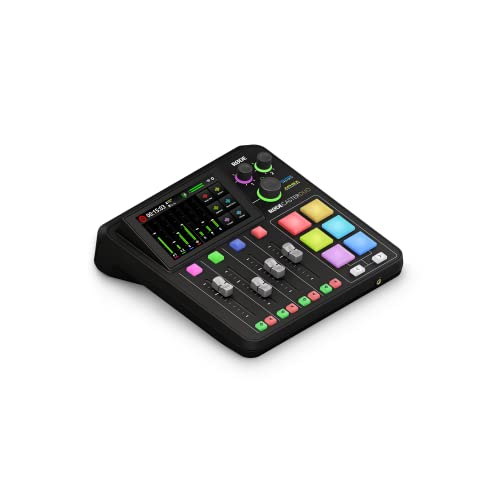
- Two combo inputs with high-gain Revolution Preamps
- Four faders and six SMART pads
- APHEX effects with touchscreen control
Best For: Compact podcast and content-production studios
Best Traditional Mixer
Yamaha MG10XU 10-Input Stereo Mixer

- 10 inputs with USB and SPX digital effects
- D-PRE preamps, EQ, filters, and compressors
- Rugged metal chassis for studio use
Best For: Expandable analog-style podcast and music setups
Best All-in-One Studio
RØDECaster Pro II Audio Production Studio

- Four XLR inputs with studio preamps
- Standalone and multitrack recording options
- Eight SMART pads with APHEX voice processing
Best For: Multi-person podcasts and advanced live productions
Best Portable Podcast Mixer

- Two XLR inputs with up to 60dB gain
- Eight customizable sound-effect pads
- USB-C, Bluetooth, loopback, and battery power
Best For: Portable two-person podcasting and streaming
Best Traditional Mixer Value
6-Channel Bluetooth Audio Mixer

- Six inputs with four XLR microphone channels
- 48V phantom power for condenser microphones
- Bluetooth, USB playback, EQ, and 16 DSP effects
Best For: Multi-source studio mixing and live performance
Best Complete Four-Person Kit

- Four dynamic microphones with stands and accessories
- Noise reduction, mute controls, effects, and loopback
- USB plug-and-play for Windows, iOS, and Android
Best For: Four-person podcasts and ready-to-start group streaming
Best All-in-One Starter
G10 Creator Audio Mixer Bundle

- Mixer, condenser microphone, and accessories included
- Noise reduction with real-time tone and pitch controls
- USB, Bluetooth, and mobile-device compatibility
Best For: Beginners creating podcasts, streams, gaming content, or singing sessions
Best for Effects-Focused Shows

- 16 background effects and four voice-changer modes
- Dual DSP noise reduction with 24-bit processing
- Supports multi-phone live-streaming setups
Best For: Interactive podcasts, live streams, gaming, and vocal performances
Best Complete Multi-Mic Package

- Two condenser microphones with suspension arms included
- Noise reduction, DSP processing, voice modes, and effects
- USB-C and broad computer, mobile, and console compatibility
Best For: Two-person podcasts, livestreams, and mixed voice-and-instrument setups
Best Flexible Starter – MAONO AME2 Audio Interface Mixer
The MAONO AME2 is a versatile audio mixer for podcast studio setups that need microphone control, sound effects, and instrument connectivity in one compact console. Its XLR inputs, USB-C connection, customizable sound pads, and live-streaming outputs suit home studios and content creators.
Best For: Podcasters and streamers wanting hands-on effects, reverb, auto-tune, and instrument input flexibility.
Pros:
- Supports XLR condenser and dynamic microphones with up to 60dB gain and 48V phantom power.
- Offers 11 customizable sound pads, including looping and longer recording slots.
- Includes instrument input, loopback, sidechain, reverb, tone controls, and multiple output options.
Cons:
- USB microphones are not supported.
- The many controls and effects may require time to learn.
The AME2 is a strong choice when creative control and broad connectivity matter more than a minimalist workflow. Confirm that your microphone uses a supported analog connection before buying.
Best Compact Production Hub – RØDECaster Duo Compact Audio Production Studio
The RØDECaster Duo is a polished audio mixer for podcast studio work, combining microphone and instrument inputs, faders, touchscreen control, effects, and USB connectivity in a compact production unit. Its two combo inputs and high-gain preamps are designed for clean, detailed recording.
Best For: Small podcast teams and creators who want an integrated recording, streaming, and content-production console.
Pros:
- Two Neutrik combo inputs accept microphones and instruments.
- Revolution Preamps provide up to 76dB of gain with very low stated equivalent input noise.
- Includes four faders, six SMART pads, touchscreen control, and APHEX processing.
Cons:
- It has four channels, which may limit larger multi-person productions.
- It requires corded power.
Choose the RØDECaster Duo if you want premium production features without moving to a larger console. Its compact format is especially practical where desk space is limited.
Best Traditional Mixer – Yamaha MG10XU 10-Input Stereo Mixer
The Yamaha MG10XU is a conventional 10-input audio mixer for podcast studio setups that need straightforward channel control and room to expand. USB connectivity, SPX digital effects, three-band EQ, high-pass filters, and one-knob compressors provide practical tools for shaping microphones and instruments.
Best For: Users who prefer a familiar analog-style mixer for podcasts, music, and multi-source recording.
Pros:
- Provides 10 inputs with USB connectivity and SPX digital effects.
- Discrete Class A D-PRE preamps are designed for natural bass and smooth highs.
- Includes three-band EQ, high-pass filters, and one-knob compressors.
- Rugged powder-coated metal chassis is built for regular handling.
Cons:
- It is larger and heavier than compact podcast-specific consoles.
- Its traditional mixer layout may require more manual setup than an all-in-one production studio.
The MG10XU makes sense for a studio that values channel count, physical controls, and conventional mixing tools. It is a practical foundation for podcasts that may also include instruments or other line sources.
Best All-in-One Studio – RØDECaster Pro II Audio Production Studio
The RØDECaster Pro II is a full-featured audio mixer for podcast studio production, with four XLR microphone inputs, headphone outputs, SMART pads, effects, and standalone recording. It can multitrack to a computer, microSD card, or USB drive, helping creators work with or without a computer.
Best For: Podcast teams and streamers who want integrated recording, voice processing, call handling, and live show control.
Pros:
- Four XLR inputs and four studio preamps accommodate multi-person recordings.
- APHEX presets provide one-tap broadcast-style voice processing.
- Records multitrack to a computer, microSD card, or USB drive.
- Eight customizable SMART pads can trigger sounds, music, and mix-minus calls.
Cons:
- Microphones must be added separately.
- Its broad feature set may be more than a basic two-person podcast requires.
The Pro II is a strong long-term option for creators who need a central production desk rather than a basic interface. Standalone recording and extensive show-control features make it particularly useful for repeatable live or recorded productions.
Best Portable Podcast Mixer – MAONO E2 Gen2
The MAONO E2 Gen2 is a practical audio mixer for podcast studio setups that need flexible connections, clean vocal amplification, and creator-focused controls. Its two XLR combo inputs, up to 60dB of gain, USB-C connectivity, and phone-friendly ports make it suitable for co-hosted podcasts, streaming, and mobile recording.
Best For: Podcasters and streamers who want a portable, feature-rich mixer for two-person recording and live content.
Pros:
- Two low-noise XLR combo inputs with up to 60dB of gain
- Eight customizable sound-effect buttons with adjustable volume
- USB-C, Bluetooth, AUX, and smartphone connectivity, plus loopback
- Built-in 1500mAh battery rated for up to eight hours of use
Cons:
- Its many voice, pitch, reverb, and routing features may take time to learn
- Designed around two XLR inputs, so it is less suited to larger groups
For creators who value portability and interactive production tools, the E2 Gen2 offers more than basic mixing. It is especially compelling when one setup needs to handle podcasting, streaming, phone connections, and occasional mobile use.
Best Traditional Mixer Value – 6-Channel Bluetooth Audio Mixer
This 6-channel console is a straightforward audio mixer for podcast studio work that also accommodates instruments, background music, karaoke, and live performance. It combines four XLR inputs with 48V phantom power, stereo inputs, Bluetooth playback, USB functionality, channel EQ, and built-in DSP effects.
Best For: Budget-conscious studios needing several inputs and a traditional console layout for microphones, instruments, and playback.
Pros:
- Six channels include four XLR inputs and stereo 1/4-inch inputs
- 48V phantom power supports compatible condenser microphones
- Bluetooth and USB support wireless or flash-drive music playback
- Three-band EQ and 16 DSP effects provide hands-on sound shaping
Cons:
- It is a corded, traditional analog mixer rather than a battery-powered podcast interface
- The included manufacturer warranty is listed as 90 days
- Operating the various controls may require careful setup
This model makes sense when channel count and physical controls matter more than podcast-specific conveniences. Its multiple inputs and effects give a small studio room to connect microphones, instruments, and playback sources in one console.
Best Complete Four-Person Kit – M100 Podcast Bundle
The M100 bundle is a ready-to-use audio mixer for podcast studio teams that need equipment for four people. It includes four dynamic microphones, stands, monitoring earphones, cables, and a mixer with dual XLR and dual 3.5mm microphone inputs, making it a convenient starting point for group podcasts and live streams.
Best For: Four-person podcast teams, beginners, and streamers who want microphones and accessories included in one package.
Pros:
- Complete package includes four dynamic microphones, stands, earphones, and cables
- Dual XLR and dual 3.5mm microphone inputs support group recording
- Includes independent volume controls, mute functions, noise reduction, and loopback
- USB plug-and-play compatibility with Windows, iOS, and Android systems
Cons:
- Its bundled microphones and accessories may be less flexible than selecting components separately
- The notes do not specify the mixer’s exact number of independent XLR channels
- Advanced effects and controls may be more than a simple voice-only setup needs
For a group starting from scratch, the M100 bundle reduces the need to source matching microphones and cables separately. Its built-in effects, Bluetooth, RGB lighting, and rechargeable 4000mAh battery also support streaming and mobile recording beyond a fixed studio.
Best All-in-One Starter – G10 Creator Audio Mixer Bundle
The TENLAMP G10 is a practical audio mixer for podcast studio beginners who want a bundled setup. It combines a two-channel mixer with a condenser microphone and supports USB, Bluetooth, auxiliary, TRS, XLR, and OTG/Type-C connections for podcasting, streaming, gaming, and voice recording.
Best For: Beginners building a flexible podcast, streaming, or singing setup with one bundled system.
Pros:
- Includes a mixer, condenser microphone, and essential accessories.
- Offers built-in noise reduction plus bass, treble, reverb, and pitch controls.
- Includes voice-changing and sound-effect features for interactive content.
- Compatible with Windows, Mac, iOS, and Android without requiring drivers.
Cons:
- Its two-channel design may be limiting for larger multi-microphone podcast setups.
- Battery-powered operation may require charging during extended sessions.
Choose the G10 when convenience and creative effects matter more than expanding to a larger studio console. Its bundled design keeps setup simple while leaving room to refine your sound with real-time controls.
Best for Effects-Focused Shows – SINWE F988 Podcast Mixer
The SINWE F988 is an effects-oriented audio mixer for podcast studio and live-streaming use. Its four-channel sound card includes multiple podcast and recording modes, fixed background effects, voice changers, Bluetooth accompaniment, and noise-reduction functions.
Best For: Podcasters, streamers, and performers who want built-in effects and flexible mobile broadcasting connections.
Pros:
- Provides 16 fixed background sound effects, seven podcast and recording modes, and four voice-changer modes.
- Uses dual DSP noise-reduction processing and supports 24-bit audio with a stated 120 kHz sample rate.
- Accepts XLR, 3.5mm, and Bluetooth inputs with USB connectivity.
- Can connect up to three mobile phones for multi-platform live streaming.
Cons:
- Adapters may be required for some iPad and smartphone connections.
- The supplied warranty details are inconsistent: the listing mentions 12 months, while the specifications state 90 days.
The F988 stands out for creators who want audience-facing sound effects and voice processing without separate hardware. It is a strong fit for interactive broadcasts, though buyers should verify the applicable warranty before purchasing.
Best Complete Multi-Mic Package – V8SS Podcast Equipment Bundle
The V8SS is a comprehensive audio mixer for podcast studio setups that need two microphones and broad device compatibility. The bundle includes two condenser microphones with suspension arms, a two-channel live sound card, USB-C connectivity, voice variations, sound effects, and direct instrument inputs.
Best For: Two-person podcasts, livestreams, and creators who also want to connect guitars, basses, or electronic drums.
Pros:
- Includes two broadcast-grade condenser microphones and anti-vibration suspension arms.
- Combines smart noise reduction, DSP processing, and 360-degree omnidirectional capture.
- Offers four voice variations, 10 sound effects, and multiple sound modes.
- Supports Windows, Mac OS, Android, iOS, Chrome OS, PS5, and Xbox according to the listing.
Cons:
- The two-channel mixer may not suit larger panel discussions without additional equipment.
- Initial charging is recommended, and driver support may require contacting the manufacturer if installation does not begin automatically.
For creators starting a two-person show, the V8SS offers more of the core hardware in one package than a standalone mixer. Its instrument inputs and cross-platform support also make it useful for varied live-production workflows.
How We Picked the Best Audio Mixer for Podcast Studio
We evaluated each option for the features that matter most in a real podcast workflow: microphone connectivity, preamp and gain control, headphone monitoring, USB or computer compatibility, onboard effects, routing flexibility, and ease of use. We also considered whether a mixer is best suited to solo recording, interviews, livestreaming, or a multi-person studio.
Bundled products were judged on the usefulness of the included microphones and accessories, not simply on the number of items in the box. Because studio needs vary widely, this list includes both compact creator consoles and larger mixers with more traditional channel layouts.
Quick Comparison
| Best For | Look For | Options in This Roundup |
|---|---|---|
| Solo podcasters | Simple controls, USB connection, and reliable headphone monitoring | Compact podcast consoles and creator bundles |
| Two-person interviews | Multiple XLR inputs, independent gain control, and separate headphone outputs | Multi-input interfaces and podcast production studios |
| Live production | Sound pads, effects, Bluetooth, and fast-access controls | All-in-one production consoles |
| Traditional studio setups | Channel flexibility, phantom power, and external equipment support | Analog-style mixers and audio interfaces |
Key Buying Factors for an Audio Mixer for Podcast Studio
Inputs and Microphone Support
Count the microphones you plan to use now, then allow room for guests or future expansion. XLR inputs are the standard choice for studio microphones. If you use condenser microphones, confirm that the mixer provides +48V phantom power and that it can supply phantom power appropriately across the connected inputs.
Computer Connection and Recording Workflow
A USB audio connection simplifies recording to a laptop or desktop. Check whether the mixer sends separate channels or only a stereo mix, as multitrack control can be important when editing guests, music, and microphones independently. Compatibility with your operating system and recording software also matters.
Monitoring and Routing
Look for enough headphone outputs for everyone recording. Independent volume controls are especially useful in interview settings. Direct monitoring can reduce distracting latency, while flexible routing helps separate the host mix from what guests hear.
Effects and Hands-On Controls
Built-in compression, equalization, reverb, voice effects, and sound pads can speed up production, but they are not essential for every studio. Choose these features when you want live polish or streaming controls; otherwise, a simpler mixer may offer better value and a shorter learning curve.
Portability and Included Equipment
Compact consoles work well for mobile recording and small desks. Bundles can be convenient for beginners, but compare microphone quality, stand construction, cables, and upgrade options before choosing a package solely for its accessory count.
Who Should Buy Which Audio Mixer for Podcast Studio?
Choose a compact podcast mixer if you want an accessible setup for one or two speakers with minimal cabling and quick controls. These models are generally the easiest starting point for new creators.
Choose an all-in-one production studio if you record interviews, livestream, trigger sound effects, or want more sophisticated routing and processing from the hardware itself.
Choose a traditional multi-channel mixer if you already own microphones and accessories, need several inputs, or prefer physical channel controls over integrated podcast features.
Choose a bundle if you are building a studio from scratch and want the basic microphone and recording equipment together. Verify the included components and plan for upgrades as your production develops.