Reliable video capture is essential for business webinars, product launches, training sessions, interviews, and live presentations. The right capture card can turn a camera or HDMI source into a stable, professional-looking stream.
This roundup compares 10 options across image quality, connectivity, latency, passthrough support, and installation style so you can choose hardware that fits your production setup and budget.
Best 10 Capture Cards for Business Livestreaming Picks for 2026
Best Camera-to-Computer Pick

- 1080p60 and compatible 4K60 capture
- Ultra-low latency for synced video and audio
- Works with OBS, Zoom, PC, Mac, and iPad
Best For: Businesses using a DSLR or mirrorless camera for polished livestreams
Best Dual-Source Switcher

- Two 4K60 HDMI inputs
- PIP, PBP, and source-switching controls
- Built-in microphone and audio ports
Best For: Two-source business streams, interviews, conferences, and presentations
Best Internal PCIe Option

- 4K60 HDR10 capture with HDMI 2.1
- Up to 1080p240 recording and 8K60 passthrough
- VRR support and dual-PC compatibility
Best For: Windows studio workstations and high-frame-rate production
Best Flexible USB Value
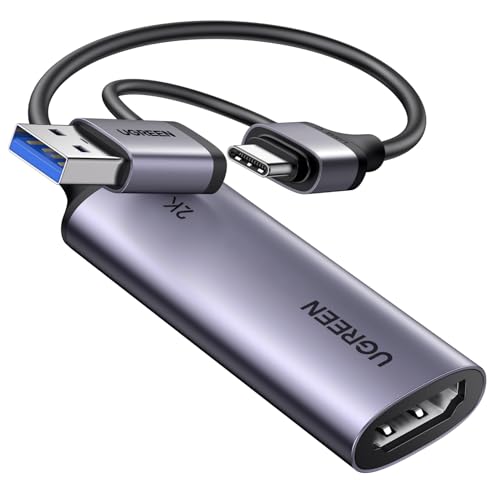
- 2K30 output and 1080p60 support
- USB-A and USB-C connectivity
- Works with Windows, macOS, Linux, and supported iPadOS
Best For: Mixed-device business streams using cameras, consoles, phones, or tablets
Versatile Starter
1080p60 Streaming Capture Card

- 1080p60 capture with 4K30 input
- 3.5mm mic input and headphone output
- Plug-and-play support across major systems
Best For: Business streaming setups needing simple 1080p capture and audio control
Premium High-Refresh Pick
PORTTA DX20R 4K60 Capture Card

- 4K60 capture and 1080p240Hz passthrough
- HDR, VRR, and ultra-low latency
- Optional software for mixing and video control
Best For: Professional livestreaming teams needing 4K and high-refresh workflows
Balanced 2K Option
UGREEN 4K Input HDMI Capture Card

- 2K30 and 1080p60 capture
- 4K30 HDMI input and loop-out
- USB-A and USB-C with wide compatibility
Best For: Flexible business streaming setups targeting 2K or 1080p output
Best Plug-and-Play Pick

- 4K30 input with 2K30 or 1080p60 recording
- No drivers or external power required
- Works with OBS, Zoom, Mac, Windows, and Android
Best For: Portable business livestreaming and online meetings
Best Portable Value
Guermok 1080p60 HDMI Capture Card
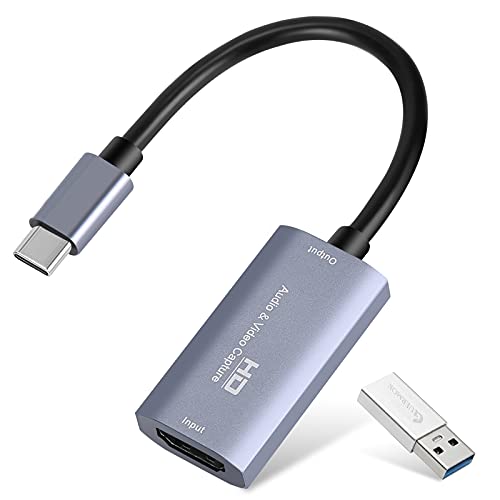
- 1080p60 and 2K30 capture output
- Includes USB 3.0-to-USB-C adapter
- Compatible with OBS, Zoom, major platforms, and multiple OSs
Best For: Traveling presenters and everyday HDMI capture
Best for Pass-Through Setups
1080p60 Capture Card with Mic Input

- HDMI loop-out for source monitoring
- Supports 4K input up to 60Hz
- Adds 3.5mm TRS microphone commentary
Best For: Desktop livestreaming with monitoring and presenter audio
Best Camera-to-Computer Pick – Elgato Cam Link 4K
If you want capture cards for business livestreaming that work with a camera you already own, the Elgato Cam Link 4K is a compact, low-latency option. It connects DSLR, mirrorless, camcorder, action-camera, or compatible iPhone HDMI output to a computer for streaming and recording.
Best For: Businesses using a DSLR or mirrorless camera for polished webinars, presentations, and live events.
Pros:
- Supports 1080p60 and, with compatible equipment, up to 4K60 capture.
- Ultra-low latency helps keep video and audio synchronized.
- Works with OBS, Zoom, Discord, PC, Mac, and iPad.
- Compact design and included USB 3.0 extension cable simplify setup.
Cons:
- Requires an HDMI-output camera and compatible computer or tablet.
- Maximum resolution depends on the camera and the specific Cam Link 4K model.
For camera-based business streaming, this is a straightforward choice that prioritizes image quality, portability, and broad software compatibility.
Best Dual-Source Switcher – Osee GoStream M2
The Osee GoStream M2 stands out among capture cards for business livestreaming when you need to manage two HDMI sources. It accepts two 4K60 inputs, outputs 1080p60, and adds built-in switching, picture-in-picture, picture-by-picture, and microphone connectivity.
Best For: Presentations, interviews, conferences, and streams that combine two cameras or another HDMI source.
Pros:
- Dual 4K60 HDMI inputs support two streaming sources.
- Built-in PIP, PBP, and screen-switching controls support varied layouts.
- Includes 3.5mm microphone and audio input/output ports.
- Plug-and-play support covers Windows, macOS, Linux, Android, and major streaming software.
Cons:
- Video output is limited to 1080p60.
- Its larger feature set may be more than needed for a single-source stream.
Choose the GoStream M2 when live production flexibility matters more than a minimal one-input setup. Its switching and layout tools can reduce the need for additional production hardware.
Best Internal PCIe Option – Elgato 4K Pro
For a dedicated Windows streaming workstation, the Elgato 4K Pro is one of the more powerful capture cards for business livestreaming. This internal PCIe card uses HDMI 2.1, supports 4K60 HDR10 capture, and provides high-resolution passthrough for demanding production and gaming setups.
Best For: Windows-based studios that need high-frame-rate capture, 8K60 passthrough, or a dual-PC workflow.
Pros:
- Captures 4K60 HDR10 and supports up to 1080p240 recording.
- HDMI 2.1 connectivity enables high-frame-rate video handling.
- 8K60 passthrough and VRR support help preserve a smooth source display.
- Compatible with OBS, Streamlabs, Twitch Studio, Zoom, Teams, and other listed apps.
Cons:
- Requires a Windows 10 computer with an available PCIe slot.
- Its internal design is less portable than USB capture hardware.
- The supplied specifications list video capture resolution as 1080p, so verify workflow requirements before purchase.
This is best suited to a permanent production system rather than a mobile presenter kit. It offers substantial headroom for businesses combining live production with high-resolution passthrough.
Best Flexible USB Value – UGREEN 2K HDMI Capture Card
The UGREEN 2K HDMI Capture Card is a practical choice among capture cards for business livestreaming when you need broad device compatibility without an internal installation. It captures HDMI sources through USB 3.0, supports 2K output at 30 fps or 1080p at 60 fps, and includes both USB-A and USB-C connectivity.
Best For: Businesses streaming from cameras, consoles, phones, tablets, or laptops across different operating systems.
Pros:
- Supports 4K input, 2K30 output, and 1080p60 compatibility.
- USB-A and USB-C interfaces suit modern and older host devices.
- Driver-free compatibility includes Windows, macOS, Linux, and supported iPadOS devices.
- Aluminum housing helps dissipate heat and shield against electromagnetic interference.
Cons:
- Supports only unidirectional HDMI input to USB output.
- iPad USB-C use requires iPadOS 17 or later.
- Some consoles require HDCP to be disabled.
For teams that stream from multiple types of HDMI equipment, this UGREEN model offers useful flexibility in a small USB-connected format. Check host ports, source resolution, and HDCP requirements before ordering.
Versatile Starter – 1080p60 Streaming Capture Card
For straightforward capture cards for business livestreaming, this model offers 1080p video capture at 60fps, 4K30 input support, and plug-and-play operation. Its microphone input and headphone output are useful for adding live commentary or monitoring audio during presentations, webinars, and other broadcasts.
Best For: Business streamers who need dependable 1080p60 capture with direct microphone and headphone connections.
Pros:
- Captures Full HD 1080p at 60fps and accepts up to 4K30 input.
- Includes 3.5mm microphone input and headphone output for audio control.
- Works with Windows, macOS, and Linux without requiring drivers or external power.
- Compatible with PCs, consoles, cameras, webcams, and common streaming software.
Cons:
- Maximum output is limited to 1080p at 60Hz.
- Requires a direct USB 3.0 connection; hubs and USB extension cables should not be used.
This is a practical choice when clear 1080p video and simple audio connectivity matter more than advanced 4K capture. The included one-year warranty and technical assistance add useful support for a business setup.
Premium High-Refresh Pick – PORTTA DX20R 4K60 Capture Card
The PORTTA DX20R is aimed at demanding capture cards for business livestreaming, combining 4K60 capture with high-refresh passthrough. HDR, VRR, ultra-low latency, and optional utility software provide more control for polished presentations, demonstrations, and live production workflows.
Best For: Professional teams that want 4K60 capture, high-refresh passthrough, and configurable video and audio settings.
Pros:
- Captures up to 4K at 60Hz and supports 2K144Hz and 1080p240Hz passthrough.
- Supports HDR and VRR for smoother, higher-quality visuals.
- Works with Windows, macOS, and Linux without driver installation.
- CapHub software enables audio mixing, firmware updates, and EDID/VRR management.
Cons:
- Advanced settings may be more than a basic livestreaming setup requires.
- The utility software is available for Windows and macOS, not Linux.
With its 4K60 capability and high-refresh passthrough, the DX20R is the most feature-rich option here for teams that prioritize image quality and workflow control. Its two-year warranty is another advantage for ongoing business use.
Balanced 2K Option – UGREEN 4K Input HDMI Capture Card
For business livestreaming teams that want sharp video without moving to 4K capture, this UGREEN card supports 2K recording at 30fps and 1080p at 60fps. It also provides 4K30 input and loop-out, dual USB-A/USB-C connectivity, and a durable aluminum design for flexible desk or mobile setups.
Best For: Streamers who need 2K recording, 4K30 loop-out, and broad device compatibility in a compact unit.
Pros:
- Captures up to 2K at 30fps or 1080p at 60fps.
- Supports 4K30 input and HDMI loop-out for low-latency monitoring.
- Offers both USB-A and USB-C connections and supports MJPEG and YUY2.
- Works with Windows, macOS, Linux, and Android, with a 24-month warranty.
Cons:
- Does not support 4K recording.
- PS4 and PS5 require HDCP to be turned off.
- It is not compatible with Fire TV Stick, and iPhones cannot serve as data acquisition devices.
This model strikes a useful middle ground for business broadcasts that need 2K detail, flexible USB connectivity, and local monitoring. Its limitations are clearly defined, so confirm your source device and desired recording resolution before buying.
Best Plug-and-Play Pick – Compact 4K USB-C Capture Card
For business livestreaming, this compact capture card offers a straightforward way to bring HDMI video and audio into a Windows, Mac, Linux, or Android setup. It accepts up to 4K at 30Hz and can record at 2K 30fps or 1080p 60fps, making it suitable for presentations, meetings, camera feeds, and live events.
Best For: Portable business livestreaming, online meetings, camera input, and multi-platform setups.
Pros:
- Supports 4K30 HDMI input with 2K30 or 1080p60 recording.
- Plug-and-play design requires no driver or external power.
- Works with OBS, Zoom, Twitch Studio, VLC, and multiple operating systems.
- Compact aluminum-alloy housing is convenient for mobile setups.
Cons:
- Requires a compatible USB 3.0 or USB-C connection and sufficient computer processing power.
- Tablet use requires OTG support to be enabled.
This is a practical choice when easy setup, broad compatibility, and portability matter more than advanced production controls. Verify that your HDMI source outputs video and audio before connecting it to the capture card.
Best Portable Value – Guermok 1080p60 HDMI Capture Card
Businesses looking for capture cards for business livestreaming may appreciate this Guermok model’s compact design and flexible USB connectivity. It supports up to 4K30 input and outputs up to 1080p60 or 2K30 through capture software, making it useful for live presentations, training, meetings, and event coverage.
Best For: Portable livestreaming kits, online teaching, meetings, and everyday HDMI capture.
Pros:
- Captures up to 1080p at 60fps or 2K at 30fps.
- Includes USB 3.0-to-USB-C adapter for broader device compatibility.
- Supports Windows, macOS, Linux, Android, OBS, Zoom, VLC, and major streaming platforms.
- Small, lightweight design is useful for traveling presenters and mobile crews.
Cons:
- It requires capture software and cannot directly cast to a monitor or TV.
- USB 2.0 connections may limit bandwidth, resolution, or recognition.
- OBS may need to be restarted after audio settings are changed.
The Guermok is a sensible budget-oriented option for teams that need a simple HDMI-to-computer workflow. Use a true USB 3.0 port whenever possible, and remember that its transmission direction is HDMI to USB-C rather than USB-C to HDMI.
Best for Pass-Through Setups – 1080p60 Capture Card with Mic Input
For business livestreaming setups that benefit from HDMI pass-through and commentary, this capture card combines USB 3.0 capture with a loop-out connection and a 3.5mm microphone input. It supports 4K30/60Hz and 1080p120/144Hz input while capturing up to 1080p, making it well suited to presentations, demonstrations, and live production workflows.
Best For: Desktop livestreaming, HDMI pass-through, live demonstrations, and presenters using an external microphone.
Pros:
- HDMI loop-out is designed to provide gameplay or source monitoring without capture delay.
- Supports 4K input up to 60Hz and capture output up to 1080p.
- Plug-and-play operation works as an automatically detected webcam.
- Includes microphone input for external commentary with a 3.5mm TRS headset.
Cons:
- It does not support 4K120Hz or 4K144Hz input.
- Capture output is limited to 1080p, with up to 2K30 specified in the product details.
- The microphone input accepts 3.5mm TRS standard headsets only.
This model is the strongest fit here for a more structured desktop setup because its loop-out and microphone input can simplify monitoring and presenter audio. Confirm your source, computer, and microphone use the supported formats before deployment.
How We Picked the Best Capture Cards for Business Livestreaming
We focused on features that matter in real business productions rather than gaming specifications alone. Key considerations included supported input and output resolutions, 1080p recording and streaming performance, USB or internal connectivity, passthrough capabilities, latency, audio handling, compatibility with common broadcasting software, and setup complexity.
Business users should also consider reliability during long sessions. A card that works well for a short test may be less suitable for conferences or webinars if it runs hot, requires unusual drivers, or lacks the ports needed for a complete production workflow.
Quick Comparison
| Type | Best For | Main Advantage | Potential Trade-Off |
|---|---|---|---|
| Portable USB capture card | Webinars, interviews, and mobile setups | Simple installation and flexible placement | May offer fewer advanced routing options |
| HDMI passthrough model | Live presentations and monitoring | Displays the source with minimal interruption | Requires additional display and cable planning |
| Dual-input capture card | Multi-camera productions | Can simplify switching between sources | More setup and software configuration |
| Internal PCIe capture card | Dedicated studio workstations | High bandwidth and clean permanent integration | Requires a compatible desktop installation |
Key Buying Factors for Capture Cards for Business Livestreaming
Resolution and Frame Rate
For most business streams, 1080p at 30 or 60 frames per second is sufficient. Look for 4K input support if your cameras or presentation sources output 4K, but verify whether the device records or streams at 4K or simply accepts a higher-resolution signal and downsamples it.
Connectivity and Compatibility
USB 3.0 is generally preferable for uncompressed or high-quality video transfer. Check whether the card uses USB-A, USB-C, HDMI input, HDMI output, or PCIe. Confirm compatibility with your computer, operating system, camera, and software such as OBS Studio, Zoom, Teams, or other broadcast tools.
Passthrough and Latency
HDMI passthrough is useful when presenters need to view the source on a confidence monitor while the computer captures it. Low latency is especially important for live switching, demonstrations, and interactive events.
Audio and Operating Reliability
Confirm how embedded HDMI audio is handled and whether the card supports your microphones or mixer workflow. For recurring events, prioritize stable drivers, adequate cooling, clear status indicators, and a reputable warranty over marginal headline specifications.
Who Should Buy Which Capture Cards for Business Livestreaming?
Choose a compact USB model if you need a portable setup for client meetings, interviews, remote presentations, or occasional webinars. A passthrough model is a better fit for presenters who need a local monitor while streaming. Businesses producing multi-camera events should consider a dual-input device or a more advanced switching setup. For a permanent studio or production workstation, an internal capture card can provide a clean, high-bandwidth installation.
Before buying, confirm the output resolution of every camera or HDMI source, the available ports on the streaming computer, and the software you plan to use. Matching those details first will help prevent dropped frames, unsupported signals, and unnecessary adapters.