Consistent vocal volume is one of the easiest ways to make a podcast sound more polished. The right compressor can smooth out loud peaks, bring up quieter speech, and help every speaker sit comfortably in the mix.
This roundup covers dedicated rack units, podcast production systems, audio interfaces, and portable recorders, so you can match the processing approach to your studio, workflow, and budget.
Best 10 Audio Compressors for Podcasting Picks for 2026
Flexible Rackmount Control

- Dual-channel VCA compression with auto attack/release
- Noise gate and LED gain-reduction monitoring
- XLR/TRS I/O plus sidechain insert
Best For: Configured studio, streaming, and live podcast setups
All-in-One Podcast Production
RØDECaster Pro Podcast Console

- Four microphone inputs and studio-grade preamps
- USB, smartphone, and Bluetooth guest channels
- Onboard APHEX processing and multitrack recording
Best For: Complete podcast and live-stream production
Peak Protection for Live Audio

- Dual-channel compression with peak limiting
- Noise gate and vocal-focused processing features
- 1U rackmount format with XLR/TRS I/O
Best For: Live podcasting and stage-oriented audio systems
De-Essing and Dynamics
Behringer Composer Pro-XL MDX2600

- Two-channel compressor, limiter, and gate
- Built-in de-esser for vocal sibilance control
- Suitable for audio production and mixing
Best For: Rack-based podcast studios needing vocal dynamics control
Flexible USB Podcast Interface

- Two XMAX-L mic preamps with phantom power
- Stereo loopback mixing for calls and applications
- Built-in effects and Stream Mix mode
Best For: Podcasters and streamers needing flexible two-mic routing
Tube Channel Strip Compressor
- Tube mic preamp, compressor, and EQ
- Selectable optical or tube compression
- Switchable VU metering for signal monitoring
Best For: Stationary studios shaping one microphone channel
Portable Multimic Podcast Recorder

- Four XLR microphone inputs with phantom power
- Four headphone outputs with individual volume
- Automatic mix-minus for phone and remote interviews
Best For: Mobile four-person podcast recording and interviews
Best Rackmount Pick
Professional Dual-Channel Compressor/Limiter

- Dual-channel VCA compression for voice and instruments
- Built-in noise gate with LED gain-reduction metering
- XLR/TRS I/O plus sidechain insert
Best For: Rack-based studio, broadcast, and streaming setups
Best All-in-One Bundle
MAONO Podcast Mixer and Mic Kit

- Includes mixer, condenser mic, tripod, and cables
- DENOISE, monitoring, voice effects, and reverb controls
- Supports two people and multiple devices or platforms
Best For: Beginners building a podcast or livestream setup
Best Interface for Two Mics
Saramonic MV-Mixer Dual-Channel Interface

- Two XLR/6.35mm combo inputs with independent gain
- 24-bit/192kHz USB recording and playback
- Switchable input or playback headphone monitoring
Best For: Two-person podcasts and Mac or PC recording
Flexible Rackmount Control – Dual-Channel Audio Compressor
This dual-channel rackmount unit is a practical choice among audio compressors for podcasting when you need hands-on control over vocal dynamics, background noise, and routing. Its VCA circuitry, noise gate, LED monitoring, and sidechain insert make it suitable for a more configurable studio, streaming, or live setup.
Best For: Podcasters and streamers using XLR/TRS equipment who want independent channel control and sidechain flexibility.
Pros:
- Dual-channel compression with OverEasy and auto attack/release settings
- Built-in noise gate helps reduce unwanted background noise
- XLR and 1/4-inch TRS connectivity supports professional signal routing
- LED indicators show gain reduction, compression, and gate thresholds
Cons:
- 1U rackmount design may be more equipment than a simple podcast desk needs
- Requires a separate microphone, mixer, or interface setup
Choose this model if you want traditional outboard processing and visual control rather than an all-in-one podcast console. The sidechain insert is especially useful when you need targeted frequency control.
All-in-One Podcast Production – RØDECaster Pro Podcast Console
The RØDECaster Pro takes a broader approach than a standalone compressor, combining microphone inputs, routing, recording, sound pads, and onboard processing in one podcasting console. For creators comparing audio compressors for podcasting, its APHEX processing is designed to provide broadcast-ready sound without a complex external setup.
Best For: Beginners and professionals who want an integrated podcast and live-stream production system.
Pros:
- Four microphone inputs with studio-grade preamps
- Supports smartphone, USB, and Bluetooth channels for remote guests
- APHEX Aural Exciter and Big Bottom processing provide onboard sound shaping
- Records to microSD or computer, including stereo and multitrack options
Cons:
- It is an all-in-one production console rather than a dedicated outboard compressor
- Its larger feature set may be more than needed for a basic one-microphone podcast
This is the most complete option in the group for managing a full podcast workflow. It makes sense when recording, guest integration, playback, and vocal processing matter as much as compression.
Peak Protection for Live Audio – 2-Channel Compressor Limiter
This 1U dual-channel processor combines compression, limiting, and noise control for creators who need consistent levels in a live or studio environment. Among audio compressors for podcasting, it is better suited to setups that also handle stage engineering, signal protection, or more extensive vocal processing.
Best For: Live podcasters, venues, and audio operators who need compression, peak limiting, and XLR/TRS integration.
Pros:
- Dual-channel compression and limiting help maintain consistent output
- Peak limiting is designed to reduce overload and harsh distortion
- Includes a noise gate for reducing unwanted background sound
- Provides XLR and 1/4-inch TRS inputs and outputs
Cons:
- Additional crossover, reverb, and feedback features may be unnecessary for a simple podcast chain
- Supplied notes provide limited detail about controls and specifications
This model is worth considering when your podcast setup overlaps with live sound duties. For a straightforward spoken-word rig, its broader processing feature set may be less important than easy, dedicated vocal controls.
De-Essing and Dynamics – Behringer Composer Pro-XL MDX2600
The Behringer Composer Pro-XL MDX2600 is a two-channel compressor, limiter, and gate with a de-esser, making it a useful option when spoken-word recordings need both level control and sibilance management. It fits buyers seeking rack-style processing for a mixer or audio-production chain.
Best For: Podcast studios that need two-channel dynamics processing with built-in de-essing.
Pros:
- Combines compressor, limiter, and gate functions
- Built-in de-esser can help address vocal sibilance
- Two-channel design suits multi-microphone podcast setups
- Designed for audio production, mixing, and mastering applications
Cons:
- Supplied notes provide limited detail about specific controls and connectivity
- Requires external podcast equipment such as microphones and a mixer or interface
This is a focused choice for a traditional hardware signal chain, particularly when sibilance is a concern. Its two-channel format can also accommodate more than one microphone without adding another dynamics processor.
Flexible USB Podcast Interface – Revelator io24
For creators comparing audio compressors for podcasting, the PreSonus Revelator io24 is a versatile USB-C audio interface with built-in effects and mixing tools. It supports XLR microphones, phantom power, loopback audio, and streaming-focused routing in a compact desktop format.
Best For: Podcasters and streamers who want an interface with integrated effects, loopback mixing, and support for two XLR microphones.
Pros:
- Two XMAX-L mic preamps with +48V phantom power support professional XLR microphones.
- Two stereo loopback streams can combine audio from applications such as Zoom, Skype, and backing tracks.
- Stream Mix mode combines hardware inputs, effects, loopback audio, reverb, and sends for streaming software.
- Includes presets plus the ability to create, save, and share custom settings.
Cons:
- Its two-channel design may be limiting for larger multi-microphone productions.
- It requires a computer or compatible tablet-based setup and USB connectivity.
The Revelator io24 is more than a basic interface: its loopback mixer and effects make it a practical choice for live podcasting and streaming workflows. It is particularly appealing when routing flexibility matters as much as microphone connectivity.
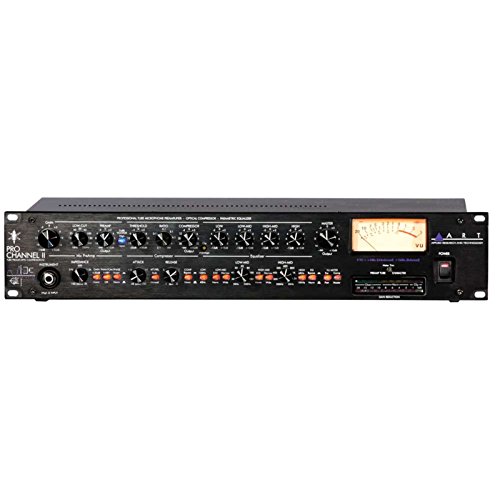
Tube Channel Strip Compressor – ART Pro Channel II
ART Pro Channel II Microphone Preamp/Compressor/EQ Professional Tube Based Selectable VU Metering
Check Price On AmazonFor users evaluating audio compressors for podcasting, the ART Pro Channel II provides a dedicated recording channel with a tube microphone preamp, selectable compressor, and tube EQ. Its rack-style design is suited to more hands-on signal shaping before audio reaches a recorder or interface.
Best For: Podcasters and voice-recording setups that want tube-based preamp, compression, and EQ controls in one channel.
Pros:
- Combines a tube mic preamp, switchable optical/tube compressor, and tube EQ.
- Selectable VU metering can monitor mic pre output, compressor output, or main output.
- Supports XLR, 1/4-inch TRS, and 1/4-inch TS connectivity.
- Precision detented potentiometers support repeatable adjustments.
Cons:
- It provides one channel, so multi-microphone sessions may require additional equipment.
- At 13.4 pounds, it is less portable than compact USB podcast interfaces.
- Its corded, professional-audio design may be more involved than a plug-and-play computer interface.
The Pro Channel II is a focused hardware option for shaping one microphone signal with tube coloration, compression, and EQ. It makes the most sense for a stationary podcast studio where tactile control and a dedicated channel strip are priorities.
Portable Multimic Podcast Recorder – Zoom PodTrak P4
When comparing audio compressors for podcasting, the Zoom PodTrak P4 stands out as a portable podcast recorder and USB audio interface rather than a dedicated compressor. It is designed for four-microphone conversations, remote interviews, headphone monitoring, and battery-powered recording.
Best For: Mobile podcast teams needing four XLR inputs, individual headphone control, remote-call support, and onboard recording.
Pros:
- Four microphone inputs include phantom power for compatible microphones.
- Four headphone outputs provide individual volume control for guests and hosts.
- Automatic mix-minus supports phone and remote interviews through TRRS and USB connections.
- Programmable sound pads and multitrack recording support more engaging production workflows.
Cons:
- It is not described as having a dedicated compressor or compressor controls.
- Battery operation lasts up to 3.5 hours on two AA batteries.
- Its compact recorder format may offer less signal-shaping control than a dedicated channel strip.
The PodTrak P4 is best viewed as a complete field podcasting hub rather than a standalone compression solution. Its four inputs, headphone outputs, remote-interview features, and battery operation make it a strong choice when recording flexibility matters more than dedicated dynamics processing.
Best Rackmount Pick – Professional Dual-Channel Compressor/Limiter
For podcasters who want dedicated dynamics control, this dual-channel rackmount unit is a more traditional option among audio compressors for podcasting. Its VCA circuit, adjustable attack and release, LED metering, and built-in noise gate can help shape voice levels and reduce unwanted background sound.
Best For: Studio, broadcast, live, and streaming setups that can accommodate rackmount XLR/TRS equipment.
Pros:
- Dual-channel compression supports multiple sources or separate processing.
- VCA design is suited to vocals, voiceovers, podcasting, and broadcast use.
- LED metering, noise gate, and sidechain insert provide detailed control.
- XLR and 1/4-inch TRS connectivity integrates with mixers and interfaces.
Cons:
- Rackmount dimensions may be excessive for a compact desktop podcast setup.
- It is an analog, corded-electric processor rather than an all-in-one USB interface.
This is the most focused choice for buyers who already have compatible studio hardware and want hands-on compression, gating, and routing control. It is less convenient for beginners seeking a complete plug-and-play podcast bundle.
Best All-in-One Bundle – MAONO Podcast Mixer and Mic Kit
The MAONO S1 bundle is a convenient starting point for creators who want podcasting hardware in one package. Rather than using a standalone compressor, it combines a mixer, 3.5mm condenser microphone, monitoring, noise reduction, voice effects, and multidevice streaming features for an accessible audio workflow.
Best For: Beginners recording podcasts, livestreams, and voice content with a smartphone or computer.
Pros:
- Includes the mixer, condenser microphone, cable, tripod, windscreen, and charging cable.
- Offers a DENOISE function, real-time monitoring, and adjustable vocal effects.
- Supports up to two people, four devices, and four streaming platforms simultaneously.
- Works with many Windows, Mac, iOS, and Android devices.
Cons:
- Uses 3.5mm microphone input and does not support phantom power.
- Phones without a 3.5mm jack require an OTG adapter, which is not included.
- Instrument connections may require an additional 6.35mm-to-3.5mm adapter.
This bundle is better viewed as a complete podcast mixer and effects station than as a dedicated audio compressor. Its included microphone and simple controls make setup approachable, while the input limitations matter if you plan to expand into studio microphones.
Best Interface for Two Mics – Saramonic MV-Mixer Dual-Channel Interface
The Saramonic MV-Mixer is a straightforward two-channel USB interface for podcasters who want flexible microphone or instrument inputs and high-resolution recording. It is not a standalone dynamics processor, but it can serve as the recording hub alongside software-based audio compressors for podcasting.
Best For: Two-person podcasts, singers, musicians, and creators recording to a Mac or PC.
Pros:
- Two XLR/6.35mm combo inputs accept microphones, instruments, and line-level sources.
- Independent gain controls simplify adjustment for each channel.
- Supports 24-bit/192kHz recording and playback.
- Provides real-time or playback monitoring through a 6.35mm headphone output.
Cons:
- It does not include a dedicated hardware compressor or built-in noise gate.
- Designed for Mac and PC recording rather than direct mobile podcast operation.
Choose this model when clean two-channel capture and flexible connectivity are more important than onboard effects. Its compatibility with major DAWs also makes it a practical foundation for adding compression during editing or recording.
How We Picked the Best Audio Compressors for Podcasting
We evaluated these options by looking at the type of compression they provide, connection options, ease of setup, voice-focused features, and suitability for solo shows, interviews, livestreams, and multi-person productions. We also considered whether each product works best as a dedicated processor, a complete podcast mixer, or an interface with software-based effects.
A useful choice should do more than reduce peaks. It should fit your microphones and recording environment, offer practical monitoring, and leave enough control for natural-sounding speech. Features such as noise gates, limiters, de-essers, sidechain inserts, loopback, and multiple headphone outputs can be especially valuable depending on your format.
Quick Comparison
- Dedicated rack compressors: Best for mixers, studio installations, and users who want hands-on control over one or more channels.
- Podcast mixers and recorders: Best for creators who need microphone inputs, headphone monitoring, remote-call connectivity, sound pads, and recording in one device.
- USB audio interfaces: Best for computer-based podcasting, streaming, and recording with software effects or loopback.
- Channel strips: Best for shaping a microphone signal with preamp gain, compression, and equalization before it reaches the recorder.
- Entry-level mixer bundles: Best for beginners who want an affordable starting package with basic live or streaming controls.
Key Buying Factors for Audio Compressors for Podcasting
Compression Controls
Look for adjustable threshold, ratio, attack, and release controls if you want to fine-tune speech dynamics. Automatic or preset-based processing is easier for beginners, while manual controls provide more flexibility for different voices and microphones.
Inputs, Outputs, and Compatibility
Confirm whether the unit accepts XLR, TRS, USB, or 3.5mm sources. Count your microphones and headphones before buying, especially for guest interviews. A USB connection, loopback mixer, or phone input can simplify remote recording and livestream production.
Voice-Focused Processing
A noise gate can reduce room noise between phrases, while a limiter helps prevent clipping. A de-esser is useful when sibilant sounds such as “s” and “sh” become harsh. These tools are helpful, but aggressive settings can make speech sound unnatural or cut off quiet words.
Workflow and Monitoring
Choose a rack processor if you already use a mixer or audio interface and want an insert-style signal chain. Choose an integrated podcast system if you prefer fewer boxes and direct access to recording, routing, monitoring, and sound effects.
Who Should Buy Which Audio Compressors for Podcasting?
Choose a dedicated dual-channel compressor if you record through a traditional mixer, need independent control for two speakers, or want dependable hardware processing. Models with sidechain inserts and peak limiting offer additional studio flexibility.
Choose a podcast mixer or recorder if you host interviews, use several microphones, record guests remotely, or want headphone outputs and sound pads in one workflow. These systems are generally easier to operate during a live show.
Choose a USB interface or channel strip if you primarily record into a computer and want a compact setup. An interface with integrated effects can provide a clean software-based workflow, while a channel strip is better when you want preamp, compression, and EQ before recording.
Choose an entry-level bundle if you are starting with a limited budget and need basic equipment quickly. Before purchasing, verify microphone quality, connector types, driver support, and whether the included controls offer enough upgrade room for your format.